

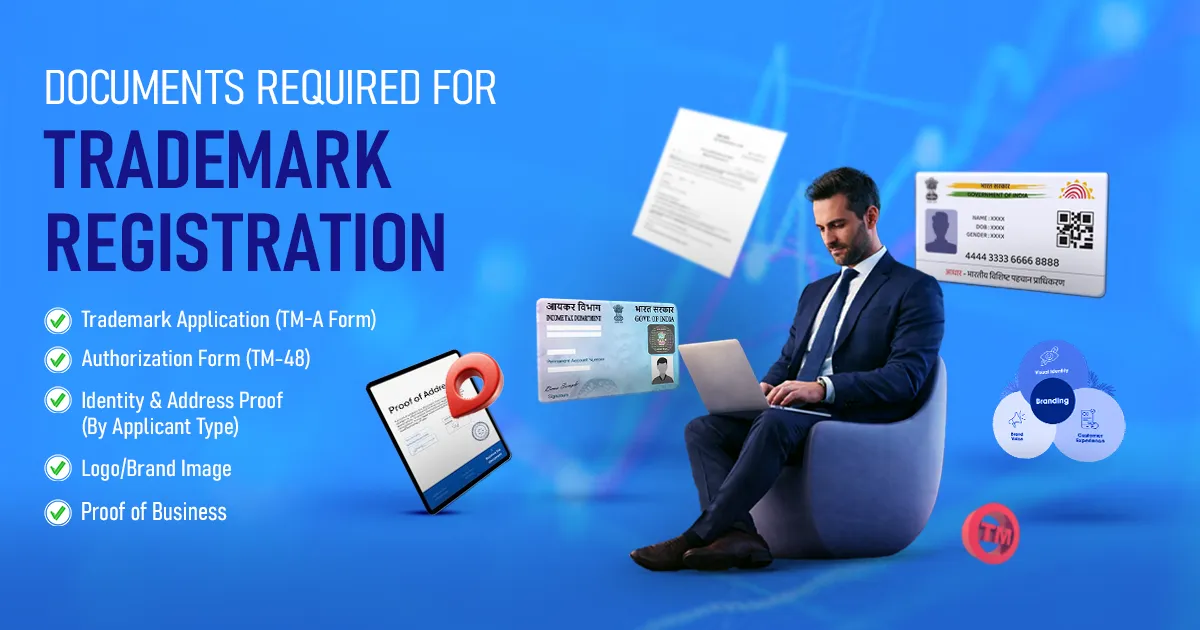
The primary document for trademark filing is Form TM-A, along with supporting documents such as Form TM-48, identity and address proof, trademark representation, proof of prior use or a user affidavit, and an authorisation document, where applicable. If applicable, you may also need a Udyam or DPIIT certificate and a Class 3 Digital Signature Certificate (DSC). Companies, LLPs, and partnerships may also require their incorporation certificate, partnership deed, LLP agreement, or board resolution, depending on their business structure and filing requirements.
These documents help the Registry verify the applicant under the Trade Marks Act, 1999.
The exact documents you need depend on your applicant type, whether you’re an individual, proprietorship, partnership firm, LLP, or company, applying for trademark registration. Missing or incorrect documents can lead to objections, requests for clarification, or delays in processing the trademark application.
Key Takeaways
- Form TM-A is the primary application form, while supporting documents vary based on the applicant and the trademark being filed.
- Proprietorships file in the individual proprietor’s name using personal identity and address proof along with applicable business proof. Companies and LLPs require their relevant incorporation documents and an authorization document, such as a board resolution for a company.
- HUFs, Trusts, and Societies apply through their authorized Karta, trustee, or office bearer, rather than filing as individuals.
- Foreign applicants must appoint an authorized Indian agent or representative and provide an address for service in India.
- If the trademark includes a logo or device mark, the representation must be uploaded in the format and specifications prescribed by the Trade Marks Registry.
- Eligible individuals, startups, and small enterprises with a valid Udyam registration certificate, where applicable, may qualify for the lower official trademark filing fee, subject to the applicable eligibility criteria and supporting documents.
Documents Commonly Required by Everyone for Trademark Filing
The documents required for trademark depend on the applicant, the type of trademark, and the filing circumstances. Common requirements include:
| Document | When it is required |
| Form TM-A | Required for filing a trademark application |
| Form TM-48 | Required when a trademark agent or attorney files the application on your behalf |
| Identity and address proof | Required based on the applicant and filing requirements |
| Trademark representation | Required to represent the word mark, logo, or other mark being registered |
| User affidavit and supporting documents | Required when claiming prior use of the trademark |
| Authorisation or business documents | Required based on the applicant’s legal structure |
Additional Documents Required for Registration
Individuals or business entities must provide the following documents, based on their applicability and requirements:
1. Signed Affidavit for Usage Claim: If you have already used the mark in commerce and want to claim prior use, you must submit a signed user affidavit along with supporting evidence showing such use. If the mark is being filed on a proposed-to-be-used basis, a prior-use affidavit and evidence are not required.
2. Board Resolution Authorizing Trademark Filing (for Companies): A board resolution or other valid authorization may be required to establish the authority of the person filing on behalf of the company. The resolution should clearly state that the company agrees to file the trademark.
Beyond these, different business structures come with their own specific document requirements, covered in detail below.
What Documents are Required for Registration for a Partnership Firm?
The partnership firm is named as the trademark applicant, so the application should include the firm’s details along with documents that establish its identity and legal status.
- Form TM-A
- Logo (graphical representation)
- Power of Attorney (Form TM-48)
- Provide the partnership deed and, where applicable, the registration certificate or other proof of the firm’s legal status
- Udyam/MSME Certificate, if applicable
- Startup Recognition Certificate (DPIIT), if applicable
- User Affidavit (if claiming prior use)
Documents Required for Registration for a Company or LLP
Companies and LLPs need to prove both the entity’s existence and who is authorized to sign on its behalf, in addition to the usual application documents:
- Form TM-A
- Certificate of Incorporation (CoI)
- A Board Resolution or other valid authorisation may be required to confirm that the person filing the trademark application is authorised to act on behalf of the company or LLP
- Power of Attorney (Form TM-48)
- Logo (graphical representation)
- Udyam/MSME Certificate, if applicable
- Startup Recognition Certificate (DPIIT), if applicable
- Details of Trademark Owner
- User Affidavit (if claiming prior use)
Documents for Registration for an Individual or Proprietorship
Since a proprietorship isn’t a separate legal entity, the individual owner files using personal identity documents, not business registration:
- Form TM-A
- PAN and Aadhaar (or Passport/Voter ID) of the applicant
- Logo (graphical representation), if applicable
- Power of Attorney (Form TM-48), if filing through an agent
- Udyam/DPIIT Certificate, if claiming the fee concession
- Details of Trademark Owner
- User Affidavit (if claiming prior use)
Documents Required for Trademark for a Hindu Undivided Family (HUF)
A HUF applies through its Karta, the family’s managing member, so identity documents belong to the Karta while the application reflects the HUF as the applicant entity:
- Form TM-A
- PAN card of the HUF
- PAN and Aadhaar of the Karta
- Logo (graphical representation), if applicable
- Power of Attorney (Form TM-48), if filing through an agent
- Details of Trademark Owner
- User Affidavit (if claiming prior use)
What Documents are Needed for a Trademark for a Trust or Society?
Trusts and societies file through an authorized trustee or office bearer, so the application needs to establish both the entity’s registration and who’s authorized to sign:
- Form TM-A
- Trust Deed or Society Registration Certificate
- Authorization letter or resolution naming the trustee or office bearer authorized to file
- PAN and Aadhaar of the authorized signatory
- Logo (graphical representation), if applicable
- POA (Form TM-48), if filing through an agent
- Details of Trademark Owner
- User Affidavit (if claiming prior use)
Documents Required for Registration for a Foreign Applicant
Foreign individuals and companies can register a trademark in India, but must route the application through a local agent, since the Registry requires an Indian address for service:
- Form TM-A
- CoI or equivalent business registration document (for foreign companies)
- Passport or equivalent identity proof (for foreign individuals)
- Power of Attorney (Form TM-48), appointing an Indian trademark agent or attorney with a local address for service
- Logo (graphical representation), if applicable
- Details of Trademark Owner
- User Affidavit (if claiming prior use)
Did You Know? Submitting the right business proof can reduce your government filing fee by 50%. Your per-class fee drops from ₹9,000 to ₹4,500 if you provide a DPIIT Recognition Certificate, Udyam Registration Certificate, or proof of individual or proprietorship status.
Trademark registration fees in India vary by applicant type, filing method, and class, so it’s worth checking the full breakdown before you file.
Tips and Common Mistakes for Trademark Documents
Before submitting your application, it’s crucial to check the required documents for the trademark carefully. Any missing or incorrect document can lead to trademark objections or delays. Here’s what most often goes wrong, and how to avoid it.
- Using an outdated Class 2 DSC: Class 2 DSCs were discontinued in January 2021 and are no longer accepted. Confirm you have a valid Class 3 DSC before starting your online application, not after.
- Search the trademark before filing: Check existing trademarks for similar names, logos, or marks in the relevant classes using the free trademark search tool before submitting your application. This can help identify potential conflicts and reduce the risk of objections.
- Trademark representation: If you are registering a logo or device mark, provide a clear representation of the mark in the format and specifications accepted by the current IP India e-filing system.
- Under-stamped Form TM-48: If you are filing through a trademark agent, the Form TM-48 must be properly stamped as required under the applicable stamp duty law. The stamp duty can vary by state, so check the applicable requirement before filing to avoid an objection or delay.
Not sure which documents you need for your trademark application? Get your applicant type, filing basis, and document requirements checked before filing. Talk to a Trademark Expert today.
