RERA Registration Online in India
RERA registration lets promoters and agents legally advertise, book, and sell real estate projects while building buyer and bank trust. RegisterKaro handles state-specific filings and documents, so you get registered faster.
 End-to-End Promoter & Agent RERA RegistrationState-Specific Guidance for All RERA AuthoritiesAccurate Document Drafting & Form 1 SubmissionRERA Fee Calculation & Online Application FilingRenewal, Extension & Ongoing Compliance Support

 What Sets Us ApartWhat Sets Us Apart
What is RERA Registration in India?
RERA registration is the mandatory process for real estate promoters (builders and developers) and agents to register with their state's Real Estate Regulatory Authority (RERA). Promoters must complete this registration before they can advertise, market, book, or sell any property. This requirement comes from the Real Estate (Regulation and Development) Act, 2016. The Act aims to bring transparency, accountability, and financial discipline to the real estate sector while protecting homebuyers from delays and fund diversion.
Since each state and Union Territory runs its own authority, such as MahaRERA in Maharashtra or UP-RERA in Uttar Pradesh, registration is completed through the respective state RERA portal. Any promoter whose project exceeds 500 square meters or 8 units, and any agent dealing in registered projects, must obtain RERA registration to operate legally.
How did RERA come into Existence?
Before RERA, India's real estate sector was largely unregulated, leaving homebuyers exposed to delays, fund diversion, and misleading advertising. To fix this, the government enacted the Real Estate (Regulation and Development) Act, 2016, which came into force on May 1, 2017, establishing a Real Estate Regulatory Authority in every state to protect buyers and bring accountability to the sector.
Main Goals of RERA
- Transparency: Ensure promoters disclose accurate project details, approvals, and timelines.
- Consumer protection: Safeguard buyers from delays, fraud, and hidden charges.
- Accountability: Hold promoters and agents responsible for what they promise.
- Financial discipline: Ring-fence 70% of buyer funds in a separate project account.
- Dispute resolution: Provide a fast, structured way to resolve disputes.
- Standardization: Set uniform rules across the real estate sector.
Benefits of RERA Registration for Promoters & Agents
RERA registration is mandatory for real estate promoters (builders and developers) launching qualifying projects and for agents dealing in registered properties. Beyond being a legal requirement, it brings real advantages to the businesses that register:
For Promoters and Developers
- Legal authorization to sell: You can legally advertise, market, book, and sell your project only after registration.
- Stronger credibility: Registered projects attract more serious buyers, investors, and lenders, since banks prefer funding RERA-approved projects.
- Fair, standardized rules: All developers follow the same clear framework, creating a level playing field.
- Structured dispute resolution: A formal system handles disputes with buyers or agents, reducing costly litigation.
For Real Estate Agents
- Legal right to operate: Registration gives you the exclusive right to deal in RERA-approved projects. It also opens access to a larger, more credible pool of business that unregistered agents cannot access.
- Professional credibility: Registration builds trust and strengthens your professional reputation.
- Access to more business opportunities: Developers and buyers prefer working with registered, compliant agents.
For Homebuyers
RERA also protects the buyers you sell to. It ensures on-time delivery of homes and requires that 70% of the amount collected from allottees be kept in a separate bank account for construction and land costs only. It also provides a five-year defect liability period and quick grievance redressal. This protection builds buyer trust and helps registered projects sell faster.
Who Needs RERA Registration?
RERA registration is mandatory for the following:
- Promoters (builders and developers): Must register if the project's land exceeds 500 square meters or has more than 8 units, including all phases.
- Real estate agents: Must register before facilitating any sale or purchase in a RERA-approved project.
- Ongoing projects: Any project that had not received a completion certificate as of May 1, 2017, had to be registered.
- Each phase of a project: In phased developments, every phase is treated as a standalone project and must be registered separately.
Among a promoter’s key post-completion duties is the title transfer by the promoter under RERA. This is where ownership of the units and common areas is formally passed to the buyers or their association.
Documents Required for RERA Registration in India
The documents required for RERA registration depend on whether you're registering as a promoter or an agent, and whether you're an individual or a company:
1. For Promoters: Individuals
- PAN Card and Aadhaar
- Passport-size photograph
- ITRs of the last 3 financial years
- Audited balance sheet (last year)
- Details of past projects from the last 5 years (if any)
- Affidavit-cum-declaration (Form B), including the 70% escrow commitment
2. For Promoters: Companies
- PAN Card of the company
- Certificate of Incorporation (CoI)
- MOA & AOA
- Corporate Identification Number (CIN) and TAN
- Registered office proof
- Audited financials of the last 3 years
- Directors' report for the last 3 years
- PAN, Aadhaar, and photographs of directors or authorized signatories
3. Project-Specific Documents (All Promoters)
- Legal title deed
- Encumbrance Certificate (EC)
- Commencement Certificate
- Sanctioned building and layout plan
- Details of development works and amenities
- Project cost estimates and funding sources
- Escrow (separate) account details for 70% fund compliance
- Proforma allotment letter and agreement for sale
- Consent agreement (if not the landowner)
- Names and details of associated professionals (architects, engineers, contractors)
4. For Real Estate Agents
- PAN Card
- Personal and business address proof
- Passport-size photograph
- ITRs of the last 3 years (if available)
- Details of any ongoing legal cases
- Self-certified copies of letterheads, stamps, and invoices
- Company documents (MOA, AOA, Incorporation Certificate), if applicable
How to Register for RERA Online in India: Step-by-Step Process
The RERA registration process is largely state-specific and completed online through the respective state’s RERA portal. Whether you're a promoter or a real estate agent, the procedure follows a clear sequence from account creation to receiving your certificate as follows:
Step 1: Visit the State RERA Portal
Access the official RERA portal of the state or UT where your project or business operates, since each state runs its own authority. For example, promoters in Maharashtra register through MahaRERA (maharera.maharashtra.gov.in).
Step 2: Create an Account
Sign up as a new user by selecting your role and providing basic details to create login credentials:
- Choose your category as Promoter or Real Estate Agent.
- Provide your mobile number and email ID for verification.
Step 3: Fill the Application (Form A)
Log in and complete the application form (usually Form A for promoters), entering accurate details:
- Promoters enter project information, type (residential/commercial), size, location, land ownership, legal title, experience, financials, and timeline.
- Agents enter personal or company details, business address, and professional particulars.
Step 4: Upload the Required Documents
Attach all mandatory documents based on your applicant type, ensuring each file meets the portal's prescribed format and size limits.
Incomplete or invalid documents are the most common cause of delays.
Step 5: Pay the Registration Fee
Pay the applicable fee online through net banking, debit/credit card, or challan:
- Promoters pay a fee, usually based on the project's area.
- Agents pay a fixed fee that varies by state and entity type.
Step 6: Submit the Application
Review every field for accuracy and completeness, then submit the application. Note the acknowledgment or application number, which you'll use to track your status.
Step 7: Verification and Approval by the Authority
The RERA authority reviews your application and documents. If everything is correct, registration is usually granted within 30 days. Under Section 5 of the RERA Act, if no decision is given within this period, the project is automatically considered “deemed registered.”
Step 8: Receive Your Registration Certificate
On approval, you receive a unique RERA registration number, a registration certificate, and login credentials. The registration number follows a state-specific format and may include the state code, project type, district, year, and a serial number. Promoters must display this RERA number in all advertisements, brochures, and marketing materials.
The RERA registration process usually takes 30 days as per law. However, in practice, it may take 30 to 60 days depending on state rules, document completeness, and project complexity.
State-Wise RERA Registration Fees
State-wise RERA registration fees vary because the RERA framework is implemented at the state level. Project fees generally fall between ₹5 and ₹25 per square meter, while individual agent fees range from ₹10,000 to ₹25,000, and corporate firm fees go up to ₹2,50,000 depending on where you register. The tables below consolidate the major states so you can quickly locate your rate:
Project Registration Fees (Per Square Meter of Land Area)
| State | Residential | Commercial | Notes / Caps |
| Maharashtra | ₹10/sqm | ₹10/sqm | Minimum ₹10,000, maximum ₹10 lakh |
| Karnataka | ₹5/sqm (≤1,000 sqm), ₹10/sqm (>1,000) | ₹20/sqm | Residential capped at ₹5 lakh |
| Uttar Pradesh | ₹10/sqm (≤1,000 sqm), ₹500 per 100 sqm (>1,000) | ₹20/sqm (≤1,000), ₹1,000 per 100 sqm (>1,000) | Higher slab for larger projects; no fixed cap |
| Haryana | ₹10/sqm (high-potential), ₹5/sqm (low/medium) | ₹20/sqm and ₹10/sqm | Zone-based rates |
| Madhya Pradesh | ₹40/sqm × FAR (plotted); ₹40/sqm × carpet area (constructed) | ₹40/sqm basis | Linked to the carpet area |
| Kerala | ₹50/sqm of floor area (new); ₹10/sqm (plotted) | Not specified | Floor-area basis |
| Telangana | Projects over 500 sqm or 8 units/apartments must register | Not specified | Per-sqm basis |
| Goa | ₹10/sqm or ₹50,000, whichever is higher | Not specified | The minimum-fee rule applies |
| Tamil Nadu / Andhra Pradesh | Calculated on built-up area | Not specified | Different calculation basis |
Note: RERA fees are usually calculated on land area, though states like Tamil Nadu and Andhra Pradesh use built-up area. Separately, under Section 4 of the Act, promoters must sell apartments on the carpet area. This refers to the net usable floor space within the walls and replaces the earlier practice of selling based on inflated “super built-up” area.
Agent Registration Fees (Fixed)
| State | Individual | Company / Firm / Other |
| Maharashtra (MahaRERA) | ₹10,590 | ₹1,00,590 |
| Karnataka | ₹25,000 | ₹2,50,000 |
| Uttar Pradesh | ₹25,000 | ₹2,50,000 |
| Telangana | ₹10,000 | ₹50,000 |
| Most other states | ₹10,000 – ₹25,000 | ₹50,000 – ₹2,50,000 |
Note: RERA registration fees are fixed by each state's own rules and are revised from time to time. Since authorities can change their rates or slabs with little notice, always confirm the current fee on your state's official RERA portal before applying.
State RERA Authorities and Portals: Where Can I Apply?
RERA is implemented state-wise, and each state or Union Territory has its own regulatory authority and online portal where promoters and agents register. Since procedures, fees, and thresholds vary by state, you must apply through the portal of the state where your project or business operates.
Here are the major state RERA authorities:
| State/UT | Authority | Official Portal |
| Maharashtra | MahaRERA | maharera.maharashtra.gov.in |
| Uttar Pradesh | UP-RERA | up-rera.in |
| Karnataka | RERA Karnataka (K-RERA) | rera.karnataka.gov.in |
| Delhi | Delhi RERA | rera.delhi.gov.in |
| Haryana | HARERA | haryanarera.gov.in |
| Tamil Nadu | TNRERA | rera.tn.gov.in |
| Gujarat | GUJRERA | gujrera.gujarat.gov.in |
| Rajasthan | RERA Rajasthan | rera.rajasthan.gov.in |
How do RERA Rules Differ Across States?
RERA is implemented at the state level; the rules are not identical everywhere. Key differences include:
- Registration fees: Per-square-meter project fees and fixed agent fees vary widely by state.
- Fee calculation basis: Most states charge based on land area, while Tamil Nadu and Andhra Pradesh use built-up area.
- Registration thresholds: Maharashtra, for instance, modified the "8 units" condition through Circular 25A/2023.
- Agent validity and renewal: The five-year validity and renewal rules can differ slightly between states.
- Jurisdiction splits: Some states have multiple authorities, such as Haryana (Gurugram and Panchkula) and Uttar Pradesh (separate zones).
RERA Registration Forms: A Complete List
RERA uses standard forms at different stages of registration, compliance, and dispute resolution. These forms make the process consistent and help keep project and agent details clear and transparent.
Here's a complete list of the key RERA forms and what each is used for:
| Form | Official Name | Purpose |
| Form A | Application for Registration of Project | The primary application that a promoter files to register a real estate project. |
| Form B | Declaration Supported by Affidavit | The promoter's declaration, including the commitment to deposit 70% of funds in a separate account. |
| Form C | Registration Certificate of Project | Issued by the authority to the promoter on successful project registration. |
| Form D | Intimation of Rejection/Revocation | Used by the authority to reject an application or revoke a project's registration. |
| Form E | Application for Extension of Registration | Filed by a promoter to extend a project's registration period. |
| Form F | Certificate for Extension of Registration | Issued when a project's registration is successfully extended. |
| Form G | Draft Agreement for Sale | The standard draft agreement for the sale or allotment of a unit. |
| Form H | Registration Certificate of Real Estate Agent | Issued to an agent on successful registration. |
| Form I | Intimation of Rejection/Revocation of Agent | Used to reject or revoke an agent's registration. |
| Form J | Application for Renewal of Agent Registration | Filed by an agent to renew their registration. |
| Form K | Certificate for Renewal of Agent Registration | Issued to an agent on successful renewal. |
| Form L | Appeal to the Appellate Tribunal | Used to file an appeal with the Real Estate Appellate Tribunal. |
| Form M | Complaint to Regulatory Authority | Used by homebuyers or stakeholders to file a complaint with the authority. |
| Form 1 | Architect's Certificate | Certifies the percentage of physical construction progress, enabling proportionate withdrawal from the escrow account. |
| Form 2 | Engineer's Certificate | Certifies the actual cost incurred on the project so far, supporting the withdrawal calculation. |
| Form 3 | Chartered Accountant's Certificate | Certifies the proportionate amount the promoter may withdraw from the 70% account based on completion. |
| Form 4 | Architect's Certificate on Completion | Issued by the architect on completion of the registered project. |
| Form 5 | Annual Statement of Accounts | The promoter's annual audited statement of the project account. |
Note: These are the model forms prescribed under the central RERA Rules. Some states use slightly different form names or numbering, so always refer to your state RERA portal for the exact forms that apply to you.
Validity and Renewal of RERA Registration in India
RERA registration is not a one-time approval and comes with a validity period. Both projects and agents must renew or extend their registration before it expires to stay compliant and continue operations smoothly.
Validity for Promoters and Projects
A project’s RERA registration is valid for the completion timeline declared by the promoter at the time of registration, rather than a fixed number of years. Once this period ends, the registration must be extended to stay valid. It can be extended in two situations:
- Force majeure events: Natural calamities such as floods, fires, earthquakes, or war allow an extension of up to one year.
- Other genuine reasons: The authority may grant an extension of up to one additional year at its discretion.
How to Extend a Project Registration?
- Apply through your state RERA portal before the current validity expires.
- Submit a justification letter, updated project timelines, and supporting documents.
- Pay the prescribed extension fee.
- The authority reviews and grants the extension if the reasons are genuine.
Validity for Real Estate Agents
An agent's registration is typically valid for five years, after which it must be renewed to continue operating legally.
How to Renew an Agent Registration?
- Log in to your state RERA portal and open the renewal application (Form J).
- Update your personal and business details.
- Upload the required documents, including proof of active business and your previous RERA certificate.
- Pay the prescribed renewal fee online.
- Download your renewed certificate (Form K) once approved.
Note: Project validity is tied to the declared completion date, with extensions only for valid reasons. This helps prevent delays and ensures timely delivery.
RERA Penalties for Non-Compliance
Disputes under RERA are first heard by the State RERA Authority, with appeals going to the Real Estate Appellate Tribunal. To enforce compliance, the Act prescribes strict penalties for promoters, agents, and buyers, which can include fines or imprisonment. Even after registration, promoters must file quarterly project updates on the RERA portal, and failure to do so can lead to penalties.
Penalties for Promoters
- Not registering a project: A penalty of up to 10% of the estimated project cost.
- Continued non-registration: If the violation continues despite orders, the promoter may face imprisonment of up to 3 years, an additional fine of up to 10% of the project cost, or both.
- Providing false information during registration: Giving incorrect or misleading details in the application can lead to a penalty of up to 5% of the estimated project cost.
- Violating other provisions of the Act: Not following RERA rules or authority directions can also result in a penalty of up to 5% of the estimated project cost.
- Not complying with Appellate Tribunal orders: Imprisonment of up to 3 years, a fine of up to 10% of the project cost, or both.
Penalties for Real Estate Agents
- Not registering as an agent: A penalty of ₹10,000 for each day the default continues, extending up to 5% of the cost of the property involved.
- Not complying with the authority's orders: A penalty of up to 5% of the estimated project cost.
- Not complying with Appellate Tribunal orders: Imprisonment of up to 1 year, a fine of up to 10% of the project cost, or both.
Penalties for Buyers (Allottees):
- Not complying with the authority's orders: A penalty of up to 5% of the property cost.
- Not complying with Appellate Tribunal orders: Imprisonment of up to 1 year, a fine of up to 5% of the property cost, or both.
RERA Registration Certificate
A RERA registration certificate is the official document issued by the respective State RERA authority once a project or agent is successfully registered. It serves as proof of compliance with the Real Estate (Regulation and Development) Act, 2016, and includes key details such as:
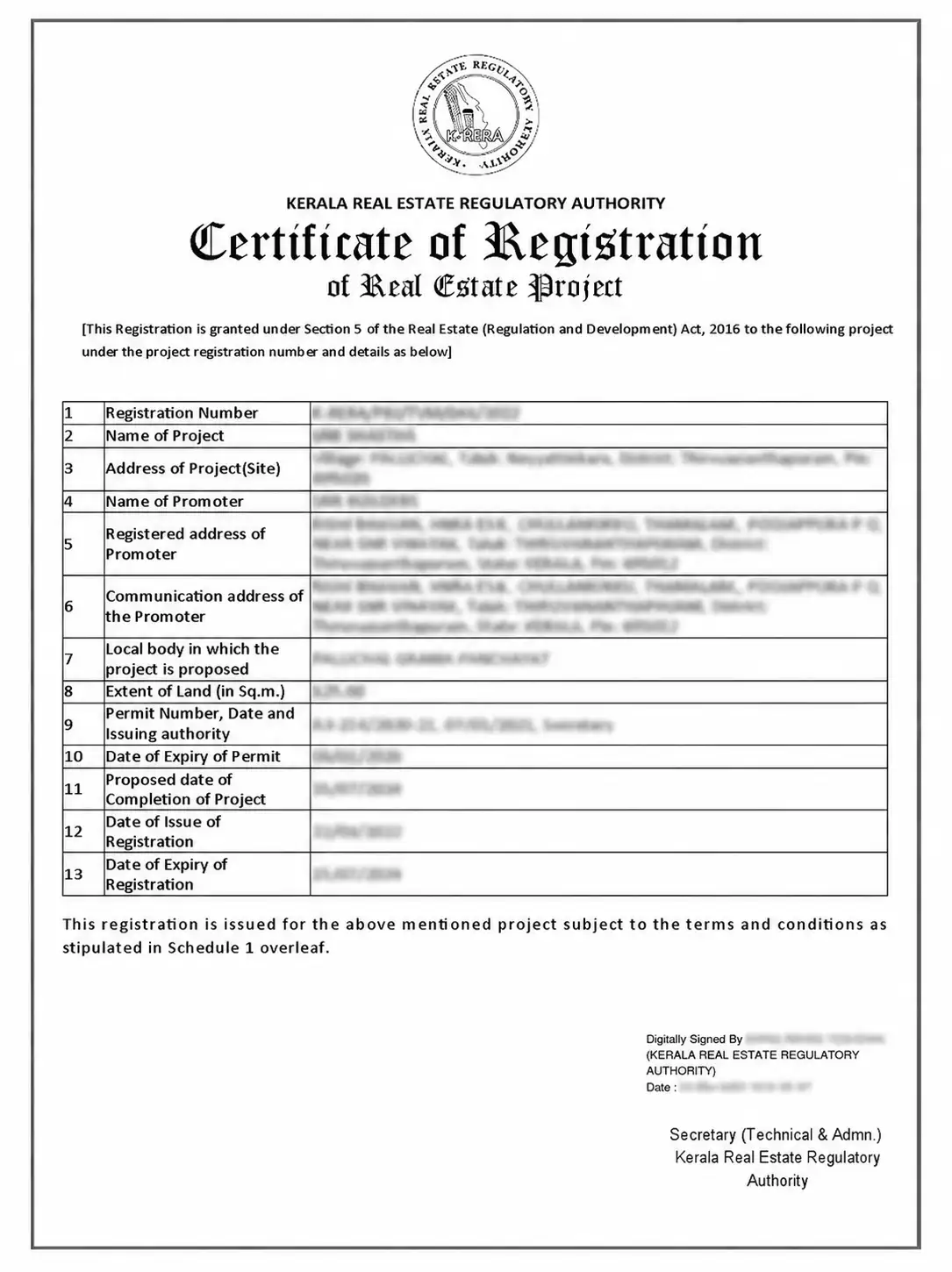
- Registration number
- Project or agent name
- Promoter information
- Validity period
- Address
How to Download the RERA Registration Certificate?
For promoters and agents:
- Log in to your account on your state's RERA portal.
- Go to a section like "My Registrations" or "My Applications."
- Locate your approved registration and download the certificate.
For homebuyers and investors:
- Most state portals allow open access to project details without a login.
- Use the project or agent search tool to view registration details.
- If a direct download isn't available, you can take a screenshot or request a copy from the developer.
How to Track Your RERA Application Status?
- Visit your state's official RERA portal.
- Open the "Application Status" or "Track Application" section.
- Enter your application number or the unique ID provided at submission.
- The portal displays the current status, such as "Under Scrutiny," "Approved," "Rejected," or "Clarification Required."
Connect with RegisterKaro and let our experts handle the legal hassle while you grow your business.
Frequently Asked Questions (FAQs)
Can RERA registration be renewed?
−Yes, real estate agent registration is valid for five years and must be renewed to continue operating legally. Project registration is valid for the promoter's declared completion period. Extensions are possible for specific reasons, such as force majeure events like floods or earthquakes, typically for up to one year.
What is the minimum area required for RERA registration?
+Can a complaint be filed if a project is not registered under RERA?
+How can an NRI check RERA project details?
+Does RERA cover rental agreements?
+What happens if a builder delays possession of a RERA-approved project?
+Can a builder change the project plan after RERA registration?
+What is the fee for filing a complaint with RERA?
+How to download the RERA registration certificate online?
+What is the defect liability period under RERA?
+What is the purpose of the RERA escrow account?
+What are the penalties for promoters and agents not registering a project?
+What is "deemed registration" under RERA?
+What is the role of the RERA Appellate Tribunal?
+
Reviewed by
Joel DsouzaJoel Dsouza is a Chartered Accountant (CA) and compliance expert with over 7 years of hands-on experience in company registration, tax structuring, GST, ROC filings, and MCA compliance. As a qualified member of the Institute of Chartered Accountants of India (ICAI) and Co-Founder at RegisterKaro, he has personally advised more than 1,000 startups and SMEs across India, helping founders navigate incorporation, regulatory frameworks, and financial planning from Day 1. With deep expertise across all three levels of Finance and Portfolio Management, Joel is committed to promoting financial literacy and simplifying India's startup ecosystem through clear, actionable guidance that entrepreneurs can act on immediately.
Why Choose RegisterKaro for RERA Registration?
RERA registration involves state-specific rules, detailed documentation, and strict timelines. RegisterKaro simplifies the entire process with expert-led, step-by-step support from start to finish.
- State-specific expertise: Our team understands the RERA Act and the rules, fees, and requirements of each state, so you get guidance specific to your location.
- Complete documentation support: We help you prepare and verify all required documents and draft necessary declarations to keep your application accurate and complete.
- End-to-end filing: We manage the entire online RERA application process, from account setup and form filling to fee calculation and submission, reducing errors and saving time.
- Proactive follow-ups: We track your application status and respond quickly to RERA authority queries to avoid unnecessary delays.
- Support across states: Whether in Maharashtra, Karnataka, Uttar Pradesh, or other states, we assist promoters and agents with RERA registration across India.

What Our Clients Say
View All
Deborah Menezes
 Verified
I had a really smooth and reassuring experience working with Jiya from Razorpay Rize. From the start, she was proactive, reaching out personally, guid... Read more

Joel Joy
VerifiedWe had the pleasure of working with Tanvish Nagpal to register our company and handle the incorporation process. From start to finish, his expertise a... Read more

Vikash Kumar Singh
VerifiedI recently used RegisterKaro for my company incorporation, and I am extremely satisfied with the service I received. The team was very professional an... Read more

Vidhya Panzade
VerifiedI had the pleasure of working with Shruti Pandey for incorporating my company, and the entire experience was excellent. She handled the process with c... Read more

ANOOP AGARWAL
VerifiedBindiya provided exceptional support throughout our company incorporation process. She was highly professional, knowledgeable, and responsive at every... Read more

Joseph Crentsil
VerifiedExcellence services by Registerkaro team at the eventual part, though it was slow initially but later part they have paid more attention towards my st... Read more

Antony Varghese
Verified"I am thoroughly impressed with the exceptional service provided by Register Karo. They handled every step of the process seamlessly, ensuring all doc... Read more

Indrapal Yadav
VerifiedI had a great experience during the incorporation process of our company, and I’d especially like to highlight the support provided by Manish Tiwari.... Read more

Bippin G Salvi
VerifiedThis people are prompt. Of course the work gets done immediately but if it doesn’t the. They escalate the matter to seniors. And they are way with tim... Read more

Sanjam Singh
VerifiedI am immensely pleased with the exceptional service provided by RegisterKaro. Their performance has far exceeded my expectations. Special thanks to Ga... Read more
Related Blogs
View All
How to Object to a Trademark Application in India?
How to Withdraw a Trademark Application in India?
How to Search a Trademark by Application Number on IP India?

How to Oppose a Trademark Application in India: Full Process

Principles of Trademark Registration in India (2026 Guide)

Board Resolution for Application of Trademark (with Sample Format)

Trademark Registration for MSMEs & Startups: Fees & Process 2026

Trademark Registration Time Period: How Long Does It Take?

Trademark Registration for a Private Limited Company in India

Power of Attorney: Meaning, Types, and Registration in India