File Your Consumer Complaint Online in India
Need to file a consumer complaint online? Our experts make the process simple, guiding you through every step to take action, resolve issues, and protect your rights confidently.
 Quick Filing & Real-Time TrackingComplete Documentation & Evidence SupportLegal Notice Drafting by ExpertsBacked by Consumer Protection Act SpecialistsTrusted by 2,000+ Consumers

 What Sets Us ApartWhat Sets Us Apart
What is a Consumer Complaint?
A consumer complaint is a formal expression of dissatisfaction by a buyer regarding a product or service they have purchased. It usually involves issues like:
- Defective goods
- Poor service
- Unfair trade practices
- Overcharging
- Delivery delays
Under the Consumer Protection Act, first enacted in 1986 and updated in 2019, anyone who buys something (fully, partly, or on promise to pay) is a "consumer." If you're a consumer, you have the right to complain to the seller, service provider, or even legal authorities to get help, like a refund, replacement, or compensation.
This applies to anything bought in stores, online, on the phone, through telemarketing, or direct selling.
What is a Consumer Court?
A consumer court is a special court in India that deals exclusively with disputes and complaints related to the sale of goods or services. If your new washing machine doesn’t work, or a company overcharges you, or your internet provider never shows up, you can go to the Consumer Court to get help.
It is designed to protect the rights of consumers by providing a legal platform where they can seek redress against unfair trade practices, defective products, poor service, or overcharging. These courts aim to offer a faster and more affordable alternative to traditional civil courts for resolving consumer grievances.
Consumer courts are organized at three levels:
- District Consumer Disputes Redressal Forum (DCDRF) – For claims up to Rs. 50 lakhs-1 Crore
- State Consumer Disputes Redressal Commission (SCDRC) – For claims over Rs. 1 Cr. and Rs. 10 Crores
- National Consumer Disputes Redressal Commission (NCDRC) – For claims above Rs. 10 Crores or appeals against SCDRC decisions.
They function under the Consumer Protection Act, 2019, and are meant to ensure that consumers are not exploited and receive fair treatment in the marketplace.
Valid Grounds for Filing a Complaint
Consumers can file a complaint on various valid grounds:
-
Defective or Faulty Products:
A product is considered defective if it fails to meet specifications, has manufacturing flaws, or does not function as expected. Examples include a mobile phone malfunctioning shortly after purchase or a faulty appliance.
-
Deficiency in Services:
This ground covers situations where services fall short of promised quality or agreed terms. Common examples include delayed deliveries, subpar repair or maintenance work, or failure to provide promised features in services like hotel stays, medical treatments, or legal assistance.
-
Overcharging or Deceptive Pricing:
Consumers can complain about hidden charges, prices that do not match advertisements, or excessive charges beyond the fair market value. The Act empowers consumers to challenge such unfair pricing practices and seek refunds or corrections.
-
False or Misleading Advertisements:
Inaccurate or exaggerated claims in advertisements that mislead consumers into purchasing goods or services under pretenses are actionable. This includes misrepresentation of product features, benefits, performance, or ingredients.
-
Unfair Trade Practices:
These are business activities designed to deceive, manipulate, or exploit consumers. Examples include selling counterfeit or duplicate products as genuine, enforcing unfair contract terms, or employing deceptive "bait-and-switch" strategies.
-
Hazardous Goods or Services:
Consumers have the right to expect that purchased goods and services are safe for use. Complaints can be filed for products or services such as contaminated food, cosmetics leading to skin reactions, or defective electrical appliances posing fire risks.
-
Product Liability:
A claim can be initiated against the product manufacturer, seller, or service provider if a defective product causes harm.
-
Other Grounds:
This includes issues like breach of contract, unfair contracts, or non-delivery of goods or services despite payment.
Who Can File a Consumer Complaint?
The following individuals and entities are entitled to do so:
- Consumer: Any individual who has purchased goods or services for consideration. This also includes those who did not directly buy the goods but used them with the buyer's consent, and goods purchased for self-employment rather than resale.
- Voluntary organizations registered under the Companies Act, 1956.
- Central or State Government authorities.
- Multiple consumers with a common interest.
- Beneficiaries of the goods or services in question.
- Legal representatives of a deceased consumer.
- Legal heirs or their representatives.
- Spouse or relatives of the consumer.
How to File a Complaint in Consumer Court?
Before initiating a formal complaint in a consumer court, consumers are encouraged to take preliminary steps to resolve the issue. This initial phase often leads to quicker and less formal resolutions.
Initial Steps Before Formal Filing
Consumers should initially try to resolve the issue directly with the seller or service provider. Many companies have established internal grievance redressal mechanisms, and often, complaints can be resolved efficiently at this stage.
If direct resolution proves unsuccessful, the next recommended step is to send a formal legal notice to the opposing party. This notice should clearly state the issue, detail the deficiency in goods or services, and specify the relief sought, such as replacement, refund, or compensation. A reasonable timeframe, typically 15-30 days, should be given for the resolution.
While sending a legal notice is generally not mandatory for consumer complaints, it is highly recommended as a matter of best practice. This strategy helps consumers get quicker, cheaper resolutions and reduces pressure on the courts. It also motivates businesses to build strong internal grievance systems.
Official Government Process for Consumer Complaint Filing
For consumers opting to file a complaint manually, a structured process ensures all necessary legal requirements are met.
Step 1. Identify the Appropriate Forum
Before taking any action, determine the correct commission or forum to approach. You can choose between District, State, or National forums based on the total value of the goods or services and the compensation you are claiming.
Step 2: Draft Your Complaint
Begin by preparing a clear and detailed complaint document, including the complainant's details (name, address, contact information) and the opposing party's details (business name, address). Crucially, it must describe the specific issue, outlining the deficiency, defect, or unfair trade practice encountered.
Additionally, the complaint should clearly state the relief sought, whether it is a refund, compensation, or replacement of goods. For authenticity, the complaint must be signed by the complainant and supported by an affidavit, which should then be notarized.
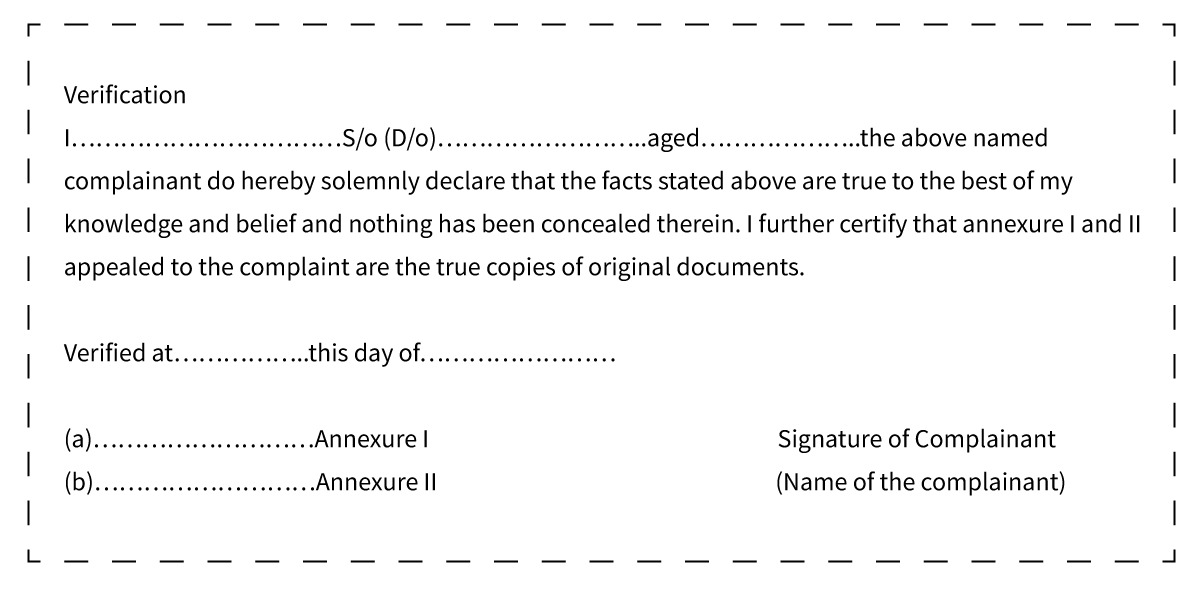
Step 3: Gather Supporting Documents
Key documents typically include:
- Proof of purchase: This can be receipts, invoices, bills, or warranty cards.
- Proof of communication: Any correspondence with the seller or service provider, such as emails, WhatsApp chats, or call recordings, is valuable.
- Evidence of defects: Photographs or video evidence clearly showing the faulty goods or deficient service.
- Agreements: Service agreements or contracts related to the transaction.
- Legal notice: A copy of the formal legal notice sent to the opposing party, if applicable.
- Memo of Parties: A document listing the names and addresses of all parties involved.
- Other relevant documents: Any additional papers that support the complaint.
Step 4: Pay the Prescribed Fee
A nominal fee is required to file the complaint, the amount of which depends on the value of the claim. This fee can typically be paid through a demand draft or online. It is important to note that complaints with a value up to Rs. 5 lakh are exempt from any filing fee.
Step 5: File the Complaint
The prepared complaint, along with all supporting documents and additional copies, must be submitted physically to the appropriate consumer court. The National Consumer Disputes Redressal Commission (NCDRC), headquartered in New Delhi, serves as the highest authority for consumer dispute resolution in India. It functions as the apex consumer court at the national level.
Here’s how the consumer court system is structured:
- NCDRC (National Level): Based in New Delhi, it is the top-tier consumer court in the country.
- SCDRC (State Level): Every state has its own State Consumer Disputes Redressal Commission.
- DCDRF (District Level): Each district operates a District Consumer Disputes Redressal Forum.
Upon submission, the complainant will receive a unique complaint number and a date for the initial hearing.
Step 6: Attend Hearings
Once the complaint is accepted, the consumer court will issue a notice to the opposing party, informing them of the complaint and the scheduled hearing. Both parties will then have the opportunity to present their arguments and evidence before the court. Hearings will continue as necessary until a final decision is reached.
Digital Process For Consumer Complaint Filing (E-Daakhil Portal)
The E-Daakhil portal is a digital platform introduced by the National Consumer Disputes Redressal Commission (NCDRC). This innovative platform significantly streamlines the consumer grievance redressal process by allowing consumers to file complaints without the need for physical visits to the consumer court.
The benefits of using E-Daakhil are substantial:
- It offers convenient access from the comfort of one's home.
- It is time-saving by avoiding long queues and extensive paperwork.
- Provides transparency through real-time online tracking of complaint status.
- Has a user-friendly interface, ensuring a paperless and transparent process for all users.
Here's how you can file a complaint via the E-Daakhil portal:
- First, visit the official E-Daakhil portal: edaakhil.nic.in
- Register and create an account using your details.
- Once logged in, draft the detailed complaint, similar to the manual process mentioned above. All supporting documents should be uploaded digitally.
- The prescribed fee (ranging from Rs. 200 - 1,000) has to be paid securely online.
- Upon submission, the system provides a unique complaint number for future reference.
Consumers can track their complaint status online and receive email or mobile notifications regarding their progress.
Navigating the E-Daakhil portal can have a learning curve. For a streamlined and error-free submission, services like RegisterKaro can manage the entire digital filing process for you.
Which Consumer Court (Commission) Should You Approach?
Choosing the correct Consumer Commission is a vital step in the complaint process. The appropriate commission is determined by two key factors:
-
Pecuniary Jurisdiction:
Based on the monetary value of the goods or services involved. The Consumer Protection Act, 2019, sets clear monetary thresholds for each level of commission, and these limits have been constitutionally upheld by the Supreme Court.
| Commission Level | Value of Goods/Services |
| District Commission | Up to Rs. 50 Lakhs - Rs. 1 Cr |
| State Commission | Between Rs. 1 Cr - Rs. 10 Cr |
| National Commission | Above Rs. 10 Cr |
-
Territorial Jurisdiction:
Depending on the geographical location of the parties or the cause of action. Consumers have several options for filing based on location:
- The complaint can be filed in the Consumer Commission where the opposing party (the company or service provider) resides or carries on business.
- Alternatively, filing is permissible where the opposing party has a branch office or personally works for gain.
- A complaint can also be filed where the cause of action—the event or circumstances leading to the dispute—occurred, either wholly or in part.
- Significantly, consumers may also file in a forum where they reside or work for gain, offering a convenient option.
- If multiple opposing parties are involved, the complaint can be filed in any forum where at least one of the parties resides or conducts business.
-
Appellate Jurisdiction:
In case of dissatisfaction with the outcome of:
- The District Forum: Consumers can file an appeal with the State Commission.
- State Commission: The consumer can further appeal to the National Commission.
- National Commission: Consumers have the option to approach the Supreme Court for a final appeal.
Consumers should always refer to the latest provisions of the Act for the most precise and up-to-date figures.
Consumer Court Fees in India
Filing a consumer complaint involves a nominal fee, which varies based on the "value of goods or services paid as consideration".
Here's a breakdown of the current court fees:
District Consumer Disputes Redressal Forum (DCDRF):
- Up to ₹5 Lakh: No fee (Nil)
- Above ₹5 Lakh and up to ₹10 Lakh: ₹200
- Above ₹10 Lakh and up to ₹20 Lakh: ₹400
- Above ₹20 Lakh: ₹1,000
State Consumer Disputes Redressal Commission (SCDRC):
- Above ₹50 Lakh and up to ₹1 Crore: ₹2,000
- Above ₹1 Crore: ₹2,500
National Consumer Disputes Redressal Commission (NCDRC):
- Above ₹2 Crores and up to ₹4 Crores: ₹3,000
- Above ₹4 Crores and up to ₹6 Crores: ₹4,000
- Above ₹6 Crores and up to ₹8 Crores: ₹5,000
- Above ₹8 Crores and up to ₹10 Crores: ₹6,000
- Above ₹10 Crores: ₹7,500
Connect with RegisterKaro and let our experts handle the legal hassle while you grow your business.
Frequently Asked Questions (FAQs)
How do I register a consumer complaint online?
Here’s how you can register a complaint online:
- Visit the E-Daakhil portal at edaakhil.nic.in.
- Register with your details, log in, and draft your complaint.
- Upload supporting documents and pay the nominal fee online.
- After submission, you'll receive a unique reference number to track your complaint status.
What is the fee for filing a complaint in the consumer court?
The fee for filing a complaint in consumer court depends on the value of the claim:
District Commission:
- Up to Rs. 5 Lakh: No fee.
- Above Rs. 5 Lakh and up to Rs. 10 Lakh: Rs. 200-500.
- Above Rs. 10 Lakh and up to Rs. 20 Lakh: Rs. 400.
State Commission:
- Above Rs. 20 Lakh and up to Rs. 50 Lakh: Rs. 1000.
- Above Rs. 50 Lakh and up to Rs. 1 Crore: Rs. 2000.
National Commission:
- Above ₹1 crore and up to ₹2 crore: ₹2500.
- Above ₹2 crore and up to ₹5 crore: ₹5000.
- Above ₹5 crore and up to ₹10 crore: ₹6000.
- Above ₹10 crore: ₹7500.
It is advisable to consult the latest fee schedule for precise figures.
Can a complaint be filed without a lawyer?
You are not required to hire a lawyer to file a consumer complaint. The Consumer Protection Act, 2019, allows you to represent yourself in consumer courts. However, for cases involving complex legal issues, substantial claims, or where court representation is anticipated, engaging a lawyer can provide valuable guidance and representation.
How long does a consumer case take to resolve?
The resolution time for a consumer case varies based on its complexity and the platform used for redressal.
- Simple cases filed through the National Consumer Helpline (NCH) may be resolved within 15-30 days.
- Cases escalated to Consumer Commissions via E-Daakhil typically take between 3-6 months.
- More complex cases, especially those at the National Commission level, might extend to 6-12 months or longer, depending on the volume of documentation and arguments.
Is it mandatory to send a legal notice before filing a complaint?
No, sending a legal notice is generally not mandatory before filing a consumer complaint. However, it is highly recommended as a preliminary step. A legal notice provides the opposing party an opportunity to resolve the dispute amicably without formal litigation. This can often lead to an early resolution, thereby avoiding unnecessary court proceedings and saving time and resources for both parties.
What documents are needed for a consumer complaint form?
Essential documents are required to support a consumer complaint. These include proof of purchase, such as receipts, invoices, bills, or warranty cards. Any communication records, including emails or messages with the seller, are also important. If applicable, photographs or video evidence of defects or deficiencies should be provided. Service agreements or contracts, along with a copy of any legal notice previously sent, are also crucial. A Memo of Parties, detailing all involved individuals and entities, is also necessary.
What is the difference between a consumer forum and a consumer court?
"Consumer forums" are quasi-judicial bodies specifically established under the Consumer Protection Act to resolve consumer disputes at the District, State, and National levels. They possess limited judicial powers focused on consumer-related grievances. "Consumer courts," in a broader sense, refer to the general judicial system that handles consumer matters, which can include District Courts, High Courts, and the Supreme Court.
What is the E-Daakhil portal?
The E-Daakhil portal is an online platform launched by the National Consumer Disputes Redressal Commission (NCDRC). Its primary purpose is to streamline the consumer grievance redressal process for convenient complaint filing, document upload, and status tracking of their cases online. This digital initiative eliminates the need for physical visits to consumer courts, saving considerable time and effort for complainants.
Where should I file a complaint if the company’s office is in a different city?
If a company's office is in another city, a complaint can be filed in the Consumer Commission where the opposing party (the company) resides or carries on business. Alternatively, it can be filed where the company has a branch office or where the cause of action (the dispute) arose, either wholly or in part. Consumers also have the option to file the complaint in a forum where they, the complainant, reside or work for gain.
What if a physical bill or invoice for a purchase is unavailable?
While a physical bill is ideal, other forms of proof of purchase are often accepted if a physical bill or invoice is unavailable. This can include digital receipts, bank statements showing the transaction, warranty cards, or even email or WhatsApp conversations that confirm the purchase and its terms.
Are WhatsApp chats, emails, and call recordings accepted as evidence?
Yes, WhatsApp chats, emails, and call recordings are generally accepted as electronic evidence in Indian courts, including consumer courts. These digital communications are recognized as "electronic records" under the Indian Evidence Act.
For their admissibility, certain conditions must typically be met: the messages should have reached their intended recipient, the electronic device used should have been in regular use, and the data presented in court should accurately match the original electronic record. A certificate under Section 65B of the Evidence Act may also be required for electronic records to be formally admitted.
What kind of compensation can be claimed from the consumer court?
Consumers can claim various types of compensation from the consumer court. Compensatory damages are awarded to cover the actual loss or injury suffered, such as the cost of a defective product, medical expenses incurred due to a faulty service, or other financial losses. This can also include a refund of the amount paid or a replacement of the defective goods.
In severe cases involving reckless or malicious conduct by the opposing party, punitive damages may be awarded.
Can a complaint be filed against an online shopping website like Amazon, Flipkart, or Myntra?
Yes, a complaint can be filed against online shopping websites such as Amazon, Flipkart, or Myntra. The Consumer Protection Act, 2019, explicitly extends its coverage to online transactions. Consumers can file complaints against e-commerce platforms for issues including defective products, deficient services, misleading advertisements, or unfair trade practices. The process for filing such a complaint is generally the same as for offline businesses, often utilizing the E-Daakhil portal for convenience.
Can a complaint be filed against a bank or an insurance company?
Yes, complaints can be filed against banks and insurance companies. These entities fall under the purview of "services" as defined by the Consumer Protection Act.
Are builders and real estate projects covered under the Consumer Protection Act?
Yes, homebuyers are explicitly considered "consumers" under the Consumer Protection Act, 2019. Complaints can be filed against builders for deficiency in service or unfair trade practices, including construction delays, faulty construction, or failure to deliver promised amenities.
Can a complaint be filed for medical negligence?
Yes, medical negligence is recognized as a "deficiency in service" under the Consumer Protection Act. Patients who suffer harm due to a medical professional's failure to provide the expected standard of care can file a complaint. This includes instances of misdiagnosis, surgical errors, administration of wrong medication, or inadequate post-operative care.

Reviewed by
Joel DsouzaJoel Dsouza is a Chartered Accountant (CA) and compliance expert with over 7 years of hands-on experience in company registration, tax structuring, GST, ROC filings, and MCA compliance. As a qualified member of the Institute of Chartered Accountants of India (ICAI) and Co-Founder at RegisterKaro, he has personally advised more than 1,000 startups and SMEs across India, helping founders navigate incorporation, regulatory frameworks, and financial planning from Day 1. With deep expertise across all three levels of Finance and Portfolio Management, Joel is committed to promoting financial literacy and simplifying India's startup ecosystem through clear, actionable guidance that entrepreneurs can act on immediately.
Why Choose RegisterKaro to File Your Consumer Complaint?
RegisterKaro offers specialized assistance designed to make this process hassle-free and efficient.
- Expert Guidance: You get expert guidance from professionals, helping draft strong and legally sound complaints.
- Document Management: You receive assistance in systematically gathering and organizing all necessary documents, from purchase proofs to communication records, ensuring that the complaint is comprehensively supported by evidence.
- Jurisdiction Clarity: RegisterKaro helps consumers accurately identify and approach the correct Consumer Commission based on the pecuniary and territorial jurisdiction. This helps prevent delays or rejections due to incorrect filing.
- Online Filing Support: Leveraging the E-Daakhil portal, we provide seamless online filing support, ensuring smooth submission of complaints and adherence to digital procedures.
- Time and Stress Savings: By handling the intricate legal formalities and paperwork, we significantly reduce the time and stress typically associated with legal proceedings.
- Increased Success Rate: With proper presentation and adherence to legal requirements, the chances of a favorable outcome for the consumer are substantially increased.

What Our Clients Say
View All
Shreya Das
 Verified
Thank you so much , my incorporation work is in a week amazing service. I recommend every startup try registerkaro atleast one time you given your all... Read more

Asteroid Ast
VerifiedSo far, my experience with the wind-up service has been very positive. Even though the application is under examination, the team has kept me informed... Read more

Chandan Murthy
VerifiedThis Registerkaro office has some great guys like Nitin and his boss Yatin. They have been saviour and helped me through and through. Would definitely... Read more

Jyoti Awasthi
VerifiedI truly appreciate RegisterKaro for their smooth and transparent registration process. All my queries were resolved on time. Aerk Singh Suryavanshi wa... Read more

Gaurav Kumar
VerifiedStarting a business can be overwhelming, but RegisterKaro simplified everything for me. Ayush Jain ensured all my queries were resolved quickly and cl... Read more

Prateek Jagadish
VerifiedThey have great services they are handling my companies (syntellite innovations private limited) compliance and gst , i have no problem so far recomme... Read more

ASTRO DIGITAL
VerifiedHarjeet Singh provided excellent support throughout our company registration process. Very professional, responsive, and knowledgeable. Highly recomme... Read more

Abhishek Arora
VerifiedI wasn't familiar with the process at all, but Shubham Bharti explained everything patiently and made sure I was comfortable at every step. He was eas... Read more

Vaibhav doharey
VerifiedI am writing to express my sincere appreciation for Aryan who was assigned as my SPOC during the compliances process. Aryan’s professionalism, diligen... Read more

Hari
VerifiedThe team was highly professional, responsive, and supportive throughout the entire process, making everything seamless and hassle-free. I would highly... Read more
Related Blogs
View All
How to Start a Masala Business in India?

How to Start a Coaching Institute in India?

How to Start a Bottled Water Business in India?

Compliance Calendar for Producer Company in India
How to Apply for DIN Number: DIR-3 Process & SPICe+ for Directors
Virtual CFO Cost in India for Startups: Fees & Pricing
Accounting Outsourcing Cost in India: Complete Pricing Guide
Documents Required for GST Registration in India (Checklist)

How to Start a Scrap Business in India: Setup & Profit

How to Register a Media Company in India: Process & Licenses