

Difference Between Shop and Establishment License & Trade License
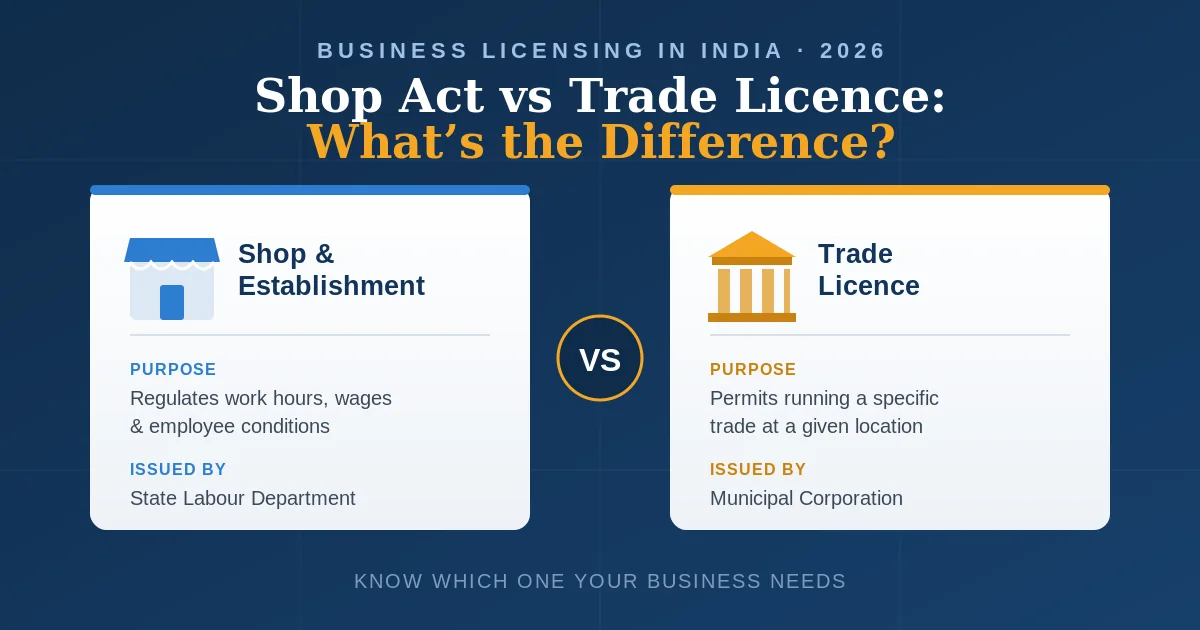
The Shop and Establishment License is a state-level registration issued by the State Labour Department under the relevant Shops and Establishments Act. It regulates employee working conditions, wages, hours, leave, and workplace welfare. The Trade License is a city-level registration issued by the Municipal Corporation or Urban Local Body. It grants permission to carry out a specific commercial activity at a specific address under municipal health, safety, and zoning regulations.
Most businesses need both, with the Establishment License covering Labour compliance, while the Trade License covers operational permission. Almost every commercial establishment needs Shop & Establishment registration. A trade license, on the other hand, is needed only if your activity falls in the municipality’s regulated-trades list.
Both must typically be obtained within 30 days of starting business operations. Authorities check both during inspections, and banks require them while opening current accounts.
Key Takeaways
- A Shop and Establishment License is issued under the state Shops and Establishments Acts to regulate employee working conditions. A Trade License is issued under the state Municipal Corporation Acts to permit specific business activity at a specific address.
- Most businesses require both, especially retail stores, restaurants, and offices with employees. Missing either can lead to penalties, legal notices, or operational restrictions.
- A Trade License is valid for one year and must be renewed between January and March each year. Late renewal attracts penalties of 10% to 50% of the renewal fee, depending on the municipal authority. On the other hand, Shop and Establishment License validity varies by state, with some states offering lifetime validity and others requiring periodic renewal.
- Trade Licenses stay tied to a specific location and business activity, and you must obtain a fresh license if you change either the premises or the nature of business.
- Non-compliance leads to serious consequences, including fines, imprisonment under labour laws, and even sealing or cancellation of business premises under municipal regulations.
How is Shop and Establishment License Issued and Who Should Apply?
A Shop and Establishment License regulates basic employment and workplace conditions. It typically includes:
- Working hours, shift timings, and overtime rules
- Overtime compensation and wage payment standards
- Employee leave, weekly offs, and public holidays
- Maintenance of employee records
- Basic health, safety, and welfare requirements at the workplace.
How is a Shop and Establishment License Issued?
The State Labour Department or the designated local authority issues a Shop and Establishment License. It is issued after verifying that your business complies with the applicable state Shops and Establishments Act. The process follows these steps:
- Visit the official state labour portal, such as the Maharashtra Labour Department portal (labour.maharashtra.gov.in) or the designated local authority’s office. Submit the application form along with the prescribed fee.
- Upload or submit identity proof, address proof, a photograph of the establishment, and details of employees working at the premises.
- Attend the inspection, verifying the working conditions and details mentioned in the application (if required).
- Collect the Shop and Establishment Certificate once the authority approves the application for your establishment.
The validity and renewal period vary by state. Some states issue lifetime certificates, while others set a validity of 1 to 5 years. Renew the license before it expires to avoid penalties (₹1,000–₹25,000 + imprisonment) and operational disruptions.
Who Needs a Shop and Establishment License?
Most types of commercial and business establishments require a Shop and Establishment license. These include:
- Shops and retail stores
- Offices and professional service firms
- Restaurants, cafes, and hotels
- Warehouses and storage facilities
- Home-based businesses with employees
- Online businesses operating from a registered place of business
Shop and Establishment: State-Wise Names and Renewal Portals
The Shop and Establishment License goes by different names across states. Here is a quick reference:
| State | Common Name | Validity | Renewal Portal |
|---|---|---|---|
| Maharashtra | Gumasta License | 1, 5, 10 years, or lifetime (chosen at registration) | aaplesarkar.mahaonline.gov.in |
| Karnataka | Shop License / e-Karmika | 5 years | ekarmika.karnataka.gov.in |
| Tamil Nadu | Shop Establishment Registration | Annual | labour.tn.gov.in |
| Delhi | Shop & Establishment Registration | Lifetime | labourcis.nic.in |
| Telangana | Shop License | Lifetime | labour.telangana.gov.in |
| Gujarat | Gumasta Dhara | 5 years | enagar.gujarat.gov.in |
| Uttar Pradesh | Shop & Establishment Registration | 1–5 years | niveshmitra.up.nic.in |
| Rajasthan | Shop & Establishment Registration | 1 year | labour.rajasthan.gov.in |
| West Bengal | Shop & Establishment Registration | 1 year | silpasathi.wb.gov.in |
| Haryana | Shop & Establishment Registration | 5 years | haryana.gov.in (labour portal) |
| Kerala | Shop & Commercial Establishment Licence | 5 years | lc.kerala.gov.in |
Who Needs a Trade License and How to Get it?
A Trade License permits the business to carry out specific commercial activities within municipal limits and covers:
- Permission to carry out specific business activities at a specific address
- Compliance with local health, safety, and environmental standards
- Regulation of noise, nuisance, and pollution
- Adherence to building and zoning rules
- Physical inspection of business premises by municipal authorities
- Restrictions on hazardous or sensitive trade activities.
This license also ensures that operations do not cause public nuisance, health hazards, or safety risks to the surrounding area. The rules, requirements, and approval process may vary from one city to another, depending on local municipal regulations.
Who Needs a Trade License?
A Trade License applies to most businesses operating within municipal limits, including:
- Shops and retail establishments
- Restaurants, cafes, and food outlets
- Manufacturing and industrial units
- Hotels and lodging facilities
- Warehouses and storage units
- Service-based businesses operating from commercial premises.
How is a Trade License Issued?
The Municipal Corporation or ULB issues a Trade License after verifying that your business complies with local rules, safety standards, and zoning regulations. The process follows these steps:
- Visit the municipal corporation’s online portal, like Pune Municipal Corporation (pmc.gov.in), or local office. After that, submit the application form along with the prescribed fee.
- Upload or submit identity proof, address proof, and ownership or tenancy documents for the business premises.
- Attend the site inspection if required. Municipal officials visit the premises to verify compliance with health, safety, and zoning norms.
- Collect the Trade License once the authority approves the application for the specific business activity at the specific address.
The license is generally valid for one year in most municipal corporations, but some states also issue multi-year or long-term validity licenses depending on local rules. Renewal requirements vary by city, with many municipal authorities accepting renewal applications annually, often between January and March.
Note: The documents required for a trade license may vary by city and business type, depending on municipal guidelines and the nature of operations.
Trade License: State-Wise Names and Renewal Portals
The Trade License is issued by the Municipal Corporation of the city where your business operates. The name and portal differ by city:
| City / State | Issuing Authority | Common Name | Renewal Portal |
|---|---|---|---|
| Delhi | MCD / NDMC | Trade License | mcdonline.nic.in |
| Mumbai | BMC (MCGM) | Shop License / Trade License | mcgm.gov.in |
| Bengaluru | BBMP | Trade License | bbmpgov.in |
| Kolkata | KMC | Certificate of Enlistment | kmcgov.in |
| Chennai | GCC | Trade License | chennaicorporation.gov.in |
| Hyderabad | GHMC | Trade License | ghmc.gov.in |
| Ahmedabad | AMC | Trade License | ahmedabadcity.gov.in |
| Pune | PMC | Trade License | pmc.gov.in |
| Gurgaon | MCG | Trade License | mcg.gov.in |
| Noida | NMC | Trade License | nmc.gov.in (or invest.up.nic.in) |
Key Difference Between a Trade and Shop and Establishment License in India
Here’s the complete difference between the Shop and Establishment License and the Trade License across every parameter:
| Parameter | Shop & Establishment License | Trade License |
|---|---|---|
| Purpose | Regulates working conditions and employee rights | Grants permission to carry out a specific trade at a specific location |
| Governing Law | State Shops and Establishments Act | State Municipal Corporation Acts + local bye-laws |
| Issuing Authority | State Labour Department or designated authority | Municipal Corporation or local body |
| What It Regulates | Working hours, wages, leave, overtime, and employee welfare | Type of business activity, health, safety, zoning compliance |
| Who Needs It | All commercial establishments — offices, shops, home-based businesses with employees | Businesses operating within municipal limits |
| Scope | Employment and workplace compliance | Public safety and municipal regulation of business activity |
| Premises Coverage | Can be obtained for commercial or residential premises (in most states) | Only for approved commercial premises |
| Application Process | Online or offline within 30 days of starting business — via the state labour portal | Online within 30 days of starting business — via municipal portal |
| Documents Required | Business address proof, owner ID, establishment photo, employee details | Ownership/tenancy proof, property tax receipt, ID/address proof, NOC (if required) |
| Validity | Varies by state (1 year to lifetime — Maharashtra, Delhi, Telangana offer lifetime) | Usually 1 year |
| Renewal Window | As per state rules (some self-renewal, some periodic) | Generally, between January and March every year |
| Renewal Requirement | Periodic renewal or self-declaration | Mandatory annual renewal |
| Registration Deadline | Within 30 days of commencement | Within 30 days of commencement |
| Fees | ₹500 – ₹5,000, depending on the employees and the state | Varies based on business type, area, and employee count |
| Penalty for Non-Compliance | ₹1,000 – ₹25,000 and/or imprisonment (varies by state labour laws) | 10% – 50% penalty on renewal fee, sealing, suspension, cancellation, or prosecution |
| Inspection Authority | Labour inspectors or state officers | Municipal health officers or inspectors |
| Transferability | Not transferable | Not transferable (location-specific) |
Shop and Establishment vs Trade: Which License Do You Actually Need?
The right type of license depends on your business type, location, and number of employees.
For example:
- A restaurant needs a Trade License for municipal approval to operate food-related activities at a specific address. It also needs a Shop and Establishment License to comply with labour laws related to employees, including working hours, wages, leave policies, and workplace conditions.
- An IT company needs a Shop and Establishment License for office registration and employee compliance. It may also require a Trade License, depending on local municipal rules for commercial establishments in that area.
Which License(s) Does Your Business Need?
| Business Type | Shop & Establishment License | Trade License | Additional Compliance |
|---|---|---|---|
| Retail shop/boutique | Mandatory | Mandatory | GST (if turnover > ₹40 lakh), Trademark |
| Restaurant/café /food outlet | Mandatory | Mandatory | FSSAI, Fire NOC, Liquor License (if applicable) |
| Medical store/pharmacy | Mandatory | Mandatory | Drug License (Form 20/21), GST, Pharmacist registration |
| IT/Software office | Mandatory | Mandatory (check city) | GST, Pvt Ltd / LLP registration |
| Manufacturing unit/factory | Mandatory | Mandatory | Pollution NOC, Factory License, Fire NOC, Labour License |
| Service business (consulting, agency) | ✓ Mandatory | ✓ Mandatory (check city) | GST, trademark |
| Home-based business (no employees) | Optional (depends on state) | Usually not required | GST (if applicable), MSME / Udyam |
| Home-based business (with employees) | Mandatory | Usually not required | GST, MSME / Udyam |
| E-commerce-only seller (no physical store) | Mandatory | Optional (depends on city) | GST (mandatory), Trademark for Amazon Brand Registry |
| Freelancer (no employees, residential) | Optional (some states require it) | Usually not required | GST (if turnover > ₹20 lakh), Sole proprietorship |
| Warehouse/storage facility | Mandatory | Mandatory | Fire NOC, Pollution NOC |
| Hotel/lodging | Mandatory | Mandatory | Fire NOC, FSSAI, Excise (if serving alcohol) |
Can a Business Operate Without Trade or Shop & Establishment Registration?
In most cases, a business cannot legally operate without the required Shop and Establishment License and Trade License. The need depends on the nature of the business, but both serve mandatory compliance functions under different laws.
- A Shop and Establishment License is required if you have a registered workplace or employees in most states.
- A Trade License is required if your business operates within municipal limits and involves commercial activity regulated by local authorities.
Operating without either a license, when applicable, can lead to penalties, inspection issues, or restrictions on business operations. Authorities may also deny other approvals, such as bank onboarding or local permissions, if these registrations are missing.
