

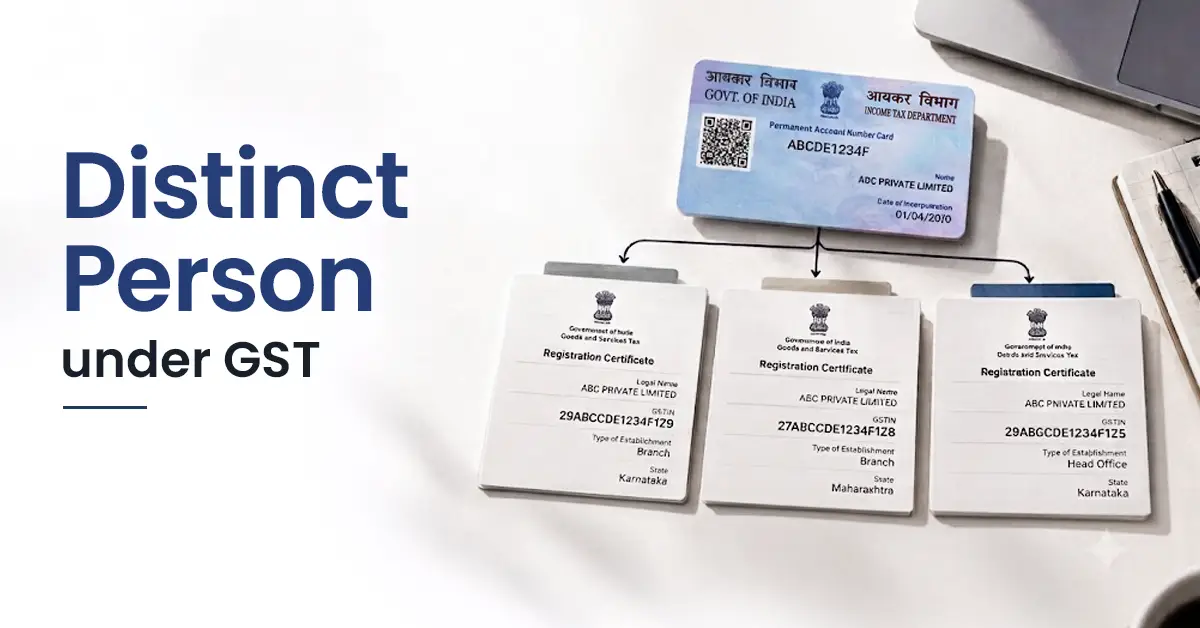
When a business operates in multiple states, it generally needs a separate GST registration in each state or Union territory from which it makes taxable supplies and is liable to register. Under Section 25 of the CGST Act, 2017, the law treats each separate registration as a distinct person under GST, even when all registrations belong to the same business and share one Permanent Account Number (PAN).
Businesses that operate branches, warehouses, depots, factories, or offices across different states must account for this requirement. For example, a stock transfer attracts GST because the locations are in different states. Similarly, services that a head office provides to a separately registered branch may qualify as taxable supplies. This guide explains the definition of a distinct person under GST, the provisions of Section 25, the taxability of inter-branch supplies, and the valuation rules under Rule 28 of the CGST Rules, 2017.
Definition of a Distinct Person Under GST as Per Section 25
Section 25(4) and Section 25(5) of the CGST Act, 2017, establish the concept of a Distinct Person as:
- Section 25(4): Each GST registration held or required by the same person is treated as a distinct person, whether the registrations cover the same state or Union territory or different states or Union territories.
- Section 25(5): When a person who has obtained, or must obtain, registration in a state for an establishment also has an establishment in another state, the law treats those establishments as establishments of distinct persons.
Example: If a company holds GST registrations in Maharashtra, Karnataka, and Tamil Nadu, GST treats each registration as a distinct person. Similarly, a company’s separately registered head office in Delhi and branch in West Bengal qualify as distinct persons for GST purposes.
When Does a Business Need Multiple GST Registrations?
Section 25 generally provides for one GST registration in each state or Union territory. However, a business may need or obtain multiple registrations in the following circumstances:
- Business operations in multiple states: A business must register separately in each state or Union territory where it becomes liable for GST registration. Each registration qualifies as a distinct person under Section 25(4).
- Multiple places of business in the same state: Under Section 25(2), a business may obtain separate GST registrations for multiple places of business within the same state or Union territory, subject to the prescribed conditions. Each separately registered location becomes a distinct person for GST purposes.
- Establishments in different states: Section 25(5) applies when the same person operates establishments in different states or Union territories and obtains, or must obtain, the law treats them as establishments of distinct persons.
- Additional place of business under an existing GSTIN: A business can add another location in the same state to its existing GST registration instead of obtaining a separate GSTIN. It can also operate multiple business activities under one GST number, provided they belong to the same legal entity and meet the applicable GST requirements. Read more about adding multiple businesses under the same GST number. The additional location does not become a distinct person unless the business obtains a separate registration for it.
Why Does the Distinct Person Concept Matter? Supply Without Consideration
The distinct person concept matters because GST can apply to transactions between separately registered branches of the same business, even when they do not exchange payment. Schedule I of the CGST Act, 2017, treats certain transactions between distinct persons as supplies even without consideration.
Schedule I: When Does GST Apply Without Payment?
Entry 2 of Schedule I covers supplies between related persons or distinct persons under Section 25, made in the course or furtherance of business, even without consideration. Entry 4 also covers the import of services by a person from a related person or any of their other establishments outside India, in the course or furtherance of business, even without consideration.
For example, a company transfers finished goods from its factory in Gujarat to its depot in Rajasthan. If the two locations hold separate GST registrations, the transfer qualifies as a supply between distinct persons. The Gujarat registration must account for the taxable supply and issue the applicable tax invoice. The Rajasthan registration may claim input tax credit on the GST charged, subject to the relevant eligibility and documentation requirements.
However, the business must determine the value of the transfer under the applicable GST valuation rules. The absence of payment between the two registrations does not, by itself, remove the GST liability.
Stock Transfers Between Branches: A Common Example
Stock transfers between separately registered branches are a common example of supplies between distinct persons. When a business transfers goods between registrations, it must account for GST even if the transfer does not involve a sale to an external customer.
For example, if a manufacturer transfers goods from its Pune registration to its Chennai registration, the inter-state transfer generally attracts Integrated GST (IGST). The supplier must report the outward supply, while the receiving registration must record the inward supply in its GST records and applicable returns.
The receiving branch can claim Input Tax Credit on the IGST, provided it meets the statutory conditions, including possession of a valid tax invoice and compliance with the applicable input tax credit requirements. Both registrations must report the transaction correctly through their respective GST return filings.
Valuation of Supply Between Distinct Persons Under GST: Rule 28
When a business transfers goods or services between distinct persons, it must determine the taxable value under Rule 28 of the CGST Rules, 2017. The rule establishes a valuation hierarchy and provides specific relief when the recipient qualifies for full input tax credit (ITC).
1. Open Market Value: The First Preference
Rule 28 first requires businesses to use the Open Market Value (OMV) of the supply. Open market value means the full monetary value (excluding GST and cess) that an unrelated buyer would pay an unrelated supplier for the same supply at the time of the transaction, when price is the sole consideration.
For example, if a company sells the same goods to independent customers at a comparable price, it can use that price as a reference when valuing a transfer between its separately registered branches.
2. Value of Goods or Services of Like Kind and Quality
If the business cannot determine the open market value, it must use the value of goods or services of like kind and quality. This approach uses the value of comparable supplies with similar characteristics and quality to determine the taxable value.
3. Cost-Based or Residual Valuation
If neither the open market value nor the value of comparable supplies is available, the business must determine the value under Rule 30 or Rule 31, in that order.
- Rule 30 (cost-based valuation): The business generally values the supply at 110% of the cost of production or manufacture, the cost of acquiring the goods, or the cost of providing the services, as applicable.
- Rule 31 (residual method): If Rule 30 does not determine the value, the business uses reasonable means consistent with Section 15 of the CGST Act and the valuation rules. For services, the supplier may choose Rule 31 without applying Rule 30.
4. Special Valuation Options Under Rule 28
Rule 28 also provides two important provisions that businesses should consider when valuing supplies between distinct persons.
Option 1: 90% of the recipient’s resale price
When the recipient intends to resupply the goods as such, the supplier may choose a value equal to 90% of the price the recipient charges an unrelated customer for goods of like kind and quality.
Option 2: Invoice value when the recipient qualifies for full ITC
The second proviso to Rule 28 states that when the recipient qualifies for full input tax credit, the value declared in the invoice is deemed to be the open market value of the goods or services.
For example, a company transfers goods from its Gujarat factory to its separately registered Rajasthan depot. If the Rajasthan registration qualifies for full ITC, the company may use the value declared in the invoice under this proviso, even if that value is lower than the open market value. The company does not need to establish the open market value separately in this situation.
The invoice-value option under the second proviso applies only where the recipient is eligible for full input tax credit. Cost-based valuation under Rule 30 applies only where open market value and the value of like goods or services cannot be determined.
Distinct Person vs Related Person Under GST: Key Differences
A distinct person and a related person have different legal meanings under GST. The following table explains their key differences:
| Aspect | Distinct Person | Related Person |
| Legal basis | Sections 25(4) and 25(5) of the CGST Act, 2017 | Explanation to Section 15 of the CGST Act, 2017 |
| Test | Separate GST registrations held or required by the same person | Specified relationships, including common control, ownership, family relationships, and employer-employee relationships. This also includes cases where a person directly or indirectly owns, controls, or holds 25% or more of the outstanding voting stock or shares of both persons. |
| Example | Head office in Delhi and branch in Mumbai, both separately registered | Holding company and its wholly owned subsidiary |
| Same PAN required? | Generally, yes, as the registrations belong to the same person | No, related persons may have different PANs |
| Valuation rule | Rule 28 of the CGST Rules, 2017 | Rule 28 of the CGST Rules, 2017 |
| Supply without consideration taxable? | Yes, for qualifying business supplies under Entry 2 of Schedule I | Yes, for qualifying business supplies under Entry 2 of Schedule I |
A business relationship can make two entities related persons, but it does not automatically make them distinct persons. For example, a parent company and its wholly owned subsidiary may qualify as related persons. However, they do not become distinct persons merely because both hold separate GST registrations in the same state. Section 25 applies to separate registrations of the same person, while Section 15 defines related persons.
Can a Person Have Two GST Numbers in the Same State?
Under Section 25(2) of the CGST Act, 2017, a person may obtain separate GST registrations for multiple places of business within the same state or Union territory, subject to the prescribed conditions. Rule 11 of the CGST Rules, 2017, if a person has more than one place of business under Section 2(85), it can’t opt for composition (Section 10) for one registration while paying regular tax (Section 9) under another; all separately registered places must pay tax and issue a tax invoice or bill of supply on supplies to each other.
For example, a company operating a factory in Pune and a distribution center in Nagpur may obtain separate GST registrations for each location, subject to the conditions in Rule 11. Separate registration depends on having more than one place of business in the state, not on running different lines of business.
However, a business does not need a separate GST number for every location in the same state. For example, a retailer operating ten outlets in Delhi can generally include all ten outlets under one GST registration by listing them as additional places of business. If the retailer obtains separate registrations for individual locations, those registrations become distinct persons for GST purposes.
Compliance Requirements for Distinct Persons Under GST
Businesses with multiple GST registrations must follow specific invoicing, reporting, and valuation requirements. To maintain GST compliance, each registration must meet the following obligations:
- Issue GST tax invoices: The supplying registration must issue a tax invoice for taxable supplies between distinct persons, even when the parties do not exchange consideration. It must charge CGST and SGST for intra-state supplies or IGST for inter-state supplies, as applicable.
- File GST returns accurately: The supplying registration must report the outward supply in GSTR-1, while the receiving registration must record the inward supply and claim input tax credit (ITC), subject to eligibility conditions. Businesses should reconcile invoices with GSTR-2B because missing or incorrect supplier reporting can affect ITC eligibility.
- Generate e-way bills when required: Businesses must generally generate an e-way bill before moving goods with a consignment value exceeding ₹50,000, including branch and depot transfers. Specific exceptions apply under the GST rules.
- Follow e-invoicing requirements: Businesses with an aggregate annual turnover of ₹5 crore or more in any preceding financial year from 2017–18 onward must generally comply with e-invoicing requirements, subject to notified exemptions. When applicable, the supplier must report eligible invoices, including qualifying supplies between distinct persons, to an Invoice Registration Portal (IRP) to generate the Invoice Reference Number (IRN).
- Apply Rule 28 for valuation: Businesses must determine the taxable value of supplies between distinct persons under Rule 28(1) of the CGST Rules, 2017. They should use the open market value first, followed by the value of like-kind and quality supplies if the open market value is unavailable. If neither value can be determined, they must apply Rule 30 or Rule 31, in that order. Where the recipient qualifies for full input tax credit (ITC), the invoice value is deemed to be the open market value.
- Account for head office services correctly: When a head office provides internally generated services to a separately registered branch, it does not have to include the salary cost of employees involved in providing those services in the taxable value, even if the branch cannot claim full ITC. If the branch qualifies for full ITC, the invoice value is deemed to be the open market value under the second proviso to Rule 28. If the head office does not issue an invoice for those services, it may treat the value as NIL under this proviso.
- Follow the mandatory ISD rules: From 1 April 2025, businesses must use the Input Service Distributor (ISD) mechanism to distribute ITC on common input services received from third parties for their branches. Cross-charge continues to apply to internally generated services provided between separately registered offices.
