Legal Heir Certificate Apply Online
Apply for your Legal Heir Certificate online with expert guidance. Ensure smooth inheritance process and avoid legal hassles with RegisterKaro’s trusted documentation support.
 Application Filing AssistanceError-Free DocumentationQuick Status TrackingJurisdiction & Legal GuidanceTrusted by 20,000+ Businesses

 What Sets Us ApartWhat Sets Us Apart
What is a Legal Heir Certificate?
A Legal Heir Certificate is an official document issued by the government that identifies the rightful living successors of a deceased person. It is similar to a formal introduction to the authorities, stating who is next in line to inherit the deceased's assets, liabilities, and responsibilities.
When a person passes away without leaving a will (this is known as dying 'intestate'), this certificate becomes vital. It establishes the relationship between the deceased and their legal heirs, paving the way for the transfer of property, bank balances, and other assets. The certificate is issued after a proper inquiry by the concerned government authorities, such as the Tehsildar or Talukdar (Sub-Divisional Magistrate – SDM) of the district.
Who are the Legal Heirs?
The law in India defines who is considered a legal heir based on the deceased person's religion. The rules of succession are governed by personal laws.
For Hindus, Buddhists, Jains, and Sikhs, the Hindu Succession Act, 1956, applies. The legal heirs are categorized into classes:
- Class I Heirs: These are the primary heirs and have the first right to the property. They inherit equally. Class I heirs include:
- Spouse (Wife or Husband)
- Sons and Daughters
- Mother
- Children of a predeceased son or daughter
- Class II Heirs: If there are no Class I heirs, the property goes to Class II heirs. This category includes:
- Father
- Grandparents
- Grandchildren
- Siblings (Brothers and Sisters)
- Other relatives
For Christians, the Indian Succession Act, 1925, governs the distribution of property. Generally, the spouse and children are the primary heirs. If there are no children, the spouse may share the assets with other relatives of the deceased, like the father or mother.
For Muslims, succession is governed by their law, which has its own distinct rules for identifying heirs and their respective shares. Islamic law defines specific shares for heirs (known as Sharers and Residuaries), which include the spouse, children, and parents. The distribution is based on a pre-defined framework within Sharia.
Note: Personal succession laws are complex. It is always advisable to consult a legal expert for specific cases.
Why is a Legal Heir Certificate Important: Key Benefits
A Legal Heir Certificate is crucial after the death of a loved one. It legally proves who the rightful successors are and helps in managing the person's financial and legal matters smoothly.
Here’s why it’s important and how it helps:
- To Claim Assets: You need this certificate to transfer or claim the deceased’s money, property, mutual funds, and bank accounts.
- For Banks and Insurance: Banks, insurers, and other institutions will ask for this certificate before allowing access to funds or processing claims.
- Government Dues: If the deceased was a government employee, the certificate is required to claim pension, PF, gratuity, and other dues.
- Property and Utility Transfers: It is needed to update ownership of real estate, electricity, water, and property tax records.
- Access to Funds and Investments: You can only manage the deceased’s bank accounts or investments with this certificate.
- Compassionate Job Appointments: In government jobs, this certificate is a must for heirs seeking employment on compassionate grounds.
- Legal Protection: It helps prevent future disputes by clearly naming all legal heirs.
- Proof of Claim: It officially validates your relationship and right to inherit.
In short, this certificate is not just a formality; it protects your rights, speeds up asset transfers, and prevents legal complications.
Rules & Regulations Governing Legal Heir Certificate
The issuance of a Legal Heir Certificate is primarily a state-level process, and the procedures may vary slightly from one state to another. There is no single central law governing its issuance. Instead, state revenue authorities issue the certificate based on applicable personal succession laws such as the Hindu Succession Law, Muslim Personal Law, or the Indian Succession Act, 1925 (for Christians and Parsis), and relevant state-specific rules.
The certificate is generally issued by the Revenue Department of the respective state. Key authorities involved in the process include the District Collector, Tehsildar, Talukdar, or Sub-Divisional Magistrate (SDM). Their role is to verify the legal heir claims through a proper inquiry before approving and issuing the certificate.
Difference Between a Legal Heir Certificate and a Succession Certificate
Many people get confused between a Legal Heir Certificate and a Succession Certificate. While both are related to inheritance, they serve different purposes and are issued by different authorities.
Here’s a simple breakdown of the differences:
| Feature | Legal Heir Certificate | Succession Certificate |
| Purpose | To identify the legal heirs of the deceased. | To grant authority to the holder to inherit the debts and securities of the deceased. |
| Issuing Authority | Issued by the Revenue Authority (Tehsildar/Talukdar/District Collector). | Issued by a Civil Court. |
| Scope | Establishes the relationship for inheriting property and claiming benefits. | Specifically deals with movable assets like stocks, bonds, and bank deposits. |
| When Required | For claiming pensions, insurance, and transferring properties and utilities. | For realizing the debts and securities of the deceased. |
| Legal Standing | It is a primary document for most inheritance claims. | It provides greater legal authority for dealing with financial assets. |
| Cost | The fees are nominal, usually a small stamp fee and affidavit cost. | The court fee is a percentage (usually 2-3%) of the value of the assets. |
Who Can Apply for a Legal Heir Certificate?
The following individuals are typically eligible to apply for a Legal Heir Certificate:
- The spouse of the deceased.
- The children (sons and daughters) of the deceased.
- The parents of the deceased.
- The siblings (brothers and sisters) of the deceased (if there are no Class I heirs).
Note: The order of heirs and who is eligible may change based on the religion of the person who died (Hindu, Muslim, Christian, etc.) and the rules of the state.
Can an NRI Apply for a Legal Heir Certificate?
Yes, Non-Resident Indians (NRIs) can apply for a Legal Heir Certificate in India. They can either:
- Apply directly through the state’s online portal (if available), or
- Appoint a representative in India using a Power of Attorney (POA).
Documents Required for Obtaining a Legal Heir Certificate
To ensure a smooth application process, it's important to have all the necessary documents ready. Here is a general list of documents required, though there might be minor variations depending on the state:
- Application Form: A duly filled and signed application form.
- Death Certificate of the Deceased: An original copy of the death certificate issued by the municipal corporation or a competent authority.
- Identity Proof of the Applicant: Aadhaar card, voter ID, passport, or driving license.
- Address Proof of the Applicant: Any of the identity proof documents that contain the address.
- Proof of Relationship: Documents establishing the relationship between the applicant and the deceased, such as a birth certificate, marriage certificate, or school leaving certificate.
- Affidavit: A self-declaration on a stamp paper, mentioning all the legal heirs of the deceased, their ages, and their relationship with the deceased.
- Photographs: Passport-sized photographs of the applicant.
- Address Proof of the Deceased: A document showing the last known address of the deceased person.
- Family Tree or Genealogy Report: A document showing the family structure and identifying all legal heirs.
How to Apply for a Legal Heir Certificate: A Step-by-Step Guide
The process for obtaining a Legal Heir Certificate can be done either offline or, in many states, online.
Offline Procedure
- Approach the Local Authority: The first step is to visit the office of the Tehsildar/Talukdar or the District Collector in the area where the deceased person resided.
- Get the Application Form: Obtain the application form for the Legal Heir Certificate from the office. In some areas, the form may also be available at nearby Common Service Centers (CSCs) for added convenience.
- Fill the Form: Carefully fill in all the required details in the application form. This will include the names of all legal heirs, their relationship with the deceased, and their addresses.
- Attach Documents: Attach all the necessary documents, as mentioned in the previous section, along with the application form.
- Submit the Application: Submit the completed form and documents to the concerned officer. You will also need to submit a self-undertaking in the form of an affidavit.
- Verification Process: After you submit the application, a verification process will begin. A Revenue Inspector or a Village Administrative Officer will conduct an inquiry to verify the details you have provided. This may involve visiting your residence and taking statements from neighbors.
- Issuance of Certificate: Once the verification is complete and the report is submitted, the Tehsildar/Talukdar will issue the Legal Heir Certificate. This process usually takes about 15 to 30 days.
Online Procedure
Many states have now made the process of applying for a Legal Heir Certificate online, making it more convenient for citizens.
- Visit the State Portal: Go to the official e-District or revenue department portal of your state. (For instance, Haryana: saralharyana.gov.in & Delhi: edistrict.delhigovt.nic.in)
- Create an Account: Register yourself on the portal by providing your basic details.
- Find the Service: Look for the option to apply for a "Legal Heir Certificate" or "Surviving Member Certificate".
- Fill the Online Form: Fill out the online application form with accurate information.
- Upload Documents: Scan and upload all the required documents in the specified format.
- Pay the Fees: Pay the nominal application fee online through the available payment gateways.
- Submit and Track: After submission, you will receive an application reference number. You can use this number to track the status of your application online.
- Download the Certificate: Once the certificate is approved and digitally signed by the concerned authority, you can download it from the portal.
Legal Heir Certificate Costs
The cost of obtaining a Legal Heir Certificate is very nominal. It mainly includes:
- Stamp Fee: A court fee stamp of a very small amount (e.g., ₹2).
- Affidavit Cost: The cost of the stamp paper for the affidavit (e.g., ₹20).
- Service Charges: If you are applying through a common service center (CSC), there might be a small service charge.
The overall cost is generally well under a few hundred rupees, making it accessible to everyone.
How to Add a Legal Heir to File ITR for Deceased?
After the demise of an individual, their legal heir is responsible for filing their Income Tax Returns (ITR) for the income earned until the date of death. To do this, the legal heir must first register themselves on the Income Tax e-filing portal.
According to Section 159 of the Income Tax Act, 1961, the legal representative of a deceased person is liable to file the income tax returns on their behalf. This is a mandatory requirement if the deceased person's income was above the basic exemption limit.
Here is a step-by-step guide on how a legal heir can file the ITR for a deceased person:
- Register as a Legal Heir:
- Visit the official Income Tax e-filing portal (eportal.incometax.gov.in).
- Log in with your credentials (the legal heir's PAN).
- Go to 'Authorized Partners' and select 'Register as Representative Assessee'.
- Click on 'Create New Request' and choose the category 'Deceased (Legal Heir)'.
- Enter the details of the deceased person, such as their PAN, date of death, and bank details.
- Upload a single .zip file containing scanned copies of the following documents:
- The deceased person's PAN card
- The death certificate
- The legal heir's PAN card
- The Legal Heir Certificate (or alternative document).
- Submit the request. The request will be sent to the e-filing administrator for approval.
- Prepare the ITR:
- Once your request is approved, you can prepare the ITR of the deceased person for the relevant financial year. The return should include income earned from the beginning of the financial year until the date of death.
- File the ITR:
- Log in to the e-filing portal using your (the legal heir's) credentials.
- Select the option to file the ITR on behalf of the deceased.
- Upload the prepared ITR XML file.
- Verify the return using your Aadhaar OTP or other available options.
Note: If you don’t have a Legal Heir Certificate, you can also submit a registered Will or a notarized affidavit signed before a magistrate. The Income Tax Department accepts these as valid alternatives.
Legal Heir Certificate Format
While the exact format may vary slightly from state to state, a typical Legal Heir Certificate will contain the following information:
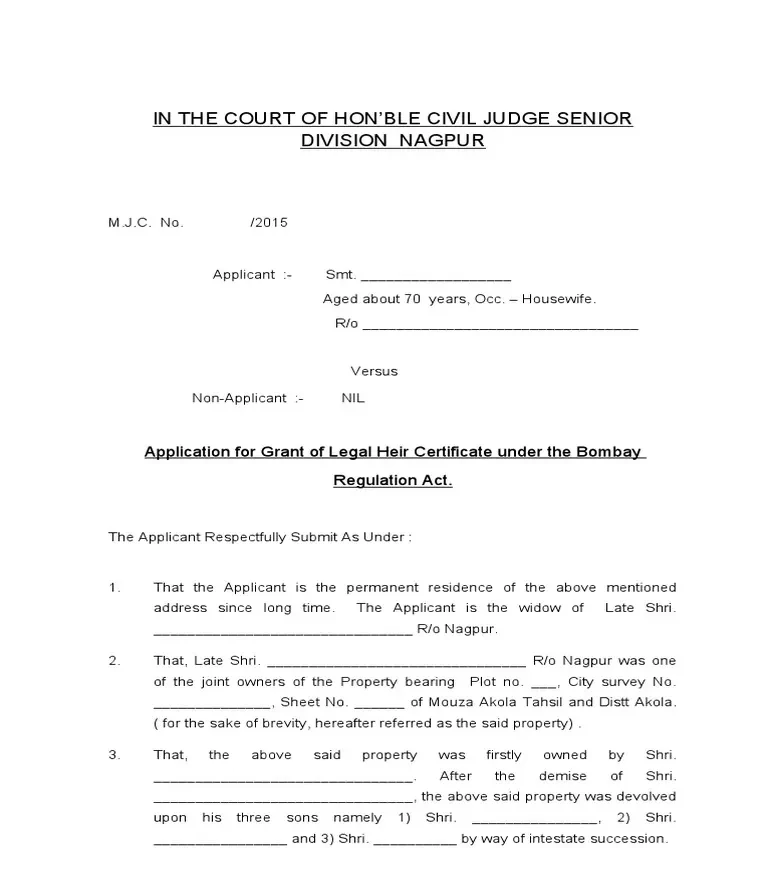
- Name of the issuing office (e.g., Office of the Tehsildar).
- Certificate number and date of issue.
- Name, age, and address of the deceased person.
- Date of death of the deceased person.
- A table listing the names, ages, and relationships of all the surviving legal heirs with the deceased.
- A statement certifying that the mentioned individuals are the legal heirs.
- The signature and seal of the issuing authority (e.g., Tehsildar).
How to Download the Legal Heir Certificate?
If you have applied for the Legal Heir Certificate online, you can usually download it directly from the state's e-District portal.
- Log in to the portal where you submitted your application.
- Go to the 'Track Application Status' or a similar section.
- Enter your application reference number.
- If the certificate has been issued, you will see a 'Download' button.
- Click on it to save the digitally signed PDF of the certificate.
How to Check the Status of Legal Heir Certificate?
You can check the status of your Legal Heir Certificate application through the same portal where you applied.
- Visit the state's e-District or revenue department website.
- Find the 'Track Application Status' link.
- Enter the application acknowledgement number that you received at the time of submission.
- The current status of your application, whether it is pending, under verification, or approved, will be displayed on the screen.
Connect with RegisterKaro and let our experts handle the legal hassle while you grow your business.
Frequently Asked Questions (FAQs)
What is a Legal Heir Certificate and Why is it Needed?
−A Legal Heir Certificate is an official document issued by the government to identify the rightful successors of a deceased person. It is essential for claiming the deceased’s assets like property, bank balances, insurance, pension, or gratuity, and for transferring ownership. Without it, legal access to such assets or dues becomes difficult.
Who can apply for a Legal Heir Certificate?
+What documents are required to apply for a Legal Heir Certificate?
+How long does it take to get a Legal Heir Certificate?
+Is a Legal Heir Certificate valid for life?
+Can I apply for a Legal Heir Certificate online?
+How is a Legal Heir Certificate different from a Succession Certificate?
+Can an NRI apply for a Legal Heir Certificate?
+Can an adopted child apply for a Legal Heir Certificate?
+What is the cost of obtaining a Legal Heir Certificate?
+What if my Legal Heir Certificate application is rejected?
+Can I use the Legal Heir Certificate for transferring property?
+Can I track my Legal Heir Certificate application status?
+What is the difference between a Legal Heir Certificate and a No Objection Certificate?
+
Reviewed by
Joel DsouzaJoel Dsouza is a Chartered Accountant (CA) and compliance expert with over 7 years of hands-on experience in company registration, tax structuring, GST, ROC filings, and MCA compliance. As a qualified member of the Institute of Chartered Accountants of India (ICAI) and Co-Founder at RegisterKaro, he has personally advised more than 1,000 startups and SMEs across India, helping founders navigate incorporation, regulatory frameworks, and financial planning from Day 1. With deep expertise across all three levels of Finance and Portfolio Management, Joel is committed to promoting financial literacy and simplifying India's startup ecosystem through clear, actionable guidance that entrepreneurs can act on immediately.
Why Choose RegisterKaro for Obtaining a Legal Heir Certificate?
With our expert guidance, you can navigate the process effortlessly, ensuring a smooth experience from start to finish.
- Simplified Process: We make the entire process clear and easy, ensuring that you understand every step from application to approval.
- Error-Free Documentation: Our team ensures that all documents are properly prepared and submitted, minimizing the chances of delays or rejections.
- State-Specific Expertise: With in-depth knowledge of local laws, we guide you through the rules and requirements of your specific state.
- Comprehensive Support: From the initial application to post-issuance assistance, we provide complete support to ensure everything runs smoothly.

What Our Clients Say
View All
MAYUR KAKADE
 Verified
RegisterKaro has been an absolute game-changer for managing all our company's filings and legal requirements. From company incorporation to annual com... Read more

Kesha Ram
VerifiedRegister Karo is a company carryout all task which you demand from Registeration process to final compliance of commencement of the new company. My e... Read more

Jit
VerifiedRegister Karo is the best platform to register your company, @kajal chowhan helped me a lot, to make the process smoothly. Thank you team registerkaro

Guru
Verifiedprofessional work, good team work by the team allocated to us, on time delivery for incorporation of my company, Ankit followed a good workflow throug... Read more

yayati
VerifiedI reached out to registerkro for company windup. Would like to give shout out to Astha gupta who was extremly helpful throughout the process. Kudos to... Read more

Vijay Azad
VerifiedHi It was pleasure to contact you@alka for company registration .Happy with the dedication and support during process and working beyond timeline...

aravind raj
VerifiedWe did startup registeration with their team, it was point to point approach and they were clear in those procedures and their followup is too good...

vinay kumar
VerifiedYour staff Ankita Matta is a polite person the way of handling the issues was good. I hope in future register karo team handle the issues in a same wa... Read more

Riya Singh
VerifiedRegister karo demonstrated professionalism and expertise in navigating complex legal and regulatory issues related to our industry. Special thanks Ank... Read more

ganesh patil
VerifiedHad a great experience with Register Karo. The LLP registration process was handled smoothly and everything was explained clearly. Highly recommended!
Related Blogs
View All
How to Register DSC on the MCA V3 Portal?
What is the Difference Between Digital Signature and Digital Certificate?

PAN Card Correction Form – Your Guide to Error-Free PAN Details

Understanding the Role of Injunctions in CPC in Legal Disputes
Revocation of Power of Attorney in India: Process and Legal Implications

Understanding the Difference Between General and Special Power of Attorney
How to Download a Digital Signature Certificate: Complete Guide 2026

Linear economy vs Circular Economy in EPR: What’s the Difference?

Step-by-Step Guide to DSC Login: Accessing Your Digital Signature Certificate Account

Understanding DSC And How To Apply: Full Form, Benefits, and Use Cases