Register for Your Insurance Repository Account
Easily register for an IRDAI-approved Insurance Repository with RegisterKaro. Centralize all your policies online for secure access, simplified management, and expert help every step of the way.
 Centralized Storage of All Insurance PoliciesEffortless Policy Access & UpdatesFaster & Transparent Claim ProcessingProtect Records from Loss or DamageExpert Assistance Throughout the Process

 What Sets Us ApartWhat Sets Us Apart
Overview of Insurance Repository in India
Any entity intending to maintain insurance policies in electronic format must obtain prior approval and registration as an Insurance Repository from the IRDAI (Insurance Regulatory and Development Authority of India). This mandate ensures the secure, standardized, and regulated management of electronic insurance policies, which enhances transparency and access for policyholders.
At RegisterKaro, we simplify the rigorous insurance repository registration process, ensuring your entity smoothly navigates IRDAI's requirements to become a licensed insurance repository in India.
Objective of the Insurance Repository System
The IRDAI created the Insurance Repository System with one primary goal: to give policyholders a secure, central, electronic facility to hold all their insurance policies. This system aims to:
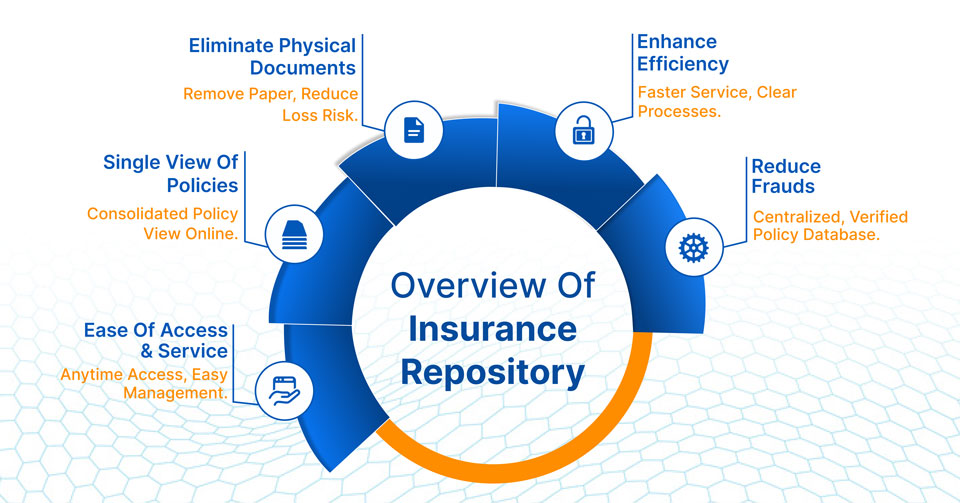
- Eliminate Physical Documents: Remove the need for physical paper insurance policy documents, reducing storage hassle and the risk of loss or damage.
- Single View of Policies: Offer policyholders a consolidated view of all their insurance policies from different insurers in a single Electronic Insurance Account (eIA). This helps policyholders track and manage their entire insurance portfolio effortlessly.
- Ease of Access and Service: Provide easy, anytime, anywhere access to policy details and facilitate quick changes, modifications, nominations, and premium payments.
- Enhance Efficiency and Transparency: Streamline policy servicing, reduce turnaround times for various requests, and bring greater transparency to the insurance ecosystem.
- Reduce Frauds: Minimize instances of fraudulent claims or misrepresentation by maintaining a centralized, verified database of policies.
- Boost Financial Inclusion: Encourage more people to buy insurance by simplifying the ownership and management process.
Entities like Central Insurance Repository Limited, National Insurance Repository, Karvy Insurance Repository Limited, and CDSL Insurance Repository Limited are key players in this system, ensuring that policyholders have multiple options to choose from for managing their e-insurance accounts securely and efficiently.
Core Functions vs. Prohibited Activities for an Insurance Repository
A licensed insurance repository in India performs crucial functions to serve policyholders and insurers. However, there are also strict prohibitions to maintain the integrity of the system.
| Category | Core Functions | Prohibited Activities |
| Policy Storage | Digitally stores life, health, motor, and other insurance policies in e-format | Cannot store policies not issued by IRDAI-registered insurers |
| Account Management | Creates and maintains e-Insurance Accounts (eIA) for policyholders | Cannot operate or offer services without IRDAI authorization |
| Policyholder Services | Enables updates to personal details, nominations, and address | Cannot misrepresent services or offer advice beyond their licensed scope |
| Claims Support | Facilitates quick claim intimation and supports communication with insurers | Cannot directly process or approve insurance claims |
| Data Security | Ensures protection of sensitive insurance data through encryption and access control | Cannot share policyholder data with third parties without consent |
| Regulatory Compliance | Adheres to IRDAI rules, submits periodic reports, and allows audits | Cannot act as an insurer, underwriter, or sell insurance policies directly |
| Technology Interface | Provides a user-friendly digital platform for policy access and document download | Cannot host unapproved apps, tools, or offer non-compliant digital services |
| Communication Channel | Sends policy updates, renewal reminders, and alerts on behalf of insurers | Cannot solicit business or influence a policyholder’s insurer selection |
Navigating these operational boundaries is critical. Contact a RegisterKaro expert to ensure your business plan and SOPs are fully compliant with IRDAI guidelines.
Who is Eligible to Become an Insurance Repository?
Becoming a licensed insurance repository in India involves meeting stringent eligibility criteria set by IRDAI. These requirements ensure that only robust and reliable entities can handle sensitive policyholder data.
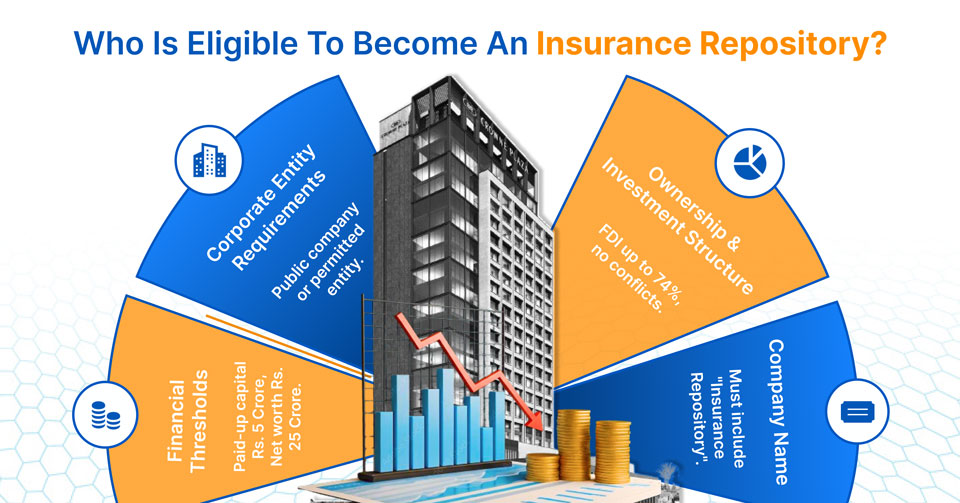
1. Corporate Entity Requirements
The applicant must be a company incorporated under the Companies Act, 2013 (or Companies Act, 1956, but would need to transition to the 2013 Act). Specifically, it must be:
- A Public Limited Company.
- A Public Financial Institution as defined in the Companies Act.
- A subsidiary of a SEBI-registered depository (e.g., NSDL or CDSL, explaining why we have National Insurance Repository and CDSL Insurance Repository Limited).
- A company promoted by the Life Insurance Council or the General Insurance Council, or both.
- Any other entity as specifically permitted by IRDAI.
2. Financial Thresholds
Financial stability is paramount for an insurance repository given the nature of the data it handles.
- Minimum Paid-up Share Capital: The applicant company must have a minimum paid-up share capital of Rs. 5 Crore (Rupees Five Crore).
- Minimum Net Worth: On receiving "in-principle" approval from IRDAI, the applicant's net worth must be at least Rs. 25 Crore. This demonstrates the financial capacity to establish and maintain robust infrastructure and operations.
3. Ownership & Investment Structure
An investment structure is necessary for an insurance repository as:
- No Foreign Direct Investment (FDI): As per current IRDAI guidelines, foreign investment is allowed up to 74% in insurance intermediaries.
- No Conflict of Interest: Neither the applicant nor its promoters should have any conflict of interest with the insurance business. This ensures neutrality and prevents potential biases.
4. Company Name
The name of the applicant company must mandatorily include the words "Insurance Repository" to indicate its nature of business. For example, Central Insurance Repository Limited or Karvy Insurance Repository Limited.
Check Your Company Name Instantly – Avoid Rejection and Reserve Your Perfect Name Today!
5. Memorandum of Association (MOA)
The Memorandum of Association (MOA) of the applicant company must clearly state that its primary objective is to act as an "Insurance Repository." This legal document outlines the scope of the company's activities and ensures that its core business aligns with the function of an insurance repository as regulated by IRDAI.
How to Get an Insurance Repository License from IRDAI?
The process to obtain an Insurance Repository license from IRDAI is multi-phased and requires meticulous planning and execution.
Phase 1: Invitation & Preparation (Pre-Application)
This initial phase focuses on preparing your organization and understanding the market and regulatory landscape before formally applying.
- IRDAI's Call for Proposals: IRDAI typically initiates the process by issuing a "Request for Proposals" (RFP) or an invitation for applications for insurance repository registration. This signals their intent to license new entities; the issuance is highly selective and only occurs when IRDAI deems it necessary to license new repositories.
- Feasibility Study: The aspiring applicant conducts a thorough feasibility study, assessing market demand, technological requirements, operational models, and financial viability to become an insurance repository in India.
- Prepare Initial Infrastructure: Begin planning and, if possible, set up initial foundational elements for the proposed operational and IT infrastructure.
Phase 2: The Formal Application
In this phase, you formally apply to IRDAI with a comprehensive proposal and supporting documentation.
- Application Form Submission: Prepare and submit the formal application in the prescribed format to IRDAI. This application must be exhaustive, covering all aspects of the proposed insurance repository operations.
- Processing Fee: Accompany the application with a non-refundable processing fee, typically Rs. 10,000, payable to IRDAI.
- Comprehensive Documentation: Compile and attach all required documents as per IRDAI guidelines, covering corporate details, financial standing, promoter backgrounds, technology plans, and operational frameworks.
Phase 3: IRDAI Scrutiny and In-Principle Approval
IRDAI carefully reviews your application and validates your organization’s capability to operate as a repository.
- Thorough Review: IRDAI undertakes a rigorous scrutiny of the submitted application and documents. They may ask for clarifications, additional information, or revisions. This is where the depth of your preparation for insurance repository registration becomes critical.
- Management Interaction: IRDAI may conduct interviews or presentations with the applicant's key management personnel and promoters. Assess their understanding, commitment, and vision for the insurance repository system.
- In-Principle Approval: If IRDAI is satisfied with the application and the due diligence, they issue an "in-principle" approval. This is a milestone, indicating that the applicant has met the preliminary criteria. At this stage, the applicant must demonstrate a net worth of at least Rs. 25 Crore.
Phase 4: Post-Approval Formalities
After receiving in-principle approval, you must finalize the legal and operational setup to meet IRDAI’s stringent standards.
- Affidavit Submission: Within 15 days of receiving in-principle approval, the applicant must submit an affidavit to IRDAI, confirming their commitment to adhere to all regulatory requirements.
- Registration Fee: Pay the registration fee to IRDAI, typically Rs. 1,00,000.
- Infrastructure Setup: This phase involves building the complete operational, technological, and security infrastructure as proposed in the application. This includes data centers, software systems, cybersecurity measures, and the "Approved Person" (AP) network.
- Systems Audit: Undergo a comprehensive audit of your IT systems and operational readiness by an IRDAI-approved auditor. Ensure they meet the stringent security and functionality standards required for an e-insurance repository.
- Demonstrate Readiness: The applicant must demonstrate to IRDAI that all systems, processes, and personnel are fully prepared to commence operations as an insurance repository in India.
Phase 5: Final Verification and Certification
The last phase involves on-site inspections and official certification by IRDAI to commence operations.
- Physical Inspection: IRDAI conducts a physical verification and inspection of the applicant's infrastructure facilities, data centers, security measures, and operational setup.
- Final Approval & Certificate of Registration: If all conditions are met and IRDAI is satisfied with the readiness, they grant the final Certificate of Registration, formally licensing the entity as an insurance repository. This marks the completion of the insurance repository registration journey.
Documentation Checklist for Application
A comprehensive and accurate documentation set is vital for successful insurance repository registration. Prepare these meticulously.
| Document Name | Purpose | Remarks |
| Certificate of Incorporation | Proof of company registration under the Companies Act | Must be a Public Limited Company |
| Memorandum & Articles of Association (MOA & AOA) | To verify the main objective of maintaining insurance policies electronically | MOA must include an insurance repository as a main object |
| Net Worth Certificate from a Chartered Accountant | Demonstrates compliance with ₹5 crore minimum net worth requirement | Must be signed and stamped by a Chartered Accountant |
| Audited Financial Statements (Last 3 Years) | For financial health and background verification | Required if the company is older than 3 years |
| Business Plan & Financial Projections (Next 3-5 Years) | To assess the viability and sustainability of repository operations | Should include capital, infra, staffing, tech, risk management, etc. |
| Details of Directors and Key Managerial Personnel | To evaluate qualifications and experience | Include PAN, DIN, resumes, ID proofs, and address proofs |
| Fit & Proper Declaration for Promoters/Directors | Confirms clean legal, financial, and regulatory record | As per IRDAI fit and proper criteria |
| Infrastructure & Technology Architecture Overview | For assessment of IT systems and data security readiness | Include server details, cybersecurity plan, and backup measures |
| Data Management and Security Policy | Ensures data privacy and protection of policyholder information | Must comply with IRDAI cybersecurity guidelines |
| Organization Chart & Staffing Plan | To show operational capacity | Include HR structure, roles, and responsibilities |
| Board Resolution Authorizing Application | Legal authorization from the company board to apply for an IR license | Duly signed and dated |
| Details of Proposed Repository Operations | Explains the scope and method of functioning | Must cover digital repository flow, services to insurers, etc. |
| Copy of PAN & GST Registration | Mandatory statutory registrations | Self-attested copies |
| Declaration of No Conflict of Interest | Confirms the company’s independence from insurance sales or underwriting | Signed by authorized signatory |
| Application Form (Prescribed by IRDAI) | Official application format as per IRDAI guidelines | Fully completed and signed |
Operational and Compliance Imperatives for Licensed Repositories
Obtaining the insurance repository license is just the beginning. Licensed entities must adhere to rigorous operational and compliance standards to maintain their registration and ensure the safety and security of policyholder data.
These are ongoing compliances for an insurance repository:
1. Building a Compliant and Robust Operational Framework
A strong operational foundation ensures seamless functioning and regulatory adherence.
- Standard Operating Procedures (SOPs): Develop and implement comprehensive SOPs for all operations, including eIA opening, policy dematerialization, data management, service requests, grievance handling, and interactions with insurers and policyholders.
- Internal Controls: Establish strong internal control systems to prevent errors, fraud, and ensure data integrity.
- Record Keeping: Maintain accurate and exhaustive records of all transactions, policy data, and communications for prescribed periods.
2. Technology and Infrastructure: The Non-Negotiable Core
Reliable technology is essential to securely manage and scale repository services.
- Secure Data Centers: Operate highly secure and redundant data centers to store policyholder data. These must meet stringent physical and logical security standards.
- Robust IT Systems: Implement and maintain robust IT systems, including application software, databases, and network infrastructure, capable of handling large volumes of data and transactions reliably.
- Encryption and Data Security: Employ advanced encryption techniques for data in transit and at rest. Implement strict access controls and authentication mechanisms to protect sensitive policyholder information. This is paramount for any insurance repository in India.
- Scalability: Ensure the technology infrastructure is scalable to accommodate future growth in policyholder accounts and data.
3. The "Approved Person" (AP) Network
A qualified and monitored AP network is key to efficient customer service and compliance.
- Appointment and Training: Appoint and manage a network of "Approved Persons" (APs) across various locations. These APs serve as physical touchpoints for policyholders for eIA opening, KYC verification, and service requests.
- Vigilant Oversight: Implement rigorous due diligence and ongoing monitoring of APs to ensure they comply with IRDAI guidelines and maintain high service standards.
- Training and Certification: Ensure all APs and their staff undergo mandatory training and certification as prescribed by IRDAI to handle policyholder interactions professionally and securely.
4. Adhering to Ongoing Governance and Compliance
Strong governance and compliance management foster accountability and regulatory trust.
- Board and Management Oversight: Establish a strong governance framework with active oversight from the Board of Directors and senior management to ensure continuous compliance.
- Compliance Officer: Appoint a dedicated Compliance Officer responsible for overseeing all regulatory compliance for an insurance repository.
- Internal Audit: Conduct regular internal audits to assess the effectiveness of internal controls and compliance with IRDAI regulations.
5. Cybersecurity and Data Protection
Protecting policyholder data from cyber threats is non-negotiable.
- Cybersecurity Framework: Implement a comprehensive cybersecurity framework as per IRDAI guidelines and industry best practices to protect against cyber threats, data breaches, and unauthorized access.
- Regular Audits: Conduct periodic cybersecurity audits and penetration testing to identify and rectify vulnerabilities.
- Incident Response Plan: Develop and regularly test an incident response plan to effectively manage and mitigate the impact of any cybersecurity incidents.
6. Business Continuity and Disaster Recovery
Ensuring uninterrupted services during disruptions is critical for customer trust.
- Robust BCP & DRP: Maintain a comprehensive Business Continuity Plan (BCP) and Disaster Recovery Plan (DRP) that are regularly tested and updated. These plans ensure the uninterrupted operation of the insurance repository system even during unforeseen events.
- Off-site Data Backup: Implement robust off-site data backup and recovery mechanisms to protect against data loss.
7. The Audit and Inspection Regimen
Regular audits and inspections verify compliance and operational soundness.
- Statutory Audits: Undergo annual statutory audits of financial statements.
- System Audits: Conduct periodic system audits as mandated by IRDAI to assess the robustness and security of the IT infrastructure.
- IRDAI Inspections: Cooperate fully with IRDAI during their routine and ad-hoc inspections, providing all necessary information and access.
8. Regulatory Reporting and Filings
Timely reporting ensures transparency and regulatory compliance.
- Periodic Reports: Submit various periodic reports to IRDAI, including operational data, financial performance, and compliance status.
- Annual Filings: File annual returns and audited financial statements with IRDAI and the Registrar of Companies (ROC).
The Cost of Obtaining an IRDAI License for an Insurance Repository
Understanding the financial outlay is crucial when considering insurance repository registration. The costs primarily comprise regulatory fees and capital requirements.
| Fee Type | Description | Amount (in Rs. ) |
| Application Fee (Non-refundable) | Payable at the time of applying to IRDAI | Rs. 10,000 |
| Registration Fee (One-time, if approved) | Payable after receiving in-principle approval from IRDAI | Rs. 1,00,000 |
| Net Worth Requirement | Minimum net worth to be maintained by the repository company | Rs. 25,00,00,000 (Rs. 25 Cr) |
| Annual Maintenance Charges | Ongoing compliance and operational oversight fees (approximate) | Rs. 1,00,000 – Rs. 5,00,000 |
| Legal and Documentation Costs | Costs for preparing legal documents, business plans, and filings | Rs. 1,00,000 – Rs. 2,00,000 |
| Technology Infrastructure Investment | Setting up secure digital infrastructure and compliance systems | Rs. 50,00,000 – Rs. 2,00,00,000 (variable) |
Connect with RegisterKaro and let our experts handle the legal hassle while you grow your business.
Frequently Asked Questions (FAQs)
What is the validity of an Insurance Repository license?
An Insurance Repository license is valid for three years from the date of issuance of the Certificate of Registration. To continue operations, the licensed entity must apply for renewal at least 60 days before the expiry of the current license, along with the prescribed renewal fee (typically Rs. 50,000).
Can a foreign company or a company with foreign investment apply for an IR license?
No. As per current IRDAI regulations, an insurance repository is generally not permitted to have foreign direct investment. The ownership structure must be entirely Indian.
What are the common reasons for the rejection of an IR license application?
Common reasons for rejection include:
- Incomplete or inaccurate documentation.
- Failure to meet the minimum paid-up capital or net worth requirements.
- Non-compliance with the "fit and proper" criteria for directors and promoters.
- Lack of a robust and secure IT infrastructure plan.
- Conflict of interest with the insurance business.
- Failure to adequately address IRDAI's queries or clarifications.
- Non-adherence to the company name requirement (insurance repository must be in the name).
Is a physical office and infrastructure mandatory for an Insurance Repository?
Yes, a robust physical and technological infrastructure is mandatory. This includes secure data centers, dedicated IT systems, and a well-defined network of "Approved Persons" (APs) or service points for policyholder interactions across various locations. While the e-insurance repository system is digital, it relies on a strong physical backbone.
What are the penalties for non-compliance after obtaining the license?
Non-compliance with IRDAI regulations can lead to severe penalties, including:
- Monetary fines on the insurance repository and its key management personnel.
- Suspension or cancellation of the Certificate of Registration.
- Disqualification of directors.
- Legal action and prosecution in serious cases of violation.

Reviewed by
Joel DsouzaJoel Dsouza is a Chartered Accountant (CA) and compliance expert with over 7 years of hands-on experience in company registration, tax structuring, GST, ROC filings, and MCA compliance. As a qualified member of the Institute of Chartered Accountants of India (ICAI) and Co-Founder at RegisterKaro, he has personally advised more than 1,000 startups and SMEs across India, helping founders navigate incorporation, regulatory frameworks, and financial planning from Day 1. With deep expertise across all three levels of Finance and Portfolio Management, Joel is committed to promoting financial literacy and simplifying India's startup ecosystem through clear, actionable guidance that entrepreneurs can act on immediately.
Why Choose RegisterKaro for the Insurance Repository License Application?
The path to becoming a licensed insurance repository in India is intricate, demanding deep regulatory knowledge, meticulous documentation, and strategic planning.
- Expert Guidance Through Complex Regulations: Seasoned legal and compliance professionals offer clear, up-to-date guidance aligned with IRDAI requirements. Get precise support to efficiently secure an insurance repository license.
- End-to-End Documentation and Filing Support: All corporate, technical, financial, and management documents are prepared with accuracy. From drafting MoA to business plans and financial projections, every detail is handled to meet IRDAI compliance standards.
- Seamless Liaison with Regulatory Authorities: A dedicated liaison manages all interactions with IRDAI, ensures timely responses to queries, and reduces delays through proactive communication and issue resolution.
- Time-Saving and Transparent Process: The registration process is streamlined to reduce timelines. Clear updates on progress, compliance requirements, and costs ensure complete visibility at every step.

What Our Clients Say
View All
Parag Wasekar
 Verified
Registerkaro is best service for registering your company and other services. I have taken their services. You can trust them, they will take care of... Read more

Sunny Guru
VerifiedNice experience and process was on time. Team is active in following up on the things. Special thanks to Kaavya Agrawal who was there in the process f... Read more

smit Bhoir
VerifiedThe company incorporation process was seamless. The staff was very supportive, especially Stuti Khandelwal, who guided me through everything quickly a... Read more

Shah Ali
VerifiedI highly appreciate Nitin Shrivastav's impressive interaction, dedication, humbleness and outstanding cooperation. I am also grateful to Register Kari... Read more

tarun saxena
VerifiedExcellent service providers. They are very punctual with deadlines this helping businesses focus on their core activities. Special mention for Surbhi,... Read more

PATTAN MOINUDDIN KHA...
VerifiedRegisterKaro made everything much easier than I expected. Shubham Bharti was knowledgeable and supportive throughout, and Pooja handled the coordinati... Read more

Sarat Shaji
VerifiedRitesh Gawri and his brilliant team helped me register my company: CultureCafe Ventures. They have been very active, responsive and responsible with t... Read more

gravinora
VerifiedExcellent support from Muskan Taneja, Compliance SPOC at RegisterKaro. She handled our GST filings efficiently, provided timely updates, and ensured s... Read more

Anisha
VerifiedThis was my first time dealing with company compliance, so I had a lot of doubts. Archana never rushed me and explained everything in simple terms. Th... Read more

Shakeel Sheroo
VerifiedExcellent experience from start to finish. As someone from the finance sector, I appreciate businesses that are organized and process-driven. Register... Read more
Related Blogs
View All
Top CA Firms in Jaipur 2026 – Best Tax, Audit & Mid-Size Firms

Corporate Laws (Amendment) Bill, 2026: Latest Companies Act and LLP Changes
Section 194JB of Income Tax Act,1961 – TDS Rate, Threshold Limit, and Applicability

Top 10 CA Firms in Pune 2026 – Mid-Size, Audit & Best Tax Firms
Section 139(1) of the Income Tax Act – Who Must File ITR, Due Dates & Rules

Section 54 of Income Tax Act: Capital Gains Exemption, Conditions, and Examples

Section 112A of Income Tax Act – LTCG Tax Rate, Exemption, Eligibility & Rules

TDS on Rent Chart FY 2026 27 – Rates, Limits, Sections and Complete Guide

Section 44ADA of the Income Tax Act – A Complete Guide and Calculation

Section 44AA of Income Tax Act – Books of Accounts, Limits, and Penalties