One Person Company Registration Online in India
Complete your one person company registration online from ₹1,499. RegisterKaro's CA-led OPC registration delivers the Certificate of Incorporation, PAN, TAN, and DIN in one SPICe+ filing, typically within 10 to 15 business days.
 100% Online Registration with Digital DocumentationCustomized MOA and AOA Prepared for the BusinessCompany Name Approval & Documentation IncludedCA-Led Filing with Dedicated Expert SupportNRIs with Indian Citizenship Can Register an OPC


 What Sets Us ApartWhat Sets Us Apart
Select the Best OPC Registration Plan Built for Solo Founders
Basic
Standard
Premium
Overview of One Person Company (OPC) Registration
An OPC, which stands for One Person Company, is a type of Private Limited Company with a single member. Introduced in April 2014 and defined under Section 2(62) of the Companies Act, 2013, OPC allows a solo entrepreneur to run a business as a separate legal entity while retaining full ownership and the benefit of limited liability. Any Indian citizen, including a Non-Resident Indian (NRI), can incorporate a One Person Company without a minimum capital requirement.
Features of a One Person Company
The OPC makes company registration possible for a single individual who needs the legal standing of a company without bringing in additional shareholders or directors. Before 2014, a solo entrepreneur could only operate as a sole proprietor. An OPC has these features:
- Single member: One natural person who is an Indian citizen holds 100% of the shares.
- Separate legal entity: The company has its own legal identity, distinct from its owner, and can own property, sign contracts, and sue in its own name.
- Limited liability: The member’s liability is limited to any unpaid amount on their shares, so personal assets stay protected from business debts.
- Mandatory nominee: The member names a nominee, who becomes the member if the owner dies or becomes incapable of contracting.
- Distinct name: The name ends with “(OPC) Private Limited”. Under Section 12(3), “One Person Company” must appear in brackets below the name on letterheads, invoices, and the name board.
- No AGM: An OPC does not have to hold an annual general meeting (Section 96(1)).
- Simpler annual return: An OPC files the abridged Form MGT-7A instead of MGT-7.
- Lower penalties: Under Section 446B, penalties for most defaults are capped at half the prescribed amount.
- Discounted Taxes: An OPC pays corporate tax at 25% (turnover up to ₹400 crore), or 22% under Section 200 of the Income Tax Act, 2025 (formerly Section 115BAA), for an effective rate of 25.168%. In contrast, a sole proprietor pays personal slab rates of up to 30%. Read our guide to OPC tax benefits for more details.
These features make One Person Company registration in India a practical choice for freelancers, consultants, and solo founders.
OPC Eligibility: Who Can Register a One Person Company?
The Companies Act, 2013 and Rule 3 of the Companies (Incorporation) Rules, 2014 set the following requirements for One Person Company registration in India:
- Indian Citizen: Only a natural person who is an Indian citizen can incorporate an OPC or act as its nominee. Both resident and non-resident Indian citizens (NRIs) are eligible under Rule 3(1), as amended with effect from April 1, 2021.
- Age Requirement: A minor under 18 years of age cannot be a member or nominee of an OPC, or hold its shares with beneficial interest (Rule 3(4)).
- Mandatory Nominee: The sole member must name a nominee, who gives written consent in Form INC-3.
- Directors: An OPC must have at least 1 director and can appoint up to 15 under Section 149(1). It can appoint more than 15 by passing a special resolution.
- Resident director: At least one director must stay in India for 182 days or more during the financial year, under Section 149(3). The applicable number of days is proportionate to the period for which the business operates during its first financial year.
- One OPC Limit: An individual can be a member of only one OPC and a nominee in only one OPC at a time (Rule 3(3)). If a person becomes a member of another OPC through nomination, they must meet this requirement within 180 days.
- No Capital or Turnover Limits: There is no minimum paid-up capital requirement for an OPC.
- Registered Office in India: The OPC must maintain a registered office address in India for official communication.
- NRI& OCI Nationals: OCI cardholders and foreign nationals cannot register an OPC in their own names. They may explore other business structures in India, such as a wholly owned subsidiary, through foreign company registration. However, since April 1, 2021, an NRI holding Indian citizenship can register a One Person Company (OPC) and act as its nominee.
Documents Required for OPC Registration in India
The following checklist covers the OPC company registration documents needed to file SPICe+:
| Category | Documents Required |
| Member / Director |
|
| Nominee |
|
| NRI Member / Director |
|
| Registered Office |
|
| Statutory (filed with SPICe+) |
|
Note: Before filing, check that the name, date of birth, and address are identical across all the documents required for OPC registration. Even minor discrepancies or expired proofs can lead the MCA to request resubmission.
OPC Registration Process: How to Register a One Person Company Online
The online One Person Company registration process runs through the SPICe+ (INC-32) form on the MCA V3 portal. Here’s how to complete the registration process through the MCA V3 portal:
Step 1. Apply for DSC
Apply for a Class 3 DSC for the proposed director to sign the incorporation forms electronically.
Timeline: Within 1 day
Step 2. Reserve the Business Name
Your OPC's name must clear the MCA's naming guidelines before it can be reserved. Some MCA naming rules include adding the suffix "(OPC) Private Limited", avoiding restricted or prohibited words like "National", or ensuring it is unique and not identical.
You can propose up to two names through SPICe+ Part A, and an approved name stays reserved for 20 days. The MCA charges a ₹1,000 name reservation fee for each Part A application, under the Companies (Registration Offices and Fees) Rules, 2014. This fee applies even when the incorporation filing fee is waived. Checking availability with our free company name check tool before filing helps avoid this.
Timeline: 1–3 business days
Step 3. Draft MOA, AOA & SPICe+ Part B
Draft the required incorporation documents, including MOA, AOA, and Form INC-3. Get the full list from the documents mentioned above. After that, complete SPICe+ Part B, AGILE-PRO-S, and the integrated PAN and TAN applications.
Timeline: 2–4 business days
Step 4. File SPICe+ on the MCA Portal
Submit the filled SPICe+ form through the MCA portal for processing. The application is handled by the Central Registration Centre (CRC), established under MCA Notification G.S.R. 99(E) and S.O. 218(E), dated January 22, 2016, under the Companies (Incorporation) Amendment Rules, 2016.
Along with this form, also file Form AGILE-PRO-S (INC-35) to avail of additional services like GST registration, professional tax registration, or opening a bank account.
Timeline: 1 business day
Step 5. CRC Verification
The CRC reviews the application and may issue resubmission queries. If it raises any such queries, submit the corrected documents or information promptly (within 15 days of the query) to avoid delays in incorporation.
Timeline: 5–7 business days
Step 6. Certificate of Incorporation, PAN & TAN
On approval, the MCA issues the Certificate of Incorporation with a unique 21-character Corporate Identification Number (CIN), along with the entity’s PAN and TAN. For an OPC, the CIN contains “OPC” as the business type code.
Timeline: 1–2 business days
Note: Within 180 days of incorporation, file Form INC-20A, the declaration for commencement of business, to confirm receipt of the subscription money. Missing this deadline attracts a penalty of ₹50,000 on the company and ₹1,000 per day on each officer in default, up to ₹1 lakh. For an OPC, Section 446B reduces these amounts to one-half.
OPC Registration Fees and Govt Charges: RegisterKaro Pricing
RegisterKaro's total charge to register a One Person Company includes government charges, the DSC costs, state stamp duty, and our professional fees. Here's how the OPC registration fees break down across different components:
| Fee component | Approximate amount | Notes |
| Government filing fees | ₹0 up to ₹15 lakh authorized capital; varies above that | OPC registration government fees are waived under the MCA's zero-fee scheme |
| Name reservation (SPICe+ Part A) | ₹1,000 | Payable for each name application, including under the zero-fee scheme |
| DSC (Class 3) | ₹2,500 per DSC | One token for the proposed director |
| DIN allotment | Included in SPICe+ | Allotted free through SPICe+ at no additional cost |
| PAN and TAN | ₹155 in total (PAN ₹78 + TAN ₹77, including GST) | Issued along with the COI |
| State-wise stamp duty (MOA + AOA) | Varies by state and capital | Varies sharply by state and authorized capital; check the exact figure on the company incorporation fees calculator |
| Professional / consultancy fees | ₹1,499 | Drafting, filing, MCA query handling, and post-incorporation kit |
| Typical total (authorized capital up to ₹15 lakh) | Over ₹5,000 | Bundled fixed pricing available with RegisterKaro |
Note: The total cost of OPC registration in India depends mainly on the authorized capital, the state of registration, and the number of directors. NRI applicants should also budget for notarization, apostille, or consular attestation of overseas documents, as these costs are not included in the professional fee.
Nominee in an OPC: Role, Change and Succession
An OPC must name a nominee in its Memorandum of Association during registration of an OPC. The nominee must meet the same citizenship, age, and other OPC requirements as the sole member. The nominee has no ownership or control while the member is alive and capable of contracting for the One Person Company. If the member dies or becomes incapable of contracting, the nominee takes their place and becomes the sole member, allowing the business to continue operating.
The transition of the OPC’s owner has to be reported to relevant authorities. For eligibility, the change process, and succession rules in detail, read the guide on OPC nominee rules.
Compliance After Incorporating a One Person Company
After OPC formation, founders must complete key formalities within the prescribed deadlines and meet its annual ROC and tax filing requirements.
Immediate Compliance After OPC Incorporation
Complete these formalities within the applicable deadlines after forming an OPC:
- Open a bank account: Deposit the member’s subscription money into the business’s account.
- Appoint the first auditor: Appoint an auditor within 30 days of incorporation under Section 139(6).
- Issue the share certificate: Issue the member’s share certificate within two months under Section 56(4).
- Display the business name: Include “One Person Company” in brackets below the entity name on its office signboard, letterheads, and invoices.
- Obtain applicable registrations: Register for GST, Udyam, Professional Tax, or other licenses required for the business.
- File Form INC-20A: Submit the commencement of business declaration within 180 days of incorporation, where applicable.
Annual Compliance for an OPC
Meet these recurring ROC and tax deadlines every year after OPC registration with the MCA in India:
- AOC-4: File financial statements within 180 days of the financial year-end, generally by September 27.
- MGT-7A: File the annual return within 60 days from the end of the prescribed AGM period, generally by November 29.
- ITR-6: File the income tax return by October 31 following the tax year (extended to November 21 for AY 2026-27).
- DPT-3: File by June 30 if the OPC has reportable outstanding loans, deposits, or other covered receipts.
Late AOC-4 and MGT-7A filings generally attract an additional fee of ₹100 per day per form, with no upper cap. For filing deadlines and penalties, read the OPC annual compliance guide.
Benefits of Online One Person Company Registration
One Person Company Registration Online gives solo founders these benefits:
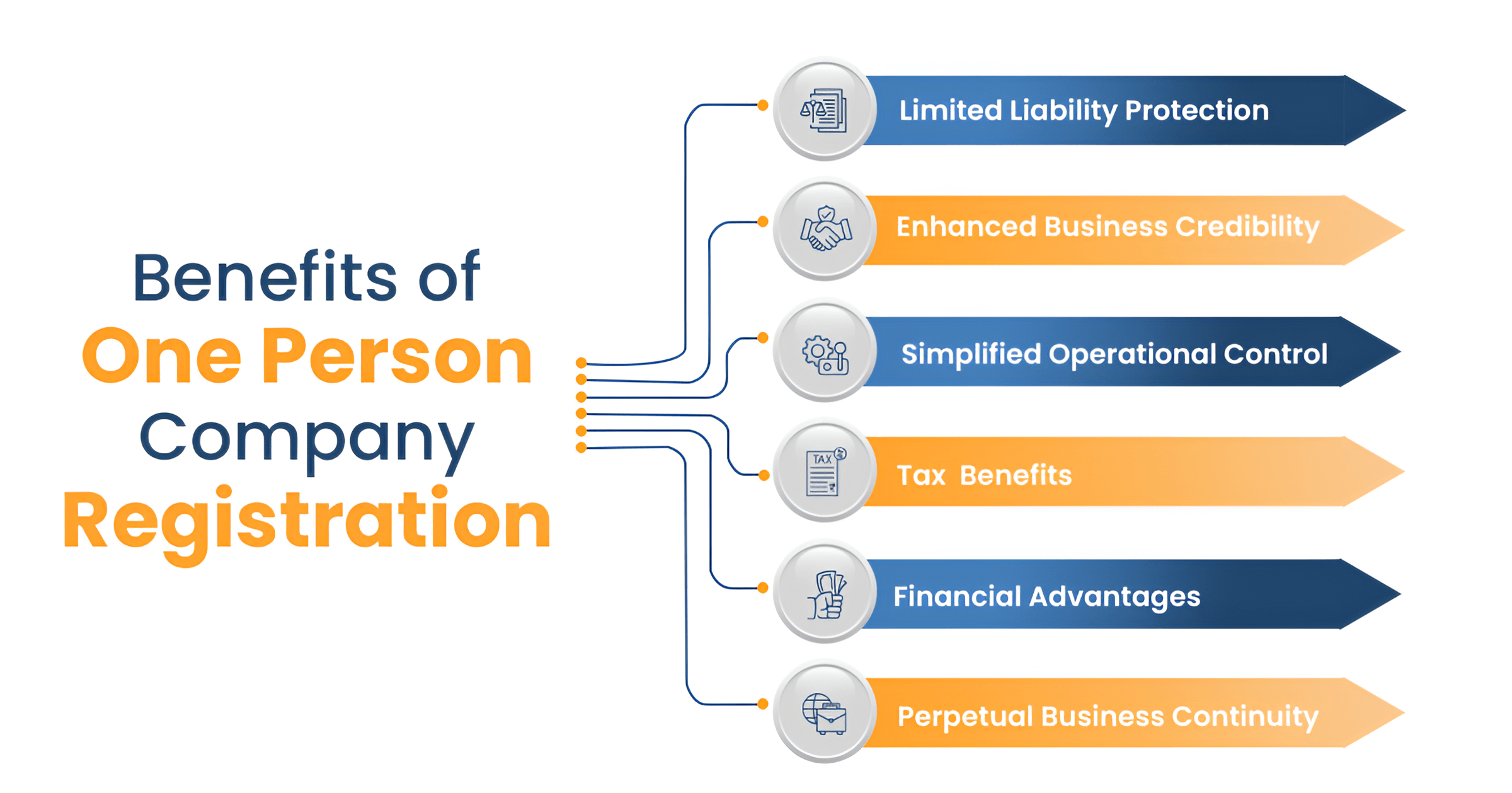
- Limited liability protection: Your personal assets are protected from business debts, and liability is limited to the amount you haven't paid for your shares.
- Single-owner control: One person holds 100% ownership and decision-making authority, with no co-founder dilution or partner disputes.
- Perpetual succession: The nominee automatically becomes a member on the death or incapacity of the OPC founder so that the business continues without dissolution.
- Lower compliance burden: An OPC does not hold an AGM (Section 96(1)) or prepare a cash flow statement (Section 2(40)). An OPC with a single director is also exempt from the board meeting rules under Section 173(5).
- Reduced penalties: Under Section 446B, an OPC pays up to half the prescribed penalty, capped at ₹2 lakh for the business and ₹1 lakh for an officer in default.
- Easier credit and corporate-grade trust: As a registered entity, an OPC has a verifiable CIN and public MCA records. This makes bank onboarding, vendor registration, and enterprise contracts easier than for an unregistered business.
- Tax structuring: An OPC is taxed at corporate tax rates and can claim deductions for eligible business expenses, such as director remuneration, depreciation, rent, and other operating costs. These tax benefits can reduce the overall liability compared to paying personal income tax rates on higher business profits.
- Easy future conversion: At any time, through Form INC-6 and MGT-14, an OPC can convert into a Private Limited Company once it has at least two members and two directors.
OPC vs Private Limited vs LLP vs Sole Proprietorship
An OPC gives a single founder limited liability and business status without a partner. The table below compares it with the three structures founders most often consider:
| Parameter | OPC | Private Limited Company | LLP | Sole Proprietorship |
| Governing Law | Companies Act, 2013 | Companies Act, 2013 | LLP Act, 2008 | No separate law |
| Legal Status | Separate legal entity | Separate legal entity | Separate legal entity | No separate identity from the owner |
| Owners Required | 1 member + 1 nominee | 2–200 shareholders, minimum 2 directors | Minimum 2 designated partners, at least one resident in India | 1 proprietor |
| Liability | Limited to unpaid share value | Limited to unpaid share value | Limited to agreed contribution | Unlimited personal liability |
| Compliance Burden | Moderate (ROC filings + ITR; no AGM) | Higher (ROC filings, AGM, board meetings, statutory records, ITR) | Lower (Form 8, Form 11 + ITR; no AGM or board meetings) | Lowest (mainly tax filings) |
| External Funding | No outside shareholders or equity without converting to a Private Limited Company | Suitable for angel, VC and equity funding | No equity shares; capital through partner contribution | Limited to the owner’s funds and loans |
| Conversion to Private Limited | Voluntary conversion through MGT-14 and Form INC-6 | Already a private company | Allowed under Section 366 of the Companies Act, 2013 through Form URC-1 | Fresh incorporation and transfer of the business |
| Nominee Requirement | Mandatory | Not required | Not required | Not required |
| Best Suited For | Solo founders who need a registered business for client contracts and plan to keep profits in the business | Startups planning angel or VC funding, or adding co-founders soon | Two or more professionals forming a firm through LLP registration | Small traders and freelancers |
Connect with RegisterKaro and let our experts handle the legal hassle while you grow your business.
Frequently Asked Questions (FAQs)
Is there a minimum capital requirement to form an OPC?
No, the Companies Act, 2013, does not prescribe a minimum capital requirement for a One Person Company (OPC). A founder can choose an appropriate capital amount based on the business's needs. Companies with authorized capital of up to ₹15 lakh are also eligible for the applicable MCA filing fee exemption, although other incorporation costs may apply.
How to Check OPC Registration Status?
Here's how to track the status of OPC registration online on the MCA V3 portal:
- Go to MCA Services and select Track SRN/Transaction Status.
- Enter the SRN generated when SPICe+ was filed.
- Check the status shown: under processing, pending for resubmission, approved, or rejected.
If the status shows pending for resubmission, respond to the CRC’s query within 15 days.
Can an OPC enter into a contract with its sole member?
Yes, an OPC can contract with its sole member (who is also a director) under Section 193. If the contract is unwritten, it must be recorded in a memorandum or the next board minutes. The OPC then has to inform the Registrar of Companies (ROC) within 15 days of board approval about the contract made.
Can an OPC apply for dormant status?
Yes, an OPC can apply for dormant status under Section 455 by filing Form MSC-1. This suits an OPC formed for a future project or to hold an asset or intellectual property, with no significant accounting transactions. Dormant status reduces annual filing requirements.
Can an OPC be converted into a Private Limited Company later?
Yes, an OPC can voluntarily convert into a Private Limited Company at any time, without a minimum waiting period. The business must meet the minimum membership and directorship requirements, pass the necessary resolution, and file the applicable forms, including MGT-14 and INC-6, where required.
Does OPC registration require a physical office address?
Yes, every OPC must have a registered office in India. The address can be residential or commercial, provided the entity can submit the required address proof. Common documents include a recent utility bill and, for rented premises, a rent agreement and the owner's No Objection Certificate (NOC).
How many OPCs can one person form?
An individual can be a member of only one OPC at a time and can also act as a nominee in only one OPC at a time. Under Rule 3(3) of the Companies (Incorporation) Rules, 2014, a nominee who becomes a member of another OPC must comply with the prescribed 180-day period to resolve the overlapping membership.
Can a salaried employee register an OPC in India?
Yes, a salaried employee can generally incorporate an OPC, as the Companies Act, 2013, does not impose a blanket restriction on employees doing so. However, the employee should review their employment contract and workplace policies for restrictions on outside business activities. Salary and OPC income are taxed according to the applicable tax rules.
What happens if the OPC nominee withdraws consent?
If the nominee withdraws consent, the sole member must appoint a replacement nominee within 15 days of receiving the notice. The OPC must then notify the RoC of the change in Form INC-4 within the prescribed period, generally 30 days.
Can an OPC have more than one director?
Yes, an OPC can have up to 15 directors under Section 149(1) of the Companies Act, 2013. It can appoint more than 15 directors by passing a special resolution. However, it must continue to have only one member, and appointing additional directors does not give them ownership in the company.
Is an audit mandatory for an OPC with low turnover?
Yes, every OPC must undergo an annual statutory audit, regardless of its turnover. Under Section 139(6) of the Companies Act, 2013, the board must appoint the first auditor within 30 days of registration. If the board fails to do so, the members must appoint the auditor within the prescribed period.
How can I check my OPC registration status online?
You can check the application status through the MCA V3 portal by using the SRN generated when you filed SPICe+. Open the relevant application tracking option under MCA services and enter the SRN to view the status, such as processing, resubmission, approval, or rejection.
Can one person be a nominee in more than one OPC?
No, under Rule 3(3) of the Companies (Incorporation) Rules, 2014, an individual can act as a nominee in only one OPC at a time. The rule also limits an individual to membership in one OPC at a time.
Does an OPC need to prepare a cash flow statement?
No, an OPC is exempt from including a cash flow statement in its financial statements under Section 2(40) of the Companies Act, 2013. However, it must still prepare the other required financial statements, including a balance sheet, a statement of profit and loss, and notes to accounts, as applicable.
What is the liability of the member in an OPC?
A member's liability is generally limited to the amount unpaid on the shares they hold. The member's personal assets are therefore generally protected from the OPC’s debts. However, this protection may not apply in cases involving fraud or where the member has separately provided a personal guarantee.

Reviewed by
Joel DsouzaJoel Dsouza is a Chartered Accountant (CA) and compliance expert with over 7 years of hands-on experience in company registration, tax structuring, GST, ROC filings, and MCA compliance. As a qualified member of the Institute of Chartered Accountants of India (ICAI) and Co-Founder at RegisterKaro, he has personally advised more than 1,000 startups and SMEs across India, helping founders navigate incorporation, regulatory frameworks, and financial planning from Day 1. With deep expertise across all three levels of Finance and Portfolio Management, Joel is committed to promoting financial literacy and simplifying India's startup ecosystem through clear, actionable guidance that entrepreneurs can act on immediately.
Why Choose RegisterKaro for OPC Registration?
RegisterKaro manages One Person Company Registration Online end to end, from document preparation to incorporation, so solo founders get registered while they focus on building their businesses.
- Transparent pricing: OPC registration starts at ₹1,499, with government fees and state stamp duty explained upfront.
- End-to-end registration: We handle Digital Signature Certificates (DSCs), name approval, MOA and AOA drafting, SPICe+ filing, PAN, TAN, and bank account application through AGILE-PRO-S.
- Support for NRI founders: Our team guides NRIs with Indian citizenship through document apostille or consular attestation requirements and the process of appointing a resident director.
- Post-registration compliance: We help track and manage applicable filings, including INC-20A, AOC-4, MGT-7A, ITR-6, and DIR-3 KYC, and support conversion into a Private Limited Company when the business needs additional shareholders.
- Dedicated support: Each client gets a single point of contact for progress updates, document verification, and questions throughout the registration process.

What Our Clients Say
View All
Naresh Bansal
 Verified
I sincerely appreciate your dedication and professionalism, Vandana Rawat , during the incorporation of JOYTROVE HOUSE OPC PRIVATE LIMITED with Regist... Read more

UKB Elevators Consul...
VerifiedI recently created my OPC with RegisterKaro and had the pleasure of connecting with Tanvish Nagpal during the process. The entire experience was seaml... Read more

sandeep More
VerifiedRegister Karo is an expert incorporation of OPC professiknal service provider and its individual reponsibility to go for entire OPC registratiin ens t... Read more

Ayush Chand
VerifiedHie had a fantastic experience with Registerkaro me and my friend incorporated our OPC private limited within a month Thanks Manish Bisht and Register... Read more

dileep kaibadi
VerifiedI had a great experience with RegisterKaro for my OPC registration. The entire process was smooth and well-managed from start to finish. A special tha... Read more

Pitambara Technology
VerifiedI have a great experience with Register Karo team , specially thanks to Rahul and Shashi for support at any time even holidays. You guys are really me... Read more

Shashi Singh
Verified"My experience with RegisterKaro was very good. The process was simple, the documentation was clear, and the team provided timely support. The registr... Read more

pratik kumar
VerifiedSuccessfully incorporated Rugvedic Ventures Private Limited through RegisterKaro. The entire process was smooth and hassle-free. Special thanks to Pra... Read more

Pooja Sharma
VerifiedMehek handled the compliance process smoothly and efficiently. She was professional, responsive, and kept me updated at every stage. By addressing all... Read more

Aman Nayan
VerifiedMr. Priyansh Jindal has been super helpful and efficient in getting my company incorporated in short time. Many Thanks and anyone can count on Registe... Read more