

To apply for an FSSAI registration, you need identity and address proof, proof of your business premises, your business constitution documents, and a list of the food products you handle. Beyond these basics, the exact documents depend on which of the three FSSAI categories you fall under: Basic Registration, State License, or Central License, and on the nature of your food business.
Every food business operator (FBO) in India, from a home kitchen to a large manufacturer, must hold a valid FSSAI license under the Food Safety and Standards Act, 2006, before starting operations. Applications are filed online through the FoSCoS portal (foscos.fssai.gov.in), which has replaced the older FLRS system.
Key Takeaways
- The required documents depend on your FSSAI category, either Basic Registration, State License, or Central License, and your business activity.
- Basic Registration generally requires identity proof, business address proof, a passport-size photograph, Form A, and a list of food products.
- State and Central Licenses require additional documents such as Form B, an FSMS plan, a layout plan, machinery details (for manufacturers), and other business-specific documents.
- Submit all applications online through the FoSCoS portal after selecting the correct license category and food business activity.
- Manufacturers, importers, exporters, e-commerce food businesses, and certain other food businesses may need to submit additional supporting documents based on FSSAI regulations.
Mandatory Documents Required for FSSAI Application
Regardless of category or business type, every FSSAI application needs the following core set of documents:
- Passport-size photograph: For the applicant or authorized signatory.
- Government-issued photo identity proof: Aadhaar card, PAN card, Voter ID, passport, or driving license of the proprietor, partners, directors, or authorized signatory.
- Proof of business premises: A rent or lease agreement with the owner’s NOC (for rented premises) or an ownership document/utility bill (for owned premises). The agreement should have at least 6 months’ validity remaining at the time of application.
- Business constitution document: This document varies by entity type (see the table further below).
- List of food products or food categories: The list consists of the products you intend to manufacture, store, sell, or distribute.
- Declaration of compliance: The declaration is reported to food safety and hygiene norms (and, for State/Central, the Food Safety Management System (FSMS) plan or declaration).
Key Documents Required for Basic FSSAI Registration
Basic Registration has the lightest documentation. For a small food business, including a stall, home-based unit, or small retailer with turnover up to ₹12 lakh, you typically need:
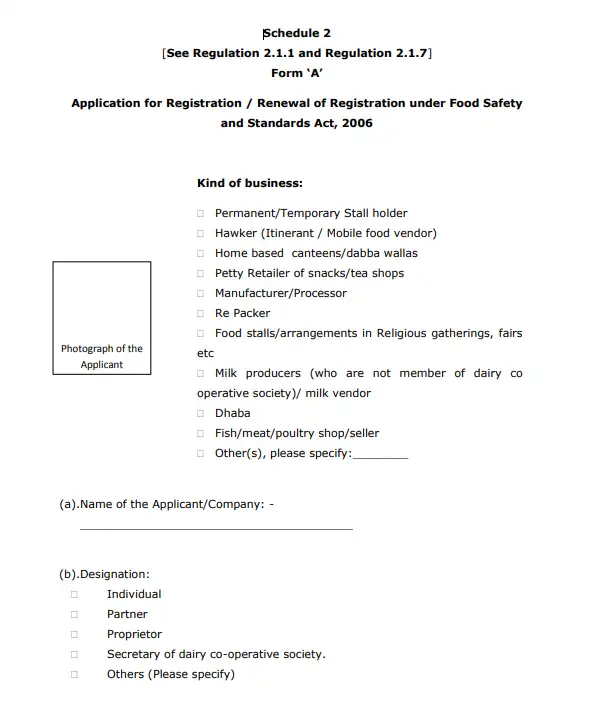
- Form A (application for registration), completed and signed.
- Photo identity proof of the proprietor/applicant (Aadhaar, PAN, or Voter ID).
- Passport-size photograph of the applicant.
- Proof of business address (rent agreement, electricity bill, or other utility bill).
- List of food categories handled.
- Signed declaration form confirming compliance with basic hygiene and safety standards.
No layout plan, water test report, or FSMS plan is required at the Basic level.
Documents Required for FSSAI State License
In addition to the mandatory documents above, the state FSSAI license application needs:
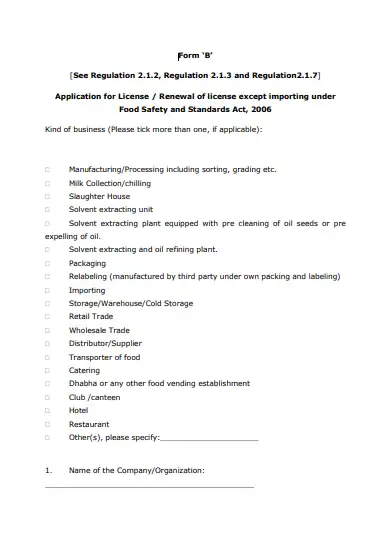
- Form B, duly filled and signed by the proprietor, partner, or authorized signatory.
- Blueprint/layout plan of the processing or production premises, drawn to scale in square metres (mandatory for manufacturers and processing units).
- List of equipment and machinery with the number, installed capacity, and horsepower (for manufacturers).
- Letter of authority (form of nomination) from the FBO nominating the person responsible for food safety, with their name and address.
- Water test report from an NABL-accredited laboratory. It is mandatory when water is used as an ingredient.
- FSMS plan or declaration.
- List of directors, partners, or the proprietor with full address and contact details.
- NOC from the local municipality or panchayat (where required by the authority).
- Business constitution document (partnership deed, certificate of incorporation, MOA & AOA, or LLP agreement).
- Proof of turnover (where applicable).
Documents Required for FSSAI Central License
A Central FSSAI License requires everything in the State License list, plus the following additional documents:
- Import Export Code (IEC) issued by the DGFT; mandatory for importers and exporters.
- A Food recall plan is the documented procedure for retrieving products from the market if a safety issue arises.
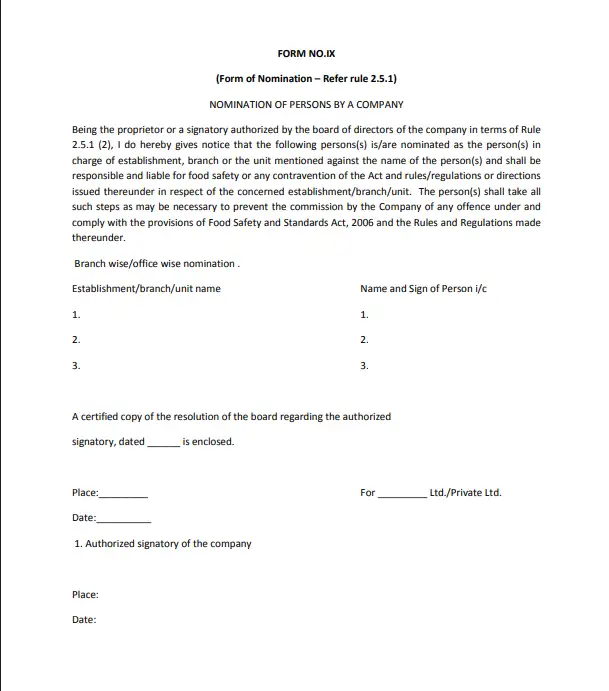
- Form IX presents Nomination of Persons by a Company, supported by a board resolution (for companies).
- Proof of annual turnover for an audited balance sheet or a CA certificate.
- Source of raw material for units handling milk, meat, or meat products.
- Geo-tagged photographs of the premises. This requirement was added to the 2026 FoSCoS portal, showing the facility with location coordinates.
- NOC and a copy of the manufacturer’s license (for importers, marketers, and re-labellers sourcing from a third-party manufacturer).
- Pesticide-residue report of water (for manufacturers of packaged drinking water or mineral water).
FSSAI Documents by Business Constitution
Beyond the license-type documents, the constitution document for the food license you submit depends on how your business is legally set up:
| Business type | Constitution documents required |
| Sole Proprietorship | Identity and address proof of the proprietor; a self-declaration of proprietorship. |
| Partnership Firm | Registered partnership deed; ID and address proof of the managing/authorized partner. |
| Limited Liability Partnership (LLP) | Certificate of Incorporation and LLP Agreement; ID proof of the designated partner applying. |
| Public/Private Limited Company | Certificate of Incorporation, MOA & AOA, board resolution authorising the application, Form IX (nomination), and a list of directors with ID proof. |
| Society / Trust | Registration certificate of the society or trust; a resolution authorizing the office bearer to apply; ID proof of the authorized representative. |
| Cooperative Society | Registration certificate under the Cooperative Societies Act; a resolution authorizing the office bearer to apply; and ID proof of the authorized representative. |
Additional FSSAI Documents for Specific Food Businesses
Some activities call for extra FSSAI documents on top of the standard checklist:
- Manufacturers: Layout/blueprint plan, list of machinery with capacity, production process flow chart, NABL water test report, and source of raw material.
- Importers: IEC code and an NOC plus license copy from the overseas/Indian manufacturer.
- Transporters: Number of vehicles and vehicle details.
- E-commerce food sellers: An undertaking and the operator’s details, in line with marketplace requirements.
- Caterers, hotels, and restaurants: Premises proof and, for star hotels, a certificate from the Ministry of Tourism (Central License).
- 100% Export-Oriented Units: Certificate from the Ministry of Commerce.
Tip: The FoSCoS portal now splits the document list into Mandatory (required for all) and Specific (based on your selected food activities). After you choose your business activity and food category on the portal, it generates the exact specific-document list you need, so select your category carefully.
How to Prepare and Upload Your FSSAI Documents Online?
The entire process of uploading documents runs through the FoSCoS portal:
- Create an account on foscos.fssai.gov.in using your mobile number and email.
- Select your category (Basic / State / Central), business type, and food categories. The portal will then show your exact document list.
- Fill the application (Form A or Form B) with your business, premises, and product details.
- Upload scanned copies of all required documents in the prescribed format and size.
- Pay the applicable FSSAI registration fee and submit the application. The costs start from Rs. 100 and vary for different license types.
- Track and respond to queries on your dashboard on time. Unanswered queries lead to rejection, so be aware of the allotted time.
Tip: Before uploading, scan each document clearly instead of using a phone photo to avoid blurred or rejected files.
