

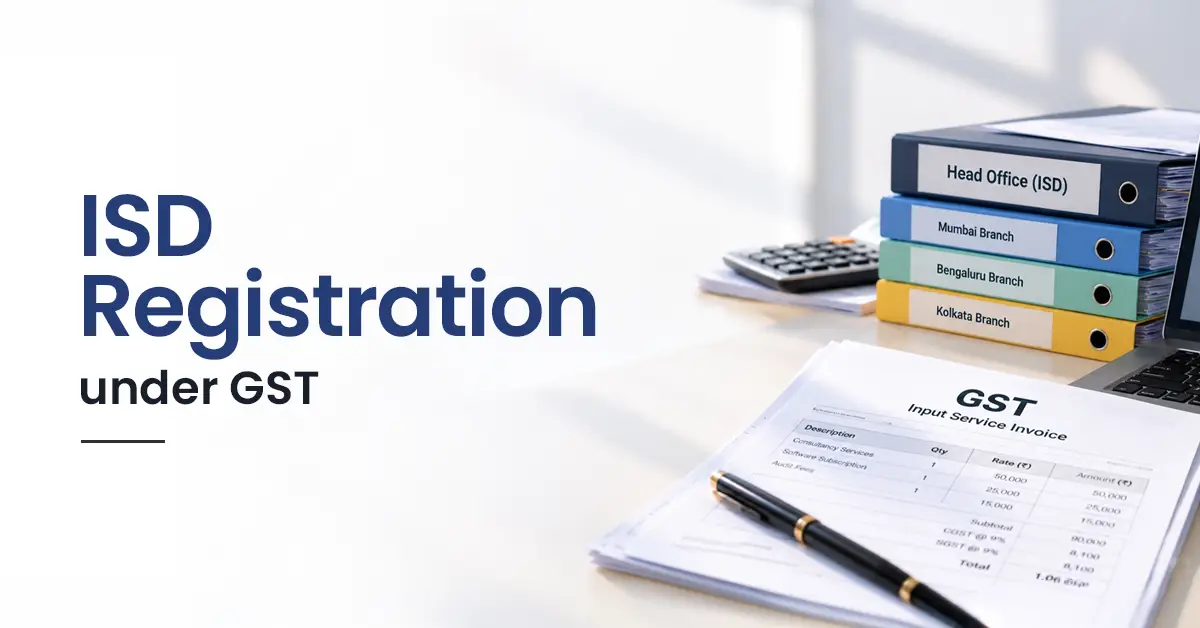
Businesses with multiple GST registrations under the same PAN may receive common service invoices at their head office. When these services benefit multiple branches, the business must distribute the eligible ITC according to GST rules. ISD registration under GST allows the designated office to distribute this credit to the relevant branch registrations through the prescribed mechanism.
ISD stands for Input Service Distributor. Under the CGST Act, 2017, an ISD receives invoices for common input services and distributes the eligible Input Tax Credit (ITC) to recipient registrations under the same PAN. From April 1, 2025, the amended provisions require businesses covered by the rules to use the ISD mechanism for qualifying common input services, including applicable services subject to reverse charge.
The Finance Act, 2024, amended Sections 2(61) and 20 of the CGST Act to make ISD registration mandatory for covered transactions. Businesses must understand when registration applies, how to apply through Form GST REG-01, and how to distribute credit using ISD invoices. The following guide also explains the credit distribution formula, GSTR-6 filing requirements, and the difference between ISD and cross-charge.
ISD Registration Under GST: Key Points
- Full form: ISD stands for Input Service Distributor.
- Who needs it? Businesses that receive common input service invoices centrally for multiple GST registrations under the same PAN may need a separate ISD registration.
- When did it become mandatory? The amended ISD framework took effect on April 1, 2025, for transactions covered by the applicable provisions.
- How to register: Apply through Form GST REG-01 on the GST portal.
- Monthly return: File GSTR-6, generally by the 13th of the following month.
- ISD vs. cross-charge: ISD distributes eligible ITC from common input services, while cross-charge applies to relevant taxable internal supplies between distinct persons.
Who Needs ISD Registration Under GST?
From April 1, 2025, businesses must obtain ISD registration when an office receives invoices for common input services on behalf of multiple distinct persons registered under the same PAN, subject to the applicable provisions. Section 24(viii) of the CGST Act, 2017, requires covered offices to register as Input Service Distributors, while Section 20 governs the distribution of eligible ITC.
This requirement generally applies when:
- Multiple GST registrations exist: The business holds separate GST registrations under the same PAN, either across different states or through eligible separate registrations within one state.
- The office receives common service invoices: The head office or central procurement office receives invoices for input services that benefit multiple GST registrations, including qualifying services subject to reverse charge.
Businesses must use the ISD mechanism to distribute ITC from qualifying third-party common input services covered by the amended provisions. Cross-charge remains relevant for taxable internal supplies between distinct persons, such as services provided by a head office to a separately registered branch. Under GST law, separate registrations under the same PAN are treated as a distinct person under GST, which affects how businesses handle inter-branch supplies and ITC distribution.
When ISD Registration is NOT Required?
ISD registration under GST generally does not apply when a business receives branch-specific service invoices or supplies services internally between its own registrations. The applicable GST treatment depends on how the business procures and distributes the services.
- When a supplier invoices a branch directly for services attributable to that branch, the branch can claim eligible ITC under the normal GST rules. The business does not need ISD registration solely for these invoices.
- A business with only one GSTIN under its PAN generally does not need ISD registration because it has no separate recipient registration to receive distributed credit.
- When one branch provides services to another branch under the same PAN, the business must assess the transaction under the applicable cross-charge and valuation rules, including Rule 28 of the CGST Rules, 2017. ISD does not replace cross-charge for these internal supplies.
How to Register for ISD Under GST: Process to Use Form REG-01
Rule 8 of the CGST Rules, 2017, requires every ISD to submit a separate registration application even if they already hold a regular GSTIN.
Step 1: Apply Through Form GST REG-01
Visit the GST portal and select Services > Registration > New Registration. In Part B of Form GST REG-01, select Input Service Distributor under the reason for registration. Enter the required business details and provide information about the existing GST registration when the portal requests it.
The ISD registration receives a separate GSTIN. If the head office serves as the ISD, the business may use the same premises for both registrations, subject to applicable requirements.
Step 2: Prepare the Required Documents
Keep the following details and documents ready for the ISD registration application:
- Business PAN: Provide the PAN associated with the business entity.
- Office address proof: Keep an eligible utility bill, rental agreement, or property ownership document available.
- Authorized signatory details: Provide the required identity information and complete applicable Aadhaar authentication.
- Authorization letter: Submit a letter of authorization when the signatory requires formal authorization to represent the business.
- Electronic verification: Sign or verify the application through the method permitted by the GST portal, such as DSC or EVC, where applicable.
Check the current Form GST REG-01 instructions for the documents relevant to your business structure and application.
Step 3: Verification and GSTIN Issuance
Submit the application and complete the required authentication and verification steps. The GST portal may process eligible applications through its prescribed automated approval mechanism or refer them to the jurisdictional tax officer for review.
After approval, the business receives a separate GSTIN for ISD activities. It must use this registration to distribute eligible ITC, while its regular GSTIN continues to cover ordinary business transactions.
ISD Invoice: Format and Mandatory Fields
An ISD must issue an ISD invoice to distribute ITC to eligible recipient GST registrations. Under Rule 54(1) of the CGST Rules, 2017, the invoice must contain the prescribed details. The ISD must also issue an ISD credit note when it needs to reduce previously distributed credit.
Mandatory Details in an ISD Invoice
Under Rule 54(1) of the CGST Rules, an ISD invoice or credit note must contain these details:
- ISD details: Name, address, and GSTIN of the ISD.
- Serial number: A consecutive serial number of sixteen (16) characters, in one or multiple series, containing alphabets, numerals, or the special characters hyphen and slash, unique for the financial year.
- Issue date: The date of the invoice or credit note.
- Recipient details: Name, address, and GSTIN of the registration receiving the credit.
- Credit amount: The amount of ITC distributed.
- Signature: The ISD’s signature or digital signature, or that of its authorized representative.
The ISD must also clearly indicate that it issues the invoice solely to distribute ITC. It must follow the applicable rules when issuing credit notes or correcting previously distributed credit.
Important: The ISD must distinguish eligible and ineligible ITC in its distribution records and GSTR-6 reporting. Rule 54(1) does not list eligibility status as a separate mandatory field on the invoice itself.
ISD Credit Distribution: Formula and Example
The Input Service Distributor (ISD) distributes eligible Input Tax Credit (ITC) among recipient GST registrations under the same PAN. Section 20 of the CGST Act, 2017, and Rule 39 of the CGST Rules prescribe the distribution method, including the turnover-based formula and the treatment of different tax components.
Credit Distribution Formula Under Section 20
Section 20 of the CGST Act requires an ISD to distribute eligible ITC according to the prescribed rules. Under Rule 39, the ISD allocates credit based on each recipient’s turnover relative to the combined turnover of the relevant recipients. The calculation uses the turnover for the prescribed relevant period, not automatically the preceding financial year in every case.
Formula:
Credit distributed to a recipient = (Recipient’s turnover ÷ Total turnover of all relevant recipients) × Total credit available for distribution
The ISD must distribute the available credit in the same month and report the distribution in GSTR-6. It must also distribute eligible and ineligible ITC separately and apply the prescribed rules for each tax component.
- Integrated Tax (IGST): The ISD distributes IGST credit as IGST to every eligible recipient.
- Central Tax (CGST) and State or Union Territory Tax (SGST/UTGST): The ISD distributes this credit as IGST when the recipient is in a different State or Union Territory. If the recipient is in the same State or Union Territory, the ISD distributes the credit as CGST and SGST/UTGST, as applicable.
How do reverse-charge services affect ITC distribution?
An ISD cannot pay reverse-charge tax through its ISD registration. Instead, the regular GST registration in the same State as the ISD must pay the applicable tax through its own GSTR-3B. That registration can then transfer the resulting ITC to the ISD by issuing an invoice or applicable document under Rule 54(1A) of the CGST Rules. The ISD subsequently distributes that credit among eligible recipient registrations under Rule 39, using the same prescribed method as for other distributable ITC.
ISD in GST Example
Suppose a company has a head office in Delhi and branches in Mumbai and Chennai. Each location holds a separate GSTIN under the same PAN. The Delhi office receives a cloud software invoice worth ₹1,00,000 plus ₹18,000 in IGST. The service benefits both recipient branches.
Assume Mumbai’s turnover for the relevant period is ₹60 lakh, while Chennai’s turnover is ₹40 lakh. The combined turnover of the two recipient branches is ₹1 crore.
- Mumbai: ₹18,000 × (₹60 lakh ÷ ₹1 crore) = ₹10,800 in ITC.
- Chennai: ₹18,000 × (₹40 lakh ÷ ₹1 crore) = ₹7,200 in ITC.
The Delhi ISD issues a separate ISD invoice to each recipient GSTIN, allocating ₹10,800 to Mumbai and ₹7,200 to Chennai. Each branch can claim the distributed credit through its GSTR-3B, subject to the applicable ITC eligibility conditions.
If the Delhi office instead receives an audit invoice from a Delhi supplier charging CGST and SGST, the ISD still distributes the eligible credit to Mumbai and Chennai according to their respective turnover shares. Since both recipients are in States different from Delhi, the ISD distributes their shares as IGST rather than as CGST and SGST.
ISD vs Cross-Charge: Key Differences
Since April 1, 2025, businesses must use the ISD mechanism to distribute eligible ITC from qualifying common input service invoices. Cross-charge continues to apply to taxable internal supplies between distinct persons under the same PAN. The following table explains the key differences:
| Aspect | ISD Mechanism | Cross-Charge |
| Applicable to | Third-party common input service invoices, including qualifying reverse-charge services | Internally generated services supplied between distinct persons |
| Requirement from April 1, 2025 | Mandatory for distributing ITC on qualifying common input services | Continues to apply to taxable internal supplies |
| Registration | Requires a separate ISD registration through Form GST REG-01 | Uses the existing regular GST registration |
| Document issued | ISD invoice or ISD credit note | Regular tax invoice for a taxable supply |
| Return filing | ISD files GSTR-6, generally by the 13th of the following month | The supplying registration reports the supply in its applicable GST returns, including GSTR-1 |
| Credit allocation or valuation | Distributes ITC under Section 20 and Rule 39, using the prescribed turnover-based method | Values internal supplies under applicable rules, including Rule 28 |
| Current applicability | Required for qualifying third-party common input service credit | Applies to relevant internal supplies between distinct persons |
Application of GSTR-6: The ISD Return
Every registered Input Service Distributor (ISD) must file Form GSTR-6 monthly to report the Input Tax Credit (ITC) received and distributed among eligible recipient GST registrations. Section 39(4) of the CGST Act, 2017, prescribes this filing requirement, with the standard due date falling on the 13th day of the following month.
GSTR-6 records ITC received from common input service invoices and credit distributed through ISD invoices or credit notes. The ISD must report eligible and ineligible ITC separately and account for the applicable tax components, including CGST, SGST, IGST, and UTGST.
After the ISD files GSTR-6, recipient branches can view the reported credit in their respective GSTR-2B statements. Each branch must check the credit’s eligibility and claim the eligible amount through its own GSTR-3B. The ISD should also reconcile its records before filing the GST return to identify discrepancies in credit distribution.
The ISD does not file GSTR-1 or GSTR-3B for its ISD activities. It is also exempt from filing GSTR-9 for that registration. However, the business must continue filing the applicable GST returns for its regular GST registrations.
For assistance with ISD registration, ITC reconciliation, and timely GST return filing, contact RegisterKaro for support with your applicable compliance requirements.
