


A Power of Attorney (POA) allows a trusted person to act on your behalf when you cannot manage your legal, financial, business, or property matters yourself. Governed primarily by the Powers of Attorney Act, 1882, it is especially useful for NRIs, senior citizens, business owners, and individuals who travel frequently.
Suppose you are an NRI who needs to sell a property in India but cannot travel for the paperwork. In such situations, a Power of Attorney lets you appoint a trusted person to act on your behalf. However, you must choose the right type of POA based on your needs, define its power, and check whether the law requires registration based on its purpose.
This guide explains the meaning of a Power of Attorney, its different types, the laws governing it, registration requirements, stamp duty, validity, revocation, and other key legal aspects in India.
Key Takeaways
- A Power of Attorney (POA) is a legal document that authorizes another person to act on your behalf in legal, financial, business, or property matters. It does not transfer ownership of any asset.
- In India, the Powers of Attorney Act, 1882, primarily governs a POA, along with the Registration Act, 1908, the Indian Stamp Act, 1899, and the Indian Contract Act, 1872.
- The most common types of POA are General Power of Attorney (GPA) and Special Power of Attorney (SPA), while Property, Financial, Medical, and Irrevocable POAs serve specific purposes.
- A POA remains valid until the principal revokes it, the attorney fulfills its purpose, the principal dies, or the law terminates it. The document has no fixed validity period unless it specifies one.
What is a Power of Attorney? Meaning & Laws
A Power of Attorney (POA) is a legal document that allows one person (the principal or donor) to authorize another person (the attorney, agent, or donee) to act on their behalf. The attorney can perform only the acts authorized in the document, such as:
- Signing legal documents
- Managing bank accounts
- Buying, selling, or managing property
- Handling business or financial transactions
- Representing the principal before government authorities or courts
Important: A Power of Attorney only delegates legal authority and does not transfer ownership of property, money, or any other asset.
Law Governing Power of Attorney in India
The Powers of Attorney Act, 1882, is the primary law governing a POA in India. Section 1A defines a Power of Attorney as an instrument that empowers a specified person to act for and in the name of the person executing it.
Several other laws also apply to a POA in India:
- Indian Contract Act, 1872: Governs the principal-agent relationship and the rights and duties of both parties.
- Registration Act, 1908: Prescribes when a Power of Attorney must be registered, particularly for certain immovable property transactions.
- Indian Stamp Act, 1899: Determines the stamp duty payable on a Power of Attorney. The amount varies across states.
- Bharatiya Sakshya Adhiniyam, 2023: Governs the use of a Power of Attorney as evidence in court.
How Does a Power of Attorney Work? Process
A Power of Attorney generally works as follows:
- Appoint an attorney: The principal chooses a trusted person to act on their behalf.
- Define the powers: The POA clearly specifies the powers, purpose, and any restrictions.
- Execute the document: The principal signs the POA and completes any required stamping, notarization, or registration.
- Get it authenticated (if required): For a registered POA, the principal usually appears before the Sub-Registrar to authenticate the document. For a POA executed outside India, the principal must get it attested at the Indian Consulate under the applicable rules.
- Act on the principal’s behalf: The attorney carries out only the authorized acts, such as managing property, signing documents, or representing the principal before authorities.
- End the authority: The POA ends when the principal revokes it, the purpose is completed, or it terminates under law.
Example: An NRI can execute a Power of Attorney authorizing a family member in India to complete a property sale. The family member can sign documents and complete the transaction only within the powers granted in the POA.
Types of Power of Attorney in India
A Power of Attorney can take different forms based on the purpose and the authority the principal wants to give. The main types of POA in India are:
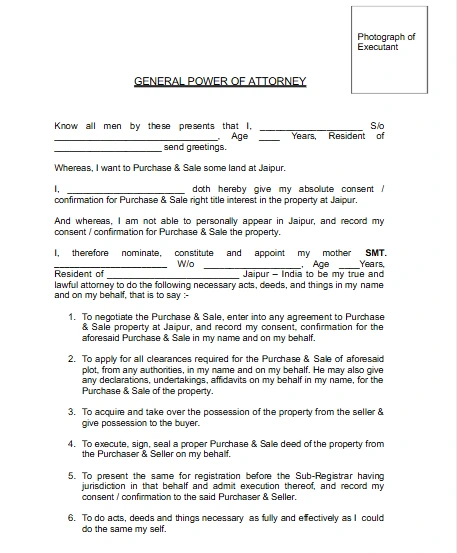
1. General Power of Attorney (GPA)
A GPA gives the attorney broad authority to manage the principal’s legal, financial, property, or business matters. Principals typically use it when they want a trusted person to handle multiple or ongoing affairs.
A GPA may allow the attorney to:
- Manage bank accounts
- Buy, sell, lease, or manage property
- Sign legal documents and contracts
- Handle business transactions
- Represent the principal before government authorities or courts.
A GPA only authorizes the attorney to act on the principal’s behalf and does not transfer ownership of any property or asset.
The Supreme Court clarified this position in Suraj Lamp & Industries Pvt. Ltd. v. State of Haryana (2011). The Court held that a GPA cannot transfer ownership of immovable property. Only a registered sale deed can legally transfer title. As a result, a genuine Power of Attorney remains valid for managing or dealing with property, but it cannot replace a registered sale deed or make the attorney the property’s owner.
2. Special Power of Attorney (SPA)
A SPA gives the attorney authority to perform only a specific act or complete a particular transaction. Once the task is completed, the authority usually ends.
People commonly use an SPA to:
- Sell a specific property
- Sign a particular agreement
- Represent the principal in a court case
- Complete a single banking transaction
- Appear before a government authority for a specific purpose.
An SPA offers greater control because it limits the attorney’s authority to the tasks mentioned in the document.
3. Durable Power of Attorney
A Durable Power of Attorney continues even if the principal later becomes mentally incapacitated. Many countries recognize this type of POA for long-term financial and healthcare planning.
However, Indian law does not recognize a separate Durable Power of Attorney. In most cases, a POA becomes ineffective if the principal becomes of unsound mind.
4. Irrevocable Power of Attorney
A principal cannot freely revoke an irrevocable Power of Attorney when it is coupled with an interest under Section 202 of the Indian Contract Act, 1872. Parties commonly use it in commercial and property-related transactions.
People commonly use an Irrevocable Power of Attorney for:
- Property development agreements
- Loan or financing transactions
- Business arrangements where the attorney has a legal interest.
Note: Simply calling a document “irrevocable” does not make it legally irrevocable. Courts decide this based on the nature of the transaction and the rights created under the agreement.
5. Property Power of Attorney
A Property Power of Attorney authorizes the attorney to manage the principal’s immovable property. NRIs and people living away from their property commonly use it to:
- Manage, maintain, or lease the property
- Collect rent on the principal’s behalf
- Pay property taxes and utility bills
- Represent the principal in property-related matters
- Execute authorized property documents
A Property POA does not transfer ownership. It only authorizes the attorney to act on the principal’s behalf.
In Suraj Lamp & Industries Pvt. Ltd. v. State of Haryana (2011), the Supreme Court ruled that a GPA cannot transfer ownership of immovable property. The Court held that only a registered sale deed can legally transfer title.
Under the Registration Act, 1908, Section 17 makes registration compulsory for documents that create or transfer rights in immovable property. Section 18 allows optional registration for other documents, including certain POAs.
After Suraj Lamp, authorities treat POAs that authorize the sale of immovable property for consideration more strictly. In such cases, many states require proper stamping and often insist on registration to prevent misuse as a substitute for a sale deed.
6. Financial Power of Attorney
A Financial Power of Attorney authorizes the attorney to manage the principal’s financial and banking affairs. It is useful when the principal cannot handle these matters due to travel, illness, or a long stay abroad. He/she may need an attorney to:
- Operate bank accounts
- Manage investments, deposits, and loans
- File tax returns and handle tax matters
- Collect payments and settle dues
7. Medical Power of Attorney
A Medical Power of Attorney authorizes the attorney to make healthcare decisions if the principal becomes unable to do so.
Unlike some countries, India does not have a separate law recognizing a standalone Medical Power of Attorney. However, the Supreme Court recognized advance medical directives in Common Cause v. Union of India (2018), which was later modified in 2023. These directives, which relate to end-of-life planning and will registration, allow individuals to appoint a person to make healthcare decisions on their behalf if they lose the capacity to decide.
Who Can Make a Power of Attorney?
Any person who is legally competent to enter into a contract can execute a Power of Attorney in India. The principal must understand the document and sign it voluntarily.
To execute a valid Power of Attorney, the principal must:
- Be at least 18 years old.
- Be of sound mind.
- Sign the document voluntarily, without fraud, coercion, or undue influence.
- Have the legal authority to delegate the powers granted under the POA.
The principal may appoint any trusted and competent person as the attorney. This can be a friend, a family member, a lawyer, or a business partner.
Note: A Power of Attorney allows the attorney to exercise only those powers that the principal legally holds. It cannot grant rights that the principal does not possess.
How to Set Up a Power of Attorney in India?
Follow these steps to set up a Power of Attorney in India:
1. Choose a Trusted Attorney
Appoint a reliable person to act on your behalf. Since the attorney may handle important legal, financial, or property matters, choose someone you trust.
2. Define the Scope of Authority
Decide whether to grant broad powers or limit the authority to a specific task. Clearly state what the attorney can and cannot do.
3. Draft the Power of Attorney
Prepare the POA using clear and specific language. Include:
- Title (General or Special Power of Attorney)
- Details of the principal and the attorney
- Purpose of the POA
- Powers granted to the attorney
- Duration of the authority
- Any restrictions or conditions
- Revocation clause, if applicable
- Date and place of execution
A well-drafted POA clearly defines the attorney’s authority and helps prevent disputes or rejection by banks, government authorities, or registration offices.
4. Pay the Stamp Duty
Execute the POA on the prescribed non-judicial stamp paper or pay the applicable stamp duty under your state’s law.
5. Sign the Document
The principal must sign the POA. Arrange for at least two witnesses to sign wherever the law or the intended transaction requires them.
6. Get the POA Notarized or Registered
- General POA: Notarization by a Notary Public is usually sufficient for banking, financial, or administrative matters.
- Property-related POA: Registration before the Sub-Registrar of Assurances may be mandatory for certain immovable property transactions.
- POA executed abroad (for NRIs): Get the document authenticated in the country where you sign it. Use the Indian Embassy or Consulate attestation, or an apostille in Hague Convention countries. Once the POA reaches India, pay the stamp duty within three months of its arrival.
The principal must appear before the Sub-Registrar with the prescribed documents and witnesses, wherever applicable, if registration of the POA is required.
Note: Attestation and apostille both authenticate an overseas Power of Attorney. The Indian Embassy or Consulate attests the document, while a designated authority in a Hague Convention country issues an apostille. An apostille eliminates the need for separate consular attestation between member countries.
7. Share the POA
After registration, if applicable, provide the original or a certified copy to the attorney so they can act on your behalf.
Tip: If the POA involves valuable assets or significant financial transactions, have it drafted or reviewed by a legal professional to minimize errors and disputes.
Is Registration of a Power of Attorney Mandatory?
Registration is not mandatory for every Power of Attorney. The table below shows when registration is required and when notarization is enough:
| Type of Power of Attorney | Is Registration Mandatory? |
| General POA for banking, financial, or administrative matters | No. Notarization is usually sufficient unless the receiving authority requires registration. |
| Special POA for a specific non-property transaction | No. Registration is generally not required unless a specific law provides otherwise. |
| POA for certain immovable property transactions | Yes, in specified cases. Registration may be mandatory under the Registration Act, 1908, and applicable state laws. |
Even when registration is optional, many people choose to register the POA because banks, government authorities, and other institutions may accept it more readily.
Notes:
- Notarize the POA if registration is not required, but authentication is necessary.
- Authenticate overseas POAs through the Indian Embassy/Consulate or a Notary Public. After the document reaches India, pay the applicable stamp duty within three months of its arrival.
- Check state-specific rules, as stamp duty and registration requirements vary across states.
Power of Attorney Stamp Duty and Cost
You must pay the applicable stamp duty before executing a Power of Attorney. The amount varies by state, the type of POA, and its purpose:
| Expense | Typical Cost |
| Stamp duty | Varies by state, generally ₹15 to ₹2,000+ (Property-related POAs, or POAs given to non-relatives, may attract higher stamp duty in some states.) |
| Notarization | ₹50–₹200 |
| Registration fee | ₹100–₹1,000, where registration is required. |
| Legal drafting fee (optional) | ₹500–₹5,000+, depending on the complexity of the POA. |
Tip: Check the latest stamp duty and registration charges under your state’s stamp laws before you execute a Power of Attorney. For foreign POAs, you can also approach the Collector of Stamps to adjudicate the stamp duty and confirm the correct amount.
Power of Attorney Validity in India
A Power of Attorney remains valid until the principal revokes it, its purpose is fulfilled, or it ends under law. Unless the POA specifies an expiry date, there is no fixed validity period in India.
A Power of Attorney generally ends when:
- A Special POA completes its purpose.
- A General POA is revoked by the principal.
- The principal dies.
- The validity period expires if specified.
- The principal becomes of unsound mind unless a specific law provides otherwise.
- The attorney dies or becomes incapable of acting, and no replacement is appointed.
Note: Registration does not make a Power of Attorney permanent. Even a registered POA can be revoked or terminated according to the law.
How to Revoke a Power of Attorney?
A principal can generally revoke a Power of Attorney at any time, unless it is irrevocable (a POA that cannot be freely cancelled). Follow these steps to revoke a POA:
- Execute a Deed of Revocation that clearly cancels the Power of Attorney.
- Notify the attorney in writing that their authority has ended.
- Inform third parties who relied on the POA, such as banks and government authorities.
- Register the revocation if you registered the original Power of Attorney.
- Publish a public notice where appropriate, especially when the POA relates to immovable property or high-value transactions.
Note: A POA given for consideration, or linked to an interest under Section 202 of the Indian Contract Act, 1872, is irrevocable. The principal cannot revoke it freely, and if a dispute arises, the parties must approach the court.
Difference Between POA and Will: Key Differences
The table below highlights the key differences between a Power of Attorney (POA) and a Will:
| Basis | Power of Attorney (POA) | Will |
| Purpose | Authorizes a person to act on behalf of the principal during their lifetime. | Specifies how a person’s assets will be distributed after their death. |
| When it applies | Works only while the principal is alive and competent. | Comes into effect only after the death of the testator. |
| Scope of authority | Covers financial, legal, property, or specific delegated powers. | Covers the distribution of property and the appointment of heirs/executors. |
| Control | Principal retains control and can revoke it (except for an irrevocable POA). | The testator has full control during their lifetime but no control after death. |
| Legal effect | Ends on the death of the principal. | Becomes effective after death and may require probate in some cases. |
| Common use | Managing property, banking, or legal matters when someone is absent or unable to act. | Planning inheritance and transferring assets to beneficiaries. |
| Revocation | Can be revoked anytime by the principal (except Section 202 POA). | Can be changed or revoked any number of times before death. |
Common Mistakes to Avoid When Using a Power of Attorney
A Power of Attorney gives another person significant legal authority. Avoid these common mistakes to prevent disputes and misuse:
- Choosing the wrong attorney: Appoint only someone you trust to act in your best interests.
- Granting overly broad powers: Limit the attorney’s authority to what is necessary, especially for valuable assets.
- Using vague language: Clearly define the powers, restrictions, and duration of the POA.
- Ignoring stamp duty or registration requirements: Complete all legal formalities to ensure the POA is valid and accepted.
- Failing to specify an expiry date or conditions: Add these details if you want the authority to end automatically.
- Not informing banks or other authorities: Notify the relevant institutions before the attorney acts on your behalf.
- Forgetting to revoke an unused POA: Revoke the document formally and inform the attorney and affected third parties.
- Assuming a POA transfers ownership: A Power of Attorney only authorizes the attorney to act on your behalf. It does not transfer ownership of your property or assets.
