

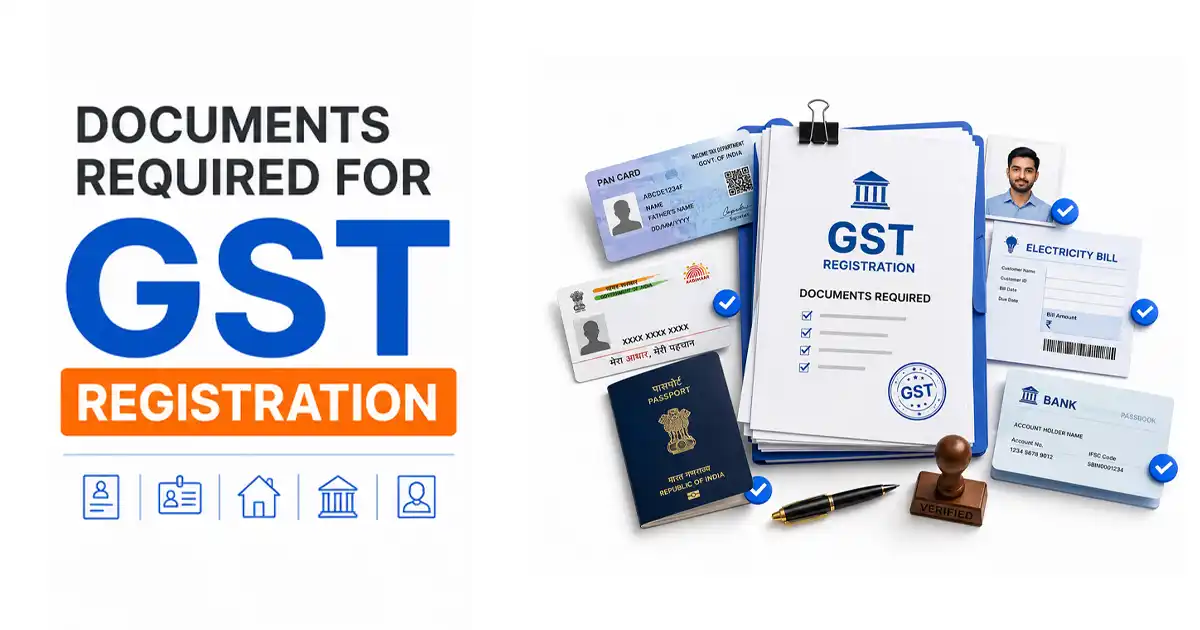
The documents required for GST registration depend on the applicant and business structure. Common documents include PAN, Aadhaar, photographs, address proof, and authorization documents. Bank details are added after registration. Additional documents may be required for partnerships, LLPs, companies, and other business structures.
Submitting complete and accurate documents can help avoid delays in processing. With successful Aadhaar authentication and no additional verification or clarification, GST registration may be granted within 7 working days. Applications requiring clarification, physical verification, or other checks may take longer, subject to the prescribed timelines. If Aadhaar authentication is not opted for or fails, physical verification or additional checks may apply, which can extend the processing time.
GST is an indirect tax levied on the supply of goods and services in India. Businesses generally need to register once their aggregate turnover crosses the applicable threshold. The threshold is ₹40 lakh for goods and ₹20 lakh for services in most states, with lower limits applicable in specified states. Certain businesses may also require registration under specific GST provisions, subject to applicable conditions.
Key Takeaways
- GST registration generally requires PAN, photographs, business address proof, and applicable identity, constitution, or authorization documents, with requirements varying by business structure.
- A proprietorship uses the proprietor’s own PAN, while a partnership, LLP, or company needs the entity’s separate PAN and constitution documents.
- Aadhaar authentication is not mandatory in every case. Applicants may use other verification options available under the GST process, depending on the applicable requirements.
- Address proof depends on the premises. Use an ownership document for owned premises, a rent agreement for rented premises, and a consent letter or NOC for shared premises.
- Documents should be clear, complete, and uploaded in the prescribed format and size. Address or document discrepancies can lead to clarification requests or delays.
- Applications that require clarification, physical verification, or other checks may take longer than applications that are complete and successfully verified.
CBIC Instruction No. 03/2025-GST for Documents
CBIC issued Instruction No. 03/2025-GST on April 17, 2025. It standardizes the processing of GST registration. It also replaced Instruction No. 03/2023-GST. The instruction addresses unnecessary document requests and avoidable queries during registration.
The instruction requires officers to follow the indicative document list provided in FORM GST REG-01. They should not issue notices based on assumptions or minor discrepancies. They should also avoid requesting documents that are not required for processing the application.
If an additional document is considered necessary, approval from the concerned Deputy or Assistant Commissioner is required.
The instruction also clarifies the documents that can be used to prove the principal place of business:
- Owned premises: Submit one prescribed ownership document. This may include a property tax receipt, municipal khata copy, electricity bill, water bill, or another document recognized under applicable State or local law.
- Rented premises: Submit a valid rent or lease agreement along with an ownership document of the lessor. For an unregistered agreement, the lessor’s identity proof may also be required. For a registered agreement, the lessor’s identity proof should not be required.
- Premises owned by a relative or another person: Submit a consent letter from the owner, the owner’s identity proof, and one ownership document.
- Shared premises: Submit the applicable rent or lease agreement or consent arrangement along with the prescribed ownership documents.
- No rent or lease agreement: An affidavit and an applicable document supporting the applicant’s possession of the premises may be submitted.
- Constitution of business: Officers should rely on the relevant constitution documents, such as a partnership deed or registration certificate. They should not demand additional documents, such as an MSME certificate or trade license, when these are not prescribed for GST.
These instructions clarify the documents that may be requested during GST filing. They also help applicants avoid unnecessary document submissions and queries.
List of Documents Required for GST Registration in India (Common for All Applicants)
GST registration requires these documents, regardless of the business type:
| Document | Details |
| PAN card | PAN of the applicant or business entity |
| Aadhaar card | Aadhaar details of the applicant or authorized signatory, used for authentication |
| Photograph | Passport-size photo of the applicant or signatory, in JPEG format under 100 KB |
| Business address proof | Electricity bill, rent agreement, property tax receipt |
| Authorized signatory proof | Proof of appointment and identity of the person authorized to file the application |
Note: PAN is required for GST registration, while Aadhaar authentication is one of the available verification methods. If Aadhaar authentication is selected, the application can proceed through the Aadhaar-based verification process. Under Rule 8(4A), the application is treated as submitted on the earlier of the date of successful Aadhaar authentication or 15 days from the submission of Part B of FORM GST REG-01. The application is then processed under the applicable verification and approval procedure.
GST Documents for Proprietorship in India
You need the following documents to register for GST for a sole proprietorship or an individual:
| Document | Details |
| PAN card | PAN of the proprietor (the proprietor’s personal PAN is used) |
| Aadhaar card | Aadhaar of the proprietor, with a linked mobile number for OTP |
| Photograph | Passport-size photo of the proprietor, in JPEG format under 100 KB |
| Business address proof | Electricity bill, rent agreement, or property tax receipt of the place of business |
| Bank account details | These are generally furnished after registration through the GST portal using the prescribed supporting document. |
Note: A proprietor can use a residential address as the principal place of business, subject to valid address proof. Bank account details are not required at the time of application. Under Rule 10A, they must generally be furnished within 30 days of receiving the registration or before filing the first GSTR-1 or IFF, whichever is earlier. Failure to furnish the details can result in suspension of the registration. Certain registrations, including TDS, TCS, and suo motu registrations, are excluded from this requirement.
Documents a Partnership Firm Needs to Apply for GST
A partnership firm must submit its registration documents along with the PAN and identity details of all partners to register on the GST portal:
| Document | Details |
| PAN of the firm | The partnership firm’s own PAN |
| Partnership deed | Showing the partners, their roles, and the profit-sharing ratio |
| PAN & Aadhaar of partners | Details required for the relevant stakeholders in the GST application |
| Authorized signatory proof | Authorization letter or resolution naming the partner authorized to file (usually the managing partner, who completes Aadhaar authentication) |
Note: For a partnership firm, Aadhaar authentication generally applies to one partner and the primary authorized signatory, where Aadhaar authentication is selected.
GST Documents Required for an LLP
A Limited Liability Partnership (LLP) must submit the following documents to complete GST registration:
| Document | Details |
| PAN of the LLP | The LLP’s own PAN |
| Certificate of Incorporation (CoI) | Issued by the MCA |
| LLP agreement | Defining the LLP’s structure and partners’ roles |
| PAN & Aadhaar of designated partners | Details required for the relevant stakeholders in the GST application |
| Authorized signatory proof | Authorization letter or other applicable document establishing the authorized signatory |
| Digital Signature Certificate (DSC) | Mandatory (the LLP’s GST application must be digitally signed) |
Note: An LLP must use a DSC because the GST portal does not accept Aadhaar-based e-signing for this entity type.
Documents Required for GST for a Company (Pvt Ltd) in India
You need the following documents to apply for GST registration for a private limited company:
| Document | Details |
| PAN of the company | The company’s own PAN |
| CoI | Issued by the MCA |
| PAN & Aadhaar of directors | Details required for the relevant stakeholders in the GST application |
| Board resolution | Authorizing a director or officer to file |
| DSC | Mandatory |
Note: The Memorandum of Association (MOA) and Articles of Association (AOA) are not mandatory supporting documents for GST. They may be provided if required in a particular case, but they should not be listed as compulsory documents.
Documents Required to Register for GST for an HUF
A Hindu Undivided Family (HUF) needs these documents:
| Document | Details |
| PAN of the HUF | The HUF’s own PAN, separate from the Karta’s personal PAN |
| PAN & Aadhaar of the Karta | The Karta heads the HUF |
| Proof of constitution | HUF deed or other document showing its formation |
Note: The HUF has its own PAN, separate from the Karta’s personal PAN.
GST Documents for a Trust, Society, or Club
A trust, society, or club needs its registration certificate along with these documents:
| Document | Details |
| Registration certificate | Of the trust, society, or club |
| PAN | Of the trust, society, or club |
| PAN & Aadhaar of members | Trustees, office bearers, promoters, or other stakeholders as required in the GST application |
| Authorized signatory proof | Authorization letter or resolution naming the person authorized to file |
Documents Required to Register for GST E-Commerce Businesses
E-commerce sellers generally submit the same documents required for their underlying business structure. This applies to proprietorships, partnerships, LLPs, and companies.
However, GST rules for e-commerce sales differ. Certain e-commerce sellers may be required to register for GST regardless of turnover under Section 24 of the CGST Act. The applicable requirement depends on the type of supply and the e-commerce model.
GST Documents for a Foreign Company
A foreign company may need GST registration depending on its activities in India. An NRTP is a specific category for persons making taxable supplies in India without a fixed place of business. Foreign companies require the following documents:
- Bank account details: You must provide bank account details. You can also add these details through an amendment after receiving the GSTIN.
- Indian place of business proof: Address proof of the company’s place of business in India, such as an electricity bill, rent agreement, or consent letter with the owner’s ownership document.
- Photograph: Passport-size photograph of the authorized signatory, as required in the GST application.
- Proof of appointment of the signatory: An authorization letter or a copy of the board resolution appointing the Indian authorized signatory.
- Indian authorized signatory’s details: The PAN and Aadhaar of the appointed authorized signatory, who must be a resident of India, along with a valid Indian mobile number and email.
- Tax Identification Number (TIN) or unique identification number: The applicant must provide the TIN or unique identification number issued by their home government. They can also submit a passport instead of an Indian PAN.
- Certificate of incorporation: The registration or incorporation certificate of the company issued in its home country, often self-attested or apostilled.
- GST Documents Required for a Non-Resident Taxable Person
A non-resident taxable person must provide documents that establish their identity, foreign business details, authorized signatory, and business activities in India. The GST registration application must be filed in Form GST REG-09 at least five days before starting business in India.
| Document | Details |
| Valid passport | Self-attested copy of the passport of the non-resident applicant |
| Foreign Tax Identification Number | Tax identification number or unique identification number issued by the applicant’s country, where applicable |
| Certificate of Incorporation | Required for a foreign business entity to establish its incorporation or constitution |
| PAN | PAN of the non-resident taxable person, if available |
| Authorized signatory details | The application must have an authorized signatory who is a resident of India and has a valid PAN |
| Proof of appointment of authorized signatory | Letter of authorization or other applicable authorization document |
| Photograph of authorized signatory | Photograph as required in the GST application |
| Indian place of business proof | Applicable proof of the principal place of business in India |
| Advance tax deposit | An amount equal to the estimated GST liability for the registration period must be deposited in advance |
Important: A non-resident taxable person must apply for registration at least five days before commencing business. The registration is generally valid for the period specified in the application or 90 days from the effective date of registration, whichever is earlier. The period can be extended by up to another 90 days, subject to the applicable conditions.
Address Proof Documents for GST in India
Business address proof is one of the most important documents for verifying your place of business during GST registration. Incorrect or outdated address proof is a common reason for rejection. The document required depends on whether you own, rent, or share the premises.
Here are the accepted address proof documents for each case:
Owning the premises:
- Ownership document: Any one of the latest electricity bill, property tax receipt, municipal khata copy, or ownership deed, showing that you own the premises.
If you rent the premises:
- Rent or lease agreement: The rent or lease agreement for the premises, along with the owner’s ownership document or a utility bill in the owner’s name.
If you use shared or consented premises:
- Consent letter or NOC: A consent letter or NOC from the owner, on plain paper, allowing you to use the premises.
- Owner’s proof: The owner’s identity proof and any one ownership document for the premises.
Note: The principal place of business details should be complete and consistent with the address proof submitted. Discrepancies may lead to clarification requests or delays.
Document Format and Size Requirements for GST Application in India
The GST portal (gst.gov.in) accepts documents only in specific formats and sizes, including:
| Document | Format | Maximum Size |
| Photograph | JPEG or PDF | 100 KB |
| Property tax receipt / municipal khata / electricity bill | JPEG or PDF | 100 KB |
| Rent / Lease Agreement | JPEG or PDF | 1 MB |
| Consent Letter | JPEG or PDF | 1 MB |
| Proof of appointment of authorized signatory | JPEG or PDF | 1 MB |
| Supporting documents for clarification | JPEG or PDF | 1 MB |
| E-KYC documents | JPEG or PDF | 2 MB |
Note: All uploaded documents should be clear, complete, and legible.
How to Submit GST Documents on the Portal?
Follow these steps to submit your GST application and upload the required documents online:
- Visit the GST portal: Go to the official GST portal and select Services, then Registration, and click on New Registration.
- Fill Part A of the form: Enter your PAN, mobile number, and email to generate a TRN after OTP verification.
- Log in with the TRN: Use the TRN to log back in and continue with Part B of the application.
- Enter business details: Fill in the business, promoter, and authorized signatory details across the relevant sections.
- Upload the documents: Upload each applicable document, such as PAN, photograph, constitution documents, and principal place of business proof, in the prescribed format and size under the relevant section.
- Complete Aadhaar authentication: Complete Aadhaar authentication where applicable, or follow the alternative verification process prescribed for the application.
- Submit the application: Verify and submit the application using a DSC, e-Sign, or EVC, and note the Application Reference Number (ARN) to track its status.
Importance of Correctly Filing GST Registration Documents
The documents you submit help the GST department verify your registration and approve your GSTIN. They also:
- Verify identity and business: PAN, Aadhaar, and incorporation documents confirm your identity and the existence of your business.
- Provide a business address: Address proof helps verify your principal place of business.
- Prevent fraud: Proper documents help prevent fake registrations and GST misuse.
- Affect approval speed: Complete and accurate documents can speed up processing. Successful Aadhaar authentication may result in faster GSTIN processing. Incomplete documents or failed authentication can cause delays.
- Support compliance: Correct details at registration help avoid issues in future GST returns and filings.
