Winding Up of a Company in India
Wind up your Private Limited Company or OPC with RegisterKaro. We prepare resolutions and final accounts, coordinate with the liquidator, and support ROC, IBBI, and NCLT filings through to dissolution.
 Right-Route Advisory: Voluntary, NCLT or Strike-OffBoard & Shareholder Resolution DraftingIBBI-Registered Liquidator for Voluntary LiquidationCreditor Notices & Claim SettlementROC, IBBI & NCLT Filing Support


 What Sets Us ApartWhat Sets Us Apart
Overview of Winding Up of a Company
Winding up is the formal process of legally closing a company by realizing its assets, paying its liabilities, and distributing any surplus to shareholders before dissolution. A liquidator manages the process, and the company remains a legal entity until the final dissolution order.
A company can wind up in two modes: a solvent company can choose voluntary liquidation under Section 59 of the Insolvency and Bankruptcy Code, 2016, while the NCLT can order winding up under the Companies Act, 2013. An inactive company with no assets or liabilities may qualify for strike-off instead, which is distinct from formal liquidation. The MCA's C-PACE struck off more than 38,600 companies between 1 May 2023 and 31 July 2025.
As of 30 September 2026, 2,741 corporate persons had initiated voluntary liquidation under the IBC, and 1,658 had received dissolution orders.
Key Aspects of Winding Up
Winding up affects the company, its creditors, shareholders, and directors in several important ways:
- Legal status: The company remains legally active until the NCLT passes the final dissolution order.
- Liquidator's role: A liquidator manages the company's affairs and protects the interests of creditors and other stakeholders.
- Creditor claims: Creditors submit their claims for money owed during the liquidation process.
- Payment priority: The law sets the order of payment, with secured creditors and workmen's dues ahead of unsecured creditors, and shareholders last.
- Past transactions: The liquidator can challenge certain transactions that unfairly reduce the company's assets.
- Directors: Directors' powers pass to the liquidator, and they may face liability if fraud or misconduct is found.
Modes of Winding Up a Company
Indian law provides different modes of winding up depending on the company's financial position and the circumstances leading to closure.
- Compulsory winding up: The NCLT orders it under Section 271 of the Companies Act, 2013, on grounds such as a special resolution, fraudulent conduct, acts against India's sovereignty, or five years of filing defaults, and the Tribunal appoints the liquidator. It has no fixed statutory timeline.
- Voluntary liquidation (voluntary winding up): A solvent company can choose it under Section 59 of the IBC, 2016, after its directors declare solvency and its members pass a special resolution, with creditor approval where debts exist. An insolvency professional acts as liquidator.
- Timeline for voluntary liquidation: The amended Section 59 requires the process to finish within one year, and both modes end with an NCLT dissolution order.
Advantages of Winding Up a Company in India
If a company has stopped operating and is no longer earning revenue, winding it up closes its legal and compliance obligations. Simply stopping operations does not end the company's existence or its compliance requirements.
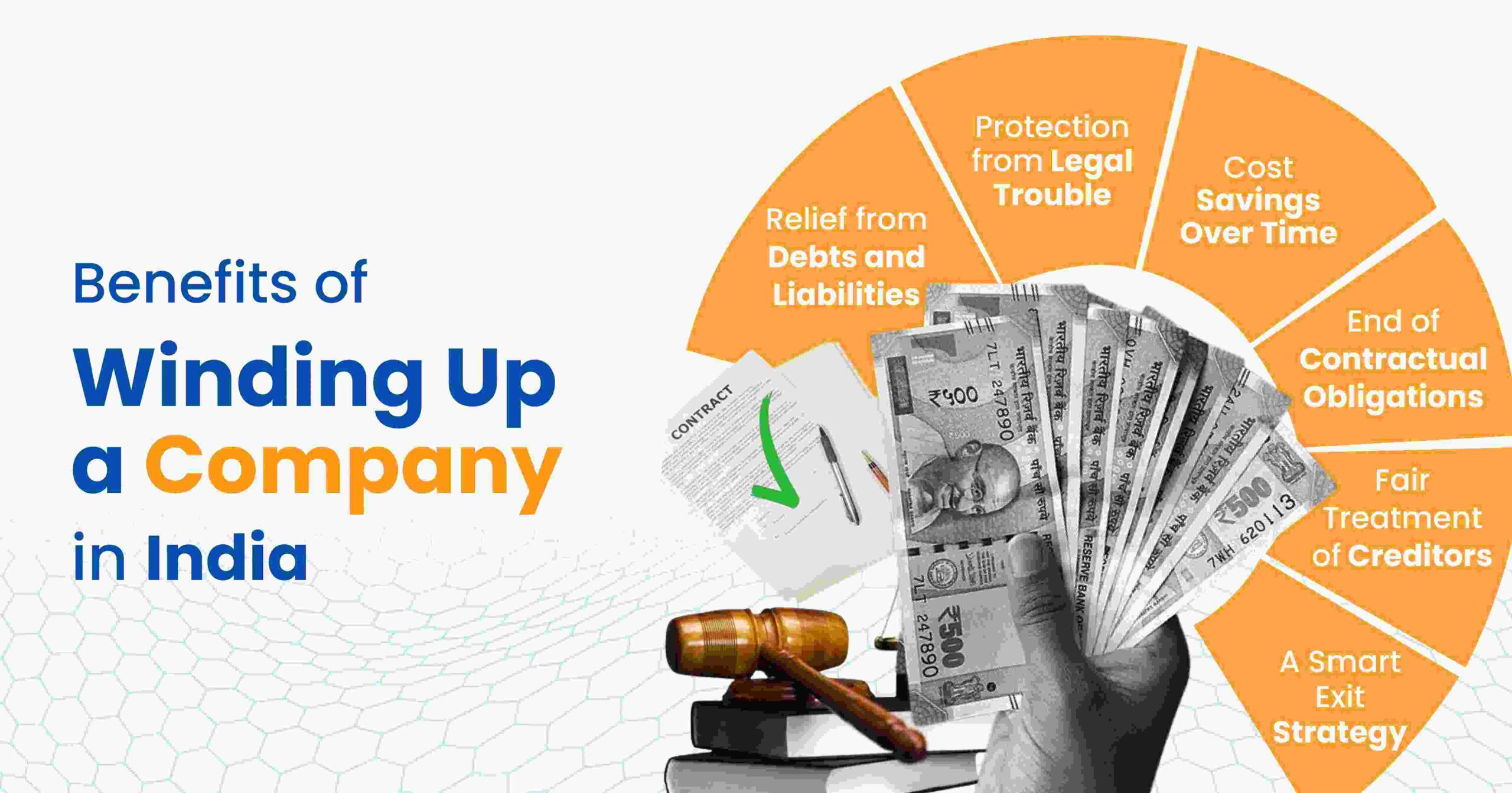
- Resolve debts and liabilities: The liquidation process identifies, verifies, and settles the company's debts from available assets.
- End recurring compliance: Once the company is dissolved, annual ROC filings, audits, and other recurring obligations stop.
- End operating costs: Formal closure stops accounting, audit, professional, and maintenance expenses for an inactive entity.
- Protect creditor interests: A formal process gives creditors a structured way to submit claims and receive payment according to legal priority.
- Create a clean exit: Owners can formally close an unprofitable business and move on to new ventures.
Consequences of Winding Up a Company in India
Winding up gives your company a legal closure, but it also closes the options a running company uses, like trading, signing contracts, raising funds, and suing or defending in its own name. Here is what changes for the company and the people responsible for it:
- Loss of legal existence: Once dissolved, the company ceases to exist and cannot conduct business, enter into contracts, or continue legal proceedings in its own name.
- Assets used to settle claims: Assets are realized and distributed according to legal priority. Shareholders receive any surplus only after all eligible claims are settled.
- Employee dues: Employee dues rank ahead of most other claims, and employment ends with the closure.
- Restrictions on assets: Once winding-up proceedings begin, dealings with company assets may need Tribunal or liquidator approval.
- Tax and statutory obligations: The company must settle income tax, GST, ROC, and other statutory dues during closure.
- Past violations remain: Penalties and proceedings for earlier violations are not wiped out by dissolution.
- Reputational impact: A creditor-driven or insolvency-related winding up can affect the company's and its directors' credit profile.
- Potential director liability: Directors are not personally liable for company debts only because they served as directors. Personal liability can arise for fraud, wrongful trading, statutory violations, or a false declaration of solvency.
Who Can Apply for the Winding Up of a Company?
Under Section 272 of the Companies Act, 2013, the following parties can file a winding-up petition with the Tribunal (the company law tribunal that handles company cases):
- The company: The company can petition after passing a special resolution to be wound up by the Tribunal.
- Any contributory: A contributor is anyone liable to contribute to the company's assets on winding up, and in practice this means a shareholder. Holding fully paid-up shares does not bar a shareholder from petitioning. The shares must have been allotted to the shareholder, or registered in the shareholder's name, for at least six months in the 18 months before winding up begins. Shares inherited from a deceased holder also qualify.
- The company and contributories together: They can file a joint petition.
- The Registrar of Companies (ROC): The ROC can petition on any ground in Section 271 except the company's own special resolution (for example, a failure to file financial statements or annual returns for five consecutive years).
- A person authorized by the Central Government: The Central Government can authorize an individual to petition.
- The Central or State Government: This applies only where the company's acts are against India's sovereignty and integrity, security of the State, friendly relations with foreign states, public order, decency, or morality.
Creditors cannot petition under Section 272. They can start insolvency proceedings under the IBC instead.
An inactive company with no assets or liabilities can usually be struck off instead. A company that cannot pay its debts falls under IBC insolvency.
Documents Required for Winding Up a Company in India
The documents depend on the route you choose. Here is what each one needs.
Voluntary liquidation (IBC)
- Board resolution approving the declaration of solvency and authorizing a director to act
- Directors' declaration of solvency with an affidavit
- Audited financial statements and a record of business operations for the last two years
- Valuation report from a registered valuer
- Special resolution of members, filed with the ROC in Form MGT-14
- Creditors' approval resolution, where the company has debts
- Liquidator's consent and appointment documents
Winding up by the Tribunal
- Winding-up petition with a supporting affidavit
- Board resolution authorizing the petition, if the company files it
- Statement of affairs, if the company files it
- Latest audited financial statements
- List of creditors, employees, and pending litigation
- Certificate of Incorporation, MOA, and AOA
Strike-off
- Application in Form STK-2
- Board resolution and special resolution, or consent of 75% of members
- Indemnity bond and affidavit from the directors
- CA-certified statement of accounts showing no assets or liabilities
- Company PAN and GST registration details
- Statement of pending litigation, if any
Strike-off follows a separate, simpler route under Section 248. For the STK-2 process, documents, and fees, see our close a Private Limited Company service.
How to Wind Up a Company in India? Step-by-Step Process
The process of winding up a company depends on the route selected: voluntary or compulsory. Follow the applicable steps below:
Voluntary Liquidation under Section 59 of the IBC
If the company is solvent and meets the eligibility conditions, follow these steps to complete voluntary liquidation:
- Declare solvency: A majority of directors make a declaration of solvency on affidavit, supported by audited financial statements and an asset valuation.
- Pass a special resolution: Within four weeks, members pass a special resolution approving voluntary liquidation and appointing an insolvency professional as the liquidator.
- Obtain creditors' approval: If the company has outstanding debts, creditors representing two-thirds in value must approve the resolution within seven days.
- Notify the ROC and IBBI: Within seven days of the resolution or creditors' approval, the company notifies the Registrar and the IBBI.
- Make the public announcement: The liquidator invites claims from stakeholders within the prescribed period.
- Realize assets and settle claims: The liquidator realizes the company's assets, verifies claims, and distributes the proceeds according to the applicable priority.
- File the final report: After completing the liquidation, the liquidator submits the final report and applies to the NCLT for a dissolution order.
- Receive the dissolution order: The NCLT dissolves the company, and a copy of the order is sent to the ROC.
Following the 2026 amendment to Section 59 of the IBC, voluntary liquidation cannot exceed one year. Within that cap, Regulation 37 asks the liquidator to file the final report within 270 days of the liquidation commencement date where creditors approved the resolution, and within 90 days in other cases. If the liquidator misses the applicable period, the Regulations require further reporting and contributories' meetings until the liquidator applies for dissolution.
Compulsory Winding-Up by the NCLT
When the NCLT orders winding-up, the process involves these steps:
- File the petition: An eligible party files a winding-up petition with the NCLT in the prescribed form.
- File objections: The Tribunal directs the company to file its objections along with a statement of affairs within 30 days, and may direct the petition to be advertised.
- Appoint a provisional liquidator: Where necessary, the NCLT appoints a provisional liquidator to protect the company's assets.
- Obtain the winding-up order: If the Tribunal finds sufficient grounds, it passes the winding-up order and appoints a Company Liquidator.
- Realize assets and settle claims: The liquidator takes control of the company's assets, verifies claims, realizes assets, and distributes the proceeds according to the applicable priority.
- Obtain dissolution: After completing the winding-up, the liquidator reports to the Tribunal, which passes the dissolution order. A copy goes to the ROC, and the company's legal existence ends.
As a Tribunal-driven process, compulsory winding-up often takes more than a year, depending on the complexity of claims, assets, and litigation.
RegisterKaro’s Cost of Winding Up a Company in India
Professional and liquidator fees usually make up most of the winding-up cost, while statutory filing fees are a smaller part. The total depends on the route, company size, assets, creditors, and legal complexity.
Winding-Up Method | Statutory / Filing Fees | Professional & Liquidator Fees |
Voluntary Liquidation (IBC Section 59) | Government fees for the ROC forms (such as MGT-14), IBBI filings, and the NCLT dissolution application. You pay the actual fees. | ₹1,00,000–₹3,00,000+ |
Compulsory Winding Up (NCLT) | NCLT petition fee and advertisement costs. You pay the actual fees. | ₹1,50,000–₹3,00,000+ |
IBC Liquidation (Insolvent Company) | No separate filing fee for you. The liquidator's fee forms part of the liquidation cost and gets priority in distribution under Section 53. The liquidation estate pays it. | The Committee of Creditors fixes the fee. Otherwise, it is a percentage of realizations or distributions, usually ₹2,00,000–₹5,00,000+. |
Additional expenses may include notary charges (₹5,000–₹10,000), valuation, audit, and newspaper or Gazette publication (₹10,000–₹15,000). Litigation, creditor disputes, and complex assets can raise the cost significantly.
Connect with RegisterKaro and let our experts handle the legal hassle while you grow your business.
Frequently Asked Questions (FAQs)
What are the two ways of winding up a company in India?
A company can be wound up voluntarily under Section 59 of the IBC, which suits solvent companies that choose to close, or compulsorily by the NCLT under Section 271 of the Companies Act, 2013, which applies only on statutory grounds. Insolvent companies are liquidated under the IBC insolvency process instead.
Can winding up a company be done voluntarily if it has debts?
Yes, but only if it is solvent and can pay its debts in full. Directors must declare solvency, and creditors representing two-thirds in value must approve the resolution within seven days. A company that cannot pay its debts cannot use voluntary liquidation and must go through the IBC insolvency process.
How long does winding up a company take in India?
Under the amended Section 59 of the IBC, voluntary liquidation must finish within one year, and IBBI regulations set stage-wise timelines. The regulatory target is 270 days where creditors approve the resolution, and 90 days otherwise. IBBI's July–September 2026 newsletter shows liquidators filed final reports in an average of 273 days that quarter, close to the 270-day target. Reaching the NCLT dissolution order took 737 days on average, so the tribunal stage adds well over a year. Across all 2,173 processes closed by final report, the average was 389 days.
How much does winding up a company cost in India?
Voluntary liquidation typically costs ₹1,00,000 to ₹3,00,000 or more; winding up by the NCLT costs ₹1,50,000 or more; and IBC liquidation of an insolvent company costs ₹3,00,000 to ₹7,00,000 or more. Professional fees form most of the cost. These figures are estimates, and disputes or complex assets can increase the final amount.
Who can act as a liquidator when winding up a company?
In voluntary liquidation under the IBC, the liquidator must be an insolvency professional registered with the IBBI, appointed through the members' special resolution. In winding up by the NCLT, the Tribunal appoints a Company Liquidator from the panel of professionals maintained under the Companies Act, 2013, not the company itself.
In what order are creditors paid when winding up a company?
Under Section 53 of the IBC, the liquidator pays liquidation costs first. Workmen's dues for 24 months then rank equally with secured creditors who relinquish their security. Other employee dues for 12 months, unsecured financial debts, and government dues for two years follow. Government dues rank equally with any secured shortfall. Remaining debts come next. Preference shareholders rank ahead of equity shareholders, who get any surplus. The 2026 amendment, in force since 26 May 2026, caps secured priority at the value of the security.
What happens to employees when winding up a company?
Employment ends with the closure, and the liquidator pays unpaid wages and dues from the sale proceeds. Under the IBC waterfall, workmen's dues for 24 months rank equally with secured creditors who relinquish security. Other employee dues for 12 months rank next, ahead of unsecured creditors, government dues, and shareholders.
Do I need to cancel GST and other registrations before winding up a company?
Yes, the company should file final GST returns, apply for GST cancellation, and clear its tax liabilities. It should also promptly close its EPF, ESI, and other registrations and licenses, and settle all pending income tax filings and compliance obligations, so no statutory dues remain open after the dissolution order.
What happens to the company after winding up is complete?
Once the NCLT passes the dissolution order, the company legally ceases to exist, and the order is filed with the ROC. Directors are generally not liable for company debts merely for holding office, but liability for fraud, misconduct, or wrongful trading can continue, and earlier violations are not automatically erased.
What if I do not wind up an inactive company?
It must keep filing annual returns, financial statements, and tax returns even without any business operations. Missed filings attract daily late fees and penalties, and directors can be disqualified under Section 164(2) after three continuous years of default. A company with no assets or liabilities may qualify for strike-off instead.

Reviewed by
Joel DsouzaJoel Dsouza is a Chartered Accountant (CA) and compliance expert with over 7 years of hands-on experience in company registration, tax structuring, GST, ROC filings, and MCA compliance. As a qualified member of the Institute of Chartered Accountants of India (ICAI) and Co-Founder at RegisterKaro, he has personally advised more than 1,000 startups and SMEs across India, helping founders navigate incorporation, regulatory frameworks, and financial planning from Day 1. With deep expertise across all three levels of Finance and Portfolio Management, Joel is committed to promoting financial literacy and simplifying India's startup ecosystem through clear, actionable guidance that entrepreneurs can act on immediately.
Why Choose RegisterKaro for Winding Up a Company?
Winding up a company involves strict filings, timelines, and creditor obligations. RegisterKaro supports you through the process, from choosing the route to closing the company properly.
- Right-route advisory: We assess your company's status and recommend the right exit route: voluntary liquidation, NCLT winding up, or strike-off.
- End-to-end support: We help with board and member resolutions, ROC and IBBI filings, and the application for the final dissolution order.
- IBC and NCLT expertise: Our team prepares and files the documents required under the IBC and before the NCLT, working with insolvency professionals and advocates where the law requires them.
- Creditor and claim support: We assist with public notices, creditor claims, verification, and settlement, so that distributions follow the legal priority.
- Compliance and risk review: We identify pending filings, tax dues, and documentation gaps before closure, reducing the risk of unresolved liabilities.

Client Reviews for Winding Up Of A Company
See what founders and business owners say about their Winding Up Of A Company experience with RegisterKaro.

pravin chauhan
 Verified
Registerkaro provided efficient and professional support for our seed funding requirements. The process was well-organized and transparent throughout.... Read more

Sanaul Haque Siddiqu...
VerifiedI wanted to express my sincere appreciation for your assistance with the documentation process. I had a great experience working with you, Ms. Bindya.... Read more

srikanth narayanaswa...
VerifiedJust wanted to say that your cooperation and helpfulness have been amazing during the company registration process. You've been a valuable asset to th... Read more

Adv. Gagan Kumar Jha
VerifiedGreat experience with the company registration process! Mr. Abhishek Singh was an excellent point of contact, guiding us through the entire process wi... Read more

sivakumar varadaraja...
VerifiedThis five star rating goes only to Ria, the person who took over at a later stage. She is exceptionally fast, thoroughly pro-active and made several... Read more

mahima dixit
VerifiedThe company really great I had really wonderful experience with it , I will prefer everyone to try it. Experienced team with great knowledge thanks Me... Read more

Azeem K
VerifiedGood service especially from Faisal, Muskaan Sonik and team. They are very knowledgeable, and provide good support every step of the way. Muskaan help... Read more

Govind Gupta
Verified"I'm grateful for the outstanding support I received from RegisterKaro, particularly from Satyapriya Tripathi. They guided me through the professional... Read more

Vedant kumar Singh
VerifiedHighly appreciate the efforts of Ms. Anchal Gupta in completing our company incorporation. Her guidance, clarity, and prompt support truly reflect exc... Read more

Vaibhav doharey
VerifiedI am writing to express my sincere appreciation for Aryan who was assigned as my SPOC during the compliances process. Aryan’s professionalism, diligen... Read more