ISO 20000 Certification in India
ISO 20000-1:2018 is the international standard for IT Service Management Systems (ITSM). Get ISO 20000 certification in India with RegisterKaro — documentation, internal audits, and audit-readiness support handled end-to-end.
 End-To-End IT SMS ImplementationDocumentation and Procedure SupportInternal and Mock Audit SupportCoordination With NABCB-Accredited Certification BodiesSurveillance and Recertification Support

 What Sets Us ApartWhat Sets Us Apart
What is ISO 20000 Certification?
ISO 20000 certification demonstrates that an organization follows an internationally recognized standard for managing and delivering IT services. The standard establishes the requirements for a Service Management System (SMS), which helps organizations plan, deliver, monitor, and continually improve their IT services. It applies to software companies, cloud service providers, telecom companies, healthcare organizations, and enterprise IT departments that deliver technology-based services.
ISO/IEC 20000-1:2018 is the current certification standard, while Amendment 1:2024 introduces climate-related considerations under Clauses 4.1 and 4.2.
An accredited certification body, such as one accredited by NABCB, audits your service management system and issues ISO 20000 certification after verifying compliance with the standard's requirements. The standard evolved from the earlier BS 15000 framework and remains closely aligned with widely accepted IT service management practices, including ITIL.
Many professionals also pursue ISO certification through Foundation, Lead Implementer, or Lead Auditor training programs to strengthen their service management knowledge and auditing skills.
Did You Know? ITIL and ISO/IEC 20000 are related, yet they serve different purposes in IT service management. ITIL provides a best-practice framework that guides how your team manages and delivers IT services. ISO/IEC 20000 is the certifiable standard that an accredited body can audit your organization against.
Is ISO 20000 Certification Mandatory in India?
ISO 20000 certification is not legally mandatory for businesses providing IT or technology-based services. However, many government departments, MeitY-related government IT tenders, large enterprises, and multinational companies prefer certified service providers during vendor selection and procurement.
Organizations with ISO 20000 certification often gain a competitive advantage during public tenders, GeM opportunities, government empanelment, large-enterprise vendor onboarding, and private sector contract bidding.
Who is Eligible for ISO 20000 Certification in India?
Although the ISO 20000 standard remains voluntary, clients and tender authorities increasingly expect it across several sectors, including:
- IT and Software Companies: These companies deliver applications, infrastructure, and technical support that require consistent service quality and reliable performance.
- Managed Service Providers (MSPs): MSPs manage client environments and use structured service controls to build trust and secure long-term business contracts.
- Cloud and Data Center Operators: These organizations manage critical workloads and need strong service management to maintain availability and respond quickly to incidents.
- IT Departments of Large Enterprises: Internal IT teams use ISO 20000 to deliver consistent services and improve operational control across business functions.
- Business Process Outsourcing (BPO) Firms: BPO companies adopt the standard to demonstrate dependable service management for domestic and international clients.
- Telecom and Network Providers: Telecom providers implement structured processes to reduce service disruptions and maintain reliable network performance.
- Government IT and Digital Service Agencies: Public sector organizations apply the standard to deliver accountable, reliable, and uninterrupted digital services.
- Financial and Healthcare Technology Providers: These organizations manage critical systems and sensitive information through effective service management and controlled operational processes.
- Startups and Small Businesses: Startups, SaaS companies, and small IT service providers can also obtain ISO 20000 certification to improve service quality and strengthen customer confidence.
Benefits of ISO 20000 Certification in India
ISO 20000 certification helps organizations improve service quality, strengthen customer confidence, and increase operational efficiency. Key business benefits of ISO 20000 are:
- More Reliable Services: A structured system reduces service failures, downtime, and repeated incidents across your operations.
- Stronger Tender Eligibility: Government and enterprise buyers increasingly list ISO 20000 as a pre-qualification condition.
- Better Client Confidence: Certified providers prove that they manage IT services against a recognized global benchmark.
- Wider Market Access: Global clients and multinational supply chains accept ISO 20000 as a credible service quality signal.
- Lower Operational Costs: Fewer service incidents, recurring issues, and unplanned outages reduce rework, minimize downtime, and improve resource utilization across your teams.
- Clearer Accountability: Defined roles and processes remove confusion and help staff resolve issues faster.
- Easier Integration: ISO 20000 shares its structure with ISO 27001 and ISO 9001, which simplifies combined management systems.
Key Clauses of ISO 20000 Certification
ISO/IEC 20000-1:2018 follows the Annex SL high-level structure, which also supports standards such as ISO 9001 and ISO 27001. The standard contains 10 clauses, but auditors assess only Clauses 4 to 10 during the ISO 20000 certification process.
Clauses 1 to 3 explain the scope, normative references, and terms used throughout the standard. Together, Clauses 4 to 10 establish the requirements for an effective ISO 20000 service management system and support continual improvement:
| ISO 20000 Clause | Purpose |
| Clause 4: Context of the Organization | Defines the scope of the service management system and identifies internal issues, external issues, and interested parties. |
| Clause 5: Leadership | Requires top management to establish the service management policy, assign responsibilities, and demonstrate leadership. |
| Clause 6: Planning | Requires organizations to address risks, identify opportunities, establish service objectives, and plan actions to achieve them. |
| Clause 7: Support | Covers resources, competence, awareness, communication, knowledge, and documented information needed to operate the system. |
| Clause 8: Operation | Controls service planning, design, transition, delivery, incident management, supplier management, and service assurance activities. |
| Clause 9: Performance Evaluation | Requires organizations to monitor performance, conduct internal audits, and complete management reviews to measure effectiveness. |
| Clause 10: Improvement | Requires organizations to correct nonconformities, implement corrective actions, and show continuous improvement of the service management system. |
Clause 8 forms the core of ISO 20000 because it governs how organizations plan, deliver, support, and improve services. Strong operational controls under this clause help organizations maintain consistent service quality and achieve successful ISO 20000 certification.
Documents Required for ISO 20000 Certification
The 2018 version reduced the number of required documents and gave organizations more freedom. However, you must still maintain clear records that prove your system works. The following ISO 20000 documentation covers the most important items every certified business must hold:
- Scope of the Service Management System: A written statement of the services, sites, and processes the system covers (Clause 4.3).
- Service Management Policy and Objectives: A formal policy that top management approves, along with measurable service goals (Clauses 5.2 and 6.2).
- Roles, Responsibilities, and Authorities: Documented information that shows who owns each service management task (Clause 5.3).
- Risk and Opportunity Records: The methodology and results of your risk assessment for the service management system (Clause 6.1).
- Service Catalogue and Service Level Agreements: A list of services and the agreed targets that define acceptable performance (Clauses 8.2 and 8.3).
- Operational Procedures: Documented controls for incident, problem, change, and configuration management (Clause 8).
- Supplier and Other-Party Records: Agreements and controls for services that external suppliers deliver on your behalf (Clause 8.2.3).
- Service Continuity and Availability Records: Plans that keep services running during disruptions and major incidents (Clause 8.7).
- Monitoring and Measurement Records: Performance data that shows how well services meet their targets (Clause 9.1).
- Internal Audit and Management Review Records: Audit reports and leadership review minutes that confirm the system works (Clauses 9.2 and 9.3).
- Nonconformity and Corrective Action Records: Investigation reports and corrective action plans that address problems (Clause 10.1).
ISO 20000 Certification Requirements: A Readiness Checklist
Before you apply for ISO 20000 certification, confirm that your organization meets the key ISO 20000 certification requirements. Use the following ISO 20000 checklist to evaluate your service management system before the certification audit.
- Define and document the scope of your service management system.
- Obtain top management approval for the service management policy and measurable service objectives.
- Identify and assess the risks and opportunities that may affect your IT services.
- Prepare a service catalogue and establish service level agreements with your customers.
- Implement documented processes for incident, problem, change, and configuration management.
- Monitor external suppliers and evaluate the services they provide on your behalf.
- Maintain effective controls for service continuity, service availability, and information security.
- Measure service performance regularly and compare the results against defined service objectives.
- Complete at least one internal audit that covers all applicable ISO 20000 clauses.
- Conduct a management review and document all decisions, actions, and improvement opportunities.
If you can provide documented evidence for every requirement, your organization is well prepared for the ISO 20000 certification audit.
ISO 20000 Certification Process: Step-by-Step
The ISO 20000 certification process follows a structured approach that helps organizations build, implement, and certify an effective service management system. The complete process involves the following steps.
Step 1: Conduct a Gap Analysis
Start with a gap analysis that compares your current service practices against ISO 20000 requirements. The review identifies missing procedures, records, and controls across your processes. It then produces an action plan with timelines, owners, and resources to close every gap.
Step 2: Build the Service Management System
Next, develop a service management system that addresses the identified gaps and supports your business operations. Prepare the service management policy, define measurable objectives, and create documents such as the service catalogue, risk register, and operational procedures. Many organizations also engage ISO 20000 consultants to support implementation and improve audit readiness.
Step 3: Train Your Team and Raise Awareness
Train employees on the service management policy, their responsibilities, and the processes they manage every day. Cover incident management, change management, supplier management, and service issue reporting to ensure consistent implementation across the organization.
Step 4: Implement the System Across Operations
Once training ends, implement the documented processes across all relevant teams and business services. Organizations usually operate the system for 2 to 4 months before the certification audit begins. Collect records, including incident logs, change approvals, and performance reports, to demonstrate that the system works effectively. These records prove that the system works in practice and not only on paper.
Step 5: Conduct an Internal Audit
After the system has operated for a few months, you must run an internal audit to test its effectiveness. Trained auditors check every clause and process, and they review areas other than their own to stay independent. Internal audits usually reveal small gaps, which you then close through corrective action.
Step 6: Hold a Management Review
Top management then audits findings, service performance, and progress toward defined objectives. The review confirms that the service management system remains effective, adequately resourced, and aligned with business goals.
Step 7: Complete the Certification Audit (Stage 1 and Stage 2)
The certification body conducts the audit in two stages. In Stage 1, auditors review your documentation, scope, and readiness, and you close any documentation gaps before Stage 2. In Stage 2, auditors visit your sites, interview staff, and verify that your processes work in real conditions. You resolve any nonconformities, after which the certification body issues the ISO 20000 certificate.
Step 8: Maintain Annual Surveillance Audits
The certificate remains valid for three years from the date of issue. The certification body conducts surveillance audits during the first two years and performs a recertification audit in the third year to renew the certificate.
Most organizations complete the full ISO 20000 certification process within 4 to 9 months. The exact timeline depends on your size, scope, and existing service maturity.
ISO 20000 Certification Costs in India
The ISO 20000 certification cost in India depends mainly on the size of your organization and the complexity of your services.
The table below shows the estimated ISO 20000 certification cost in India by company size as of 2026:
| Company Size | Suitable For | Estimated Total Cost (3-Year Cycle) |
| Small (up to 50 employees) | Single-site IT firms and small service providers | ₹1,25,000 – ₹2,50,000 |
| Medium (51 to 200 employees) | Growing MSPs and mid-sized software companies | ₹2,50,000 – ₹4,00,000 |
| Large (201 to 500 employees) | Multi-team IT operations and cloud providers | ₹4,00,000 – ₹6,00,000 |
| Enterprise (500+ or multi-site) | Large IT groups and telecom operators | ₹6,00,000+ |
Note: The estimated costs shown above represent typical market ranges and may vary between certification bodies.
Certification bodies calculate the audit duration using IAF MD 5 principles and their own internal audit policies. The final certification cost then depends on the audit man-days, your employee count, the number of locations, the certification scope, and the overall complexity of your services.
Validity and Renewal of ISO 20000 Certification
An accredited certification body issues an ISO 20000 certificate that remains valid for three years. The certification body conducts surveillance audits during the first and second years to confirm continued compliance with ISO 20000 requirements.
During the third year, the organization undergoes a recertification audit to renew the certificate for another three-year cycle. Auditors review improvement records, incident trends, corrective actions, and overall system performance during the recertification audit.
Your certificate may become suspended or invalid if you miss a required surveillance audit or fail to resolve major nonconformities within the specified timeframe. The certification body may also withdraw the certificate if you fail to meet certification requirements or stop paying the required certification fees.
Common Challenges During ISO 20000 Implementation and How to Avoid Them
Prevent delays and audit failures by recognizing these ISO 20000 implementation challenges early and addressing them the right way:
- Unclear scope and objectives: Many teams define a vague scope that does not match their real operations. Set a clear and realistic scope, then link measurable objectives directly to the services you actually deliver.
- Weak or unmeasurable service level agreements: Organizations often create service targets that they cannot track or measure properly. Define specific and measurable targets, and review your performance against those targets on a regular basis.
- Disconnected service processes: Incident, problem, and change processes frequently operate in isolation across different teams. Connect these processes so that information moves smoothly and every issue reaches the right people quickly.
- Weak supplier controls: Businesses often overlook the services that external suppliers deliver on their behalf. Define supplier responsibilities, agree on clear targets, and monitor supplier performance throughout the service relationship.
- Insufficient records before the audit: Many teams cannot show enough evidence that the system operates well in daily practice. Run the system for a few months and collect records such as incident logs and performance reports.
Difference Between ISO 20000 and ITIL
ISO/IEC 20000-1 is a certifiable standard that defines the requirements your organization must meet. The Information Technology Infrastructure Library (ITIL) is a best-practice framework that guides how your team delivers and improves IT services.
In simple terms, ISO 20000 tells you what to achieve, while ITIL suggests how to achieve it. An accredited body can audit and certify your organization against ISO 20000. ITIL does not certify organizations, but it certifies individuals who pass recognized exams.
The table below shows the main differences between ISO 20000 and ITIL:
| Factor | ISO 20000 | ITIL |
| Nature | Certifiable international standard | Best-practice guidance framework |
| Certification | Certifies organizations after an audit | Certifies individuals through exams |
| Requirements | Mandatory requirements you must meet | Flexible recommendations you may adopt |
| Ownership | Published by ISO and IEC | Owned by PeopleCert on behalf of Axelos |
ISO 20000 and ITIL work well together rather than against each other. Many organizations adopt ITIL practices first, then pursue ISO 20000 certification to formally validate their service management system.
Connect with RegisterKaro and let our experts handle the legal hassle while you grow your business.
Frequently Asked Questions (FAQs)
What is ISO 20000 certification?
ISO 20000 certification confirms that an organization follows the requirements of a recognized Service Management System (SMS) for IT services. It demonstrates your ability to deliver consistent, reliable, and continually improving IT services. Organizations across different industries use this certification to strengthen customer confidence and improve service quality.
Who can apply for ISO 20000 certification?
Any organization that delivers or manages IT services can apply for ISO 20000 certification. The standard applies to businesses of every size, including software companies, managed service providers, cloud service providers, telecom companies, and internal IT departments. It supports both private and public sector organizations.
Is ISO 20000 certification mandatory in India?
No, ISO 20000 certification is not legally mandatory in India for most organizations. However, many government departments, enterprise customers, and multinational companies prefer certified service providers during vendor selection. Certification often improves business opportunities and strengthens your competitive position during contract bidding.
What documents do I need for ISO 20000 certification?
You need documented policies, service management objectives, operational procedures, risk assessments, service catalogues, internal audit records, and management review reports. The exact documents depend on your certification scope, service complexity, and the size of your organization. Your organization must also maintain evidence that demonstrates effective implementation of the service management system before the certification audit begins.
How long does the ISO 20000 certification process take?
Most organizations complete the ISO 20000 certification process within four to nine months. The timeline depends on your organization's size, operational complexity, documentation readiness, and existing service management practices. Proper planning and experienced implementation support often reduce delays during certification.
How much does ISO 20000 certification cost in India?
ISO 20000 certification cost in India depends on your organization's size, service complexity, number of locations, and certification scope. Consultant fees, certification body charges, training, and surveillance audits also affect the overall cost. Request quotations from accredited certification bodies for accurate pricing.
What are the main benefits of ISO 20000 certification?
ISO 20000 certification improves service quality, customer confidence, and operational efficiency through structured service management practices. It also strengthens tender eligibility, reduces service disruptions, improves accountability, and supports continual improvement. Many organizations also gain better market credibility after successful certification.
Can individuals obtain ISO 20000 certification?
Yes, individuals can earn ISO 20000 certification through recognized training and examination providers. Popular options include Foundation, Lead Implementer, and ISO 20000 Lead Auditor certification programs. These qualifications help professionals develop practical IT service management and auditing skills.
How long does an ISO 20000 certificate remain valid?
An ISO 20000 certificate remains valid for three years when an accredited certification body issues it. The certification body conducts annual surveillance audits during the first two years and completes a recertification audit during the third year to renew the certificate.
How do I choose the right ISO 20000 certification body?
Choose an ISO 20000 certification body accredited by NABCB or another International Accreditation Forum (IAF) member accreditation body. Review the organization's industry experience, accreditation status, service scope, audit process, and customer references before making your final decision.
What is the difference between ISO 20000 and ITIL?
ISO 20000 is a certifiable standard that defines the requirements your organization must meet for service management. ITIL is a best-practice framework that guides how your team delivers and improves IT services. ISO 20000 certifies organizations, while ITIL certifies only individuals who pass recognized exams.
Is ISO 20000 internationally recognized?
Yes, ISO 20000 is recognized worldwide when an IAF-member accreditation body, such as NABCB in India, backs the certificate. The International Accreditation Forum agreement supports acceptance across most countries and global supply chains. This recognition helps you qualify for export contracts and multinational client requirements.
Can startups obtain ISO 20000 certification?
Yes, startups can obtain ISO 20000 certification at an early stage, even with a small team. The certification scope adjusts to match the size and complexity of the business. Early certification helps startups win enterprise contracts, government tenders, and larger client opportunities.
Is ISO 20000 applicable outside IT companies?
Yes, any organization that delivers technology-based or managed services can apply ISO 20000, not only IT companies. Sectors such as telecom, healthcare, finance, and outsourcing use the standard to manage their services. The standard suits any organization that wants consistent and reliable service delivery.
How often are surveillance audits conducted?
The certification body conducts surveillance audits once a year during the first and second years of the cycle. These audits confirm that your service management system continues to meet ISO 20000 requirements. In the third year, you complete a full recertification audit instead.
Can ISO 20000 integrate with ISO 27001?
Yes, ISO 20000 and ISO 27001 share the same Annex SL structure, so they integrate smoothly. An integrated system reduces duplicate documentation and simplifies audits across both standards. Many IT businesses hold both certificates to cover service quality and information security together.
Can one consultant implement ISO 20000?
Yes, one experienced consultant can guide a small or mid-sized organization through the entire implementation. The consultant manages gap analysis, documentation, training, and audit preparation across every stage. Larger or multi-site organizations may need a small team to complete the work on time.

Reviewed by
Joel DsouzaJoel Dsouza is a Chartered Accountant (CA) and compliance expert with over 7 years of hands-on experience in company registration, tax structuring, GST, ROC filings, and MCA compliance. As a qualified member of the Institute of Chartered Accountants of India (ICAI) and Co-Founder at RegisterKaro, he has personally advised more than 1,000 startups and SMEs across India, helping founders navigate incorporation, regulatory frameworks, and financial planning from Day 1. With deep expertise across all three levels of Finance and Portfolio Management, Joel is committed to promoting financial literacy and simplifying India's startup ecosystem through clear, actionable guidance that entrepreneurs can act on immediately.
Why Choose RegisterKaro for ISO 20000 Certification?
Achieving ISO 20000 certification requires accurate documentation, real implementation, and careful audit coordination. RegisterKaro offers expert ISO 20000 certification services that guide you from gap analysis to certificate issuance without confusion:
- Practical Implementation Support: We develop a service management system that reflects your actual business processes instead of using generic templates.
- Experienced ISO 20000 Consultants: Our consultants guide you through gap analysis, documentation, implementation, internal audits, and certification readiness.
- Transparent Pricing: We provide detailed quotations that clearly explain consulting, documentation, training, and certification costs without hidden charges.
- Accredited Certification Partners: We coordinate with NABCB- and IAF-accredited certification bodies to help you obtain a globally recognized certificate.
- End-to-End Compliance Support: Our team assists with surveillance audits, recertification, and ongoing compliance to help you maintain your ISO 20000 certification.
What Our Clients Say
View All
Suruthilaya K
 Verified
Pranjal Coordinated to get the Incorporation for STARC ESTATES PRIVATE LIMITED. She clarified all the doubts clearly and also helped to sort out all... Read more

Ashish Kulkarni
VerifiedMy SPOC was Miss. Garima Sharma, who assigned the task of handling my company incorporation and the associated legal procedures. Since i was to the en... Read more

Shoyab Ahmad
VerifiedOne of the best registration service providers. The team is experienced, friendly, and delivers exactly what they promise. I would definitely recommen... Read more

Senthil kumar Ganesa...
VerifiedI had an excellent experience with RegisterKaro throughout my company registration process. A special thanks to Mr. Hansen for his exceptional support... Read more

Afzal Khan
VerifiedThe process and support was smooth for Incorporation of the company. Team especially Ms. Harshita coordinated at every step efficiently. Regular updat... Read more

Pavan kumar
VerifiedMy experience with RegisterKaro has been excellent so far. They've ensured my tax compliance is handled promptly, and I appreciate their consistent fo... Read more

Kr Vignesh
VerifiedChavvi did a good job of helping me choose from a wide variety of schemes and apply for them as well. She also followed up on the application process!... Read more

Venu Lakshman
VerifiedI’m a startup based in Bangalore, and for the past six months, we’ve been working with Muskan from RegisterKaro for our GST filing and bookkeeping nee... Read more

Siddhesh Mobarkar
VerifiedErlier I have post negative review about this company, but after discussion with the team, the company has been successfully resolved my issues. And n... Read more

Malar Mannan
VerifiedVery good Experience to do business with RegisterKaro. They working with us (IMSOFAI) from company registration to annual compliance and their staffs... Read more
Related Blogs
View All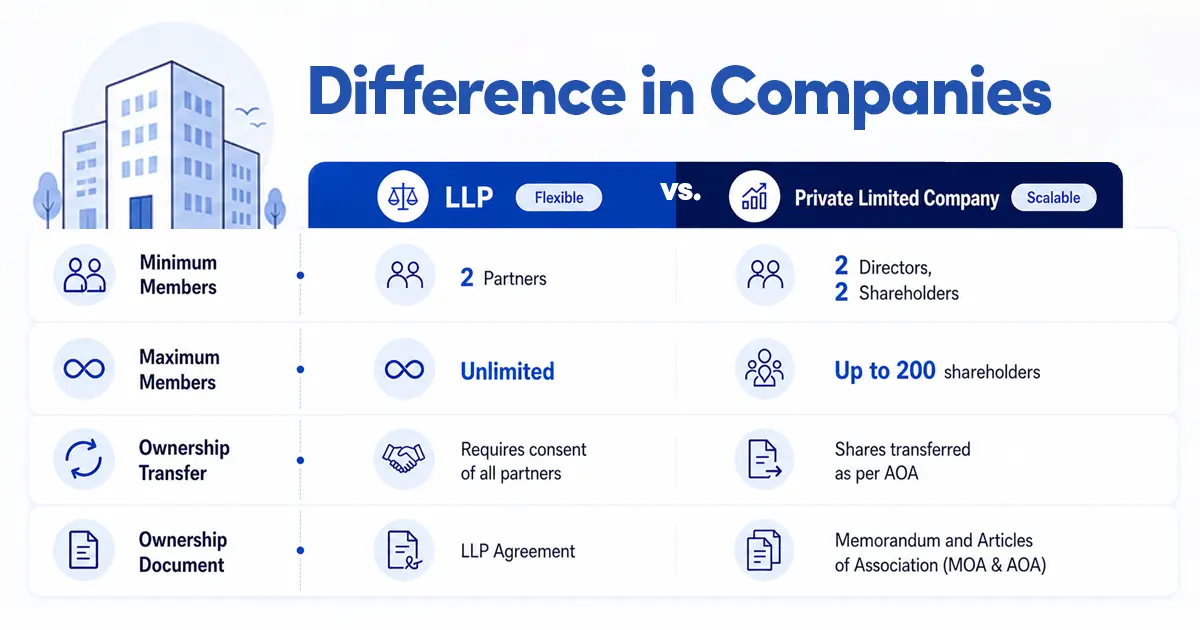
Difference Between Private Limited Company and LLP in India (2026)
Memorandum of Association (MoA) in Company Law: Meaning & Format

Types Of Voting Under Companies Act, 2013

Minimum and Maximum Number of Directors in a Public Company

Maximum & Minimum Number of Members in a Private Company
How to Run Multiple Businesses Under One Company in India?
Nidhi Company Registration Fees in India: Govt Costs & Other Charges

Oppression and Mismanagement in Company Law: Remedies & Legal Framework

Certificate of Incorporation: Meaning, Contents & How to Get It
Partnership Firm vs Private Limited Company: Which is Right for You?