

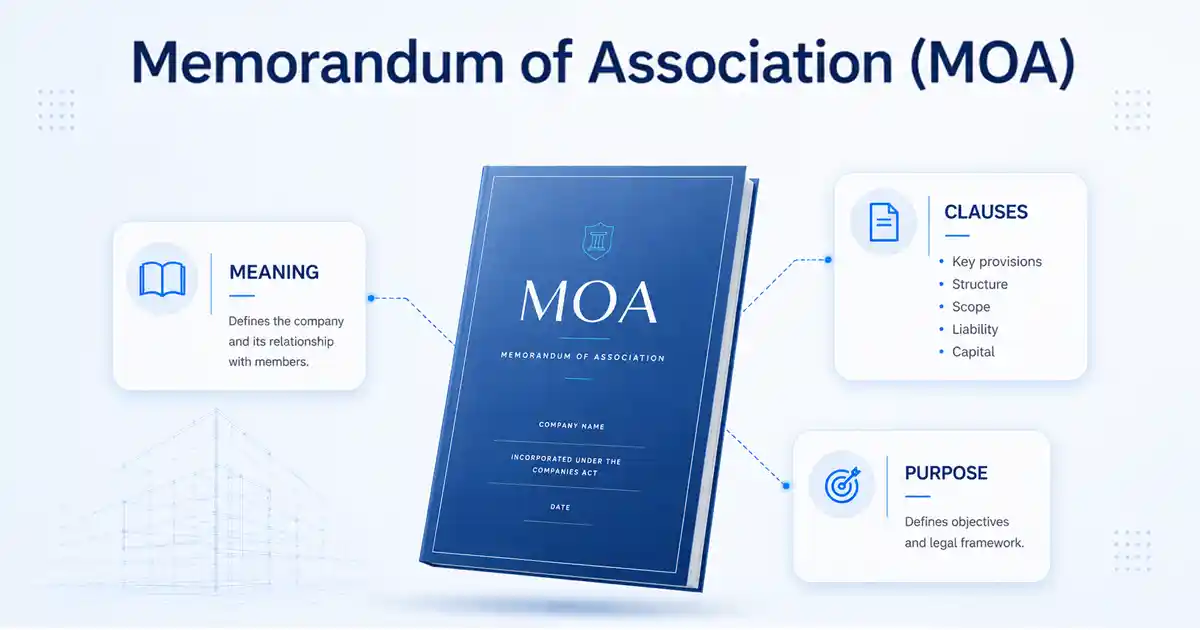
Every company incorporated in India must prepare and file a Memorandum of Association (MOA) with the ROC before it can legally begin operations. An MOA is the primary legal document filed during company incorporation that defines a name, registered office, objectives, capital, and subscribers under the Companies Act, 2013. Sections 4 and 13 of the Companies Act, 2013, govern the mandatory contents of the MOA in company law and the procedure for altering it.
The Registrar of Companies will not process any incorporation without examining a properly drafted MOA on record. In company law, the MOA works as the constitution of the company and is now found as an e-MOA (INC-33). Here is what it governs:
- The company’s official name and home state
- The scope of business activities that it can legally carry out
- The liability of its members toward the company’s debts
- Its relationship with shareholders, creditors, investors, banks, and regulatory authorities.
This guide covers the MOA meaning, its legal framework under the Companies Act, 2013, the six clauses it must contain, the purpose it serves, and the process for altering it when required.
Key Takeaways
- The Memorandum of Association acts as the foundational legal document of a company and defines its identity at the time of incorporation.
- Sections 4 and 13 of the Companies Act, 2013 govern its contents, structure, and alteration process.
- The MOA sets clear limits on business activities, ensuring the company operates only within its approved scope.
- It protects shareholders, creditors, and investors by defining liability, capital structure, and business boundaries.
- The document contains six mandatory clauses, including Name, Registered Office, Object, Liability, Capital, and Subscription Clauses.
- Any modification in the MOA requires shareholder approval and ROC filing, with specific procedures depending on the clause.
- The MOA remains a public document, accessible through the MCA portal for transparency and regulatory compliance.
MOA Format and Sample Under Schedule I
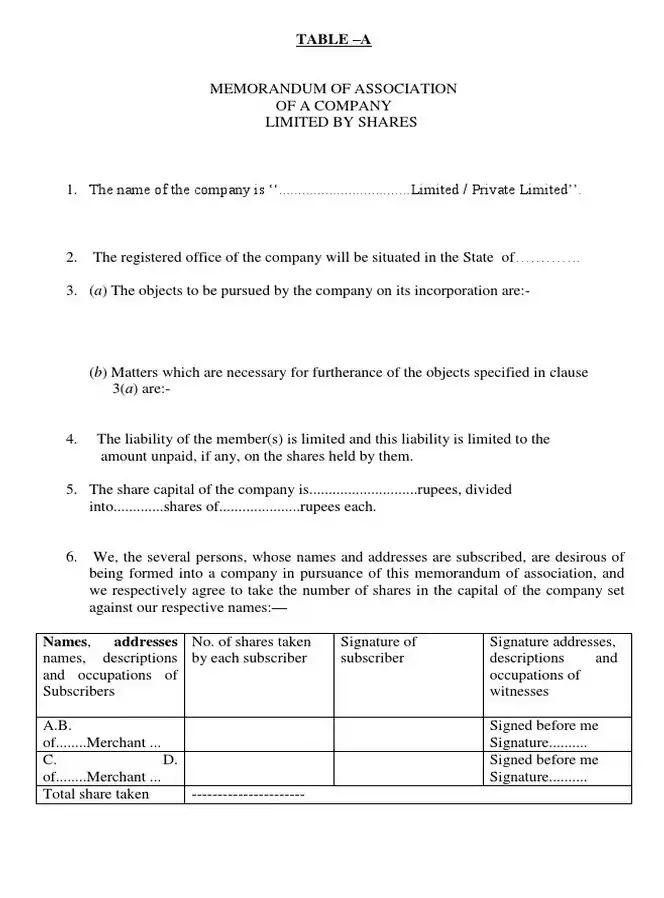
Section 4(6) of the Companies Act, 2013, prescribes the format of the MOA through Tables A to E under Schedule I. Every company must select the table format that matches its classification under the Companies Act:
- Table A applies to companies limited by shares
- Table B applies to companies limited by guarantee without share capital
- Table C applies to companies limited by guarantee with share capital
- Table D applies to unlimited companies without share capital
- Table E applies to unlimited companies with share capital
The image below shows a sample MOA format under Table A, which applies to the most common company type in India, a company limited by shares.
Purpose of the Memorandum of Association
The Memorandum of Association does much more than fulfill an incorporation formality. MOA’s importance can be understood through the following roles it performs:
- It establishes the company’s legal identity by recording its official name, home state, and objectives in an official government-recorded public document.
- It protects shareholders and creditors by defining the business scope, ensuring their funds are not used for unauthorized activities.
- It prevents ultra vires acts by ensuring any activity outside the Object Clause has no legal effect and cannot be legally enforced or accepted.
- It provides full transparency about what a company is legally authorized to do, helping investors, banks, and partners assess risk before entering agreements.
- It supports regulatory compliance by helping authorities assess licenses, tax obligations, and business activities against defined legal boundaries.
Six Clauses of the Memorandum of Association: Contents of MOA
The contents of the Memorandum of Association are organized into six mandatory clauses under Section 4 of the Companies Act, 2013:
1. Name Clause: The Name Clause records the company’s official registered name. During the incorporation of a private limited company, the company name must end with “Private Limited,” while Public Companies must end with “Limited,” and Section 8 companies are exempt. A Section 8 company drafts its MoA in Form INC-13. The MCA screens every name against existing registrations and trademarks and rejects any identical or similar name.
2. Registered Office Clause: This clause states the state where the company’s registered office is located. The company does not need to give the full address at incorporation, but must inform the ROC within 30 days. All government and court communications go to this address.
3. Object Clause: The Object Clause defines what business the company can legally carry out. Any act outside this clause is ultra vires and void. Even unanimous shareholder approval cannot validate such an act. Precise drafting of this clause is therefore critical.
4. Liability Clause: This clause sets the financial limit each member holds toward company debts. Members of a company limited by shares pay only the unpaid amount on their shares. Members of a guarantee company contribute a fixed amount on winding up. Unlimited companies carry full personal liability. Courts can still hold members of a limited company personally liable through the lifting of the corporate veil in cases of fraud or misuse.
5. Capital Clause: The Capital Clause states the company’s total authorized share capital and its division into shares. For example, ₹10 lakh divided into 1,00,000 equity shares of ₹10 each. The MOA does not include paid-up capital as that appears in separate ROC filings.
6. Subscription Clause: This clause records the names, details, and signatures of the founding subscribers. A private limited company needs at least two subscribers, a public company needs seven, and a One Person Company needs one. Each signature is a binding legal commitment to acquire shares.
Memorandum of Association (MOA) vs Articles of Association (AOA)
The MOA and the Articles of Association serve different purposes. The MOA defines the company’s external limits and identity. The Articles of Association govern internal management within those limits. Where any AOA provision conflicts with the MOA, the MOA is given precedence.
The table below highlights the key differences between the two documents:
| Basis | Memorandum of Association | Articles of Association |
| Purpose | Defines external scope and company identity | Governs internal management and operations |
| Legal status | Supreme document; overrides the AOA | Subordinate to MOA; must stay within its limits |
| Alteration | Special resolution; some clauses need extra approval | Special resolution; generally simpler to change |
Under Section 7(1)(a) of the Companies Act, 2013, every company must submit both the MOA and AOA at the time of incorporation. The subscribers to the memorandum, meaning the founding members, must draft and sign both documents before filing them with the Registrar of Companies.
Alteration of the Memorandum of Association
Section 13 of the Companies Act, 2013, governs the alteration of the Memorandum of Association. Every clause can be altered, but each follows a specific approval and filing process.
The below-mentioned are general procedures that apply to all clause changes:
- The Board of Directors passes a resolution recommending the alteration and authorizes a general meeting.
- Shareholders pass a special resolution with at least 75% of the votes in favor.
Once passed, the filing requirement depends on the clause being altered:
- Object Clause: File Form MGT-14 with the ROC within 30 days. Under Section 117(2), late filing attracts a penalty of ₹10,000 plus ₹100 per day on the company, capped at ₹2 lakh. Each officer in default faces the same penalty, capped at ₹50,000.
- Registered Office (inter-state shift): Under Section 13(4) read with Rule 30 of the Companies (Incorporation) Rules, 2014, the company must obtain Central Government approval. The Central Government has delegated this power to the Regional Director, MCA, who processes the application through Form INC-23. No inter-state shift takes effect without this order.
- Capital Clause: An increase in authorized capital needs only an ordinary resolution under Section 61, unless the articles require a special resolution. File Form SH-7 under Section 64 with the ROC within 30 days.
- Name Clause: Pass a special resolution, file MGT-14, and obtain ROC approval through Form INC-24. The ROC then issues a fresh Certificate of Incorporation.
Any act a company performs outside its MOA is ultra vires and void, and directors who authorize it can be held personally liable.
