ITR-3 Filing Online in India
File your ITR-3 online with RegisterKaro - the return for individuals and HUFs with business or professional income. We handle income computation, deductions, tax credits, and e-verification.
 ITR-3 Eligibility AssessmentBusiness and Professional Income ReportingP&L, Balance Sheet & Depreciation SchedulesTax Audit (Sec 44AB) & Books of Account SupportF&O, Capital Gains & Partner-Income Reporting


 What Sets Us ApartWhat Sets Us Apart
What is the ITR-3 Form?
ITR-3 is an Income Tax Return form for individuals and Hindu Undivided Families (HUFs) earning income from a business or profession. It applies to eligible taxpayers who are not eligible to file ITR-1, ITR-2, or ITR-4. Sole proprietors, self-employed professionals, contractors, and insurance agents earning commission commonly use ITR-3.
It allows eligible taxpayers to report business profits alongside income from other sources. Apart from business or professional income, ITR-3 can cover:
- Salary or pension
- Income from house property
- Capital gains
- Income from other sources, such as interest and dividends
- Taxable interest or remuneration from a partnership firm, where applicable
- Foreign income and foreign asset disclosures, where applicable
The form also captures relevant details of business accounts, deductions, tax payments, and tax credits. The schedules and disclosures required depend on the taxpayer's income sources and circumstances.
Is ITR-3 the Right Form For You?
The right return form depends on how your income is computed and what you earn. Use this table as a quick guide before you start:
| Taxpayer situation | General direction |
| Business or professional income under regular provisions | Assess ITR-3 eligibility |
| Eligible presumptive income under Sections 44AD, 44ADA or 44AE | Check whether ITR-4 is available |
| Business income plus salary or capital gains | Check ITR-3 eligibility and other conditions |
| Company or LLP | Use the applicable entity return, not ITR-3 |
Latest Changes in ITR-3 for AY 2026-27
The Income Tax Department has introduced changes to ITR-3 for AY 2026-27, covering income earned during FY 2025-26. These changes affect income reporting, deductions, and taxpayer disclosures.
- Section 44BBD reporting fields have been added for eligible non-residents earning income from specified services or technology-related activities covered by this section, including gross receipts and net profit.
- The form provides separate fields for speculative business turnover, gross profit, expenses, and net income.
- The form includes separate fields for Futures and Options (F&O) turnover and income, which must be disclosed separately from other business income.
- Taxpayers must report relevant details of partnership firms in which they are partners. Applicable interest and remuneration must also be reported under the correct income schedules.
- Schedule VDA requires transaction-wise details for transfers of virtual digital assets, including acquisition dates, transfer dates, cost, and consideration.
- The capital gains schedule no longer requires the earlier split between transfers made before and after 23 July 2024.
- Taxpayers claiming a deduction under Section 80GGC must provide the political party’s name and PAN.
- Taxpayers claiming a deduction under Section 80G must provide additional details, including the transaction reference number and bank IFSC code.
- A secondary address field has been added to Part A – General Information for communication purposes.
- Section 234-I introduces a fee for revised returns filed after 31 December. For AY 2026-27, the fee is ₹1,000 where total income does not exceed ₹5 lakh and ₹5,000 where it exceeds ₹5 lakh, subject to the applicable conditions.
These changes apply to the relevant taxpayers and transactions. The information required depends on the income reported and the deductions claimed.
Who Can File ITR-3 in India?
Individuals and Hindu Undivided Families (HUFs) can file ITR-3 if they earn income from a business or profession and are not eligible to file ITR-1, ITR-2, or ITR-4. The following categories may need to use this form, depending on their income and filing conditions.
1. Business Income
Individuals running a business may need ITR-3 when their income must be reported under the regular provisions rather than an eligible presumptive taxation scheme. Examples include:
- Sole proprietorships involved in trading or retail
- Manufacturing businesses
- Service-based businesses
- Business activities involving taxable speculative or other trading income
2. Professional Income
Professionals earning income from their independent practice, consultancy, or freelance work may need ITR-3, depending on their eligibility for other forms. Examples include:
- Doctors and medical practitioners
- Chartered accountants and lawyers
- Architects and engineers
- Consultants and freelancers
3. Other Income Alongside Business Income
With ITR-3, eligible taxpayers can report business or professional income along with income from other applicable sources. These may include:
- Salary or pension
- Income from house property
- Capital gains
- Interest and dividend income
- Foreign income and foreign asset disclosures, where applicable
- Income from virtual digital assets, including cryptocurrency transactions, where applicable
4. Income from a Partnership Firm
Individuals who are partners in a partnership firm may need to report taxable income received from the firm in their ITR-3. This can include:
- Interest received on capital, where taxable
- Remuneration or salary received as a working partner, where taxable
- Commission or bonus forming part of taxable remuneration, where applicable
A partner’s share of profit from a firm is generally exempt under Section 10(2A) of the Income-tax Act, 1961. This exempt income should be reported in Schedule EI (Exempt Income) of ITR-3. The firm itself must file its applicable income tax return.
Who Cannot File ITR-3?
ITR-3 is specifically meant for individuals and HUFs with business or professional income who do not qualify for ITR-1, ITR-2, or ITR-4. The following taxpayers must use another applicable return form:
- Companies: Generally file ITR-6, unless they are required to file ITR-7. A company should also track its Pvt Ltd compliance deadlines alongside its income tax return.
- Limited Liability Partnerships (LLPs): Generally file ITR-5.
- Partnership Firms: Generally file ITR-5. Eligible resident firms other than LLPs may opt for ITR-4 if they meet the presumptive taxation conditions.
- Trusts and Certain Institutions: Entities required to file ITR-7 must use that form. Other entities, including non-profit companies with their own Section 8 company compliance requirements, must select the form applicable to their legal status.
- Individuals Eligible for ITR-1: Taxpayers meeting ITR-1 conditions should use that form.
- Individuals and HUFs Eligible for ITR-2: Taxpayers without business or professional income who meet ITR-2 conditions should use ITR-2.
- Eligible Taxpayers Choosing ITR-4: Resident individuals, HUFs, and eligible firms other than LLPs may choose ITR-4 when they satisfy the applicable presumptive taxation requirements.
What is the Structure of the ITR-3 Form?
ITR-3 includes general information, business financial statements, income schedules, deduction details, tax calculations, and verification. The sections required depend on the taxpayer’s income sources, business records, and applicable reporting rules.
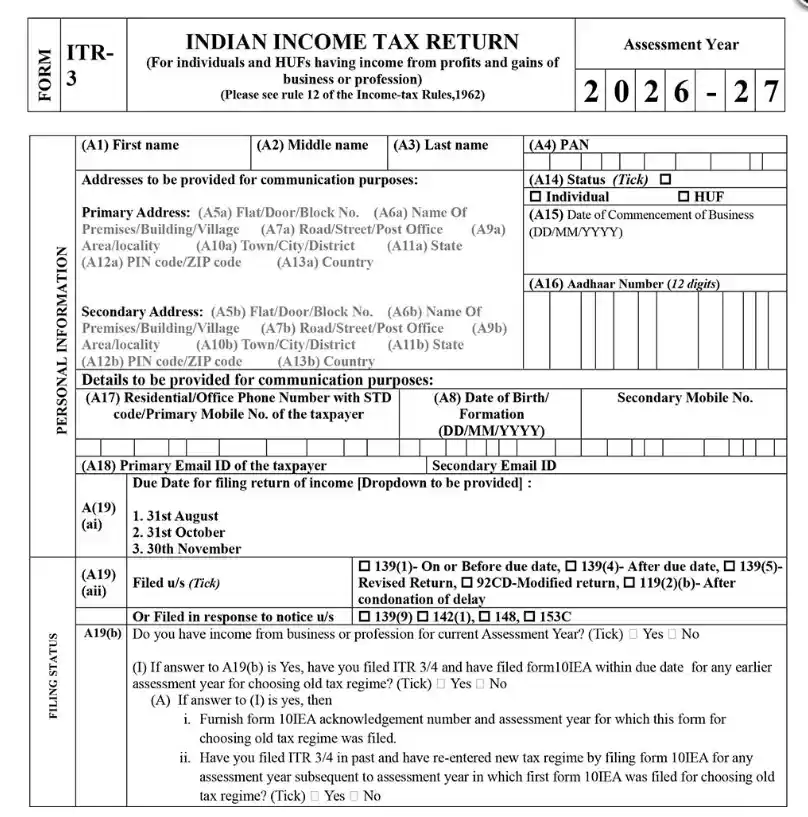
Part A: General Information and Financial Details
Part A captures personal details and information about the taxpayer’s business or profession. Its main sections include:
- Part A-GEN: General information, filing status, and nature of business or profession.
- Part A-BS: Balance sheet details or specified financial information for taxpayers who do not maintain regular books of account.
- Part A-Manufacturing Account: Manufacturing costs and related figures, where applicable.
- Part A-Trading Account: Trading receipts, purchases, and gross profit.
- Part A-P&L: Business or professional income and expenses.
- Part A-OI and Part A-QD: Other information and quantitative details, where required.
Schedules for Income, Deductions, and Tax Reporting
ITR-3 contains schedules for different income sources, deductions, losses, and disclosures. The main schedules include:
- Schedule S: Income from salary.
- Schedule HP: Income from house property.
- Schedule BP: Income from business or profession.
- Schedule CG: Income from capital gains.
- Schedule 112A: Specified long-term capital gains covered by Section 112A.
- Schedule OS: Income from other sources.
- Schedules DPM, DOA, and DEP: Depreciation calculations for eligible business assets.
- Schedules CYLA, BFLA, and CFL: Set-off and carry-forward of eligible losses.
- Schedule VI-A: Deductions under Chapter VI-A.
- Schedule 80G: Donations eligible for deduction under Section 80G.
- Schedule IF: Details of partnership firms in which the taxpayer is a partner.
- Schedule PTI: Pass-through income from business trusts and investment funds, where applicable.
- Schedules FA and FSI: Foreign assets and foreign income, where applicable.
- Schedule GST: Turnover or gross receipts reported for GST purposes.
- Schedule AL: Details of assets and liabilities. This schedule generally applies when the taxpayer’s total income exceeds ₹1 crore. The threshold increased from ₹50 lakh to ₹1 crore from AY 2025-26.
- Schedule VDA: Income from transfers of virtual digital assets.
Other schedules cover special-rate income, tax relief, unabsorbed depreciation, alternative minimum tax, specified deductions, and other disclosures. Taxpayers need to complete only the schedules relevant to their circumstances.
Part B: Total Income and Tax Liability
Part B summarizes the taxpayer’s income and calculates the tax payable after applicable deductions, credits, and adjustments. It includes:
- Part B-TI: Computation of total income.
- Part B-TTI: Computation of tax liability on total income.
- Verification: Confirmation that the information provided in the return is accurate and complete.
Documents Required for ITR-3 Filing
Keep the documents relevant to your income, business or profession, deductions, and tax payments ready before filing ITR-3. Requirements vary according to your income sources and applicable reporting rules.
Most common documents to file the ITR-3 form are:
- PAN and Aadhaar Details
- Bank Account Details and Statements
- Form 16: If you have salary income.
- Form 16A and Other TDS Certificates: For tax deducted from non-salary income, where applicable.
- Form 26AS, AIS and TIS: To reconcile tax credits, reported transactions and other tax-related information.
- Business or Professional Records: Sales and purchase invoices, expense receipts, and details of income and expenses.
- Profit and Loss Account and Balance Sheet: Where required based on your accounting and reporting obligations.
- GST Returns and Turnover Records: If registered under GST or relevant to your business.
- Capital Gains Statements: For the sale of shares, mutual funds, property, or other capital assets, where applicable.
- Investment and Deduction Proofs: Documents supporting eligible deductions and claims.
- Advance Tax and Self-Assessment Tax Challans: Proof of tax payments made during the year.
- Depreciation and Loan-Interest Records: Where relevant to business assets or eligible interest expenses.
- Tax Audit Report: Form 3CA or Form 3CB, along with Form 3CD, where a tax audit is required.
- Foreign Asset and Income Details: Where foreign income or assets must be disclosed.
These documents help you report income accurately, reconcile tax credits, and support claims made in your return. You generally do not need to attach supporting documents to the ITR, but should retain them for your records and any future verification by the Income Tax Department.
How to File ITR-3 Online in 2026-27?
The ITR-3 filing process involves reporting your business or professional income, checking tax details, and submitting the return through the Income Tax Department’s e-filing portal. Follow these steps to file ITR-3 for AY 2026-27:
- Log in to the e-filing portal: Visit the official Income Tax e-filing portal and sign in using your PAN as the user ID and your password.
- Select ITR-3: Go to e-File > Income Tax Returns > File Income Tax Return. Select AY 2026-27 and choose ITR-3.
- Choose the filing mode: Select online filing to complete the return on the portal or offline filing to use the Income Tax Department’s ITR utility.
- Review pre-filled details: Verify your personal information, income details, tax deducted, tax payments, and tax credits. Correct any errors and add missing information.
- Report income and deductions: Enter your business or professional income, salary, house property income, capital gains, and other applicable income. Report eligible deductions, losses, and taxes paid.
- Validate the return: Review the relevant schedules, resolve validation errors, and check the calculated tax payable or refund. Confirm that the details match your financial records.
- Submit the return: Preview the completed ITR-3 and submit it. For offline filing, generate the JSON file using the utility and upload it through the portal or follow the utility’s prescribed submission process.
- Verify the return: Complete e-verification using an available method, such as Aadhaar OTP, EVC through an eligible bank or demat account, net banking, or DSC, subject to the applicable requirements. You may also submit a signed ITR-V through the prescribed physical verification process.
After filing, save the acknowledgment for your records. Verify your return within 30 days of filing. If you submit a physical ITR-V, it must reach the Centralized Processing Centre within the prescribed period. Late verification may affect the date on which the return is treated as filed.
Due Date for Filing ITR-3 for FY 2025-26
The due date for filing ITR-3 for AY 2026-27 depends on the taxpayer’s category and whether a tax audit or transfer pricing report is required. The applicable deadlines are listed below:
| Taxpayer category | ITR-3 filing due date | Tax audit or TP report due date |
| Non-audit business cases | 31 August 2026 | Not applicable |
| Tax-audit cases covered by the September 2026 extension | 21 November 2026 | 21 October 2026 |
| Transfer Pricing (TP) cases | 30 November 2026 | 31 October 2026 |
Filing the return by the applicable deadline helps avoid late-filing fees and interest, where applicable. Taxpayers should also complete any required audit reporting within the prescribed time.
Note: Some deadlines, including the original non-audit filing date, have already passed as of October 2026.
ITR-3 Filing Fees and Penalties for Late Filing
The cost of filing ITR-3 depends on your income sources, business records, and need for professional assistance. Missing the filing deadline may also lead to late fees, interest, and restrictions on certain tax benefits.
Cost to File ITR-3
ITR-3 filing charges vary depending on the filing method and complexity of your tax return. The following table provides indicative estimates for different filing options:
| Filing Method | Estimated Cost |
| Self-filing through the government portal | Free |
| Self-filing through a private platform | ₹500–₹2,500 |
| CA-assisted online filing | ₹3,000–₹6,500+ |
| Chartered Accountant for complex business or F&O income | ₹3,000–₹8,000+ |
| Tax audit services, where applicable | ₹15,000–₹40,000+ |
These are indicative estimates, not fixed charges. The final fee depends on transaction volume, accounting records, turnover, and return complexity. Tax audit fees are generally charged separately from ITR filing fees.
Penalties for Late Filing of ITR-3
Filing ITR-3 after the applicable deadline can result in the following fees, interest, and tax consequences.
- Late filing fee under Section 234F: ₹5,000 if total income exceeds ₹5 lakh, or ₹1,000 if total income does not exceed ₹5 lakh.
- Interest under Section 234A: Interest at 1% per month or part of a month may apply to unpaid tax for the delay in filing.
- Loss of carry-forward benefits: Business and capital losses generally cannot be carried forward if the return is filed late, subject to applicable exceptions.
- Delayed refunds: Late filing may delay the processing of an eligible tax refund.
For AY 2026-27, a belated return can generally be filed by 31 December 2026, or before completion of the assessment, whichever is earlier, subject to applicable provisions. Since the original non-audit filing deadline has passed, eligible taxpayers should check their filing status and act within the permitted period.
Difference Between ITR-3 and ITR-4
ITR-3 and ITR-4 both report business or professional income, but they apply to different taxpayers and income-computation methods. ITR-3 covers eligible individuals and HUFs who are not eligible for ITR-1, ITR-2, or ITR-4, while ITR-4 is an optional simplified return for taxpayers meeting specific presumptive-taxation conditions.
The table below highlights the main differences between the two forms for AY 2026-27:
| Particulars | ITR-3 | ITR-4 |
| Business Income | Business or professional income reported under the applicable regular provisions or other eligible treatment | Eligible business or professional income computed under Sections 44AD, 44ADA or 44AE |
| Professionals | Professionals who do not qualify for ITR-4 or report income under the applicable regular provisions | Eligible resident professionals who meet Section 44ADA and ITR-4 conditions |
| Company Directors | May be eligible, subject to ITR-3 conditions | Not eligible |
| Total Income Limit | No ₹50 lakh ceiling for using the form | Generally up to ₹50 lakh, subject to other eligibility conditions and the treatment of eligible Section 112A gains |
| Books of Accounts | Accounting and audit requirements depend on the taxpayer’s circumstances and applicable provisions | Regular books are generally not required to compute eligible presumptive income, but other record-keeping requirements may apply |
| Eligible Taxpayers | Individuals and HUFs who have business or professional income and are not eligible for ITR-1, ITR-2 or ITR-4 | Resident individuals, HUFs and firms other than LLPs that satisfy the applicable conditions |
If you report business or professional income under regular provisions, ITR-3 is generally the relevant form. ITR-4 may be used as an option only if you meet its presumptive taxation and other eligibility requirements.
Connect with RegisterKaro and let our experts handle the legal hassle while you grow your business.
Frequently Asked Questions (FAQs)
Who should file ITR-3?
Individuals and Hindu Undivided Families (HUFs) with business or professional income generally file ITR-3 if they are not eligible to use ITR-1, ITR-2, or ITR-4.
Can salaried individuals or freelancers file ITR-3?
Yes, salaried individuals who also earn business or professional income may need ITR-3. Freelancers may use ITR-3 if they do not qualify for ITR-4 or another applicable form.
What is the due date for filing ITR-3 for AY 2026-27?
For non-audit cases, the extended due date is 31 August 2026. For specified tax-audit cases covered by CBDT Circular No. 07/2026, the due date is 21 November 2026. Transfer-pricing cases generally have a due date of 30 November 2026.
What is the difference between ITR-3 and ITR-4?
ITR-3 covers eligible individuals and HUFs with business or professional income who cannot use ITR-4. ITR-4 is an optional simplified return for eligible resident individuals, HUFs, and firms other than LLPs reporting qualifying presumptive income, subject to additional conditions.
Is a tax audit mandatory for every ITR-3 filer?
No, a tax audit is required only when the taxpayer meets the conditions under the applicable provisions. Turnover, gross receipts, cash transactions, and other statutory criteria may affect the requirement.
What happens if I file ITR-3 after the due date?
A belated return may attract a late-filing fee under Section 234F and interest under Section 234A, where applicable. Late filing may also restrict the carry-forward of certain losses. For AY 2026-27, the general deadline for a belated return is 31 December 2026, subject to the applicable provisions.
Can I revise my ITR-3 after filing?
Yes, for AY 2026–27, you can generally file a revised return by 31 March 2027 or before the assessment is completed, whichever is earlier, subject to applicable provisions. Revision remains free until 31 December 2026. From 1 January 2027, a fee under Section 234-I applies: ₹1,000 if your total income does not exceed ₹5 lakh and ₹5,000 if it exceeds ₹5 lakh.
How long do I have to e-verify ITR-3?
You must generally e-verify your return or submit the signed ITR-V within 30 days of filing. If verification is delayed, the date of filing may change, and late-filing consequences may apply. An unverified return may be treated as invalid.
ITR 3 for which income is applicable?
ITR-3 is applicable to individuals and Hindu Undivided Families (HUFs) earning income from a business or profession, including income from proprietorship businesses, freelancing, consultancy, and professional practice. It may also be used by taxpayers with capital gains, house property income, salary, or other sources, subject to the applicable eligibility conditions.

Reviewed by
Joel DsouzaJoel Dsouza is a Chartered Accountant (CA) and compliance expert with over 7 years of hands-on experience in company registration, tax structuring, GST, ROC filings, and MCA compliance. As a qualified member of the Institute of Chartered Accountants of India (ICAI) and Co-Founder at RegisterKaro, he has personally advised more than 1,000 startups and SMEs across India, helping founders navigate incorporation, regulatory frameworks, and financial planning from Day 1. With deep expertise across all three levels of Finance and Portfolio Management, Joel is committed to promoting financial literacy and simplifying India's startup ecosystem through clear, actionable guidance that entrepreneurs can act on immediately.
Why Choose RegisterKaro for ITR-3 Filing Online?
ITR-3 requires accurate reporting of business or professional income, expenses, deductions, tax credits, and other applicable income. RegisterKaro provides filing assistance to help eligible individuals and Hindu Undivided Families (HUFs) prepare their returns and meet relevant tax requirements. Our support covers the key stages of filing:
- ITR-3 Filing Assistance: Support for business owners, freelancers, consultants, and professionals who need to file ITR-3.
- Document Review: Help reviewing financial statements, income records, expense details, bank statements, and tax documents.
- Business Income Reporting: Assistance with reporting turnover, business expenses, depreciation, and eligible deductions under the applicable provisions.
- Income and Tax Credit Reconciliation: Support in checking capital gains, other income, AIS, Form 26AS, TDS, and tax payment details.
- Return Review and E-Verification: Review of the return for missing information or inconsistencies, with guidance on submission and verification.
- Deadline and Compliance Support: Guidance on applicable filing deadlines, tax audit requirements, and tax payments based on your circumstances.

What Our Clients Say
View All
Piyush Mishra
 Verified
Vibha is a really great supporter and really polite and courteous. She has been extremely helpful in the process. The way in which she has guided me t... Read more

Shishira Das
VerifiedBeing new to the whole process of registering a company, Regusterkaro team made it extremely seamless. My SPOC Swati Vasisth was very helpful, patient... Read more

Manoj Kumar
Verified"Thank you for your outstanding support! Your prompt responses and expert guidance made all the difference. I truly appreciate your dedication to help... Read more

Dev Patel
VerifiedI recently got my company incorporated through Register Karo and was very happy with their service. The process was smooth from start to finish. Speci... Read more

Aayush Chaubey
VerifiedAmazing service. The service provided by RegisterKarp was fast and efficient. Kudos to swati and preet from their team for doing all the due diligence... Read more

amit gupta
VerifiedI took their Dormancy service and process was fast and smooth. A special shoutout to Mehul , who handled my case—he was professional, proactive, and... Read more

shilpa deshmukh
VerifiedWe had a good experience working with Sumit Kumar. He was incredibly patient in addressing all our queries and diligent with follow-ups, which signifi... Read more

Akshit Singh Pathani...
VerifiedRegistration process was smoothly handled by the spoc and the company got incorporated within 20 days, quite impressed.Great job has been done by the... Read more

Satya prakash Singh
VerifiedHad a great experience with RegisterKaro. The process was smooth and straightforward, and the team was professional and helpful throughout. They expla... Read more

Shivani Nagwanshi
VerifiedI really appreciate register karo because I am new in company incorporation process I don't know the procedure but register karo help me a lot and mak... Read more
Related Blogs
View All
How to Convert Sole Proprietorship to LLP in India (2026): Process & Fees

LLP Audit Applicability 2026: Statutory & Tax Audit Limits

How to Convert Proprietorship to Private Limited Company

LLP Form 8: Due Date, Late Fee, Filing Process, and Format

Trademark Class 35: Advertising & Business Services in India

Complete Overview of Can Director Give Loan to a Company

CEO Appointment in Private Limited Company: Procedure Guide

Debentures Under the Companies Act, 2013: Section 71 Explained

Deemed Public Company Under the Companies Act, 2013: Meaning and Compliance

Difference Between Brand and Company in India: 2026 Guide