

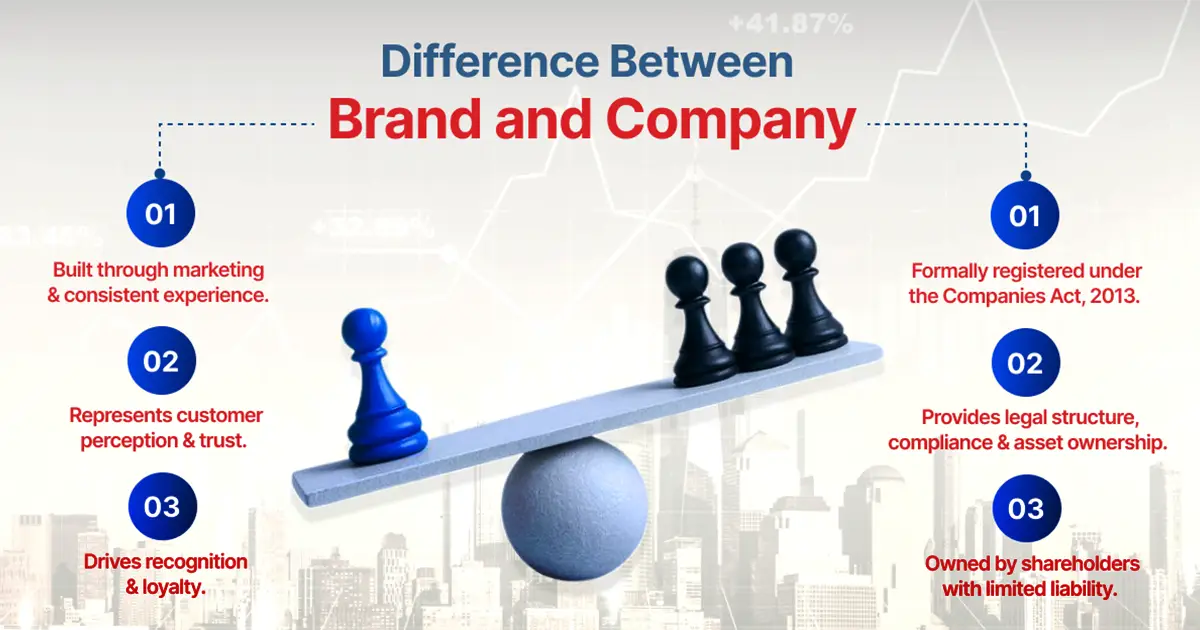
The difference between a brand and a company comes from what each one is. A company is a legal entity created through formal registration with the Ministry of Corporate Affairs. It can own assets, sign contracts, and be sued in its own name. A brand is the identity and perception a business builds through its name, logo, and reputation. It has no separate legal existence unless backed by a trademark.
The two concepts work together but are not interchangeable. A company can operate for decades under one registered name and run multiple brands. A business can also build a strong brand before registering as a company.
Key Takeaways
- A company is a legal entity registered under the Companies Act, 2013; a brand is a market identity with no separate legal existence of its own.
- A company name and brand name can differ freely, HUL owns Dove, Lux, and Surf Excel, none of which match the company name.
- Company registration takes 3–15 working days; trademark registration for a brand takes 18–24 months.
- Companies now have no minimum capital requirement, since the Companies (Amendment) Act, 2015.
- A brand only gets legal protection through trademark registration under the Trade Marks Act, 1999, not through company registration.
- A business, sole proprietorship, partnership, or LLP can build a strong brand without ever registering as a company.
- Without trademark registration, others can freely use the same brand name, reducing market exclusivity.
What is a Company?
A company is a legally registered entity under the Companies Act, 2013, in India. It has a separate legal identity, allowing it to own assets, enter into contracts, and take legal action independently.
In India, businesses register companies with the Ministry of Corporate Affairs (MCA) through the Registrar of Companies (ROC). The registration process involves:
- Filing the SPICe+ (INC-32) form for incorporation. This web-based form combines up to 10 services, including incorporation, DIN allotment, PAN, TAN, GSTIN, EPFO, ESIC, Professional Tax, and bank account opening.
- Reserving a unique company name.
- Filing the Memorandum of Association (MOA) and Articles of Association (AOA).
- Obtaining a Company Registration Certificate.
Once incorporated, the company receives a Corporate Identification Number (CIN) that serves as its official identity in all legal and regulatory dealings.
A company creates the legal structure behind the products and services that customers use. Some examples of well-known Indian companies include:
- Titan Company Limited
- Hindustan Unilever Limited
- Mahindra & Mahindra Limited
- Maruti Suzuki India Limited
These companies own the business, sign contracts, manage operations, and are legally accountable, while their various brands interact with customers in the market.
Key Features of a Company
A company operates under defined legal and regulatory rules and boasts the following features:
- Perpetual existence: A company continues to exist even when its owners change, retire, or pass away.
- Limited liability: Shareholders are only liable for the company’s debts up to the amount they have invested, protecting personal assets.
- Formal governance: A company must maintain statutory registers, file annual returns with the ROC, hold board meetings, and comply with MCA filing requirements.
- Transferable ownership: Shares in a company can be transferred or sold, enabling changes in ownership without affecting the company’s legal continuity.
Note: Since the Companies (Amendment) Act, 2015, private and public companies do not need minimum paid-up capital to incorporate. Earlier, the requirement was ₹1 lakh for private companies and ₹5 lakh for public companies.
What is a Brand?
A brand is an identity, name, symbol, feeling, or perception that exists in customers’ minds. It represents what people think, feel, and expect when they interact with a product or service. It is built through consistent marketing, product quality, customer experience, and communication over time.
A brand can be a company’s name, a product line name, or a combination of both. Some popular brands in India are:
- Tanishq and Fastrack, both from Titan Company Limited
- Dove, Lux, Surf Excel, and Lifebuoy by Hindustan Unilever Limited
- Mahindra Cars and Mahindra Tractors, part of Mahindra & Mahindra Limited
- Maruti Suzuki Alto and Maruti Suzuki Swift, under Maruti Suzuki India Limited
When a customer sees a brand like Tanishq or Dove, they associate it with reliability and quality. This highlights the difference between a brand and a company, where the company creates the structure and the brand builds recognition.
Key Elements of a Brand
A strong brand develops through several important elements:
- Name and logo: The visible identifiers that customers recognize and remember (Amul Girl mascot).
- Tagline and messaging: The words and tone a business uses to communicate its values (Nike’s “Just Do It” slogan).
- Customer perception: This reflects what customers believe about quality, reliability, and personality (Apple is often seen as premium and innovative).
- Experience: The feeling customers get from every interaction with the product, the packaging, the website, and the customer service (Amazon’s fast delivery and easy returns).
- Reputation: The accumulated trust that builds over time through consistent delivery of promises (Tata is widely trusted for reliability and ethics).
Difference Between Brand and Company: Complete Comparison
The table below covers the key differences between a brand and a company across the parameters that matter most:
| Basis | Company | Brand |
|---|---|---|
| Meaning | A legally registered entity under the Companies Act, 2013 | A market identity created through customer perception, marketing, and experience |
| Nature | Exists as a legal and tangible structure | Exists as an intangible perception in customers’ minds |
| Legal Basis | Operates under the Companies Act, 2013, and MCA rules, as a distinct legal entity | Has no separate legal identity of its own, but gains legal protection through the Trade Marks Act, 1999 |
| Registration Authority | Ministry of Corporate Affairs (MCA) | Controller General of Patents, Designs and Trademarks, under the Ministry of Commerce |
| Registration Timeline | Usually 3 to 15 working days | 18 to 24 months for full trademark registration |
| Purpose | Provides a legal structure to run and manage business operations | Builds recognition, trust, and differentiation in the market |
| Ownership & Rights | Shareholders own the company; it can contract, own assets, hire, and sue or be sued | The entity or individual owns the brand and can license, franchise, or enforce exclusive rights over its use |
| Risk if Not Registered | Can’t legally operate as a registered entity (except sole proprietorships and partnerships); faces penalties | Others can freely use the same name, reducing market exclusivity |
| Examples | Titan Company Limited, Hindustan Unilever Limited, Tata Motors Limited | Tanishq (Titan), Dove (HUL), Jaguar (Tata Motors) |
How Do Brand and Company in India Complement Each Other?
A company and a brand serve different purposes, but both are important. The company provides the legal structure, manages operations, and ensures compliance with laws. The brand creates recognition, builds trust, and connects with customers. Together, they help a business grow, protect its identity, and stand out in the market.
For example, Titan Company Limited manages operations, production, and legal compliance. Tanishq delivers a premium jewelry experience. Similarly, ITC Limited manages diverse product lines. Brands like Aashirvaad, Sunfeast, and Classmate build distinct identities and connect with customers.
In short, the company provides the foundation and stability. The brand brings the business to life in customers’ minds.
Can a Company Name and Brand Name Be Different?
A company can have a different brand name, and this practice is very common in Indian business. Many large companies operate multiple brands under a single registered company.
For example, Hindustan Unilever Limited is the registered company, and its brands include Surf Excel, Dove, Lux, Lifebuoy, Knorr, and Horlicks. None of these brand names match the company name. A customer who uses Dove soap may not know or care that the company behind it is Hindustan Unilever Limited. What matters to them is the Dove brand experience, the packaging, the fragrance, and the quality they associate with it.
This separation gives large businesses significant flexibility. They can launch new brands, retire underperforming ones, or acquire existing brands without needing to change the registered company name. The legal entity stays stable while the brand portfolio evolves.
Brand vs Company vs Business: Clearing the Confusion
People often use these terms interchangeably, but they have different meanings:
- Company: A company provides a legal structure for running a business. It registers under the Companies Act, 2013, gets a CIN, and operates as a separate legal entity. Not every business needs to register as a company.
- Brand: A brand represents the identity and perception a business builds with customers. It reflects trust, quality, and customer experience. A business can build a brand without forming a company.
- Business: A business is any activity that generates income. A fruit vendor, freelancer, or startup can operate as a business. Company registration is not always required, but other registrations may apply, such as GST, a trade license, or Udyam/MSME registration, depending on the business and location.
A sole proprietor, partnership firm, LLP, or company can create and grow a brand. The legal structure determines how the business operates, while the brand shapes how customers perceive it. LLP or company can create and grow a brand. The legal structure determines how the business runs, while the brand shapes how customers perceive it.
