

LLP Form 8: Due Date, Late Fee, Filing Process, and Format

LLP Form 8, also known as the Statement of Account and Solvency, is an annual filing that every Limited Liability Partnership (LLP) must submit to the Registrar of Companies (ROC) through the MCA portal by October 30. It reports the LLP’s assets, liabilities, income, and expenditure for the financial year, along with a declaration by its designated partners regarding the LLP’s ability to meet its financial obligations.
Form 8 filing is mandatory even if your LLP had no business activity or revenue during the year. Once you incorporate an LLP, you must include Form 8 in the annual compliance with LLP, alongside the annual return in Form 11. Form 8 LLP for FY 2025-26 is due on October 30, 2026 (October 30, 2027, for FY 2026-27). Missing this attracts an additional fee of up to 30 times the normal filing fee. Under Section 34(5) of the Limited Liability Partnership Act, 2008, the LLP may also face a penalty of ₹100 per day, capped at ₹1 lakh, while each designated partner may face a penalty of up to ₹50,000.
Key Takeaways
- Form 8 of an LLP is the Statement of Account and Solvency that every LLP must file annually with the Registrar under Section 34 of the LLP Act, 2008.
- The due date for Form 8 for FY 2026-27 is October 30, 2027.
- Every LLP must file Form 8, including dormant LLPs and those with no turnover.
- At least two designated partners must sign the form using their DSCs. An audit is required if turnover exceeds ₹40 lakh or contribution exceeds ₹25 lakh.
- The filing fee ranges from ₹50 to ₹600, depending on the LLP's contribution. Late filing can attract additional fees of up to 30 times the normal fee.
- Under Section 34(5), failure to file can also attract a penalty of ₹100 per day, up to ₹1 lakh for the LLP and ₹50,000 for each designated partner.
Purpose, Format, and Legal Framework of Form 8
The purpose of Form 8 is to report an LLP’s financial position and solvency to the Registrar. It helps partners, lenders, and creditors assess whether the LLP maintains proper accounts and can meet its financial obligations. Since partners generally have limited liability, this annual filing provides creditors with useful information when evaluating the LLP before extending credit or entering into contracts.
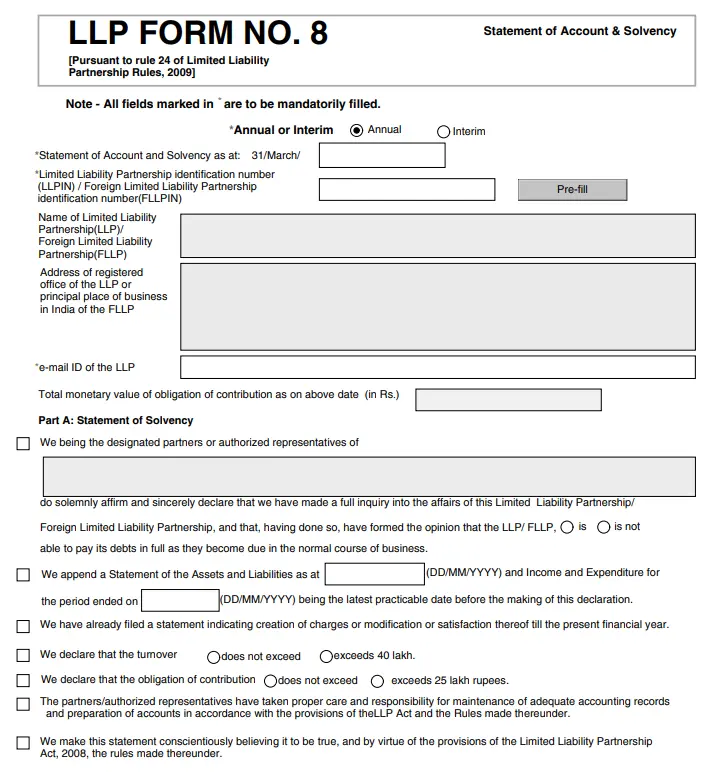
Filed online through the MCA V3 portal, LLP Form 8 consists of two parts:
- Part A, Statement of Solvency: The designated partners declare whether the LLP can pay its debts as they fall due.
- Part B, Statement of Account and Income and Expenditure: This section records the LLP’s assets, liabilities, income, and expenditure. It also captures partner remuneration and details of any charges created, modified, or satisfied during the financial year.
Before filing Form 8 online, prepare the LLP’s balance sheet, income and expenditure statement, partner remuneration details, and charge details. To review every field in advance, download the LLP Form 8 format.
Who Needs to File LLP Form 8?
Every LLP registered in India must file Form 8 for each financial year, regardless of its size, turnover, or business activity. The applicability of LLP Form 8 includes:
- LLPs with active business: All operating LLPs must report their financial position, whether they earn a profit or incur a loss.
- Dormant or inactive LLPs: LLPs that have not started operations or conducted business during the year must still file Form 8 with the applicable nil figures.
- LLPs with zero turnover: An LLP that earns no revenue must file Form 8 because Section 34 of the LLP Act, 2008, applies regardless of turnover.
- LLPs that have paused operations: Temporarily suspending business does not end an LLP’s filing obligations. It must continue filing Forms 8 and 11 until it is formally struck off or dissolved. To apply for strike-off through Form 24, it must first bring both forms up to date through the financial year of cessation. It cannot avoid pending filings by applying for strike-off.
- LLPs incorporated after September 30: Under Section 2(1)(l) of the LLP Act, 2008, an LLP incorporated after September 30 can choose to extend its first financial year beyond the immediately following March 31, up to March 31 of the next calendar year. For example, an LLP incorporated on November 15, 2026, can choose March 31, 2028, as its first financial year-end instead of March 31, 2027. In that case, it files its first Form 8 by October 30, 2028, covering the extended period.
Note: Unlike companies, LLPs cannot apply for dormant status. An inactive LLP must keep filing Form 8 until it is struck off or dissolved.
LLP Form 8 Due Date
Every LLP must file Form 8 by October 30 each year, which falls within 30 days after the end of the six months following the financial year-end. For FY 2026-27, the LLP Form 8 due date is October 30, 2027. This deadline applies to all LLPs, including those that have not started operations or earned any revenue.
The MCA’s General Circular No. 05/2026, dated October 24, 2026, extended the filing timelines for certain Companies Act forms:
- AOC-4 to December 31, 2026
- MGT-7 and MGT-7A to January 31, 2027
However, this relief covers only Companies Act forms, and no extension has been notified for LLPs, so the Form 8 and Form 11 deadlines are unchanged. An LLP that misses the October 30, 2026 deadline can still file Form 8 by paying the applicable additional fee. You can track these and other annual filing deadlines through our compliance calendar and mark the relevant dates to avoid missing them.
Details and Documents Required for LLP Form 8
Before filing LLP Form 8, gather the LLP’s identification details, finalized accounts, and solvency position. Form 8 is a web form, so these details are entered directly into its fields rather than uploaded as documents.
| Category | Details Required | Why It Matters |
| LLP information | LLP name, LLPIN, and registered office address | Identifies the LLP in the Registrar’s records |
| Financial details | Assets and liabilities as of March 31, income and expenditure, dues to micro and small enterprises, contingent liabilities, turnover, and contribution | Provides the financial information reported in Part B and helps determine whether an audit is required |
| Solvency declaration | Confirmation from the designated partners regarding the LLP’s ability to pay its debts as they fall due | Forms Part A of Form 8 |
LLP Form 8 Attachments
You must prepare the applicable supporting documents before submitting Form 8. The required attachments with LLP Form 8 include:
- Optional attachments: Up to five documents, in PDF or JPG format, up to 2 MB each, to provide any additional information. A routine Form 8 filing has no mandatory attachments.
- Instrument of charge (if applicable): The document creating or modifying a charge, which is mandatory only when Form 8 is filed for a charge.
- Charge holder’s letter (if applicable): A letter confirming that the charged amount has been repaid, which is mandatory only when filing for satisfaction of a charge.
Tip: Finalize your accounts and complete the audit, if required, well before the October 30 deadline. This gives you time to resolve discrepancies and correct filing errors before submission.
Who Needs to Sign and Certify LLP Form 8?
Before submitting Form 8 through the MCA V3 portal, make sure it has the required signatures and professional certification:
- Signatures of designated partners: At least two designated partners must digitally sign the form using their Digital Signature Certificates (DSCs), confirming the accuracy of the information provided.
- Professional certification, where required: An auditor must certify the form if the LLP’s turnover exceeds ₹40 lakh or its contribution exceeds ₹25 lakh.
Note: Since a small LLP stays within both limits, its designated partners can sign Form 8 without professional certification.
How Do You File MCA Form 8 of an LLP?
Here’s how to file Form 8 of an LLP on the MCA V3 portal:
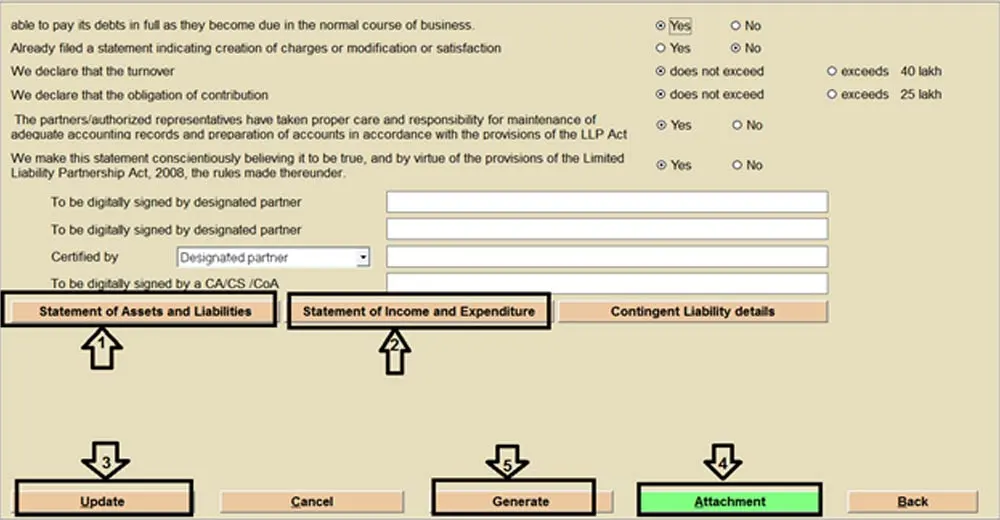
- Log in to the MCA portal: Go to mca.gov.in and sign in with the LLP’s or designated partner’s credentials. New users must register first.
- Open Form 8: Go to MCA Services > LLP E-Filing > Form 8 and select Form 8 (Statement of Account and Solvency). Choose the financial year being filed for.
- Enter the LLP details: Enter the LLPIN. The portal auto-fills the LLP’s name and registered office from MCA records.
- Complete Part A and Part B: Fill in the solvency declaration in Part A, and the assets, liabilities, income, expenditure, and changes in contribution in Part B. Make sure the figures match the LLP’s audited or finalized accounts.
- Upload the attachments: Attach the mandatory MSME disclosure, the statement of contingent liabilities (if any), and any optional supporting documents.
- Apply digital signatures: Two designated partners sign the form with their DSCs. A practicing auditor also certifies it where the LLP crosses the prescribed limits.
- Submit the form and pay the fee: Submit Form 8 to generate a Service Request Number (SRN), then pay the filing fee based on the LLP’s contribution within 15 days. If you miss this window, the SRN may lapse, and you may need to file the form again. Keep the payment challan and filing acknowledgment for your records.
Tip: The MCA periodically updates the V3 portal and its filing process, so professional assistance can help avoid errors. Our experts can prepare, certify, and file Form 8 as part of your LLP compliance, helping you meet the filing requirements accurately and on time. Fill the form and get a free consultation now!
LLP Form 8 Filing Fees
The government fee for filing LLP Form 8 depends on the LLP’s total partner contribution. The applicable fee brackets are:
| Contribution of the LLP | Filing Fee |
| Up to ₹1 lakh | ₹50 |
| More than ₹1 lakh, up to ₹5 lakh | ₹100 |
| More than ₹5 lakh, up to ₹10 lakh | ₹150 |
| More than ₹10 lakh, up to ₹25 lakh | ₹200 |
| More than ₹25 lakh, up to ₹1 crore | ₹400 |
| More than ₹1 crore | ₹600 |
The fee is calculated using the LLP’s total contribution, not its turnover or profit. For example, if your LLP has a total partner contribution of ₹8 lakh, the Form 8 filing fee is ₹150, regardless of its annual revenue.
Note: You can pay the fee online through the MCA V3 portal during the filing process. If you submit Form 8 after the October 30 deadline, additional fees apply on top of the regular filing fee, depending on the delay.
Form 8 LLP Late Fee and Penalty
Filing Form 8 after October 30 can lead to two separate financial consequences: an additional filing fee under the LLP Rules and a statutory penalty under Section 34 of the LLP Act, 2008. The additional fee depends on how late you file and whether your LLP qualifies as a small LLP.
Additional Fee for Late Filing
Since April 1, 2022, the additional filing fee has been calculated as a multiple of the normal fee, with higher multiples applying as the delay increases. Small LLPs pay lower multiples than other LLPs.
The table below shows the applicable multiple for each delay period:
| Delay Period | Small LLPs | Other LLPs |
| Up to 15 days | 1× normal fee | 1× normal fee |
| 16 to 30 days | 2× normal fee | 4× normal fee |
| 31 to 60 days | 4× normal fee | 8× normal fee |
| 61 to 90 days | 6× normal fee | 12× normal fee |
| 91 to 180 days | 10× normal fee | 20× normal fee |
| 181 to 360 days | 15× normal fee | 30× normal fee |
| Beyond 360 days | 15× normal fee + ₹10 per day | 30× normal fee + ₹20 per day |
Under Section 2(1)(ta) of the LLP Act, 2008, a small LLP has a partner contribution of up to ₹25 lakh and turnover of up to ₹40 lakh in the preceding financial year. For example, if your small LLP has a normal Form 8 filing fee of ₹100 and files 45 days late, the additional fee is ₹400, calculated at four times the normal fee.
Note: The small LLP thresholds mirror the audit limits under Rule 24(8) of the LLP Rules, 2009, but the wording creates an inconsistency. The rule appears to exempt an LLP from audit if either its turnover is up to ₹40 lakh or its contribution is up to ₹25 lakh. In contrast, the Form 8 instruction kit requires auditor certification if either limit is exceeded. An LLP that crosses only one threshold should document its interpretation and the basis for it before filing Form 8.
LLP Form 8 Penalty Under Section 34
The additional filing fee is separate from the statutory penalty for non-compliance. Under Section 34(5) of the LLP Act, 2008, the LLP and each designated partner are liable to a penalty of ₹100 per day of default, subject to a maximum of ₹1 lakh for the LLP and ₹50,000 for each designated partner.
Note: You cannot edit Form 8 once the MCA approves it. Form 8 is processed in STP mode and taken on record automatically, so it cannot be revised after approval. The Registrar can still examine it later and may raise queries. Check every figure before you submit. If you discover a mistake after approval, consult a professional about the next steps by filling the form. Before filing, check the figures in Part B against the LLP’s final accounts to avoid errors.
LLP Form 8 vs Form 11: Key Differences
Form 8 and Form 11 are both annual LLP filings, but they report different things. Form 8 covers the LLP’s finances, while Form 11 is itsannual return, covering partners and contributions:
| Basis | LLP Form 8 | LLP Form 11 |
| Name | Statement of Account and Solvency | Annual Return |
| Governing provision | Section 34 of the LLP Act, 2008, and Rule 24 of the LLP Rules, 2009 | Section 35 of the LLP Act, 2008, and Rule 25 of the LLP Rules, 2009 |
| What it reports | Assets, liabilities, income, expenditure and a solvency declaration | Partners, designated partners, contribution and other details of the LLP |
| Due date | October 30, within 30 days from the end of six months of the financial year, under Rule 24(4) of the LLP Rules, 2009 | May 30, within 60 days of the end of the financial year, under Rule 25(1) of the LLP Rules, 2009 |
| Signed by | Two designated partners | Designated partners |
| Audit link | Accounts must be audited if turnover exceeds ₹40 lakh or contribution exceeds ₹25 lakh | No audit requirement |
| Professional certification | LLP’s auditor where the prescribed limits are crossed | By a practicing CS if turnover exceeds ₹5 crore or contribution exceeds ₹50 lakh |
| Applies to | Every LLP, including dormant LLPs | Every LLP, including dormant LLPs |
| Filing fee | ₹50 to ₹600, based on contribution | ₹50 to ₹600, based on contribution |
| Late filing | Additional fee, plus a penalty under Section 34(5) | Additional fee, plus a penalty under Section 35 |
Conclusion
Accurate Form 8 filing starts with keeping the LLP’s financial records up to date throughout the year. When you record partner contributions, supplier dues, and bank balances regularly, preparing the annual statement becomes easier, with fewer last-minute corrections.
Consistent recordkeeping also helps an LLP maintain a reliable compliance history, which can be useful when applying for a loan, bidding for a tender, or planning to convert into a company. If you need help managing these obligations, get in touch with RegisterKaro to support your LLP with its annual filings and related compliance requirements.

Comments
Be the first to comment!