

Consequences of Not Filing Company Compliance – Penalties, Disqualification, and Strike-Off
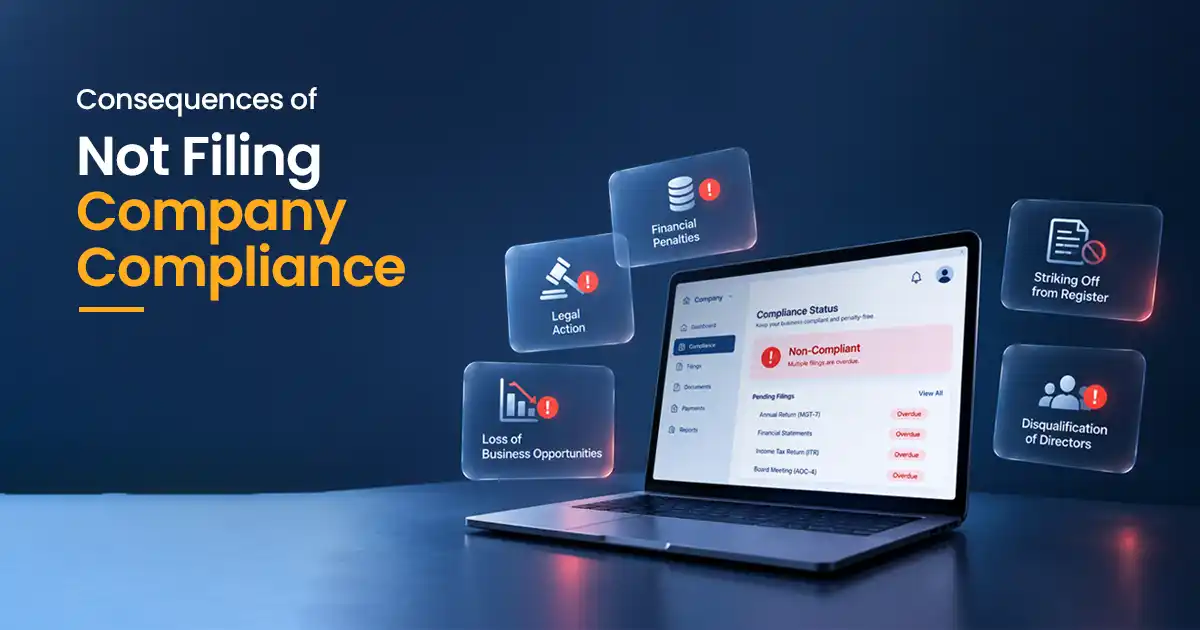
If your company has missed maintaining compliance filings, there could be consequences depending on how long the default has continued and which forms are pending. For a recent missed filing, you may generally need to submit the overdue form and pay the applicable additional fee. If multiple years remain pending, the company may need to address accumulated defaults, additional fees, and further action from the Registrar of Companies (ROC). Prolonged non-compliance can also lead to director disqualification or company strike-off.
Companies must file annual returns and financial statements with the Registrar within prescribed timelines under the Companies Act, 2013. This article explains the consequences of missed Private Limited Company Compliance, including filing annual returns, financial statements, GST returns, and income tax returns in India.
It also covers applicable penalties, Section 164(2) director disqualification, Section 248 strike-off, and the steps to regularize pending company compliance.
ROC Compliance – What Happens When AOC-4 and MGT-7 are Not Filed?
Every company registered in India must file Form AOC-4 (financial statements) within 30 days of the Annual General Meeting and Form MGT-7 or MGT-7A (annual return) within 60 days of the AGM. These are the two core ROC annual filings. Companies should track these deadlines through a company compliance calendar to avoid missed filings, additional fees, and further regulatory action.
1. Additional Filing Fee for Delayed Forms
Under Section 403 of the Companies Act, 2013, delayed filing of AOC 4 or MGT 7 attracts an additional fee of ₹100 per day for each form. The fee continues to accrue until the company completes the filing.
If you miss: AOC 4 or MGT 7 filing deadlines.
What will be the consequence: The company must pay the applicable additional fee when it files the overdue form. For example, a 90-day delay in one form can result in ₹9,000 in additional filing fees.
This additional fee is separate from statutory penalties that may apply to the underlying default.
2. Statutory Penalties for Non-Filing
Failure to file annual returns or financial statements can also attract statutory penalties under Sections 92(5) and 137(3). These provisions can impose penalties on the company and officers in default, subject to the applicable statutory limits and adjudication process.
If you miss: Annual return or financial statement filings and continue the default.
What will be the consequence: The company and officers in default may face statutory penalties in addition to the additional filing fee for delayed filing.
3. Director Disqualification Under Section 164(2)
Not every missed ROC filing automatically disqualifies a director. Section 164(2) applies when a company fails to file its financial statements or annual returns for a continuous period of three financial years.
If you miss: Annual filings for three continuous financial years.
What will be the consequence: A director covered by Section 164(2) can become ineligible for appointment or reappointment as a director for five years. The DIN may also be deactivated in accordance with the applicable MCA process.
4. Section 248: Company Strike Off by ROC
The ROC can initiate strike-off proceedings under Section 248 when the statutory conditions are met. Non-filing of financial statements or annual returns for two consecutive financial years is one ground for ROC-initiated strike-off. Other grounds can also apply, such as failure to commence business within one year of incorporation or a company not carrying on business for two immediately preceding financial years without obtaining dormant status.
If you miss: Required filings over a prolonged period or failure to meet other conditions under Section 248.
What will be the consequence: The ROC can initiate strike-off proceedings after following the prescribed process. If the company is struck off and its name is published in the Official Gazette, it stands dissolved. An eligible company can seek restoration under Section 252 through the NCLT.
GST Non-Filing – Penalties, Interest, and Registration Cancellation
GST compliance failures carry their own separate set of consequences that operate independently from the Companies Act penalties:
a. Late Fees and Interest on GST Returns
A company that fails to file GSTR-3B on time may incur late fees and interest. The GST Portal currently calculates late fees at ₹25 per day under the CGST Act and ₹25 per day under the corresponding SGST or UTGST law where applicable. For nil liability, the rate is ₹10 per day under each Act. The late fee for GSTR-3B is capped at ₹500 for nil returns, while different caps apply based on the taxpayer’s turnover slab for other returns. Interest on delayed payment of GST is generally charged at 18% per annum.
Non-filing can also restrict subsequent GST compliance. In specified circumstances, GSTR-1 filing may be restricted when the corresponding GSTR-3B remains pending. This can delay reporting of outward supplies and affect input tax credit availability for recipients.
b. Suo Motu GST Cancellation
Under Rule 22 of the CGST Rules, 2017, the GST officer may initiate suo motu cancellation of GST registration when a business fails to file six consecutive GSTR-3B returns (monthly filers) or two consecutive GSTR-3B returns (quarterly filers). Cancellation of GST registration means the business cannot collect GST from customers, cannot claim input tax credit, and faces penalties for continuing to operate as a GST-registered business.
Revocation of a suo motu cancellation requires filing all pending returns and paying all outstanding tax, interest, and late fees before the revocation application is processed.
Income Tax Non-Filing: Penalties and Prosecution Risk
Every company registered in India must file an income tax return each year, regardless of whether it earned any income. A company that is required to furnish a transfer pricing report generally has an ITR filing due date of November 30, while other companies subject to a tax audit generally follow the applicable October 31 due date.
Section 234F: Late Filing Fee and Interest
Under Section 234F, a company that files its income tax return after the due date pays a late filing fee of ₹1,000 if its total income does not exceed ₹5 lakh and ₹5,000 in other cases. Interest under Section 234A accrues at 1% per month on the unpaid tax liability from the applicable due date.
Under Sections 234B and 234C, interest applies where advance tax payments are inadequate. Persistent failure to file the income tax return can result in prosecution under Section 276CC of the Income Tax Act.
Section 271B: Penalty for Tax Audit Default
Companies carrying on business generally require a tax audit under Section 44AB when turnover exceeds ₹1 crore. This threshold increases to ₹10 crore where cash receipts and cash payments do not exceed 5% of total receipts and payments. For specified professions, the general threshold is ₹50 lakh, which increases to ₹75 lakh when the applicable 5% cash condition is satisfied.
Failure to comply with the tax audit requirement can attract a penalty under Section 271B equal to 0.5% of total sales, turnover, or gross receipts, subject to a maximum of ₹1,50,000.
Operational and Commercial Consequences in a Company
Beyond the statutory penalties, the consequences of not filing company compliance extend into every aspect of business operations:
- Difficulty obtaining bank finance: Banks may scrutinize companies with an active non-compliant status on the MCA portal. Pending filings can affect loan applications, while a company struck off by the ROC may face restrictions on its banking operations.
- Due diligence concerns: Pending ROC filings can raise concerns during investor due diligence, mergers, acquisitions, and vendor onboarding. Serious compliance gaps may delay transactions or cause investors or buyers to reconsider the deal.
- Tender and business opportunities: Certain government tenders require businesses to maintain proper statutory compliance and provide relevant compliance records. Companies with unresolved defaults may therefore face difficulty meeting eligibility requirements.
- Challenges with company closure: A company that has already been struck off cannot proceed through the normal voluntary closure process. Restoration generally requires an application before the NCLT under Section 252, followed by completion of pending compliance requirements.
What Happens If a Company Misses Its Annual ROC Filings?
The first step is to identify how serious the default is, which filings remain pending, and whether the company or its directors have already received any regulatory action. A recent filing delay may only require submitting the overdue form with the applicable additional fee. Multiple years of pending filings may require several overdue forms, higher additional fees, and further action from the ROC. The key steps include:
- ROC filings: Check the company’s filing status on the MCA V3 portal, prepare the required financial statements and annual returns, and file the pending AOC-4 and MGT-7 forms with applicable fees.
- Director disqualification: Not every compliance default triggers director disqualification. Section 164(2) applies when the statutory conditions for disqualification are met, including failure to file financial statements or annual returns for three continuous financial years. Where DIN deactivation or Section 164(2) disqualification applies, the appropriate remedy depends on the reason for the restriction. Eligible applications for removal of disqualification can use DIR 10. DIR 3 KYC is a separate director compliance requirement and should not be confused with the disqualification process.
- GST cancellation: If GST registration has been cancelled for non-filing, the taxpayer must address pending returns and applicable dues before seeking revocation. The GST Portal requires pending returns up to the cancellation date to be filed before submitting the revocation application.
- Struck-off company: A struck-off company can seek restoration under Section 252 through the NCLT. After receiving the restoration order, the company must complete the applicable filings and formalities to restore its active status.
