

How to Convert an OPC to LLP in India: 2026 Guide
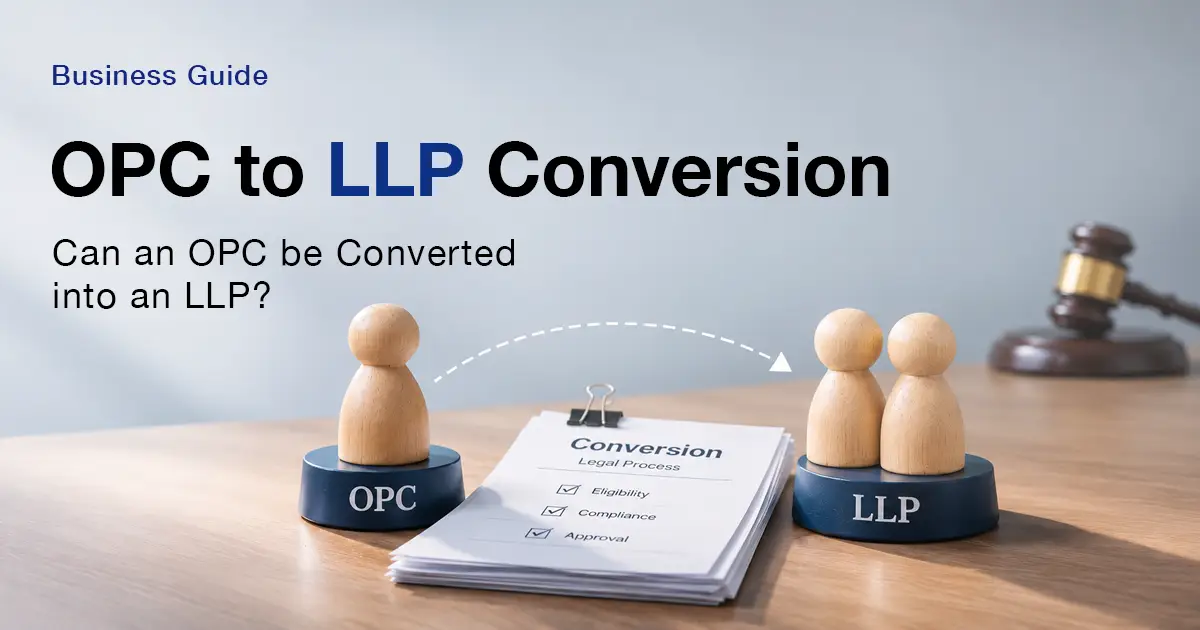
A One Person Company (OPC) cannot convert directly into a Limited Liability Partnership (LLP) because the two structures have different membership requirements. An OPC has one member, while an LLP must have at least two partners. However, a business owner can complete the conversion through two legal stages: first, convert the One Person Company into a Private Limited Company under the Companies Act, 2013; then convert that company into an LLP under the Limited Liability Partnership Act, 2008.
This article explains the conversion process, including the required forms, documents, fees, timelines, and tax implications. It also covers the legal conditions that the business must meet before completing the conversion.
OPC to LLP Conversion at a Glance
Item | Detail |
Direct conversion? | Not possible. Two stages: OPC → Pvt Ltd → LLP |
Stage 1 law & forms | Section 18 + Rule 6; MGT-14, DIR-12, INC-6 |
Stage 2 law & forms | Section 56 + Third Schedule, LLP Act; RUN-LLP, FiLLiP + Form 18, Form 19, Form 3 (≤30 days) |
Form 14 | Not required (firm conversions only) |
Govt fee estimate | About ₹8,300 (₹1 lakh capital, ₹5 lakh contribution, 2 DSCs), excl. stamp duty |
Capital-gains exemption | Section 70(1)(ze): turnover ≤ ₹60L and assets ≤ ₹5cr in each of 3 prior years |
Can an OPC Be Converted into an LLP?
An OPC cannot convert directly into an LLP because it has one member, while an LLP requires at least two partners. Section 6(1) of the LLP Act, 2008, sets this minimum requirement. The Third Schedule also requires all shareholders of the converting company to become LLP partners, preventing an OPC from meeting this condition.
Section 56 and the Third Schedule of the LLP Act, 2008, govern the conversion of a company into an LLP. Therefore, an OPC must first convert into a Private Limited Company under Section 18 and Rule 6 of the Companies (Incorporation) Rules, 2014. It can then complete the second conversion into an LLP.
Note: An LLP must have at least two designated partners. At least one designated partner must stay in India for 120 days or more during the financial year under Section 7(1) of the LLP Act. This is a general LLP requirement, not a separate conversion restriction.
How to Convert an OPC into an LLP: Two-Stage Process Explained
The conversion of an OPC into an LLP requires two separate legal steps. First, the OPC must become a Private Limited Company. It can then be converted into an LLP under the LLP Act, 2008:
Step 1: Convert the OPC into a Private Limited Company
An OPC can voluntarily convert into a Private Limited Company without waiting for a specific period. The Companies (Incorporation) Second Amendment Rules, 2021, removed the earlier two-year waiting period and the paid-up capital and turnover limits. These changes took effect on April 1, 2021.
The conversion involves the following steps:
Add a second member and director: Allot or transfer shares to bring in another member. Appoint a second director to meet the minimum requirements for a private company.
Pass a special resolution: Approve the conversion and amend the company's Memorandum and Articles of Association (AOA).
File Form MGT-14: Submit the special resolution to the Registrar of Companies (ROC) within 30 days of passing it.
File Form DIR-12: Report the appointment of the additional director within 30 days of the appointment. The second director must be in place before filing Form INC-6.
File Form INC-6: Submit the conversion application to the ROC through the MCA V3 portal. Attach the amended constitutional documents, required lists of members and directors, and the existing Certificate of Incorporation (COI). Once the ROC approves Form INC-6, it issues a fresh Certificate of Incorporation reflecting the company's new status.
Tip: Bring in the second member for the new LLP by fresh allotment rather than a transfer from the existing firm. A transfer can trigger capital gains and stamp duty for the transferor. Additionally, keep the later LLP profit-sharing ratio identical to the post-allotment shareholding, and note that the ₹60 lakh turnover/₹5 crore asset test under Section 70(1)(ze) covers the three years before conversion, including the OPC years.
For the full procedure, see our guide on converting an OPC into a Private Limited Company.
Step 2: Convert the Private Limited Company into an LLP
Before applying for conversion, the Private Limited Company must complete its pending statutory requirements. It must also clear all charges on its assets and file Form CHG-4 to record their satisfaction. The company should file its pending financial statements, annual returns, and income tax returns.
Once these requirements are complete, follow these steps:
Reserve the LLP name: Apply through RUN-LLP and pay the prescribed fee of ₹200. The approved name remains reserved for three months. The company can generally retain its existing brand name by replacing "Private Limited" with "LLP", subject to name approval.
File FiLLiP with Form 18: Submit the incorporation and conversion application with the required attachments. These include the shareholders' consent, a statement of assets and liabilities certified by an auditor, and the latest income tax return acknowledgment. A Chartered Accountant, Company Secretary, or Cost Accountant in full-time practice must certify Form 18.
Receive the registration certificate: After approval, the ROC issues the certificate of registration in Form 19 and assigns an LLP Identification Number (LLPIN). The company stands dissolved from the date of LLP registration.
Notify authorities holding property records: Under Paragraph 7 of the Third Schedule, notify every relevant authority where the company's property is registered. Complete the required formalities and provide the LLP's details as prescribed by that authority.
Update official correspondence: Under Paragraph 15(1) of the Third Schedule, include a statement in all official correspondence confirming the conversion from a company into an LLP. Also mention the former company's name and registration number. Maintain this disclosure for 12 months, starting no later than 14 days after registration.
File Form 3: Submit the LLP agreement to the ROC within 30 days of registration.
Important: Form 14 is not required for company-to-LLP conversion because the requirement under Rule 39(3) of the LLP Rules, 2009, was removed in 2015. However, the proviso to Section 58(1) of the LLP Act requires the LLP to inform the Registrar of Companies within 15 days of registration. This intimation remains mandatory, regardless of the form used.
What Changes After the Company Converts into an LLP?
The LLP’s partners must include all the company’s shareholders and no one else. If the business wants the capital gains exemption under Section 70(1)(ze), the partners’ capital contributions and profit-sharing ratios must also match their shareholding on the conversion date.
Documents Required to Convert OPC to LLP
The conversion involves two stages, so the company must prepare different documents for each application. The following lists explain when each document is required.
Documents to Convert OPC to Private Limited Company
Prepare these documents for the conversion application:
Memorandum and Articles of Association: Amended MOA and AOA reflecting the company's new structure.
Member and director details: Updated lists showing the additional member and second director.
Special resolution: Copy of the resolution approving the conversion and amendments to the constitutional documents.
Director appointment documents: Consent and other applicable documents for appointing the additional director.
Existing Certificate of Incorporation: Copy of the OPC's current COI for the INC-6 application.
Documents to Convert Private Limited Company to LLP
Prepare these documents for the LLP conversion application:
Statement of assets and liabilities
List of secured creditors with their consent, if applicable
Latest audited financial statements
Latest Income Tax Return acknowledgment
Declaration of compliance
Class 3 Digital Signature Certificates of proposed designated partners
The LLP agreement must also record the partners' contributions and profit-sharing ratios. File the signed agreement separately through Form 3 within 30 days of registration.
The full procedure and tax conditions are covered in our conversion of a Pvt Ltd company into an LLP guide.
Fees Charged for OPC to LLP Conversion
The cost of converting an OPC into an LLP depends on the company's authorized capital, the LLP's total contribution, and the applicable state stamp duty. The process involves two stages, so separate filing fees apply under the Companies Act and the LLP Act:
Fee Component | Indicative Cost or Deadline |
INC-6, MGT-14, and DIR-12 (Step 1) | ₹200–₹600 per form, based on authorized capital |
Class 3 DSC for each designated partner | Approximately ₹2,500; varies by provider |
₹200 | |
FiLLiP registration fee (Step 2) | ₹500–₹25,000, based on total LLP contribution |
Form 18 and Form 3 filing fees | ₹50–₹600 per form, based on total LLP contribution |
Stamp duty on the LLP agreement | Varies by state |
The LLP registration fee ranges from ₹500 to ₹25,000 under the revised fee structure introduced by the LLP (Amendment) Rules, 2022, effective April 1, 2022. The filing fee for Form 18 and Form 3 depends on the LLP's contribution.
Example: Suppose an OPC has an authorized capital below ₹1 lakh and converts into an LLP with a total contribution of ₹5 lakh. It appoints two designated partners, each requiring a DSC costing approximately ₹2,500.
The estimated government and DSC fees would be:
Step 1 filing fees (three forms × ₹200): ₹600
Two DSCs: ₹5,000
RUN-LLP name reservation: ₹200
FiLLiP registration: ₹2,000
Form 18 filing: ₹100
Form 3 filing: ₹100
Estimated total: ₹8,000, excluding LLP agreement stamp duty and professional fees.
Additional costs: Professional fees for legal and compliance assistance are separate. The final cost may also increase due to pending filings, outstanding charges, or other compliance requirements.
Tax Treatment of Converting an OPC into an LLP
Converting an OPC into an LLP involves two stages, but the tax treatment mainly applies to the second stage: conversion of the Private Limited Company into an LLP.
Under Section 70(1)(ze) of the Income-tax Act, 2025, this conversion can qualify for capital gains tax exemption if the company meets all the prescribed conditions. This provision replaced Section 47(xiiib) of the Income-tax Act, 1961, with effect from April 1, 2026.
The company must meet the following conditions:
Turnover limit: The company's total sales, turnover, or gross receipts must not exceed ₹60 lakh in any of the three tax years preceding the conversion.
Asset limit: The total value of its assets, as recorded in its books of account, must not exceed ₹5 crore in any of those three tax years.
Transfer of assets and liabilities: All company assets and liabilities must be transferred to the LLP.
Shareholding and partnership ratio: All shareholders must become LLP partners. Their capital contributions and profit-sharing ratios must match their shareholding proportions on the conversion date.
No additional consideration: Shareholders must not receive any other consideration or benefit apart from their capital contribution and share in the LLP's profits.
Minimum profit-sharing ratio: The former shareholders must collectively retain at least 50% of the LLP's profit-sharing ratio for five years after conversion.
Restriction on accumulated profits: The LLP must not pay any amount to its partners from the company's accumulated profits for three years after conversion.
If the LLP or its former shareholders fail to meet these conditions, Section 71 of the Income Tax Act, 2025, withdraws the exemption. The resulting capital gains become taxable in the tax year when the conditions are breached.
Other Tax Considerations After Conversion
The conversion also affects certain tax records and benefits:
MAT credit: Unused Minimum Alternate Tax (MAT) credit does not transfer to the LLP.
PAN and GSTIN: The LLP must obtain a new PAN and GSTIN after conversion.
Input tax credit: The LLP can transfer eligible unutilized GST input tax credit through Form GST ITC-02, subject to the applicable GST conditions and supporting certification.
Carry-forward of losses: Under Section 116(10) of the Income-tax Act, 2025, the LLP can inherit eligible business losses and unabsorbed depreciation if it meets Section 70(1)(ze). Section 116(12) limits business loss carry-forward to eight tax years from the year of first computation for reorganizations on or after April 1, 2025. This limit does not apply to unabsorbed depreciation. If the LLP breaches Section 70(1)(ze), Section 116(11) taxes the amount already set off in the year of non-compliance.
Important: The tax exemption is not automatic. The company and the LLP must satisfy every condition under Section 70(1)(ze) to claim it.
Once the LLP is registered, it must submit its agreement through Form 3 within 30 days. It must also file Form 11 by May 30 and Form 8 by October 30 every year. An audit becomes mandatory if annual turnover exceeds ₹40 lakh or capital contribution exceeds ₹25 lakh.
For filing deadlines and other recurring obligations, refer to our LLP annual compliance page.

Comments
Be the first to comment!