

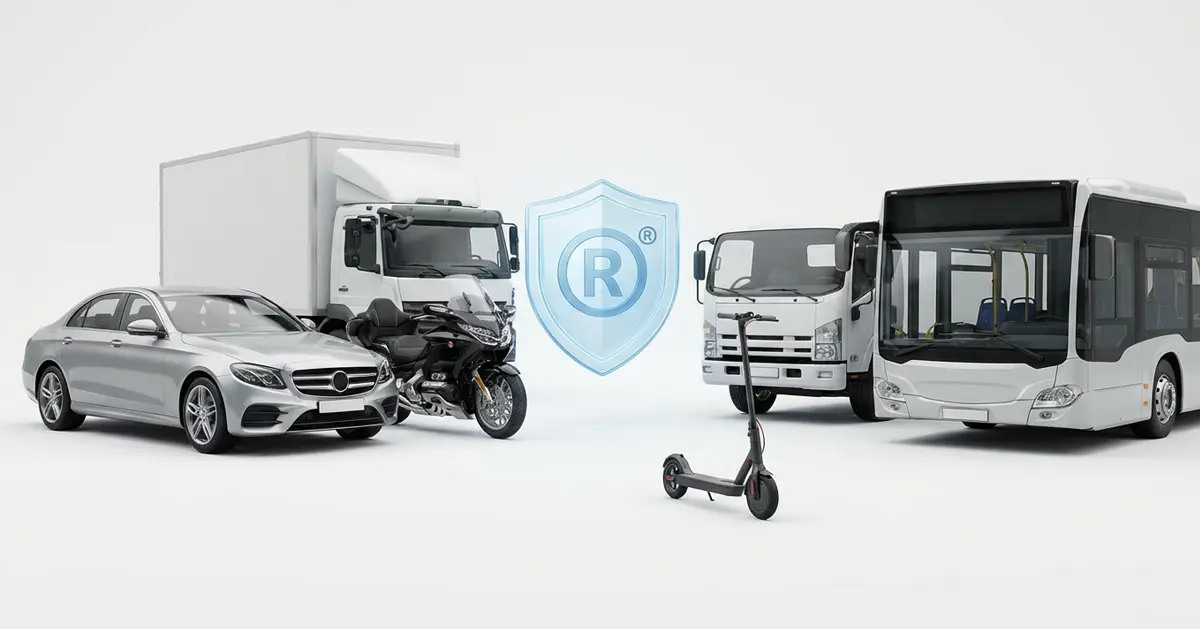
Trademark Class 12 protects brands related to vehicles and transportation products. This includes cars, electric vehicles, bicycles, and their essential parts and accessories. By registering under this class, businesses can secure their logos, names, and product designs, preventing competitors from copying them.
The World Intellectual Property Organization (WIPO) recognizes the importance of trademark protection in maintaining brand identity and preventing market confusion. Companies like Tesla and Toyota use Class 12 trademarks to protect their vehicle brands and ensure their products remain distinct.
Key Takeaways
- Class 12 covers vehicles and apparatus for locomotion by land, air, or water, including their essential parts and accessories.
- Motors and engines for land vehicles stay in Class 12; motors and engines for anything else fall under Class 7.
- It does not cover vehicle electronics like batteries, radios, and mileage recorders (Class 9), vehicle lights (Class 11), or automobile carpets (Class 27).
- Toy vehicles, including tricycles for infants and scooters, fall under Class 28, not Class 12.
- Filing costs ₹4,500 per class for individuals and small enterprises, and ₹9,000 for other applicants.
- Validity runs for 10 years, renewable via trademark renewal before expiry.
What is Trademark Class 12 in India?
Trademark Class 12 covers vehicles and products that enable movement by land, air, or water. It protects brand names used for transporting people or goods through motor-driven or mechanical means. This includes automobiles, electric vehicles, bicycles, aircraft, boats, and related vehicle components.
The NICE Classification system, managed by WIPO, places these goods under a single mobility-focused category. This helps businesses register their trademarks accurately. In India, correct classification ensures enforceable rights under the Trade Marks Act, 1999.
Who Can File for Trademark Class 12?
Any business involved in vehicles or transportation can file for trademark registration under Class 12. Businesses that may file for Class 12 of trademark include:
- Automobile manufacturers: Companies producing cars, trucks, and electric vehicles can protect their brand name and design.
- Vehicle parts suppliers: Businesses selling essential components like engines, tyres, and brakes.
- Car accessory providers: Companies offering bumpers, seat covers, and steering wheels.
- Aviation and marine companies: Manufacturers of aircraft, boats, and ships, plus suppliers of parts for these vehicles.
- Bicycle manufacturers: Businesses producing bicycles and bicycle components.
What are the Goods Covered Under Trademark Class 12?
Trademark Class 12 covers a wide variety of products related to vehicles, from manufacturing to accessories. The table below breaks down what’s covered:
| Category | Description |
|---|---|
| Vehicle Manufacturing | Land, air, and water vehicles, including cars, trucks, bicycles, and boats |
| Vehicle Parts and Components | Tyres, engines, steering wheels, axles, brakes, chassis, and other essential parts |
| Vehicle Accessories | Car mats, covers, bumpers, mirrors, lights, and safety devices |
| Electric and Autonomous Vehicles | Electric cars, scooters, bicycles, and driverless vehicles |
| Air and Water Transport Equipment | Aircraft, helicopters, airships, ships, and yachts |
| Special Purpose Vehicles | Ambulances, fire trucks, motorhomes, and armored vehicles |
| Remote-Controlled Vehicles | Drones, RC cars, and other controlled vehicles for commercial or inspection use |
| Vehicle Safety and Security Systems | Anti-theft alarms, airbags, anti-skid chains, and other safety devices |
| Vehicle Mobility Components | Axles, wheel hubs, brakes, and transmission parts |
What Does Trademark Class 12 Not Cover?
Several vehicle-adjacent items are excluded from Class 12, confirmed directly against WIPO’s own explanatory notes:
- Certain vehicle parts, including electric batteries, mileage recorders, and radios, fall under Class 9; lighting apparatus falls under Class 11; and automobile carpets fall under Class 27.
- Railway material of metal falls under Class 6, not Class 12.
- Motors, engines, couplings, and transmission components not meant for land vehicles fall under Class 7. Land vehicle engines and motors, by contrast, stay in Class 12.
- All parts of motors and engines, such as starters, mufflers, and cylinders, are classified under Class 7.
- Rubber tracks for crawlers used in construction, mining, or agricultural heavy machinery fall under Class 7.
- Toy vehicles, including tricycles for infants and toy scooters, fall under Class 28.
- Special wheeled machines not built for transportation, like road sweeping machines, fall under Class 7, and tea carts fall under Class 20.
How to Register a Trademark in Class 12 in India?
Here’s how to register your trademark under Class 12:
- Search first: Use the trademark availability search tool. Check existing Class 12 marks, including similar-sounding names. This can help avoid trademark objections.
- Prepare your application: Gather the applicant’s details and a clear logo or wordmark in JPEG format. Include proof of use, if applicable. Select the correct class under the Nice Classification. You can file on a “proposed to be used” basis if your product has not launched yet.
- File and pay the fee: Submit your application through the IP India Trademark E-Filing Portal. The fee is ₹4,500 per class for individuals and small enterprises. Other applicants pay ₹9,000 per class.
- Complete the examination: The examiner checks your application for distinctiveness and conflicts with existing Class 12 marks. If you receive an objection, respond within 30 days to avoid abandonment.
- Publication and opposition: Once approved, the mark is published in the Trademark Journal. It remains open for opposition for 4 months.
- Complete registration: If no one opposes the mark, or you resolve all objections, the Indian Trade Marks Registry grants registration. You can then use the ® symbol.
The trademark is valid for 10 years. You must renew your trademark before it expires to maintain protection.
Which are the Trademark Classes Similar to Class 12?
While Class 12 protects vehicles and transportation-related goods, other classes cover related services or products:
- Class 7: Covers engines, motors, and mechanical components for machinery, but not for land vehicles specifically; that distinction stays with Class 12.
- Class 9: Protects vehicle electronics like batteries, mileage recorders, and radios; the accessories rather than the transportation apparatus itself.
- Class 28: Covers toy vehicles like miniature cars and tricycles, distinct from the functional vehicles covered under Class 12.
Businesses in transportation often need multiple classes for full protection. Honda, for example, files under Class 12 for its vehicles and Class 37 for vehicle maintenance and repair services. This protects both its goods and services.
