

MCA rejects a company name when the Central Registration Centre (CRC) finds it unacceptable under Rule 8 and Rule 8A of the Companies (Incorporation) Rules, 2014. The CRC most often rejects a name on the following grounds:
- Resemblance to an existing company, LLP, or registered trademark
- Use of restricted words such as Bank, National, or India
- Generic wording that lacks a distinctive element
- Violation of the Emblems and Names (Prevention of Improper Use) Act, 1950
After a rejection, you usually get one free resubmission before you must file a fresh application and pay again. Since an approved name stays valid for only 20 days, a mid-cycle rejection leaves a tight window to reapply.
This guide explains how name approval works in 2026 and sets out the naming rules under Rule 8, Rule 8A, and the Emblems Act. It also covers the main reasons the CRC rejects names, how to recover after a rejection, and how to change a company name after incorporation through Form INC-24.
Key Takeaways
- MCA rejects company names that violate Rule 8, Rule 8A, trademark rules, or the Emblems and Names Act, 1950.
- Check your proposed name on the MCA database, trademark registry, and domain search before applying.
- Avoid names that are identical, phonetically similar, generic, misleading, or contain restricted words without approval.
- Match your company name with your main business activity and explain its significance clearly in the application.
- If MCA rejects your name, use the one free resubmission to fix the issue. If it is rejected again, file a fresh application and pay the applicable fee.
How Company Name Approval Works in India?
Before starting with rejections, you need to understand the two routes for getting a name approved. Both are processed by the Central Registration Centre (CRC) under the MCA:
1. SPICe+ Part A (for Companies)
A company reserves its name through Part A of the SPICe+ form, embedded in the incorporation process, so it carries no separate fee. You may submit two names in order of preference, and the CRC usually responds within one to three working days. The approved name then holds for 20 days, within which you must file Part B.
2. RUN form
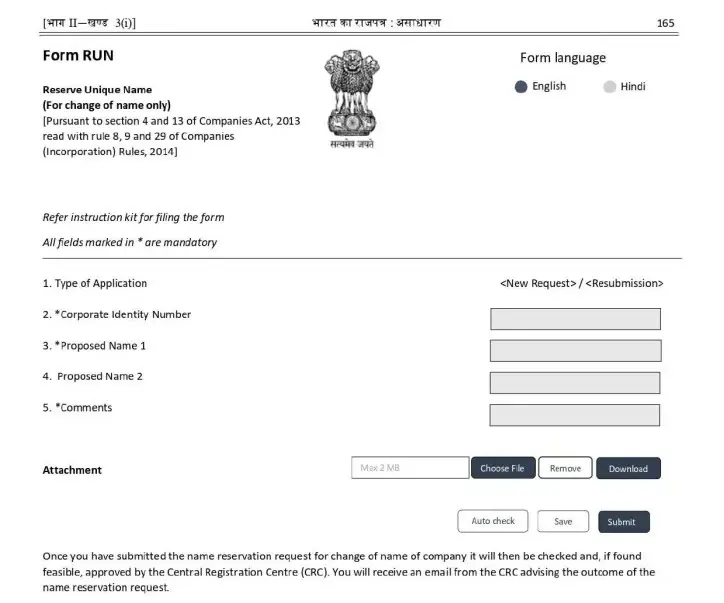
An LLP reserves its name through the RUN service for ₹200, with two name choices, usually cleared within two to five working days. A RUN-approved name stays reserved for 3 months, within which the applicant must complete the filing.
Note: If the CRC rejects both proposed names under either route, you generally receive one free resubmission. If that attempt also fails, you must file a new application and pay the fee again.
MCA Rules for Company Name Approval in India
Company name approvals in India are governed primarily by the Companies Act, 2013, and the Companies (Incorporation) Rules, 2014, issued by the Ministry of Corporate Affairs (MCA). Before approving a company name through SPICe+ Part A or the RUN service, the Central Registration Centre (CRC) checks whether the proposed name complies with Rule 8, Rule 8A, trademark regulations, and other naming restrictions.
1. Rule 8 of Companies (Incorporation) Rules, 2014
Rule 8 lays down the core criteria for determining whether a company name is considered undesirable or unacceptable. Under this rule, the MCA may reject a proposed company name if it:
- Is identical to or too similar to an existing company, LLP, or registered trademark
- Creates confusion due to phonetic resemblance
- Uses offensive, misleading, or prohibited words
- Suggests association with the Government of India, state governments, embassies, or regulatory authorities without approval
- Includes regulated words such as “Bank,” “Insurance,” “Stock Exchange,” or “Mutual Fund” without sectoral regulator approval
- Contains generic business terms without a distinctive element
- Misrepresents the company’s business activity or objects
The MCA also checks whether the proposed name reflects the company’s actual business activity mentioned in the incorporation documents. If the business objective and company name do not align, the CRC may reject the application.
2. Rule 8A: Undesirable and Identical Names
Rule 8A specifically focuses on names that are identical or closely resemble existing entities. The CRC applies strict similarity checks while reviewing applications.
A company name may be rejected under Rule 8A if:
- The spelling differs slightly, but the pronunciation remains similar
- Only plural forms, punctuation marks, spacing, or special characters are changed
- Common words like “New,” “Shree,” “Om,” or “The” are added to an existing name
- The proposed name differs only by type of entity, such as “Private Limited” versus “LLP”
The MCA uses automated similarity checks along with manual review by CRC officers to identify such conflicts.
3. Emblems and Names (Prevention of Improper Use) Act, 1950
Apart from MCA naming rules, company names must also comply with the Emblems and Names (Prevention of Improper Use) Act, 1950.
This law restricts the use of names, symbols, emblems, and official references connected with:
- The Government of India
- United Nations (UN)
- World Health Organization (WHO)
- National symbols and official emblems
- Prime Minister’s Office or the President of India
- International organizations and government-backed institutions
The purpose of this law is to prevent businesses from misleading the public by falsely implying government recognition, patronage, or affiliation.
How to Check Company Name Availability Before Applying: 3-Layer Search
The single biggest reason for first-attempt rejection is inadequate pre-submission search. Before filing SPICe+ Part A or RUN, complete this 3-layer check:
Layer 1: MCA Company / LLP Name Search
- Go to mca.gov.in → MCA Services → Master Data → View Company / LLP Master Data
- Search using both the exact name and phonetic variations
- Check existing companies AND LLPs (the system pools both)
- Note any active, dormant, or struck-off entities with similar names, even struck-off names, can be a concern for 20 years post strike-off
Layer 2: Trademark Database Search
- Go to ipindia.gov.in → Trademark Public Search
- Run Wordmark Search on your proposed name across all 45 NICE classes
- Run Phonetic Search for sound-alike marks
- Check at minimum: Class 35 (general business services), Class 9 (software/IT), and the specific class matching your business activity
- Even pending (not yet registered) trademark applications can trigger MCA rejection
Layer 3: Domain and Brand Availability
- Check .com, .in, and .co.in domain availability for the exact name
- Search Google for the name to identify any active businesses operating under similar trade names (even without formal registration)
- Check trademark filings in the WIPO Global Brand Database if international expansion is planned
Why all three layers matter: MCA approval alone does not protect you from trademark infringement claims post-incorporation. A name that clears MCA but conflicts with an existing trademark can force an expensive rebrand within months of incorporation.
Top Reasons a Company Name Gets Rejected by MCA
The CRC rejects a proposed name for a defined set of reasons, and knowing them is the first step to securing approval. The most frequent grounds appear below:
1. Name is Identical or Too Similar to an Existing Entity
The MCA maintains a database of every registered company, LLP, and trademark in India, and it rejects any name that matches an existing entry. The rule also covers close resemblance, not identical names alone. Suppose if “Acme” already exists; the CRC may treat “Aacme” or “Akme” as too similar and refuse it.
2. The Name Is Phonetically Similar
The CRC rejects names that sound like an existing name, even when the spelling differs. For instance, if “TechVista” already exists, the CRC will likely refuse variations such as “TekVista” or “TechVysta” for phonetic resemblance.
3. The Object Word Does Not Match the Main Activity
A company name usually carries an object word that signals what the business does. The CRC rejects the name when that object word conflicts with the main activity declared in the application. For example, the CRC will refuse “ABC Hospital Private Limited” when the stated main object is to manufacture and service cars, because the name misleads the public.
4. The Name is Too Generic
The CRC rejects names that carry no distinctive element, such as “Super Enterprises Private Limited,” “Best Business Private Limited,” or “Trading Company Private Limited.” A name must include a distinctive prefix that sets the brand apart before the CRC will register it.
5. Use of Restricted or Prohibited Words
Several categories of words trigger rejection unless the applicant holds the required approval:
- Government-related words: The MCA does not permit terms such as National, Central, Union, Federal, Republic, State, President, and Parliament, since they imply government patronage.
- Regulated sector words: Words such as Bank, Insurance, Mutual Fund, Stock Exchange, and Securities require approval from the relevant regulator.
- Scale implying words: The MCA allows words such as International, Hindustan, India, Bharat, Continental, Asiatic, and Corporation only when the scale of the business genuinely justifies them, which usually excludes new startups.
- Broad activity words: The MCA permits words such as Industry, Udyog, Enterprises, Products, Business, and Manufacturing only when the applicant operates across multiple activities or holds a track record of doing so.
6. Name Implies Government Connection or Patronage
The CRC refuses any name that suggests a link to the government, a national leader, or a public authority. For example, “Delhi State Hospital Private Limited” implies state backing, so the CRC will reject it.
7. Conflict With a Registered Trademark
If your proposed name clashes with a registered or pending trademark in the same or a similar class, the CRC can reject it. This is why a trademark search is as important as a company-name search.
8. A Weak or Missing Significance Explanation
Every applicant must explain the significance of the proposed name, including what it means, whether it is coined or derived, and how it relates to the business. Coined words and abbreviations need a clear explanation in particular. The CRC may reject a name with a vague or missing significance section even when nothing else is wrong.
9. Numbers, Length, or Format Issues
The CRC may flag names that run excessively long, use single letters with no meaning, or include numbers without justification, such as “247 Services” or “5Star Solutions.” The MCA expects a standard format of a unique prefix, an activity or descriptive word, and a suffix, for example “BrightEdge Solutions Private Limited.”
Restricted Words in MCA Company Names: Complete List
Several categories of words are restricted under Rule 8A and related provisions. Some require sectoral regulator approval; others are entirely prohibited unless specific conditions are met.
| Word Category | Examples | Requirement |
|---|---|---|
| Government / National terms | National, Central, Union, Federal, Republic, State, President, Parliament, PM, PMO | Generally prohibited; central government approval required in rare cases |
| Regulated sector words | Bank, Banking, Insurance, Insurer, Mutual Fund, Stock Exchange, Securities, Depository, NBFC | Require approval from RBI, IRDAI, SEBI, or relevant sectoral regulator |
| Scale-implying words | India, Indian, Bharat, Hindustan, International, Continental, Asiatic, Corporation | Require minimum authorized capital thresholds + demonstrated scale |
| Broad-activity words | Industries, Udyog, Enterprises, Products, Manufacturing, Business | Require multiple business activity declarations OR existing track record |
| International organisations | UN, WHO, UNESCO, UNICEF, Red Cross, Olympic | Prohibited under the Emblems Act, 1950 |
| National symbols / leaders | Names of national leaders (Mahatma, Sardar, Netaji), national emblems, and national anthem terms | Generally prohibited |
| Misleading objects | Names suggesting trust, foundation, association without Section 8 status | Reserved for Section 8 companies / non-profits |
| Religious terms | Names that may offend religious sentiments | CRC discretion; usually rejected if offensive |
Authorized Capital Requirements for Scale-Implying Words
| Word | Minimum Authorized Capital |
|---|---|
| International, Continental, Asiatic, Hindustan, Bharat | ₹1 crore |
| India, Indian | ₹5 lakh |
| Corporation | ₹5 lakh |
Even meeting the capital threshold doesn’t guarantee approval; the CRC also evaluates whether the business scale and scope genuinely justify the world.
What Happens After Company Name Rejection: Step-by-Step Recovery
A name rejection is procedural, not terminal. Here’s the precise recovery flow:
Step 1: Read the Rejection Reason in Detail
Log in to the MCA V3 portal → My Application → SPICe+ Part A (or RUN). The rejection status will state the specific ground, typically with reference to Rule 8(2)(a), (b), or other sub-clauses. Address that exact reason; generic substitution of one letter rarely satisfies the CRC.
Step 2: Use Your Free Resubmission Window
SPICe+ Part A and RUN both allow one free resubmission per application after rejection. The system reopens the name field, allowing you to:
- Replace one or both proposed names
- Strengthen the significance section
- Add documentary support (NOC from existing entity, trademark proprietor permission, etc.)
The resubmission must happen within the original SPICe+ Part A application timeline.
Step 3: If Resubmission Also Fails — File Fresh
If the second attempt also fails, you must:
- For RUN: File a fresh RUN application with a ₹1,000 fee for companies (₹200 for LLPs); the old application closes
- For SPICe+ Part A: Restart Part A within the same SPICe+ instance, OR file a separate RUN application
Step 4: Document Strategy for High-Risk Names
If your name involves any of these elements, prepare supporting documentation before the first submission:
- Trademark concern → Attach trademark search report; if you own the trademark, attach registration certificate
- Use of personal name → Attach NOC from the person whose name you’re using
- Use of restricted scale-words (India, International) → Demonstrate authorised capital meeting threshold + business plan justifying scale
- Section 8 / Non-profit context → Attach evidence of non-profit objects from the proposed MOA
- Use of foreign / parent company name → Attach board resolution from the parent + NOC from the foreign entity
How to Avoid a Company Name Rejection: Detailed Checklist
The best way to handle rejection is to avoid it entirely. Follow this checklist to get approved on the first try:
1. Search Before You Submit
Use the MCA portal’s Company/LLP Name Search to check for existing matches and variations. Then check the trademark registry at ipindia.gov.in for conflicts in your business class.
2. Choose Coined or Invented Words
Unique, made-up names like “Infosys” or “Zomato” face far fewer conflicts than generic descriptors. Combining two meaningful words — “Tech” + “Vista,” “Corp” + “Edge” — works well too.
3. Keep Additional Options Handy
Internally shortlist four or five strong names, research each one, then submit your two best as equally strong alternatives. Avoid the common trap most founders make of keeping one good name with a filler one.
4. Write a Clear Significance Section
Spell out what your name means and how it connects to your business. This single step prevents a surprising number of rejections.
5. Match your Object to Your Activity
Make sure the descriptive word in your name aligns with the main object you declare. Consistency keeps the CRC comfortable.
