Income Tax Return Filing Online in India
RegisterKaro assists with online Income Tax Return (ITR) filing in India, selecting the correct ITR form, computing taxable income, claiming eligible deductions, reconciling TDS, and completing e-verification, accurately and on time.
 Start-to-Finish ITR Filing SupportAssistance in Selecting the Right ITR FormTDS, AIS, and Form 26AS reconciliationTax Computation and Return ReviewOld vs New Regime Comparison & Tax-Saving Review

 What Sets Us ApartWhat Sets Us Apart
How to File Your Income Tax Return Online – Complete Video Guide
Want to file your income tax return but not sure how to start? Our video guide walks you through the complete ITR e-filing process, explains which documents you need, and highlights key deductions to help you reduce your tax liability.
Make your ITR filing fast, accurate, and stress-free.
Still have questions? Our experts are here to clarify the process and help you file.

What is Income Tax Return (ITR) Filing?
An Income Tax Return (ITR) is a return filed with the Income Tax Department to report income, deductions, taxes paid, and other required details. Filing an ITR is mandatory for taxpayers who meet the conditions under Section 139 of the Income-tax Act, 1961, including those whose total income exceeds the applicable basic exemption limit or who meet other specified mandatory-filing conditions.
Filing an ITR can also allow eligible taxpayers to claim deductions and report eligible tax credits or refunds. The ITR form depends on the taxpayer's status and sources of income. For AY 2026-27, the Income Tax Department provides seven ITR forms, from ITR-1 to ITR-7, under the Income-tax Act, 1961.
Note: Income earned during FY 2025-26 is reported for AY 2026-27 under the Income-tax Act, 1961. Income earned during FY 2026-27 will fall under Tax Year 2026-27 under the Income-tax Act, 2025, with the return filed after the tax year ends.
Financial Year and Tax Year Under the New Income-tax Act
From 1 April 2026, the Income-tax Act, 2025 introduces the Tax Year concept. Income earned from 1 April 2026 to 31 March 2027 falls under Tax Year 2026-27. There is no separate Assessment Year for this period. The corresponding income tax return is filed after the Tax Year ends.
Key takeaway: For income earned in FY 2025-26, use AY 2026-27. For income earned from FY 2026-27 onward, the new framework uses the Tax Year instead of the Assessment Year.
Who Needs to File an ITR?
An ITR must be filed when the applicable conditions under the Income-tax Act are met. This can depend on your total income, type of income, taxpayer category, and certain financial transactions or assets. This may include:
- Salaried individuals
- Self-employed professionals and freelancers
- Businesses, companies, firms, and LLPs
- Individuals with income from house property, capital gains, or other sources
Other Conditions That Can Require ITR Filing
Even if your income is below the applicable basic exemption limit, you may still be required to file an ITR if you meet certain prescribed conditions under the seventh proviso to Section 139(1), read with Rule 12AB.
For AY 2026-27, these conditions include:
- Depositing more than ₹1 crore in one or more current accounts during the financial year.
- Spending more than ₹2 lakh on foreign travel for yourself or another person.
- Incurring more than ₹1 lakh in electricity expenses during the financial year.
- Having business sales, turnover, or gross receipts exceeding ₹60 lakh.
- Having professional gross receipts exceeding ₹10 lakh.
- Having aggregate TDS and TCS of ₹25,000 or more, or ₹50,000 or more for a resident individual aged 60 years or above.
- Depositing ₹50 lakh or more in one or more savings bank accounts.
Certain resident individuals may also need to file an ITR if they hold specified foreign assets, financial interests, or signing authority in foreign accounts, subject to applicable exceptions.
Note: Income earned during FY 2025-26 is reported in AY 2026-27 under the Income-tax Act, 1961. Income earned during Tax Year 2026-27 is covered by the Income-tax Act, 2025, where Section 263 contains the return-filing provisions. The corresponding prescribed conditions are now provided under the Income-tax Rules, 2026, including Rule 163.
Latest Income Tax Slabs and Rates for Tax Year 2026-27
For Tax Year 2026-27, the new tax regime is the default regime for eligible taxpayers. The old tax regime remains available subject to the applicable conditions. The basic slab rates are:
| Tax Regime | Basic Slab Rates |
| New Tax Regime | Up to ₹4 lakh: Nil,
₹4–8 lakh: 5%, ₹8–12 lakh: 10%, ₹12–16 lakh: 15%, ₹16–20 lakh: 20%, ₹20–24 lakh: 25%, Above ₹24 lakh: 30% |
| Old Tax Regime | Up to ₹2.5 lakh: Nil,
₹2.5–5 lakh: 5%, ₹5–10 lakh: 20%, Above ₹10 lakh: 30% |
The new regime provides a rebate of up to ₹60,000 for eligible resident individuals with taxable income up to ₹12 lakh. The old regime provides a rebate of up to ₹12,500 where taxable income does not exceed ₹5 lakh, subject to the applicable conditions.
Get the full details of the breakdown for Old Tax Regime vs the New Tax Regime and choose the right regime based on your turnover & income.
Different Income Tax Return Forms in India
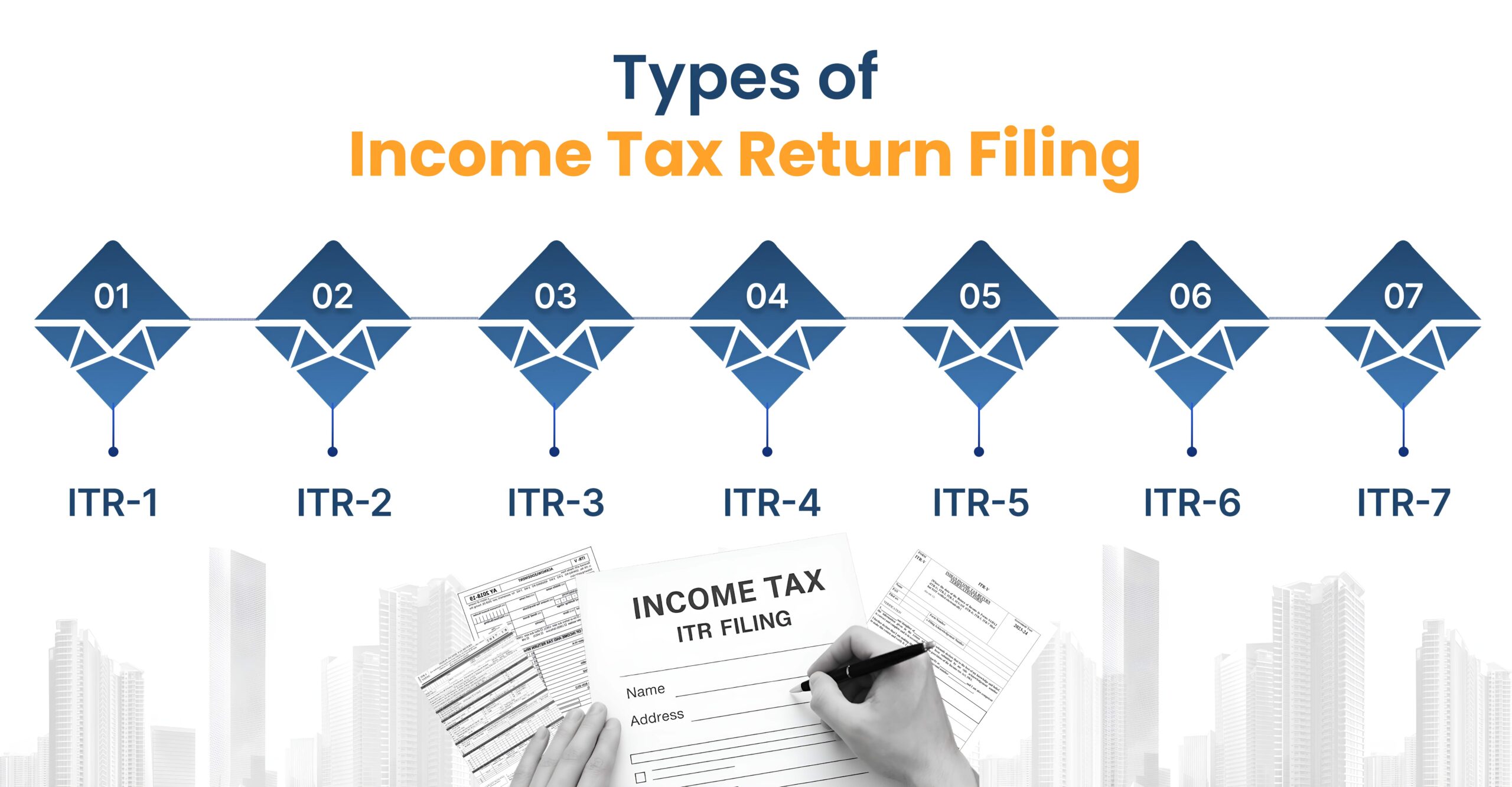
Selecting the correct ITR form is an important part of filing your income tax return. The applicable form depends on your taxpayer category, residential status, income sources, and other conditions.
| Form | Applicable To | Main Income Covered |
| ITR-1 (SAHAJ) | Eligible resident individuals with total income up to ₹50 lakh | Salary or pension, up to two house properties, other sources, agricultural income up to ₹5,000, and eligible LTCG under Section 112A up to ₹1.25 lakh |
| ITR-2 | Individuals and HUFs without business or professional income who are not eligible for ITR-1 | Salary or pension, house property, capital gains, other sources, and applicable foreign income or assets |
| ITR-3 | Individuals and HUFs with business or professional income who are not eligible for ITR-4 | Business or professional income along with salary, house property, capital gains, and other sources |
| ITR-4 (SUGAM) | Eligible resident individuals, HUFs, and firms other than LLPs with total income up to ₹50 lakh and presumptive business or professional income | Presumptive income under Sections 44AD, 44ADA, or 44AE, along with eligible salary or pension, up to two house properties, other sources, agricultural income up to ₹5,000, and eligible LTCG under Section 112A up to ₹1.25 lakh |
| ITR-5 | Firms, LLPs, AOPs, BOIs, AJPs, cooperative societies, local authorities, and certain other entities | Income applicable to these entities |
| ITR-6 | Companies that are not claiming exemption under Section 11 | Income of companies |
| ITR-7 | Persons, including companies, required to file under specified provisions | Income of entities such as charitable or religious trusts, political parties, and certain institutions required to file under the specified sections |
The Income Tax Department currently lists ITR-1 to ITR-7 for AY 2026-27 under the Income-tax Act, 1961. Always check the latest notified form and eligibility conditions before filing.
What's New for AY 2026-27?
The Income Tax Department has introduced several changes to the ITR forms for AY 2026-27. Key changes include:
- ITR-1: Eligible taxpayers can now report income from up to two house properties instead of one.
- ITR-4: Eligible taxpayers can also report income from up to two house properties.
- Deductions: Deduction claims under Sections 80C to 80U require selection of the applicable deduction and specific clause from the available options.
The Income Tax Department regularly updates ITR utilities, schemas, and validation rules. Use the latest version available on the e-filing portal when preparing your return.
Documents You Need to Share for ITR Filing
Keeping the relevant documents ready before filing can help you report income, taxes, deductions, and other details accurately. The documents required depend on your income sources and the ITR form you use.
- PAN and Aadhaar: PAN is required for filing an ITR. Linking Aadhaar with PAN is important for accessing e-filing services, but Aadhaar is not the only method available for e-verifying a return.
- Form 16: Salaried taxpayers can use Form 16 to report salary income and TDS deducted by their employer.
- Form 16A: This may be required for TDS deducted on income other than salary, such as interest income.
- Form 26AS and AIS: Check both before filing to reconcile TDS, TCS, tax payments, and other reported financial information with your records.
- Bank Statements and Interest Certificates: These help report savings account interest, fixed deposit interest, and other relevant transactions.
- Capital Gains Statements: If you sold shares, mutual funds, securities, or other capital assets, keep the relevant capital gains statements and transaction details.
- Home Loan Interest Certificate: Keep this if you are claiming an eligible deduction for home loan interest.
- Rent Receipts and Rental Agreement: These may be required to calculate or support an HRA exemption claim, where applicable.
- Investment and Payment Proofs: Keep receipts for eligible deductions such as life insurance, PPF, health insurance, donations, or other qualifying payments, where applicable.
- Bank Account Details: Keep your bank account and IFSC details ready, particularly if you expect an income tax refund.
How to File an Income Tax Return Online: Step-by-Step Process
Filing an income tax return involves gathering your documents, reporting your income and deductions, submitting the applicable ITR form, and verifying the return.
Step 1: Gather Your Documents
Collect the documents relevant to your income and deductions, such as PAN, Form 16, Form 16A, bank statements, investment or payment proofs, Form 26AS, and AIS. Keeping these records ready helps you report the correct details.
Step 2: Calculate Your Total Taxable Income
Report income under the applicable heads, including salary or pension, house property, business or profession, capital gains, and other sources. The resulting gross total income is calculated before eligible deductions are applied.
Step 3: Claim Eligible Deductions
Claim deductions available to you under the applicable tax regime. For example, Section 123 of the Income-tax Act, 2025 retains the ₹1.5 lakh aggregate deduction for specified savings and payments that was available under Section 80C of the Income-tax Act, 1961. This deduction is not available under the new tax regime. Other deductions have their own eligibility conditions and may differ between the two regimes.
Step 4: File on the Income Tax Portal
Select the applicable ITR form and enter your income, deductions, tax details, and other required information on the e-filing portal. Review the pre-filled information and reconcile it with your Form 26AS, AIS, bank records, and other documents before submitting the return.
Step 5: E-Verify Your Return
After submitting the return, complete verification within 30 days. You can e-verify using Aadhaar OTP, EVC through a pre-validated bank or demat account, net banking, an ATM option, or a Digital Signature Certificate (DSC). You can also verify the return manually by sending the signed ITR-V to the Centralised Processing Centre.
For a straightforward return, gathering documents, preparing the return, filing, and e-verification can typically take 1–3 working days. Returns involving business income, capital gains, multiple income sources, or reconciliation issues may take longer.
Income Tax Return Filing Fees, Due Dates & Penalties
The government fee for filing an income tax return online is ₹0. However, you may pay professional fees if you use a tax professional or filing service. The professional fee depends on the type of return, income sources, transaction volume, tax audit requirements, and complexity of the filing.
What is the Last Date to File Your ITR?
For FY 2025-26 (AY 2026-27), the applicable due dates are:
| Taxpayer / Return Category | Due Date | Status as of 30 September 2026 |
| Individuals and other non-audit taxpayers | 31 July 2026 | Passed |
| Non-audit taxpayers with business or professional income | 31 August 2026 | Passed |
| Taxpayers subject to tax audit | 21 November 2026* | Upcoming |
| Transfer pricing cases requiring a report under Section 92E | 30 November 2026 | Upcoming |
*The original 31 October 2026 deadline has been extended to 21 November 2026 for the specified taxpayers covered by CBDT Circular No. 07/2026.
Revised Return and Late Filing Fees
For AY 2026-27, the following fees may apply:
| Fee | When It Applies | Fee |
| Section 234F | Filing the ITR after the applicable due date | ₹1,000 up to ₹5 lakh total income; ₹5,000 above ₹5 lakh |
| Section 234-I | Filing a revised return after 31 December 2026 | ₹1,000 up to ₹5 lakh total income; ₹5,000 above ₹5 lakh |
A revised return for AY 2026-27 can generally be filed up to 31 March 2027, subject to the applicable conditions.
Interest on Delayed Tax Payment
Late filing and unpaid tax can result in interest in addition to the late filing fee.
- Section 234A: Interest for delay in furnishing the return when tax remains payable, generally at 1% per month or part of a month on the applicable unpaid amount.
- Section 234B: Interest may apply where there is a shortfall in payment of advance tax.
- Section 234C: Interest may apply for deferment or short payment of advance tax installments.
The applicability and calculation of interest depend on the taxpayer's tax liability and payment history. The relevant interest provisions continue to appear in the notified AY 2026-27 return forms.
Advance Tax Due Dates and Payment Schedule
If your estimated tax liability is ₹10,000 or more, advance tax is generally payable in installments. The applicable payment schedule is:
| Installment | Due Date | Cumulative Tax Payable |
| First | 15 June | 15% |
| Second | 15 September | 45% |
| Third | 15 December | 75% |
| Fourth | 15 March | 100% |
For taxpayers under eligible presumptive taxation schemes, the entire advance tax liability is generally payable by 15 March.
What Happens if You Miss the ITR Filing Deadline?
Missing the original due date can have several consequences:
- Belated return: You can generally file a belated return under Section 139(4) until 31 December 2026, subject to the applicable late filing fee.
- Loss carry-forward: Certain business and capital losses generally cannot be carried forward if the return is not filed within the prescribed time. House property loss is treated differently under the Act.
- Delayed refund: The timing of interest on an eligible income-tax refund can be affected when the return is filed after the applicable due date.
- Old tax regime: For non-business taxpayers, choosing the old tax regime instead of the default new regime generally requires exercising the option in the ITR by the applicable due date. Business and professional taxpayers have additional requirements for opting out of the default regime.
- Further tax consequences: If tax remains unpaid, applicable interest and other consequences may arise depending on the circumstances.
Can You File an ITR After 31 December 2026?
For AY 2026-27, the normal belated return deadline is 31 December 2026. After this date, an eligible taxpayer may file an updated return under Section 139(8A), subject to the applicable conditions and additional tax.
An updated return can generally be filed within 48 months from the end of the relevant assessment year, making 31 March 2031 the outer deadline for AY 2026-27. The additional tax is:
| Time of Filing Updated Return | Additional Tax |
| Within 12 months from the end of AY | 25% |
| More than 12 months but within 24 months | 50% |
| More than 24 months but within 36 months | 60% |
| More than 36 months but within 48 months | 70% |
Note: AY 2026-27 relates to income earned during FY 2025-26 and continues to be governed by the Income-tax Act, 1961. The new tax framework applies separately to Tax Year 2026-27, covering income earned from 1 April 2026 onward.
How to Save More on Taxes with Eligible Deductions
Eligible deductions can reduce taxable income, but the deductions available depend on the tax regime and the applicable tax year. From Tax Year 2026-27, the Income-tax Act, 2025 uses new section numbers for several deductions.
1. Section 80C / Section 123 — Investments and Payments
For AY 2026-27, eligible individuals and HUFs can claim a combined deduction of up to ₹1.5 lakh under Section 80C for specified investments and payments. Under the Income-tax Act, 2025, the corresponding provision is Section 123. The deduction under Section 123 is not available under the new concessional tax regime.
Eligible payments and investments include:
- Public Provident Fund (PPF)
- Employees' Provident Fund (EPF)
- Equity Linked Savings Schemes (ELSS)
- National Savings Certificates (NSC)
- Eligible life insurance premiums
- Home loan principal repayment
- Tuition fees for eligible children
- Sukanya Samriddhi Yojana
- Senior Citizen Savings Scheme
- Eligible five-year tax-saving fixed deposits
2. Section 80D / Section 126 — Health Insurance Premiums
For AY 2026-27, Section 80D provides deductions for eligible health insurance premiums, preventive health check-ups, and certain medical expenses for senior citizens. Section 126 provides the corresponding deduction under the Income-tax Act, 2025.
The applicable limits include:
- Self, spouse and dependent children: ₹25,000, or ₹50,000 if the insured person is a senior citizen
- Parents: ₹25,000, or ₹50,000 if the parent is a senior citizen
- Preventive health check-up: Up to ₹5,000, included within the applicable limit
- Eligible medical expenses for a senior citizen without health insurance: Up to ₹50,000, subject to the applicable conditions
For example, a taxpayer below 60 who pays eligible health insurance premiums for themselves and senior-citizen parents may claim up to ₹75,000, subject to the applicable conditions.
3. Section 24(b) / Section 22 — Home Loan Interest
For AY 2026-27, Section 24(b) allows eligible taxpayers to claim a deduction for interest on borrowed capital used for house property. Under the Income-tax Act, 2025, the corresponding house-property deduction is covered by Section 22.
- Self-occupied property: Interest deduction can be up to ₹2 lakh, subject to the applicable conditions.
- Let-out property: Actual eligible interest can be deducted while computing income from house property. However, the house-property loss that can be set off against other income is limited to ₹2 lakh under Section 71(3A).
- Unadjusted house-property loss: Eligible loss can generally be carried forward for up to eight subsequent assessment years.
4. Standard Deduction for Salaried Taxpayers
The standard deduction depends on the tax regime:
- Old Tax Regime: ₹50,000
- New Tax Regime: ₹75,000
The ₹75,000 standard deduction continues under the new tax regime for Tax Year 2026-27.
5. Other Key Deductions
- Section 80G / Section 133, Donations: Eligible donations may qualify for a 50% or 100% deduction, depending on the recipient and applicable conditions. Certain donations are subject to qualifying limits, and cash donations above ₹2,000 are not eligible. Section 133 is the corresponding provision under the Income-tax Act, 2025.
- Section 80TTA / Section 80TTB / Section 153, Interest on Deposits: Section 80TTA allows eligible non-senior individuals and HUFs a deduction of up to ₹10,000 on savings-account interest. Section 80TTB allows resident senior citizens a deduction of up to ₹50,000 on eligible deposit interest. These provisions are combined under Section 153 of the Income-tax Act, 2025.
- Section 80E / Section 129, Education Loan Interest: Eligible individuals can claim the interest paid on a qualifying higher-education loan. There is no fixed monetary deduction limit, and the deduction is available for the initial tax year and seven succeeding tax years, or until the interest is fully paid, whichever is earlier.
- Sections 80EE and 80EEA / Sections 130 and 131, Additional Home Loan Interest: These deductions are available only to borrowers who meet the historical eligibility conditions. Section 80EE applies to qualifying loans sanctioned from 1 April 2016 to 31 March 2017, while Section 80EEA applies to qualifying loans sanctioned from 1 April 2019 to 31 March 2022. The corresponding provisions under the Income-tax Act, 2025 are Sections 130 and 131.
Note: Most Chapter VI-A deductions listed above are relevant to taxpayers opting for the old tax regime. Always check the applicable conditions and the latest notified provisions before claiming a deduction.
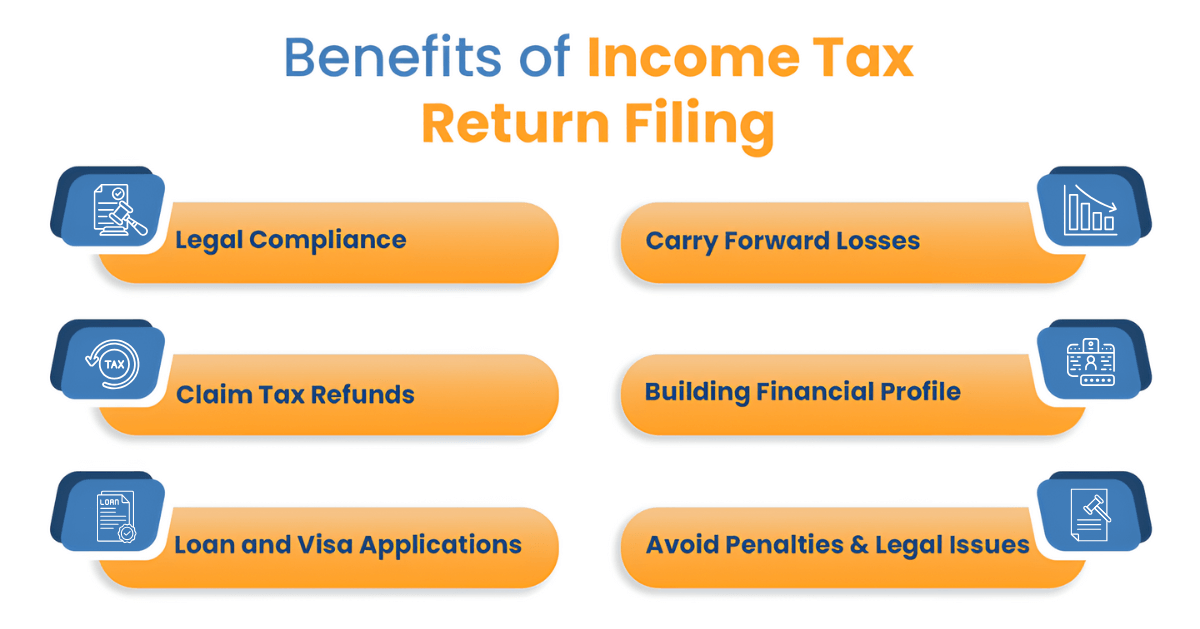
Why is Filing Your Income Tax Return Important?
Filing an income tax return can help you meet applicable tax filing requirements and maintain proper records of your income and taxes. It:
- Helps avoid late filing consequences: Filing after the applicable due date may result in a late filing fee and interest on unpaid tax, where applicable.
- Enables you to claim eligible refunds: If excess tax has been deducted as TDS, filing an ITR allows you to report the income, claim the available TDS credit, and receive a refund if excess tax was paid.
- Helps preserve eligible loss carry-forward claims: Certain business, capital, and other losses can be carried forward when the applicable conditions are met. For losses subject to the timely filing requirement, filing the loss return by the prescribed due date is important. Loss from house property is subject to different rules.
- Supports loan and visa applications: ITR acknowledgments and related tax records may be requested by lenders, visa authorities, or other institutions as proof of reported income.
Assessment Year vs. Financial Year: Key Difference
The Financial Year (FY) refers to the period in which income is earned. The Assessment Year (AY) is the year used to assess income earned during the preceding financial year under the Income-tax Act, 1961.
| Feature | Financial Year (FY) | Assessment Year (AY) |
| Definition | The year in which income is earned | The year in which income from the preceding FY is assessed |
| Period | 1 April to 31 March | 1 April to 31 March immediately after the FY |
| Example | FY 2025-26: 1 April 2025 to 31 March 2026 | AY 2026-27: covers income earned during FY 2025-26 |
For example, income earned from 1 April 2025 to 31 March 2026 is reported in the ITR for AY 2026-27 under the Income-tax Act, 1961.
How to Check Your ITR E-Filing Status?
You can check your ITR status to confirm whether your return has been verified, processed, or requires further action. The Income Tax e-Filing portal provides both pre-login and post-login options.
Method 1: Through the E-Filing Portal
- Log in to the Income Tax e-Filing portal using your user ID and password.
- Go to e-File → Income Tax Returns → View Filed Returns.
- Use the available filters to select the relevant Assessment Year or filing type.
- Click View Details next to the relevant return to view its lifecycle and any pending actions.
The portal can show details such as whether the return is pending for e-verification, under processing, processed, defective, or requires further action.
Method 2: Check ITR Status Without Logging In
- Go to the Income Tax e-Filing portal homepage.
- Select Income Tax Return (ITR) Status.
- Enter your acknowledgment number and a valid mobile number.
- Enter the 6-digit OTP received on your mobile number.
- View your ITR status after successful OTP verification.
You can find the acknowledgment number in your ITR-V or from the View Filed Returns section after logging in.
What to Expect After Filing Your Income Tax Return?
Filing your ITR is not the final step. You must verify the return, track its processing and refund status, and respond to any notice or communication from the Income Tax Department when required.
1. E-Verify Your Return
You must verify your ITR within 30 days of filing. If you do not verify it within the prescribed time, the return can be treated as invalid. If verification is completed after 30 days, the date of verification may be treated as the date of filing, with applicable consequences.
2. Track ITR Processing and Refund Status
After verification, the Income Tax Department processes the return. You can track the status through the e-Filing portal and check whether the return has been processed, a refund has been issued, or further action is required.
3. Respond to an Income Tax Notice
If you receive a notice, check the response deadline and follow the instructions provided. You may need to submit documents, provide an explanation, or take corrective action through the e-Filing portal.
Connect with RegisterKaro and let our experts handle the legal hassle while you grow your business.
Frequently Asked Questions (FAQs)
Can I file ITR without Form 16?
Yes, Form 16 makes filing faster, but you don't strictly need it. Pull your salary details from monthly payslips, then check TDS against Form 26AS and your AIS. Together, these give you everything Form 16 would have shown, just assembled by hand instead of by your employer.
What if I made a mistake in my ITR after filing it?
You can file a revised return under Section 139(5) to correct a mistake. For AY 2026-27, a revised return can be filed up to 31 March 2027. If you file it after 31 December 2026, an additional fee under Section 234-I applies.
Is filing a NIL return mandatory?
A NIL ITR is not automatically mandatory just because you have income below the basic exemption limit. However, filing may still be compulsory if you meet any other prescribed conditions under the Income-tax Act, such as high-value deposits, foreign travel or electricity spending, TDS/TCS of ₹25,000 or more, or foreign assets. You may also choose to file voluntarily to claim a refund or maintain an ITR record where useful.
Do I need to file ITR if my employer already deducted TDS?
Yes, once your income crosses the exemption limit or if your aggregate TDS and TCS is ₹25,000 or more (₹50,000 or more for resident individuals aged 60 or above). TDS only settles part of your tax bill upfront. It doesn't replace the return itself. TDS being deducted does not by itself determine whether you must file an ITR. Filing is how you report your full income, claim any deductions you're owed, and reconcile what's already been deducted.
What happens if I select the wrong ITR form?
The department can treat your return as defective under Section 139(9). You'll receive a notice giving you a set window to correct and refile it. Save yourself the trouble by matching your income type to the right form before you submit anything.
Can I use ITR-1 if I own two houses?
Yes, starting AY 2026-27. The updated ITR-1 utility now accepts income from up to two house properties. Before this change, owning a second property forced you into ITR-2, even if every other part of your income fit neatly into ITR-1's simpler format.
Which section numbers change if I'm filing for FY 2026-27 instead of FY 2025-26?
FY 2026-27 falls under the Income-tax Act, 2025, which renumbers many familiar provisions. Section 80C becomes Section 123, Section 80D becomes Section 126, and Section 234F corresponds to Section 428 for late filing fees. Your FY 2025-26 return is still governed by the Income-tax Act, 1961 and uses the old section numbers.

Reviewed by
Joel DsouzaJoel Dsouza is a Chartered Accountant (CA) and compliance expert with over 7 years of hands-on experience in company registration, tax structuring, GST, ROC filings, and MCA compliance. As a qualified member of the Institute of Chartered Accountants of India (ICAI) and Co-Founder at RegisterKaro, he has personally advised more than 1,000 startups and SMEs across India, helping founders navigate incorporation, regulatory frameworks, and financial planning from Day 1. With deep expertise across all three levels of Finance and Portfolio Management, Joel is committed to promoting financial literacy and simplifying India's startup ecosystem through clear, actionable guidance that entrepreneurs can act on immediately.
Why Choose RegisterKaro for ITR Filing Online?
The Income Tax Department offers free e-filing, but taxpayers must choose the correct ITR form, report income, claim deductions, and file the return. RegisterKaro provides professional assistance with these steps.
- Professional Review: Your return is prepared and reviewed by tax professionals based on the information and documents you provide.
- ITR Form and Tax Regime Assistance: We help identify the applicable ITR form and compare the available tax regimes based on your income and eligible deductions.
- Deduction and Refund Assistance: We help identify eligible deductions and review your tax credits, including TDS and other applicable credits, before filing.
- End-to-End Filing Support: From document collection and return preparation to e-verification, we assist throughout the filing process.
- Notice Assistance: Additional support may be available for responding to income tax notices, depending on the service package.

What Our Clients Say
View All
PRIMART AYURVEDA
 Verified
I had a great experience with RegisterKaro while registering my new company. A special thanks to Garima Sharma for her excellent support throughout th... Read more

SR Digital
VerifiedI had an amazing experience with Register Karo! The entire process of handling my corporate paperwork was seamless, professional, and completely stres... Read more

tausif raza
VerifiedI had a very smooth experience incorporating my LLP. Aryan Singh is an experienced professional who guided me through each step of the process from s... Read more

Yumnam Ajit
VerifiedShubham Singh's commitment to expediency and thoroughness in post-incorporation procedures is commendable. His swift resolution of queries reflects no... Read more

12B28 Snehasingh
VerifiedI had a great experience with the Professional Tax service. The team was professional, responsive, and guided me through the entire process smoothly.... Read more

Sahib
VerifiedI had an outstanding experience with Register Karo, and I want to give a special shoutout to Bindiya. From the moment my case was assigned to her she... Read more

sunil sandeep
VerifiedRegisterkaro provided exceptional assistance in incorporating our firm. Their agent, Vandana, was highly supportive and ensured seamless communication... Read more

KULDEEP KHANNA
VerifiedIt's a nice experience with register Karo...team ..special thanks to entire team& supportive team who keep calling and provide a good support while ur... Read more

Ancient ChillZ
VerifiedVery happy with services provided by RegisterKaro. Hrishita Sharma handles our company's compliances and she is very diligent and prompt in filing for... Read more

Fatima ibs
VerifiedI never knew company incorporation process can also be this buttery smooth and all thanks to Register Karo for making it real. I found the executives... Read more
Related Blogs
View All
Professional Tax Slab Rates in India: Rules & Applicability (FY 2026-27)

ITR Filing Cost for Companies in India
Powers and Functions of Income Tax Authorities: Rules, Rates and Compliance
Section 269ST: Cash Transaction Limit in India (2026 Guide)

TDS Compliance Checklist for Private Limited Company
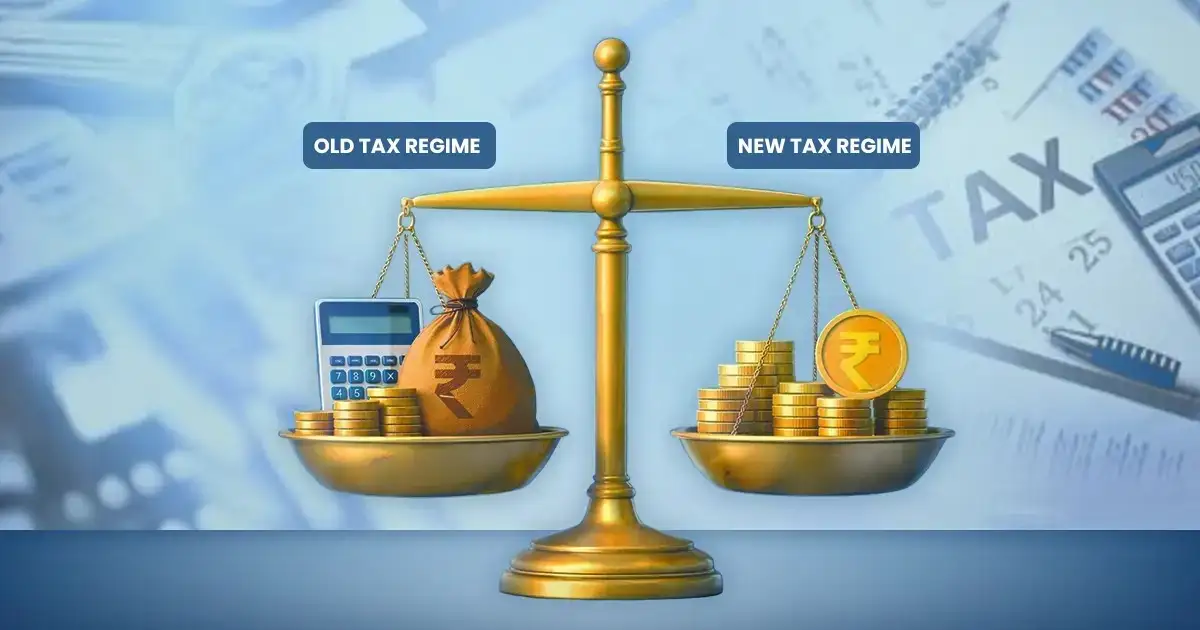
Old vs New Tax Regime in India: Comparison for FY 2026-27