Winding Up of a Company in India
Wind up your Private Limited Company or OPC with RegisterKaro. We prepare resolutions and final accounts, coordinate with the liquidator, and manage ROC and NCLT filings through to dissolution.
 Right-Route Advisory: Voluntary, Compulsory (NCLT) or Strike-OffBoard & Shareholder Resolution DraftingIBBI-Registered Liquidator AppointmentCreditor Notices & Claim SettlementROC, IBBI & NCLT Filing Support

 What Sets Us ApartWhat Sets Us Apart
What is the Winding Up of a Company?
In company law, winding up of a company is the formal process of settling a company's affairs, realising assets and paying off liabilities, before it is dissolved. Companies may undergo winding up due to sustained losses, changing business conditions, or founders moving on to new ventures. The MCA's fast-track exit route, C-PACE, has also seen more than 38,600 companies struck off, although strike-off is distinct from formal liquidation.
During winding up, the liquidator takes control of the company's assets and affairs, realizes assets, settles liabilities according to legal priority, completes statutory filings, and distributes any remaining surplus to shareholders. The company continues as a legal entity during the process and ceases to exist only after the competent authority passes the final dissolution order.
The applicable route depends on the company's financial and legal position. Companies eligible for strike-off may use that simpler route, while those needing to realize assets, settle creditor claims, or address other liabilities may require formal liquidation. Under the IBC, 2016, a solvent company that meets the requirements can undergo voluntary liquidation under Section 59, while winding up ordered by the NCLT is governed by the Companies Act, 2013.
As of March 2025, more than 2,200 companies had opted for voluntary liquidation under the IBC, of which over 1,170 had already been dissolved, while around 2,758 companies had entered liquidation through the insolvency process.
Key Aspects of Winding Up
Winding up affects the company, its creditors, shareholders, and directors in several important ways:
- Legal status: The company remains legally active until the NCLT passes the dissolution order.
- Liquidator's role: A liquidator manages the company's affairs and protects the interests of creditors and other stakeholders.
- Creditor claims: Creditors can submit claims for money owed to them during the liquidation process.
- Payment priority: The law sets the order in which creditors and other claims receive payment.
- Shareholder rights: Shareholders receive any surplus only after higher-priority claims are settled.
- Past transactions: The liquidator can challenge certain transactions that unfairly reduce the company's assets.
- Final dissolution: The company ceases to exist only after the NCLT issues the dissolution order.
Modes of Winding Up a Company
Indian law provides different modes of winding up depending on the company's financial position and the circumstances leading to closure.
| Particulars | Compulsory Winding Up | Voluntary Liquidation |
| Governing law | Section 271, Companies Act, 2013 | Section 59, IBC, 2016 |
| Initiated by | Petition to the NCLT by the company, contributories, ROC, or Central/State Government, as applicable | Company's members through a special resolution |
| Applies to | Companies that meet statutory grounds for Tribunal-ordered winding up | Solvent companies that can pay their debts in full |
| Grounds/trigger | Special resolution, fraudulent or unlawful conduct, actions against India's sovereignty, five-year filing default, or just and equitable grounds | Members' decision to close a solvent company, supported by a declaration of solvency |
| Who manages it | Company Liquidator appointed by the NCLT | Insolvency professional appointed as liquidator |
| Ends with | Dissolution order from the NCLT | Dissolution order from the NCLT |
Advantages of Winding Up a Company in India
If a company has stopped operating, formally winding it up is important to close its legal and compliance obligations. Simply stopping operations and becoming inactive does not automatically end the company's existence or its filing requirements:
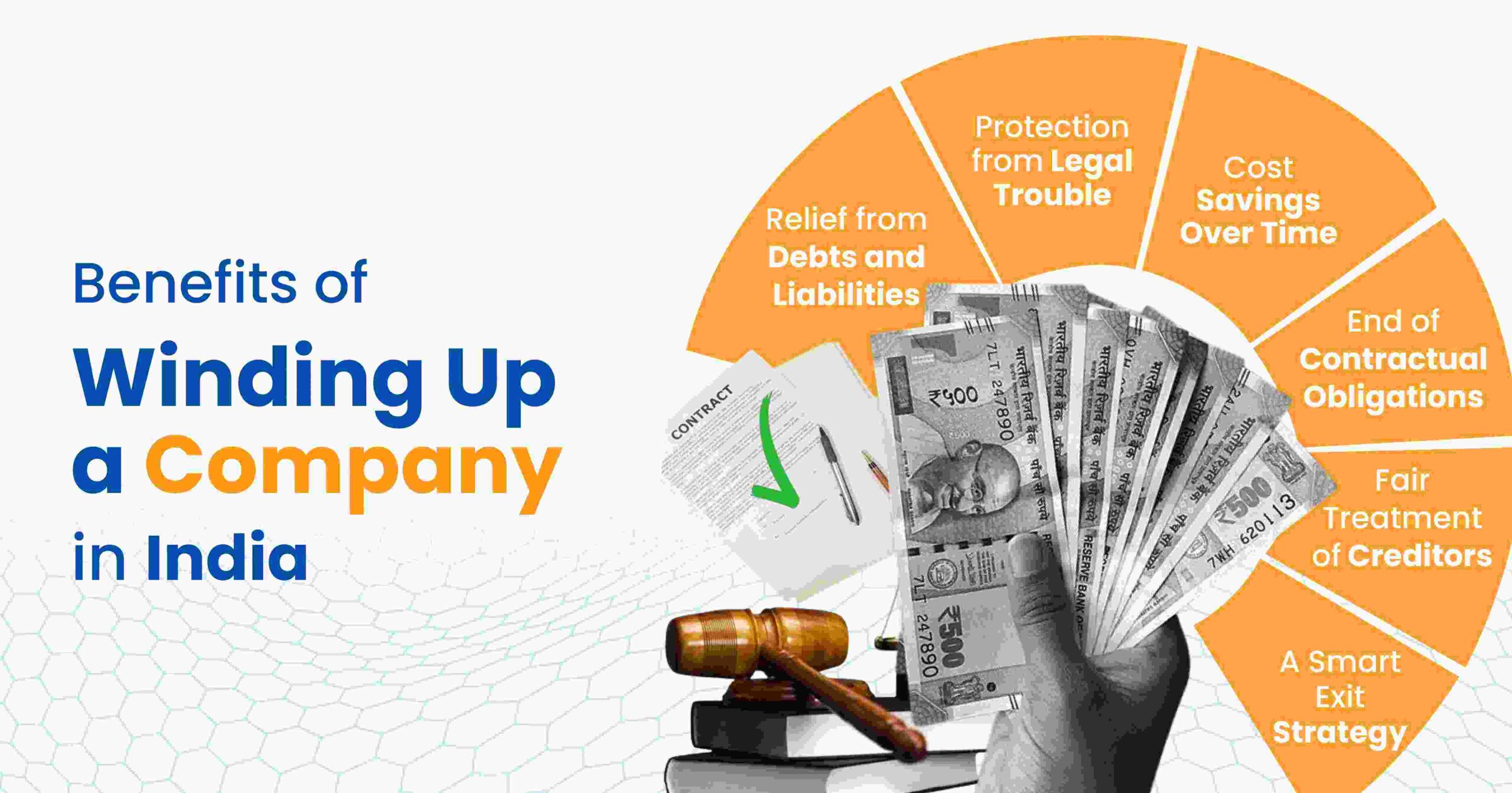
- Resolve debts and liabilities: The liquidation process identifies, verifies, and settles the company's debts from available assets. Directors do not automatically become personally liable for company debts.
- Reduce compliance burden: Closing an inactive company ends the need for ongoing ROC filings, audits, and other recurring compliance obligations.
- End unnecessary operating costs: Formal closure can stop expenses such as accounting, audit, professional fees, and maintenance costs for an inactive entity.
- Settle contractual obligations: The liquidator can address leases, service agreements, and other outstanding contracts as part of the closure process.
- Protect creditor interests: A formal process provides a structured mechanism to notify creditors, verify claims, and distribute available assets according to the applicable legal priority.
- Create a clean exit: Winding up allows owners to formally close an inactive or unprofitable business and focus on new ventures.
Consequences of Winding Up a Company in India
Winding up also has important consequences for the company and its stakeholders:
- Loss of legal existence: Once dissolved, the company ceases to exist and generally cannot conduct business, enter new contracts, or continue legal proceedings in its own name.
- Assets used to settle claims: The company's assets are realised and distributed according to the applicable legal priority. Shareholders receive any remaining surplus only after eligible claims are settled.
- Potential reputational impact: A creditor-driven or insolvency-related winding up can affect the company's and its directors' business reputation and credit profile.
- Restrictions on company assets: Once winding-up proceedings begin, restrictions may apply to dealings with company assets, and transactions may require Tribunal or liquidator approval.
- Tax and statutory obligations: The company must address outstanding income tax, GST, ROC, and other statutory obligations during the closure process.
- Potential director liability: Directors are generally not personally liable for company debts solely because they served as directors. However, personal liability can arise for fraud, wrongful conduct, statutory violations, or other breaches of duty.
Who Can Apply for the Winding Up of a Company?
According to Section 272 of the Companies Act, 2013, a petition for winding up can be presented to the Tribunal by:
- The company itself: A company can decide to be wound up by the Tribunal through a special resolution.
- Any contributory(s): Shareholders, even those holding fully paid-up shares, can file a petition. This is possible even if the company has no assets or surplus assets for distribution.
- All or any of the persons specified above: A combination of the company, contributories, or others can jointly file.
- The Registrar of Companies (ROC): The ROC can present a petition, especially if the company has defaulted in filing financial statements or annual returns for five consecutive years. The ROC typically needs prior sanction from the Central Government, and the company must be given a chance to respond.
- Any person authorized by the Central Government: The Central Government can authorize individuals to file a winding-up petition.
- The Central Government or a State Government: This applies if the company's actions are against India's sovereignty, integrity, security, public order, morality, or friendly relations with foreign states.
Eligibility for Winding Up a Company
The appropriate winding up route depends on its financial position and circumstances. The conditions differ for the two modes:
Voluntary Liquidation
Under Section 59 of the IBC, a company can enter voluntary liquidation if it:
- Is solvent and able to pay its debts in full from the liquidation proceeds.
- Has a majority of directors make a declaration of solvency supported by audited financial statements and an asset valuation.
- Pass a special resolution of members approving voluntary liquidation and appointing a liquidator.
- Obtain approval from creditors representing two-thirds in value, where the company has outstanding debts.
- Not have any ongoing insolvency proceedings under the IBC.
- Must satisfy the eligibility and solvency requirements applicable to voluntary liquidation under Section 59 of the IBC and related regulations.
Compulsory Winding-Up
Under Section 271 of the Companies Act, 2013, the NCLT may order winding-up if the company:
- Approves a special resolution requesting winding-up by the Tribunal.
- Acts against the sovereignty, integrity, or security of India.
- Conducts its affairs fraudulently or for unlawful purposes.
- Fails to file financial statements or annual returns for five consecutive financial years.
- Meets the just and equitable grounds that, in the Tribunal's opinion, require winding up.
If a company is inactive and has no assets or liabilities, strike-off is generally a simpler exit route than liquidation. If the company cannot pay its debts, the applicable IBC insolvency process may apply instead.
Documents Required for Winding Up a Company in India
The documents required for winding up may vary by the closure route, but you will generally need:
- Board resolution approving the winding-up and authorizing a director to act.
- Declaration of solvency and affidavit for voluntary liquidation.
- Special resolution passed by the shareholders.
- Latest audited financial statements and a statement of assets and liabilities.
- Asset valuation report prepared by a qualified valuer, where required.
- Liquidator's consent and appointment documents for voluntary liquidation.
- Creditors' approval or NOC, where the company has outstanding debts.
- Certificate of Incorporation, MOA, and AOA of the company.
- Company PAN and details of GST and other applicable registrations.
- List of creditors, employees, and pending litigation, where applicable.
How to Wind Up a Company in India? Step-by-Step Process
The process of winding up a company depends on the route. Follow the applicable steps below.
Voluntary Liquidation under Section 59 of the IBC
If the company is solvent and meets the eligibility conditions, follow these steps to complete voluntary liquidation:
- Declare solvency: A majority of directors make a declaration of solvency on affidavit, supported by audited financial statements and an asset valuation.
- Pass a special resolution: Within four weeks, members pass a special resolution approving voluntary liquidation and appointing an insolvency professional as the liquidator.
- Obtain creditors' approval: If the company has outstanding debts, creditors representing two-thirds in value must approve the resolution within seven days.
- Make the public announcement: The liquidator invites claims from stakeholders and submits the required intimation to the ROC and IBBI within the prescribed period.
- Realize assets and settle claims: The liquidator realises the company's assets, verifies claims, and distributes the proceeds according to the applicable priority.
- File the final report: After completing the liquidation, the liquidator submits the final report and applies to the NCLT for a dissolution order.
Voluntary liquidation typically takes around 270 days from start to finish. Where the company has no creditor dues, the process can take as little as 90 days. The actual timeline can vary depending on factors such as the company's assets, creditor claims, regulatory approvals, and the complexity of the liquidation.
Compulsory Winding-Up by the NCLT
When the NCLT orders winding-up, the process involves these steps:
- File the petition: An eligible party files a winding-up petition with the NCLT in the prescribed form, along with the required statement of affairs.
- Attend the Tribunal proceedings: The NCLT examines the petition, may direct its advertisement, and considers objections from the company and other stakeholders.
- Appoint a provisional liquidator: Where necessary, the NCLT appoints a provisional liquidator to protect the company's assets.
- Obtain the winding-up order: If the Tribunal finds sufficient grounds, it passes the winding-up order and appoints a Company Liquidator.
- Realize assets and settle claims: The liquidator takes control of the company's assets, verifies claims, realises assets, and distributes the proceeds according to the applicable priority.
- Obtain dissolution: After completing the winding-up, the liquidator reports to the Tribunal, which passes the dissolution order and brings the company's legal existence to an end.
As a Tribunal-driven process, compulsory winding-up usually takes one to two years or more, depending on the complexity of claims, assets, and litigation.
Cost of Winding Up a Company in India
Professional and liquidator fees usually make up most of the winding-up cost, while statutory filing fees form a smaller portion.
The total depends on the route, company size, assets, creditors, and legal complexity:
| Winding-Up Method | Statutory / Filing Fees | Professional & Liquidator Fees | Indicative Total |
| Voluntary Liquidation (IBC Section 59) | Applicable IBBI, NCLT, and other filing charges | ₹1,00,000–₹3,00,000+ | ₹1,00,000–₹3,00,000+ |
| Compulsory Winding-Up (NCLT) | NCLT petition and other applicable filing fees | ₹1,50,000–₹3,00,000+ | ₹2,00,000+ |
| IBC Liquidation (Insolvent Company) | Process and insolvency-related costs | ₹2,00,000–₹5,00,000+ | ₹3,00,000–₹7,00,000+ |
Additional expenses may include notary charges (₹5,000 – ₹10,000), valuation, audit, and newspaper or Gazette publication (₹10,000 – ₹15,000). Litigation, creditor disputes, and complex assets can increase the overall cost significantly.
Governing Laws for Winding Up a Company
The winding up of companies in India is primarily governed by two key legislative frameworks:
1. The Companies Act, 2013
This Act provides a comprehensive structure for winding-up procedures, particularly under Chapter XX (Sections 270 to 365). It outlines provisions for both compulsory winding up by the Tribunal and, historically, voluntary winding up.
However, after the enforcement of the Insolvency and Bankruptcy Code (IBC), 2016, most provisions related to voluntary winding up under the Companies Act have been omitted or made inapplicable. As of now, only winding up by the Tribunal continues to be governed under the Companies Act, 2013 (specifically under Section 271 and onwards).
2. The Insolvency and Bankruptcy Code (IBC), 2016
With its enactment, the IBC, particularly Section 59, now largely governs voluntary liquidation for corporate persons. The IBC focuses on making the resolution process faster and more efficient. It also covers compulsory liquidation procedures, especially when a company is unable to pay its debts.
Connect with RegisterKaro and let our experts handle the legal hassle while you grow your business.
Frequently Asked Questions (FAQs)
What are the two ways to wind up a company in India?
A company can generally exit through voluntary liquidation under Section 59 of the IBC or winding-up by the NCLT under Section 271 of the Companies Act, 2013. Voluntary liquidation applies to solvent companies that choose to close, while NCLT winding-up occurs when the Tribunal orders it on specified statutory grounds.
Can a company with debts be wound up voluntarily?
Yes, a company can enter voluntary liquidation if it is solvent and can pay its debts in full. Where the company owes creditors, the required creditor approval also applies. If the company cannot pay its debts, it must follow the applicable insolvency process under the IBC rather than voluntary liquidation.
How long does winding up take?
The timeline depends on the company's assets, liabilities, creditors, and any disputes. Voluntary liquidation generally has a 270-day timeline, subject to applicable extensions and circumstances, while simpler cases may conclude sooner. NCLT-ordered winding-up can take one to two years or longer, particularly where litigation or complex assets are involved.
How much does it cost to wind up a company?
Voluntary liquidation can typically cost ₹1,00,000–₹3,00,000 or more, while NCLT-led winding-up can cost ₹2,00,000 or more. Liquidator, valuation, professional, legal, and other process-related expenses usually make up most of the cost. The final amount depends on the company's assets, liabilities, and complexity.
Who can act as a liquidator?
For liquidation under the IBC, the liquidator must be an insolvency professional registered with the IBBI and meet the applicable eligibility requirements. RegisterKaro can coordinate with a qualified insolvency professional and assist with the company's documentation and compliance throughout the process.
In what order are creditors paid during liquidation?
The proceeds are distributed according to the waterfall under Section 53 of the IBC. Broadly, liquidation costs are paid first, followed by specified claims of workmen and secured creditors, employees, unsecured financial creditors, government dues, and certain other claims, with shareholders receiving any remaining amount.
What happens to employees when a company is wound up?
Employees' outstanding wages and other eligible dues are dealt with under the applicable liquidation waterfall. Workmen's dues and certain employee claims receive priority over unsecured creditors and shareholders, subject to the limits and conditions prescribed by the IBC.
Do I need to cancel GST and other registrations before winding up?
The company should address its GST, tax, and other statutory registrations and pending filings as part of the closure process. This may include filing final returns, cancelling registrations where applicable, and settling outstanding dues. The exact requirements depend on the company's registrations and tax position.
What happens to the company after winding up?
After the winding-up process is completed, the NCLT passes a dissolution order, following which the company ceases to exist as a legal entity. Dissolution does not automatically erase liabilities arising from misconduct, fraud, or other matters for which directors or officers may remain legally responsible.
What if I don't wind up an inactive company?
An inactive company must continue meeting its statutory filing obligations until it is formally closed. Failure to file annual returns or financial statements can attract ₹100 per day per form, subject to the applicable caps. Directors can also face five-year disqualification after three consecutive years of specified filing defaults.

Reviewed by
Joel DsouzaJoel Dsouza is a Chartered Accountant (CA) and compliance expert with over 7 years of hands-on experience in company registration, tax structuring, GST, ROC filings, and MCA compliance. As a qualified member of the Institute of Chartered Accountants of India (ICAI) and Co-Founder at RegisterKaro, he has personally advised more than 1,000 startups and SMEs across India, helping founders navigate incorporation, regulatory frameworks, and financial planning from Day 1. With deep expertise across all three levels of Finance and Portfolio Management, Joel is committed to promoting financial literacy and simplifying India's startup ecosystem through clear, actionable guidance that entrepreneurs can act on immediately.
Why Choose RegisterKaro for Winding Up a Company?
Winding up a company involves strict filings, timelines, and creditor obligations. RegisterKaro manages the entire process end-to-end, helping you complete the required formalities and close the company properly.
- Right-route advisory: We assess your company's status and recommend the appropriate exit route, whether voluntary liquidation, NCLT winding-up, or strike-off.
- End-to-end winding-up support: We handle the process from board and shareholder resolutions through liquidation formalities and the final dissolution order.
- IBC and NCLT expertise: Our team helps navigate IBC requirements and NCLT procedures, ensuring filings and documentation meet applicable requirements.
- Creditor and claim management: We assist with public notices, creditor claims, verification, and settlement, helping ensure distributions follow the applicable legal priority.
- Compliance and risk management: Our experts help identify pending filings, tax obligations, and documentation gaps before closure, reducing the risk of unresolved liabilities and compliance issues.

What Our Clients Say
View All
Rajkumar Singh
 Verified
Register Karo proved to be an exceptional choice for incorporating my company. The seamless process of registering GST, MSME, and Company Details, gui... Read more

NS Enterprise
VerifiedA very smooth experience with RegisterKaro during the registration of our company. I was so impressed by how helpful and patient the team was. Everyth... Read more

Devraj Bhuriwale
VerifiedI am using their service for a long time. They handled my company registration and still manage annual return and other compliances. Everything is fil... Read more

Chanchal Singla
VerifiedRazorpay is fantastic! The platform is intuitive, and customer service is stellar. Special thanks to Jiya for her timely assistance and for making the... Read more

Anuj Vishwakarma
VerifiedRegisterKaro provided a professional experience from beginning to end. Archana guided me well, explained the process clearly, and made everything feel... Read more

Irfaz Najar
VerifiedA fantastic organisation! Great cutomer support from beginning to end of the process.I thanked my advisor Mr.Akeel U Zaman for great communication and... Read more

Zeeshan khan
VerifiedThe entire experience was seamless and super efficient. Priya’s professionalism and expertise made the whole process hassle-free. I'm really impressed... Read more

Akansha Tomar
VerifiedAditi Sharma from Register Karo( Banglore office ) has handled all the compliance, registration, and related work for my company very professionally a... Read more

SOLANKI SHIVAJI
VerifiedExcellent service with quick turnaround time. All my GST and MSME-related queries were resolved accurately and professionally. Truly reliable and high... Read more

Saikanth Krishna
VerifiedTanvish Nagpal provided exceptional service throughout the registration process. He kept me informed about the status every step of the way. If you’re... Read more
Related Blogs
View All
Difference Between Strike Off and Winding Up of a Company in India
Form STK-2 for Company Strike Off in India