

Closing a company sounds simple until you consider the compliance required to legally shut down. Many businesses simply stop operating without filing STK-2. So, they remain legally active in the eyes of the law. These companies also continue to trigger requirements like annual filings, meetings, etc. as mandated by the company’s structure. To avoid piling up late fees and unwanted notices from the Ministry of Corporate Affairs (MCA), you are required to file the STK-2 Form.
When filed correctly at the appropriate time under Section 248(2) of the Companies Act, 2013, it helps promoters exit responsibly and reduce long-term compliance risk. STK-2 applications are now centrally processed by C-PACE (Centre for Processing Accelerated Corporate Exit) rather than the jurisdictional ROC. This change was introduced in May 2023, which led to a reduction in processing time to roughly 3–6 months from 6 to 9 months.
Rule 4 of the Companies (Removal of Names of Companies from the Register of Companies) Rules, 2016 (the application) and Rule 3 (the list of companies that cannot apply) together govern the STK-2 filing.
Key Takeaways
- Form STK-2 is the MCA form used by an eligible company to apply for voluntary removal of its name from the Register of Companies under Section 248(2) of the Companies Act, 2013. The application is processed through C-PACE.
- A company should satisfy the applicable strike-off conditions before filing, including settling its liabilities and meeting the statutory requirements for voluntary closure.
- The application generally requires documents such as STK-3 (Indemnity Bond), STK-4 (Affidavit), a recent Statement of Accounts certified by a CA, and the required resolutions/consents.
- Shareholders must approve the voluntary strike-off through a special resolution or consent of at least 75% of members in terms of paid-up share capital, as applicable.
- The company must submit the STK-2 application with the prescribed government fee and use the DSC of the authorised director for filing.
- Companies should carefully verify their eligibility, pending filings, liabilities, bank accounts, and supporting documents before submitting STK-2 to avoid objections or delays.
- Filing STK-2 does not mean the company is immediately dissolved. The application is scrutinised, notices may be issued, and the company’s name is removed only after the prescribed strike-off process is completed.
What is the STK-2 Form?
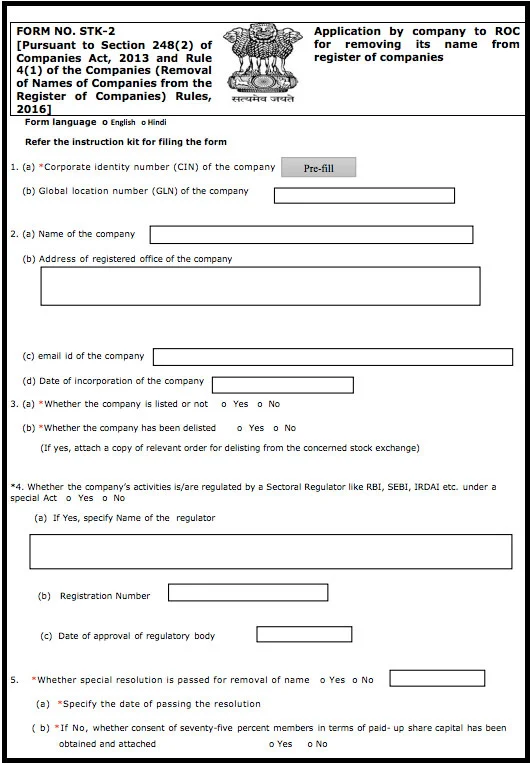
Companies file the statutory Form STK-2 with the MCA to voluntarily strike off their name and wind up a company that is inactive or no longer required. They file it under Section 248(2) of the Companies Act, 2013, along with the relevant MCA rules and notifications. Filing STK-2 allows a company to notify the Registrar of Companies (ROC) that it has ceased operations or does not intend to carry on business. Once the ROC approves, it removes the company’s name from the MCA records.
You typically file the MCA STK-2 Form to:
- Apply for voluntary strike-off of an inactive or non-operational company
- Avoid continued statutory filings and late fees
- Close a company that has no assets or liabilities
- Ensure a clean and lawful exit under the Companies Act, 2013
Businesses use this form when they want to formally close an inactive or defunct company in a legally compliant manner.
Submitting the STK-2 Form correctly also helps companies:
- Eliminate future compliance burdens and penalties
- Prevent regulatory notices for non-filing
- Maintain proper closure records for promoters and directors
- Reduce legal and financial risks after business closure
Who Needs to File the STK-2 Form?
Not every company is eligible to file the STK-2 Form. It is used when promoters or directors decide that the company should no longer continue its operations.
Companies that may file STK-2 include:
- Private Limited Companies that are inactive, non-operational, or no longer required.
- Public Limited Companies that meet the eligibility conditions for voluntary strike-off.
Companies that cannot file STK-2 as per Rule 3:
- Section 8 companies,
- Listed companies, c
- Companies with charges pending satisfaction,
- Companies under inspection/prosecution,
- Vanishing companies,
- NBFCs, and
- Companies that have moved their registered office or disposed of property in the previous three months
Situations that commonly trigger STK-2 filing are:
- The company has not commenced business since its incorporation.
- The company has ceased business activities for a prolonged period (at least two continuous financial years).
- The company has no assets and no liabilities.
- Promoters wish to close an inactive or dormant company to avoid ongoing compliance.
However, a company cannot file STK-2 if it:
- Has pending litigation or regulatory proceedings.
- Has outstanding liabilities, loans, or creditor dues.
- Has carried out business activity in the preceding year prescribed by law.
- Is under inspection, inquiry, or investigation by any authority.
Documents Required to File STK-2 Form
The commonly required documents include:
- Board Resolution approving the voluntary strike-off of the company and authorizing a director to file Form STK-2
- Special Resolution passed by shareholders or consent of at least 75% of members (in terms of paid-up share capital)
- Indemnity Bond (Form STK-3) executed by all directors
- Affidavit (Form STK-4) from all directors confirming the company has no liabilities
- Statement of Accounts (Form STK-8) showing nil assets and liabilities, certified by a Chartered Accountant, not older than 30 days
- Copy of PAN of the company
- Digital Signature Certificate (DSC) of the authorized director
Depending on the company’s status, additional documents may be required, such as:
- Approval from regulatory authorities
- No Objection Certificate (NOC), if applicable
Companies should carefully review all attachments to ensure consistency between the form and supporting documents. Accurate documentation is critical, as any discrepancy may lead to rejection or resubmission by the ROC.
How to File the STK-2 Form?
Closing a company through the STK-2 Form is not a single-step action. It follows a defined MCA process that validates eligibility, documents, and intent before approval.
Here is the step-by-step process to file the STK-2 form:
Step 1: Ensure Eligibility for Strike-Off
Confirm that the company:
- Has not commenced business or has ceased operations
- Has no assets and no liabilities
- Is not involved in any litigation, inspection, or investigation
- Has completed all pending statutory filings up to the date of closure
Step 2: Pass Board and Shareholder Resolutions
- Convene a Board Meeting to approve the strike-off proposal and authorize a director to file Form STK-2
- Obtain approval of shareholders by passing a Special Resolution in accordance with Section 114 of the Companies Act, 2013. You can also do it by securing the consent of at least 75% of members (based on paid-up share capital)
Step 3: Prepare Required Documents
Arrange all mandatory attachments, including:
- Indemnity Bond (Form STK-3)
- Affidavit (Form STK-4)
- Statement of Accounts certified by a Chartered Accountant
- Certified copies of resolutions and other supporting documents
Refer to the “Documents Required to File STK-2 Form” section above for the complete list and specific requirements.
Step 4: File Form STK-2 on MCA Portal
- Log in to the MCA portal using valid credentials.
- Select Form STK-2 from the e-Forms section.
- Enter the Company Identification Number (CIN) and other required details.
- Upload all prescribed documents in the correct format.
Step 5: Pay the Prescribed Fees
- Pay the prescribed Form STK-2 fees as specified by the MCA.
- Ensure successful payment before submission.
Note: The prescribed government fee for Form STK-2 filing is ₹10,000 for companies, including private limited companies. Ensure you check the MCA portal for any updates or exceptions before submission.
Step 6: Submit and Track the Application
- Submit the form using the DSC of the authorized director.
- After submission, the ROC examines the application and raises queries if needed.
Step 7: Publication and Final Strike-Off
- If satisfied, the ROC publishes a public notice on the MCA website and in the Official Gazette.
- After the notice period, the ROC strikes the company’s name off the Register of Companies.
In certain situations, stakeholders can strike-off a company and restore it by applying to the National Company Law Tribunal (NCLT) if they meet the statutory conditions for restoration. As per Section 252, these companies can appeal to the NCLT within 3 years, or file an application by the company/member/creditor within 20 years to restore.
Following this process carefully ensures a smooth and compliant closure of the company. Any errors or missing documents may delay approval or lead to rejection of the STK-2 application.
Common Mistakes While Filing STK-2 Form and Tips to Rectify Them
Filing the STK-2 Form may appear straightforward, but even minor errors, like a mismatch in dates, can result in objections, delays, or rejection by the Registrar of Companies (ROC). Understanding common mistakes helps ensure a smooth and compliant company strike-off process.
- Filing Without Meeting Eligibility Conditions: Companies often apply for STK-2 without confirming eligibility, such as having pending liabilities, active bank accounts, or ongoing litigation. Always ensure the company meets all strike-off conditions before filing.
- Submitting Incomplete or Incorrect Documents: Missing or wrongly executed documents like Form STK-3, Form STK-4, or the Statement of Accounts can lead to rejection. Use a checklist and verify that all documents are properly signed, notarized, and dated.
- Statement of Accounts Not Certified or Outdated: The statement of accounts must be certified by a Chartered Accountant and should not be older than the prescribed period. Submitting outdated financials is a common reason for ROC objections.
- Mismatch in Dates or Information Across Documents: Inconsistencies in dates mentioned in resolutions, affidavits, and the STK-2 Form create red flags during scrutiny. Ensure all details align across documents before submission.
- Non-Closure of Bank Accounts and Liabilities: Failing to close bank accounts or settle dues before filing STK-2 may result in rejection. Confirm that the company has no assets or liabilities at the time of application.
- Skipping Final Review Before Submission: Overlooking minor errors in form fields or attachments often leads to resubmission. Conduct a thorough final review to ensure accuracy and completeness.
