Import Export Code (IEC) Registration Online in India
Apply for your Import Export Code online through the DGFT portal with RegisterKaro; IEC registration starts at a ₹500 government fee. We handle document preparation, filing, and issuance end-to-end.
 Complete DGFT Application FilingDocument Preparation & ReviewBank Account Validation SupportApplication Error & Clarification SupportIEC Modification & Annual Update Support

 What Sets Us ApartWhat Sets Us Apart
What is IEC Registration in India?
Importer Exporter Code (IEC) is a 10-character alphanumeric code issued by the Directorate General of Foreign Trade (DGFT) to identify entities engaged in applicable import and export activities. The IEC is PAN-based and is generally the same as the entity's PAN, with the IEC being separately issued by DGFT.
An IEC is generally required for importing or exporting goods from India, unless a specific exemption applies. It is also required in certain cases involving the export or import of services or technology, particularly when benefits are claimed under the Foreign Trade Policy.
The IEC application is submitted online through the DGFT portal. Once issued, the IEC remains valid, subject to the requirement to update its details electronically during the prescribed annual update period.
Who Can Apply for IEC Registration in India? Eligible Entities
IEC registration is available to different types of businesses and entities that carry out applicable import or export activities. The IEC is issued based on the firm's legal structure and PAN. The following entities can apply for an IEC:

| Business or Entity Type | IEC Registration |
| Sole Proprietorship | The IEC is issued in the proprietor's name and is linked to the proprietor's PAN. |
| Partnership Firm | The firm can apply for an IEC in its registered name using its firm PAN and required business details. |
| Limited Liability Partnership (LLP) | An LLP can obtain an IEC using its LLP registration details and PAN. |
| Public or Private Limited Company | A company can apply for an IEC using its incorporation details and company PAN. |
| Trust | A trust engaged in applicable import or export activities can apply for an IEC. |
| Society | A registered society can apply for an IEC for applicable import or export activities. |
| Hindu Undivided Family (HUF) | An HUF can obtain an IEC using the HUF's PAN and required details. |
Who Needs an Import Export Code in India?
You may need an IEC if you:
- Import goods into India: Businesses importing goods for commercial or business purposes generally need a valid IEC.
- Export goods from India: An IEC is generally required when sending goods from India to overseas buyers.
- Import or export services or technology: IEC requirements may apply when you are claiming benefits under the Foreign Trade Policy.
- Carry out regular international trade: An IEC helps identify the importer or exporter in applicable trade and customs transactions.
An IEC is issued by the DGFT and is PAN-based. However, having a GST registration does not automatically mean that you have an IEC. If your business requires an IEC, you must apply for it through the DGFT portal.
When is an IEC Not Required?
Although an IEC is generally required for import and export activities, DGFT provides specific exemptions. You may not need an IEC in certain situations, including:
- Personal-use imports or exports: Goods imported or exported for personal use and not connected with trade, manufacture, or agriculture.
- Certain government transactions: Imports or exports by specified Ministries, Departments, and government bodies covered under the applicable exemptions.
- Specified non-commercial imports: Certain imports for charitable, religious, or other notified non-commercial purposes may be exempt, subject to applicable conditions.
- Other notified exemptions: DGFT provides specific exemptions for certain categories of imports and exports, including specified transactions and border trade subject to prescribed conditions.
If your transaction falls within an exemption, you may not need to obtain an IEC. Since exemptions can depend on the type, purpose, value, and destination of the transaction, check the applicable DGFT provisions before proceeding without one.
Documents & Details Required for IEC Registration in India
You need to provide the following documents and details when applying for an IEC through the DGFT portal:
- PAN: A valid PAN of the firm or entity is required. DGFT verifies the PAN details against Income Tax Department records.
- Entity Details: Provide the legal structure and details of the proprietor, partner, director, Karta, or authorized person, as applicable.
- Bank Account Proof: The bank account should be in the name of the firm or entity. A prescribed bank proof, such as a cancelled cheque or bank certificate, may be required for electronic validation.
- Address Proof: Provide valid proof of the firm's or entity's address. If the address proof is not in the firm's name, a No Objection Certificate (NOC) from the premises owner may be required.
- Entity-Specific Documents: Partnership firms, LLPs, companies, trusts, societies, HUFs, and other applicable entities must provide their incorporation, registration, establishment, or other prescribed documents.
- Mobile Number and Email Address: Provide valid contact details for communication and verification.
- Digital Authentication: Complete the applicable Aadhaar-based e-Sign or Digital Signature Certificate (DSC) authentication.
Entity-Wise Documents Required for IEC Registration
The supporting documents may vary depending on the legal structure:
- Proprietorship: Proprietor's identity/address proof and applicable bank and address documents.
- Partnership Firm: Partnership deed and applicable firm and partner details.
- LLP or Company: Incorporation or registration documents and applicable details of designated partners or directors.
- Trust or Society: Trust deed or society registration documents, as applicable.
- Other Entities: Additional documents may be required depending on the entity type and the information declared in the IEC application.
How to Apply for IEC Registration Online in India?
You can apply for an IEC online through the DGFT portal by creating an account, entering your business and bank details, uploading the required documents, completing authentication, and paying the application fee. The process can be completed by following these steps:
Step 1: Register on the DGFT Portal
Visit the DGFT website and create an account using your valid mobile number and email address. If you already have a DGFT account, log in with your existing credentials.
Step 2: Apply for a New IEC
After logging in to the DGFT portal:
- Go to IEC Profile Management.
- Select the option to apply for a new IEC.
- Enter the firm's PAN and other required business details.
- Provide details of the proprietor, partner, director, Karta, or managing trustee, as applicable.
- Enter the firm's registered address and contact details.
Step 3: Enter and Validate Bank Details
Provide the required bank account details, including the account number, account holder name, IFSC code, bank, and branch details.
The bank account must be in the firm's name and is subject to electronic validation. Provide the required bank account proof, such as a cancelled cheque or bank certificate.
Step 4: Provide Other Application Details
Enter the required information about the purpose of applying for the IEC and the relevant import, export, or other activities.
Review the information carefully before moving to the next stage.
Step 5: Upload the Required Documents
Upload the applicable documents based on your business structure and application details. These may include:
- PAN
- Address proof
- Bank account proof
- Incorporation, registration, or establishment documents, where applicable
- NOC, if the address proof is not in the firm's name
- Other entity-specific documents, where required
Step 6: Complete Authentication and Pay the Fee
Complete the required Aadhaar e-Sign or DSC authentication, as applicable. Then pay the ₹500 IEC application fee through the DGFT payment gateway.
Step 7: Submit the IEC Application
Review the complete application and submit it through the DGFT portal. The application is processed after the required validations are completed.
If any information or document does not meet the requirements, you may need to correct the application or provide the required clarification.
Step 8: Download the IEC Certificate
Once the IEC is issued, download the IEC certificate from the DGFT portal. Check the PAN, entity name, address, and other details to make sure they are correct.
IEC Registration Fees and Penalties in India
The government fee for a new IEC application is ₹500, while an IEC modification costs ₹200 per application. If a Digital Signature Certificate is required, the cost may be around ₹2,500.
The following table shows the main costs associated with IEC registration and maintenance:
| Fee Component | Amount | Applicability |
| New IEC application | ₹500 | Payable when applying for a new IEC |
| IEC modification | ₹200 | Payable for an IEC modification application |
| Annual IEC update during April–June | ₹0 | No fee when the annual update is completed within the prescribed period |
| Annual IEC update after the prescribed period | ₹200 | Payable when the annual update is completed after the prescribed period |
| Digital Signature Certificate | ₹1,500–₹3,000 | Applicable if DSC-based authentication is used |
| Professional assistance | ₹1,000–₹5,000 | Optional service-provider fee |
The ₹500 IEC application fee, ₹200 modification fee, and annual update charges are prescribed under DGFT's fee schedule. DSC and professional assistance are separate costs and are not DGFT government fees.
Penalties for IEC Non-Compliance
Not following IEC and foreign trade requirements can result in monetary penalties or action against the IEC. Under Section 11 of the Foreign Trade (Development and Regulation) Act, 1992, the penalty for a contravention can be at least ₹10,000 and up to five times the value of the goods, services, or technology involved, whichever is higher, subject to the applicable legal provisions.
The following table explains the main consequences:
| Type of Non-Compliance | Penalty or Consequence |
| Contravention of the FTDR Act, rules, orders, or Foreign Trade Policy | ₹10,000 minimum, up to five times the value of the goods, services, or technology involved, whichever is higher, subject to the applicable provisions |
| Specified violations under the FTDR Act | IEC may be suspended or cancelled by DGFT |
| IEC suspension or cancellation | Import and export activities may be restricted, except where permitted under applicable provisions or a special licence |
| Failure to complete annual IEC update within the prescribed period | ₹200 late annual update fee and possible deactivation if the required update is not completed |
| Other contraventions | Additional statutory action may apply based on the nature of the violation |
These penalties should not be presented as an automatic fine for every case of operating without an IEC. The applicable action depends on the specific contravention and the relevant provisions of the law.
Benefits of IEC Registration in India
An IEC helps businesses meet the requirements for applicable import and export transactions. Key benefits include:
- Enables Import and Export: An IEC is generally required to import or export goods from India, unless a specific exemption applies.
- Supports Customs Procedures: The IEC identifies the importer or exporter in applicable customs and shipping documents.
- Helps Access Export Benefits: A valid IEC may be required to claim eligible benefits under the Foreign Trade Policy, such as RoDTEP and duty drawback, subject to the conditions of the relevant scheme.
- Supports International Trade: An IEC provides a recognized identification code for applicable import and export transactions.
- No Periodic Renewal: Once issued, an IEC does not require renewal. However, its details must be updated annually during the prescribed period.
What to Do After Getting IEC Registration in India?
Getting an IEC is an important requirement for applicable import and export transactions. Depending on your business and product, you may also need customs registrations, export certificates, licenses, and other approvals before starting international trade. After receiving your IEC, consider the following steps:
1. Register Your AD Code
- An Authorised Dealer (AD) Code is a 14-digit code provided by the bank where you maintain your business account.
- After obtaining your IEC, register the AD Code through the ICEGATE portal for the relevant customs location.
- AD Code registration is required for applicable export transactions and links your bank account details with the customs system.
- ICEGATE allows users to register their AD Code through their profile.
2. Register on ICEGATE
- ICEGATE (Indian Customs Electronic Gateway) is the online customs portal used by importers and exporters.
- ICEGATE Registration allows you to carry out customs-related electronic filings and access services through the portal.
- Exporters can use ICEGATE for filing and tracking Shipping Bills and other customs documents.
3. Obtain RCMC if Required
- A Registration-cum-Membership Certificate (RCMC) is issued by the relevant Export Promotion Council, Commodity Board, Development Authority, or other competent authority.
- RCMC registration may be required when applying for an authorization or a benefit or concession under the Foreign Trade Policy, subject to applicable exemptions.
- The appropriate authority depends on the product or service you export.
- Check the specific requirements of the export benefit or authorization you plan to claim before applying for RCMC.
4. Check Your Product's Export Policy
- Check the ITC(HS) classification of your product before exporting.
- Confirm whether the product is classified as Free, Restricted, Prohibited, or subject to specific conditions under the applicable export policy.
- Restricted products may require an additional authorization or approval from DGFT or another relevant authority.
- An IEC does not by itself permit the export of products that are subject to separate restrictions or regulatory requirements.
5. Arrange the Required Export Documents
- Prepare the commercial invoice and packing list for the shipment.
- Arrange the applicable transport document, such as a Bill of Lading or Air Waybill.
- Additional documents may be required depending on the product, destination country, buyer, or government agency requirements.
- Product-specific certificates, licenses, or approvals may also be required where applicable.
6. Check Country-Specific Requirements
- Check the import requirements of the destination country before shipping.
- The buyer or importing country may require certificates of origin, product certifications, labeling requirements, or other documents.
- Meeting Indian export requirements does not automatically mean the goods meet the destination country's import requirements.
7. Maintain Your IEC Details
- Keep your IEC details updated on the DGFT portal.
- IEC holders must confirm or update their IEC details electronically during the prescribed annual update period.
- Failure to complete the required annual update can result in deactivation of the IEC.
Note: The exact requirements after obtaining an IEC depend on your product, export destination, customs location, and the type of transaction. Not every exporter will need every registration or certificate listed above.
IEC Validity and Annual Update in India
An IEC has permanent validity and does not require periodic renewal. However, IEC holders must confirm or update their IEC details electronically every year during the April to June period, even if there are no changes. If the required annual updation is not completed, the IEC may be deactivated. Keep the following points in mind:
- No changes in details: You must still complete the annual confirmation even when your IEC details remain unchanged.
- Fee for late updation: Annual IEC updation is free during April to June. A ₹200 fee applies when the updation is completed after the stipulated period.
- Deactivation for non-updation: An IEC that is not updated as required may be deactivated by DGFT.
- Changes in business details: Update changes such as the entity name, address, bank details, ownership, or other applicable IEC information through the DGFT portal.
- Surrender of IEC: If you no longer wish to operate your IEC, you can submit a surrender request through the DGFT portal.
- Reactivation: If an IEC has been deactivated, the holder can take the required corrective or updation action through the DGFT portal, subject to the applicable DGFT process.
Grounds for IEC Suspension or Cancellation in India
DGFT may suspend or cancel an IEC when an importer or exporter violates specified foreign trade laws or engages in activities covered under Section 8 of the Foreign Trade (Development and Regulation) Act, 1992. The action depends on the nature of the violation and the applicable legal provisions. The main grounds include:
- Violation of Foreign Trade Laws: Contravening the FTDR Act, its rules or orders, or the applicable Foreign Trade Policy.
- Customs or Foreign Exchange Violations: Violating applicable laws relating to customs, central excise, foreign exchange, or other laws specified under the Act.
- Economic Offences: Committing an economic offence covered by a notification issued by the Central Government.
- Prejudicial Import or Export Activities: Conducting imports or exports in a manner that is prejudicial to India's trade relations with another country or to the interests of other importers or exporters.
- Bringing Disrepute to Indian Trade: Conducting trade in a manner that brings disrepute to the credit of Indian goods, services, or technology.
- Violation Involving Specified Goods or Services: Importing or exporting specified goods, services, or technology in contravention of the FTDR Act, applicable rules or orders, or the Foreign Trade Policy.
Before suspending or cancelling an IEC under Section 8, the DGFT or an authorised officer generally issues a written notice stating the proposed grounds. The IEC holder is given a reasonable opportunity to submit a representation and, if requested, to be heard.
If an IEC is suspended or cancelled, the holder generally cannot import or export goods, services, or technology. Exceptions may apply if DGFT issues a special licence.
What is an IEC Certificate in India and How to Download It?
The IEC certificate is issued by DGFT after an Importer Exporter Code is granted. The IEC is a 10-character alphanumeric code used to identify an importer or exporter for applicable foreign trade transactions. The certificate contains details such as the firm name, address, IEC number, date of issue, and branch details, where applicable. Newer IEC certificates also contain a unique QR code for online verification.
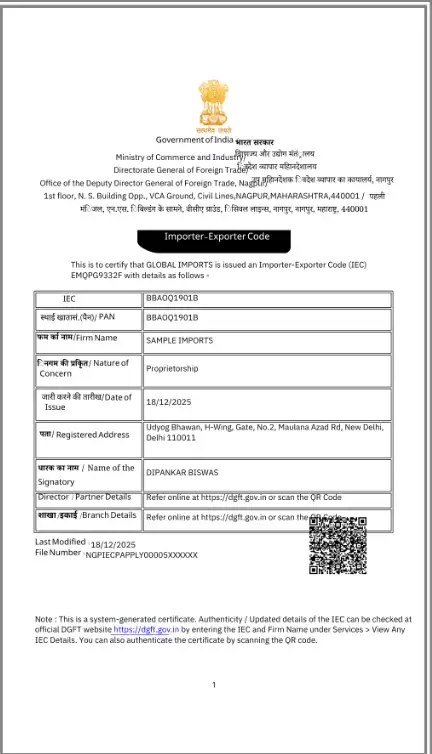
You can download the IEC certificate online from the DGFT portal by following these steps:
- Log in to the DGFT portal: Enter your registered username and password.
- Open IEC Profile Management: Go to Services → IEC Profile Management from the DGFT dashboard.
- Select Print IEC: Click the Print IEC option.
- Verify your details: Check the IEC number, firm name, address, date of issue, and branch details, where applicable.
- Download the certificate: The IEC certificate will be displayed as a PDF that you can save or print for your records.
You can access and print the IEC certificate again through the DGFT portal whenever you need a copy for applicable import, export, customs, or other business requirements.
IEC Verification: How to Verify or Check an IEC Code Online
You can verify an IEC online through the DGFT portal using the “View IEC Related Details” service. The public lookup requires the IEC number, firm name, and CAPTCHA.
Follow these steps to check an IEC online:
- Open the DGFT Portal: Visit the official DGFT website and go to Services → View IEC Related Details.
- Enter IEC Details: Enter the Importer Exporter Code and at least the first three characters of the registered firm name.
- Complete CAPTCHA: Enter the CAPTCHA shown on the page.
- View IEC Details: Click View IEC to access the available IEC details recorded with DGFT.
For your own IEC, you can also log in to the DGFT portal and use View IEC Profile to access detailed information linked to your IEC.
IEC vs GST vs AD Code vs RCMC: Key Differences
Businesses involved in international trade may need different registrations or codes depending on their activities. IEC, GST registration, AD Code, and RCMC serve different purposes, as shown below:
| Particulars | IEC | GST Registration | AD Code | RCMC |
| Full Form | Importer Exporter Code | Goods and Services Tax | Authorised Dealer Code | Registration-cum-Membership Certificate |
| Issued By | Directorate General of Foreign Trade (DGFT) | GST authorities | Authorised Dealer bank | Relevant Export Promotion Council, Commodity Board, Development Authority, or other prescribed authority |
| Main Purpose | Identifies an importer or exporter for applicable international trade transactions | Enables compliance with applicable GST requirements | Links the exporter's bank account with customs for export-related transactions | Provides registration with the relevant export promotion body and may support specified authorizations or benefits under the Foreign Trade Policy |
| When It Is Required | Generally required for commercial import or export, unless an exemption applies | Depends on the nature of the supply, turnover, and applicable GST rules | Required for applicable export customs transactions and registered with the relevant customs location | Required when applicable for a specific authorization, benefit, or concession under the Foreign Trade Policy |
| Validity | Permanent, subject to annual IEC updation and other applicable requirements | Continues until cancelled, surrendered, or otherwise terminated under GST law | Depends on the applicable bank and customs registration | Generally valid for five years, unless otherwise specified |
| Government Fee | ₹500 for a new IEC application | No government fee for GST registration | No separate government fee generally applies for obtaining the AD Code from the bank | Fee depends on the issuing authority |
| Required for Every Exporter? | Generally required for commercial exports, unless an exemption applies | Not necessarily. Applicability depends on GST law and the nature of the transaction | Required for applicable export customs procedures | No. It depends on the export activity, authorization, or benefit involved |
Connect with RegisterKaro and let our experts handle the legal hassle while you grow your business.
Frequently Asked Questions (FAQs)
What is the difference between IEC, AD Code, and RCMC?
An IEC is the Importer Exporter Code issued by DGFT to identify an importer or exporter. An AD Code is a bank-issued code used for customs and foreign exchange-related export transactions. An RCMC is issued by the relevant Export Promotion Council or other competent authority and may be required to obtain certain authorizations or benefits under the Foreign Trade Policy.
Do GST-registered businesses still need an IEC?
Yes, GST registration does not replace an IEC. Businesses generally need an IEC for applicable import or export of goods. For services or technology, IEC requirements depend on the nature of the transaction and whether benefits under the Foreign Trade Policy are being claimed.
Do I need an IEC if I only import or export services?
Under the Foreign Trade Policy, an IEC may be required for certain service or technology transactions, particularly when the service provider or technology supplier is claiming benefits under the Foreign Trade Policy or dealing with specified services or technologies. You should check the applicable DGFT requirements for your transaction.
Can an NRI or foreign national apply for IEC in India?
An NRI or foreign national may be involved in an Indian business that applies for an IEC, subject to the applicable entity, PAN, and DGFT requirements. The eligibility and documentation can differ based on the business structure and the person's role in the entity.
Can I use the same IEC for multiple businesses?
No, DGFT follows the one-PAN-one-IEC principle. A separate legal entity with a different PAN generally requires its own IEC. You cannot use one IEC for unrelated businesses that have separate PANs.
Can an IEC be transferred to another business?
An IEC cannot generally be transferred as a simple change of ownership. However, DGFT provides specific procedures for cases such as merger, acquisition, inheritance, liquidation, or business transfer. A new IEC may be required when the resulting entity has a different PAN.
What should I do if my IEC is deactivated?
Check your IEC profile on the DGFT portal and identify the reason for deactivation. If the IEC was deactivated because the required annual updation was not completed, complete the pending updation through the DGFT portal and follow the applicable process for reactivation.
Do I need to update my IEC if my business details change?
Yes, you should update relevant IEC details when information such as the business name, address, bank details, or other registered particulars changes. IEC holders must also complete the prescribed annual updation even when there are no changes.
What should I do if my IEC application is rejected?
First, check the reason provided by DGFT and correct any missing information, document issue, or validation problem. If the portal provides an option to address the issue or submit the application again, follow the prescribed process. For a specific refusal or regulatory issue, check the communication from DGFT before taking further action.

Reviewed by
Joel DsouzaJoel Dsouza is a Chartered Accountant (CA) and compliance expert with over 7 years of hands-on experience in company registration, tax structuring, GST, ROC filings, and MCA compliance. As a qualified member of the Institute of Chartered Accountants of India (ICAI) and Co-Founder at RegisterKaro, he has personally advised more than 1,000 startups and SMEs across India, helping founders navigate incorporation, regulatory frameworks, and financial planning from Day 1. With deep expertise across all three levels of Finance and Portfolio Management, Joel is committed to promoting financial literacy and simplifying India's startup ecosystem through clear, actionable guidance that entrepreneurs can act on immediately.
Why Choose RegisterKaro for IEC Registration?
RegisterKaro helps you complete your IEC application with support from document preparation to submission and future updates. Here are the key ways we can assist you with your IEC registration:
- DGFT Application Support: Get assistance with the IEC application and DGFT filing process.
- Document Assistance: Get help reviewing and preparing the documents required for your IEC application.
- Authentication Support: Get assistance with Aadhaar e-sign or DSC-based authentication, depending on the application requirements.
- Application Review: Have your application details and documents reviewed before submission to reduce errors or missing information.
- IEC Update Support: Get assistance with IEC modifications and annual updation when your business details change or an update is due.
- Status Assistance: Get help tracking your IEC application and addressing issues that may arise during processing.

What Our Clients Say
View All
Amit Sharma
 Verified
Amazing experience with them. Helped me with company, GST and IEC registration. The team is very helpful especially Isha, she has been a real help thr... Read more

Shiv pal Shiv pal
VerifiedIEC registration has been successfully completed by the RegisterKaro team. The entire process was handled smoothly, efficiently, and professionally by... Read more

Maha Lakshmi
VerifiedExcellent service from RegisterKaro! A huge thanks to Ayush Jain for his proactive support. He kept us on track with regular follow-ups and made the w... Read more

Anandraj Jadhav
VerifiedI had a great experience with the team for the compliance process. The entire procedure was handled in a very professional, hassle-free, and timely ma... Read more

Ronam Nial
VerifiedThank you so much to RegisterKaro and especially to Shruti mam for making our company incorporation process incredibly smooth and hassle-free. Her gu... Read more

priyanka kutty
VerifiedWe have reached them for registration of our firm and the process went very smooth. Thank you @Himanshu Kalwani for explaining and assisting us in the... Read more

Subrahmanyam Saga
VerifiedI am extremely satisfied with the service and very knowledgeable and supportive staff. Shivani she helped us to complete the entire process very smoot... Read more

devi prasad prajaati
VerifiedVery good and amazing service, coperative staff, very fast service, everyone try for firm registration and account services received from Register Kar... Read more

Atif Habib
VerifiedNice and very supportive team. I would suggest register karo team for others. Thanks razor pay specially Ms Kajal who co ordinate me and guide me well... Read more

Aadil Kazi
VerifiedFast, smooth, and professional service. Thanks to Shubham Bharti for the guidance and to Pooja for the timely follow-ups. Really happy with the overal... Read more
Related Blogs
View All
Professional Tax (PT) in India: Slab Rates, Rules & Applicability (FY 2026-27)

GST Registration Fees & Charges in India: Filing Cost Breakdown

Cost of Hiring a CA: What Chartered Accountants Charge in India

Certificate of Incorporation: Meaning, Contents & How to Get It

Appointment of Auditor Under the Companies Act, 2013
How to Get a Digital Signature Certificate (DSC) in India

Appointment of Auditor in LLP: Procedure & Rules 2026

MCA LLP Master Data: View Partners, LLPIN & Status on V3
Difference Between Private Limited Company and LLP in India (2026)

LLP Partner Limit in India: Maximum & Minimum Partners