ISI Mark Registration Online in India
Get your ISI Mark Registration online in India with RegisterKaro. Our experts handle everything from documentation and application to certification guidance, ensuring a smooth and compliant process.
 Product Testing & Certification GuidanceBIS Standards & Scheme AssistanceExpert Support at Every StepQuick Certification ProcessTrusted by 20,000+ Manufacturers

 What Sets Us ApartWhat Sets Us Apart
What is the ISI Mark in India?
An Indian Standard Institute (ISI) Mark is mandatory for over 200 product categories in India, with enforcement increasing by 40% in the last five years. This trend demonstrates the growing importance of standardized quality certification in the Indian marketplace.
An ISI Mark provides official recognition that your products meet the national standards established by the Bureau of Indian Standards (BIS). ISI Mark registration in India ensures compliance under the BIS Act, 2016, and is one of the oldest quality certification schemes in India, operating since 1955.
Types of ISI Mark Registration/Certification in India
ISI Mark certification comes in various forms to accommodate different product categories and compliance requirements:
1. Standard ISI Mark Scheme
Certifies products conforming to Indian Standards, covering essential consumer products including electrical appliances, cement, packaged drinking water, and household items. A common example is the ISI mark on pressure cookers, which indicates compliance with safety and performance standards.
2. Special ISI Mark for Critical Safety Products
Mandates stringent certification for products where safety is paramount, such as LPG cylinders, helmets, and infant food products. For instance, motorcycle helmets must obtain special ISI certification before they can be legally sold in the Indian market.
3. ISI Mark for Small Scale Industries (SSI)
Provides concessions and special provisions for small-scale manufacturers to obtain ISI certification with reduced fees and simplified procedures. This scheme allows, for example, a small-scale soap manufacturer to obtain ISI certification with concessional rates.
4. ISI Mark for Food Products
Certifies food products like packaged drinking water, milk products, and edible oils, ensuring they meet quality and safety standards. For instance, the ISI mark on packaged drinking water bottles verifies their purity and safety.
5. Construction Materials ISI Mark
Certain construction materials like cement, steel bars, pipes, and electrical wires require mandatory ISI certification before they can be sold in the Indian market. For instance, steel reinforcement bars require ISI certification to ensure they meet strength and durability standards.
6. Electrical Appliances ISI Mark
Covers electrical products where safety certification is crucial, including switches, cables, appliances, and lighting products. For example, a distribution board receiving ISI certification ensures electrical safety standards.
7. Voluntary ISI Mark Scheme
Covers products where certification is voluntary but adds market value by demonstrating compliance with national standards. For instance, a furniture manufacturer voluntarily obtains ISI certification to demonstrate its quality commitment to consumers.
8. Eco-Mark Scheme with ISI
Combines ISI certification with environmental compliance, awarded to products that meet both quality and ecological standards. For example, a detergent manufacturer obtains both ISI and Eco-Mark certification to demonstrate both quality and environmental commitment.
Understanding the different types of ISI marks is essential for ensuring product authenticity, quality, and compliance with Indian safety standards. Whether for electronics, construction materials, or consumer goods, the ISI mark provides consumers with confidence and helps manufacturers maintain trust and credibility in the market. Always look for the correct ISI mark relevant to the product category to ensure safety and reliability.
Objectives of the ISI Mark Certification in India
An ISI Mark serves several key strategic and compliance purposes:
- Legal Compliance: Fulfill mandatory regulatory requirements for selling regulated products in the Indian market.
- Consumer Protection: Ensure products meet established safety parameters through rigorous testing and quality standards.
- Market Access: Open doors to the vast Indian consumer market by meeting entry requirements for regulated product categories.
- Brand Reputation: Build consumer confidence through the visible ISI certification mark that signifies verified quality.
- Liability Reduction: Minimize product liability risks through compliance with established national standards.
- Competitive Advantage: Position your brand as quality-conscious and compliance-oriented in a competitive marketplace.
- Government Procurement Eligibility: Enable participation in government tenders that specifically require ISI mark certification.
- Quality Assurance: Establish frameworks for consistent product quality and safety standards throughout production.
Laws Governing ISI Mark Certification in India
The ISI mark certification process is governed by strict standards to ensure product quality, safety, and compliance with national regulations.
1. BIS Act, 2016: Establishes BIS as India's national standards body and empowers it to grant and regulate ISI Mark certification.
2. BIS Rules, 2018: Sets fees, license terms, appeals process, and penalties for ISI Mark misuse or violations.
3. BIS (Conformity Assessment) Regulations, 2018: Details specific requirements for ISI mark certification, including testing protocols and marking guidelines.
4. Quality-Control Orders (QCOs) under Section 16: Various ministries mandate ISI certification for specific products (e.g., electronics, toys, cement, automobile accessories).
5. The Standards of Weights and Measures Act: Works in conjunction with ISI certification to ensure accurate product measurements and quantities.
Characteristics of an ISI Mark Registration in India
An ISI Mark has distinct characteristics that shape how these compliance frameworks function:
1. Standard Compliance
- Products must conform to relevant Indian Standards (IS) published by BIS, outlining quality requirements, testing methods, and safety parameters.
- This ensures that products meet the necessary standards for safety and quality before reaching the market.
2. Territorial Nature
- The ISI Mark is mandatory for certain product categories sold within India, but is generally not required for products manufactured solely for export.
3. Time-Bound Protection
- ISI Mark licenses are typically valid for 1-2 years, requiring renewal to maintain compliance status.
- Regular renewal ensures ongoing compliance with the necessary quality and safety standards.
4. Surveillance-Based System
- ISI Mark operates on a "continuous monitoring" principle, including surprise factory inspections and market surveillance.
- This ensures that certified products maintain quality standards consistently over time.
5. Product Category Specificity
- ISI Mark applies to specific product categories, each with its own Indian Standard number.
- Businesses must identify the correct IS number for their product category to ensure proper certification.
6. Quality Assurance Focus
- ISI Mark certification emphasizes maintaining consistent product quality through rigorous testing and monitoring.
- Regular testing helps identify potential issues and ensures products meet quality expectations.
7. Compliance Documentation
- ISI Mark requires comprehensive records of testing, manufacturing processes, and quality control measures.
- Proper documentation is essential for demonstrating ongoing compliance and facilitating audits.
8. Legal Enforceability
- Non-compliance with ISI Mark requirements for mandatory products can lead to product seizures, penalties, and market exclusion.
- Businesses must ensure compliance to avoid legal and financial repercussions.
Benefits of ISI Mark Certification in India
Obtaining ISI Mark certification in India, especially with professional assistance, offers several key benefits:
1. Quality Assurance
- Guarantees that products meet established Indian safety and quality standards, building consumer trust and reducing defects.
2. Market Credibility
- Increases consumer trust and market acceptance with a recognized quality symbol.
- Boosts product visibility and consumer confidence, enhancing the brand's market standing with the trusted ISI symbol.
3. Regulatory Compliance
- Helps businesses comply with mandatory regulations for regulated product categories.
- Ensures your product adheres to national standards and avoids potential penalties or legal issues from non-compliance.
4. Competitive Advantage
- Differentiates products in the market, enhancing business opportunities and market share.
- Provides an edge over competitors by showcasing your product's commitment to quality and safety standards.
5. Consumer Safety
- Protects consumers by ensuring the products are safe for use and meet performance standards.
- Minimizes health or safety risks by certifying that products meet required safety standards and specifications.
6. Domestic Recognition
- Recognized throughout India as a mark of quality, with high consumer awareness and trust.
- Allows broader market access across all Indian states with a universally recognized quality certification.
7. Increased Sales
- ISI-certified products often have higher demand due to quality assurance and consumer preference.
- Encourages consumer preference and can lead to a rise in sales and brand loyalty in quality-conscious market segments.
8. Legal Protection
- Protects against legal issues related to non-compliance with mandatory product standards.
- Safeguards against disputes or legal actions due to failure to meet regulatory requirements for controlled categories.
Eligibility Criteria for ISI Mark Registration in India
Manufacturers must ensure their products comply with the relevant Indian Standards set by the Bureau of Indian Standards (BIS) to become eligible for ISI Mark registration in India. BIS grants the certification only after it verifies that the product meets all prescribed quality and safety requirements.
1. Legal entity: Applicant must be the actual manufacturer with a valid manufacturing license and business registration in India.
2. Manufacturing facility: The factory must have proper infrastructure, quality control equipment, and must permit a BIS audit, during which samples are drawn for lab testing.
3. Product coverage: Item must conform to the relevant Indian Standard and, if listed in a QCO (Quality Control Order), certification is mandatory before sale.
4. Testing capability: The manufacturer must have in-house testing capabilities or access to a BIS-recognized third-party lab to test production batches against all required parameters.
5. Quality management: Maintain documented process controls, test records, and qualified technical personnel; submit quality-assurance plan to BIS.
6. Production consistency: Demonstrate the capability to consistently manufacture products that meet the relevant Indian Standards.
Meeting these statutory and technical requirements paves the way for securing an ISI Mark license and lawfully marketing regulated products in India.
Documents Required for ISI Mark Registration in India
To ensure your product complies with Indian quality standards, the ISI certification process requires the following specific documents to confirm compliance:
1. Application Form (Form-I)
- An official form that collects details about the manufacturer, factory location, and product specifications.
- This document includes information on the manufacturer, product details, and factory address.
2. Proof of Identity
- For individual applicants: Documents like Aadhaar card, PAN card, passport, or voter ID.
- For companies: Incorporation certificates, GST registration, and other legal business documents required for ISI registration.
3. Proof of Factory Address
- Factory licenses, municipal trade licenses, lease agreements, or property ownership documents confirming the manufacturing location for ISI registration.
- This ensures the factory is registered with local authorities and adheres to regulatory requirements.
4. Manufacturing License
- A valid license or permit from local authorities confirming your legal authorization to manufacture the product.
5. Technical Documentation
- Detailed product specifications, manufacturing processes, raw material specifications, and component details are required for the ISI certification process.
- This documentation is essential to demonstrate how the product complies with technical and quality standards.
6. Quality Manual
- Documentation of the quality management systems implemented at the manufacturing facility, including control procedures and testing protocols.
- This ensures that the factory operates according to standard quality processes for continuous compliance.
7. Factory Layout Plans
- Detailed layout plans showing manufacturing capacity, production areas, testing facilities, and storage spaces.
- These plans help assess the factory's capability to meet production and testing standards for certification.
8. Test Equipment List
- Inventory of testing equipment available at the manufacturing facility for quality control.
- This demonstrates your capability to perform routine quality checks during production.
9. Raw Material Specifications
- Details of raw materials used, their specifications, and testing methods.
- This helps verify that inputs meet the quality requirements necessary for the finished product.
10. Authorization Letter
- If using an authorized representative for ISI registration, a properly executed authorization letter is required.
- This letter grants your representative legal permission to act on your behalf during the certification process.
How to Get an ISI Mark Certification in India
Creating an effective ISI Mark compliance program requires careful planning and execution. The ISI Mark registration procedure is as follows:
1. Identify Applicable Indian Standard
Determine the specific Indian Standard (IS) that applies to your product to understand the exact requirements your product must meet.
2. Prepare and Submit Application
Submit the appropriate application form (Form-I) along with supporting ISI mark registration documents and application fees to the nearest BIS branch office or through the RegisterKaro portal.
3. Sample Submission
Provide representative product samples for comprehensive testing against applicable standards at BIS laboratories.
4. Initial Factory Assessment
BIS officials conduct an on-site inspection of the manufacturing facility to verify production processes, quality control measures, and testing capabilities.
5. Laboratory Testing
Products undergo comprehensive testing at BIS laboratories to verify compliance with all relevant standard parameters specified in the Indian Standard.
6. Review of Test Reports and Inspection
BIS authorities evaluate both laboratory test results and factory inspection reports to determine compliance with relevant standards.
7. Grant of License
Upon successful review, BIS issues the ISI Mark license, allowing you to mark your products with the distinctive ISI certification mark along with your license number.
8. Regular Surveillance
After certification, products and manufacturing facilities undergo periodic and surprise inspections to ensure ongoing compliance with standards.
9. Renewal
ISI Mark certifications require regular renewal, typically every 1-2 years, involving renewal applications, ISI mark fees, and surveillance inspections.
Connect with RegisterKaro and let our experts handle the legal hassle while you grow your business.
Frequently Asked Questions (FAQs)
What is the ISI mark?
The ISI mark stands for Indian Standards Institute mark, which is a certification mark indicating that a product meets the quality and safety standards set by the Bureau of Indian Standards (BIS). It is a symbol of reliability and trust for consumers. Products with an ISI mark undergo rigorous testing to ensure they conform to Indian standards.
How to apply for the ISI mark?
To apply for the ISI mark, you need to submit an application to the Bureau of Indian Standards (BIS) along with the required documentation and product samples. The BIS will review the application, inspect the manufacturing facility, and conduct tests on the product. After a successful evaluation, the ISI mark is granted.
How to get the ISI mark registration certificate?
To obtain the ISI mark registration certificate, an applicant must apply through BIS, provide necessary documents, and undergo factory inspections and product testing. The BIS evaluates the compliance of products and processes with relevant Indian standards. Once all criteria are met, the certificate is issued for the ISI mark.
What is the validity of the ISI certificate?
The ISI certificate is typically valid for one year. However, the validity is contingent on continuous compliance with the required standards. Regular inspections by BIS are necessary to renew the certification annually.
Who can apply for an ISI certificate?
Manufacturers and producers of products that are listed under the Indian Standards Act can apply for the ISI certificate. The applicant must have a registered manufacturing facility and meet the quality criteria defined by BIS. Only those who meet all these requirements can apply for certification.
What is the timeline for ISI mark registration in India?
The timeline for ISI mark registration in India can vary, but it generally takes around 4 to 6 months. This includes the time required for document submission, factory inspection, and product testing. The entire process depends on the complexity of the product and the compliance checks.
Is an ISI certificate mandatory?
Yes, for certain products, the ISI certificate is mandatory, especially those related to safety, health, and environmental standards. It ensures that the products meet the necessary quality criteria and safeguards consumer interests. Without this certification, selling certain products in India is illegal.
How much does ISI Certification cost?
The cost of ISI certification varies depending on the product and the scope of testing required. It includes application fees, testing charges, and factory inspection costs. Typically, fees range from ₹10,000 to ₹50,000 or more, based on the product type and complexity.
Which products require a mandatory ISI Mark in India?
Several product categories require mandatory certification, including cement, electrical appliances, drinking water, LPG cylinders, helmets, steel products, and certain plastic products.
Can I sell products without an ISI Mark if they're not mandatory items?
Yes, for non-mandatory items, ISI certification is voluntary. However, having certification can still provide competitive advantages and consumer trust in the marketplace.
How long does the ISI Mark certification process take?
The process typically takes 3-6 months, depending on product complexity, test results, and how quickly you provide the required documentation and address any non-conformities.
What is the difference between ISI Mark and BIS certification?
ISI Mark is a specific certification scheme under BIS (Bureau of Indian Standards). BIS is the governing body that administers various certification schemes, including ISI Mark, Hallmarking, and CRS.
Can foreign manufacturers directly apply for an ISI Mark?
Foreign manufacturers cannot directly obtain the ISI Mark certification. They must either establish a manufacturing unit in India or obtain BIS certification through the Foreign Manufacturers Certification Scheme (FMCS).
What happens during a factory inspection for ISI Mark certification?
Inspectors evaluate manufacturing facilities, quality control systems, testing capabilities, record-keeping, raw material quality, and whether production consistently meets relevant standards.
How much does an ISI Mark certification cost?
ISI mark fees vary by product category and manufacturer scale, typically including application fees (₹1,000 - ₹5,000), testing charges (₹8,000 - ₹85,000), licensing fees (₹1,000-₹3,000), and marking fees based on production volume.
Can I use my existing international test reports for ISI Mark certification?
In most cases, BIS requires testing at their laboratories or recognized Indian laboratories. International test reports may be considered as supplementary information, but are rarely accepted as a substitute.
What happens if my product fails ISI testing?
You'll receive a non-conformity report and must address the issues identified before resubmitting samples for testing, which will involve additional testing charges.
Is ISI Mark certification the same as ISO certification?
No, ISI Mark certification focuses on product compliance with Indian Standards, while ISO certification relates to management systems and processes within an organization.
How often do ISI Mark surveillance inspections occur?
Frequency varies by product risk category, typically ranging from quarterly to bi-annual inspections, with additional surprise checks possible, especially for high-risk products.
Can ISI Mark certification be transferred if ownership of the company changes?
Yes, ISI Mark certification can be transferred following a formal application process and verification of continued compliance under new ownership, subject to BIS approval.
What marking requirements apply after receiving the ISI Mark license?
Products must display the ISI Mark logo along with the license number and relevant IS number according to specific marking guidelines provided by BIS.
How do I check if a product has a valid ISI Mark?
To verify an ISI Mark's authenticity, find the CML (license) number displayed below the logo on the product. You can then confirm its details by entering this number on the official BIS verification portal or by sending it via SMS to the BIS verification service.
What is the renewal process for the ISI Mark license?
Renewal requires submitting an application at least 3 months before expiration, paying renewal fees, clearing any outstanding dues, and possibly undergoing a renewal inspection to verify ongoing compliance.
How do I update my ISI Mark if I modify my product?
Significant product modifications require reporting to BIS and may necessitate additional testing to maintain certification validity. Minor changes may require notification only.

Reviewed by
Joel DsouzaJoel Dsouza is a Chartered Accountant (CA) and compliance expert with over 7 years of hands-on experience in company registration, tax structuring, GST, ROC filings, and MCA compliance. As a qualified member of the Institute of Chartered Accountants of India (ICAI) and Co-Founder at RegisterKaro, he has personally advised more than 1,000 startups and SMEs across India, helping founders navigate incorporation, regulatory frameworks, and financial planning from Day 1. With deep expertise across all three levels of Finance and Portfolio Management, Joel is committed to promoting financial literacy and simplifying India's startup ecosystem through clear, actionable guidance that entrepreneurs can act on immediately.
Why Choose RegisterKaro for Your ISI Mark Certification Needs?
Here's why we are the trusted choice for ISI Mark certification services:
- Our specialized compliance experts have extensive experience in navigating ISI certification in India across diverse product categories and standards.
- We provide step-by-step guidance through the entire ISI registration process, from standard identification to license issuance and maintenance.
- Our team combines technical expertise with regulatory knowledge to create efficient compliance strategies tailored to your specific products and manufacturing setup.
- We offer transparent pricing with no hidden costs for ISI mark certification, ensuring you know exactly what you're paying for throughout the certification journey.
- Our experts handle all documentation preparation, testing coordination, and inspection preparations, minimizing your administrative burden and maximizing success rates.
ISI Mark registration in India can be a complex yet mandatory requirement, so ensure your products meet compliance standards effortlessly by letting RegisterKaro guide you through the entire process.

What Our Clients Say
View All
Kavya chellamuthu
 Verified
The service was good and they have done the work on time without any delay. The company strike off process was completed on time and they have cleared... Read more

Surajpal
VerifiedI highly recommend this service for anyone seeking reliable assistance in company registration. Their expertise and commitment make them a trustworthy... Read more

Raghu Singh
VerifiedThe best part wasn't that my work got done—it was that I never had to worry about whether it would get done. Archana kept everything on track, and tha... Read more

Mohamed Ismail
VerifiedI've done company incorporation with Register Karo. Incorporation part all the documentation and follow ups everything the process was done smoothly b... Read more

Gaurav Sharma
VerifiedThe experience was amazing, as Muskan facilitated every process of application very smoothly. I recommend her for the prospective endeavours in Regist... Read more

tirumalesh N
VerifiedVery good support for getting registered online. Team is really good in terms of understanding, follow ups . Specially I dealt with Mr. Yash Mehra wh... Read more

Rahul Nalawade
VerifiedThanks to Registerkaro team for efficient response to register my organization. Appreciate Palak bansal, kush and shlok for prompt actions to initiate... Read more

INDRESH PATHAK
VerifiedI register my llp with registerkaro with minimum cost they give all counselling & did fantastic job special thanks to Vishal from registerkaro he take... Read more

Vedant kumar Singh
VerifiedHighly appreciate the efforts of Ms. Anchal Gupta in completing our company incorporation. Her guidance, clarity, and prompt support truly reflect exc... Read more

fb parth
VerifiedAETHERIX TECNOLAB PVT. LTD. made our company registration process simple and stress-free. Their team provided excellent support, clear guidance, and t... Read more
Related Blogs
View All
How to Register a Trademark for Meesho Sellers?

Difference Between Brand and Trademark in India
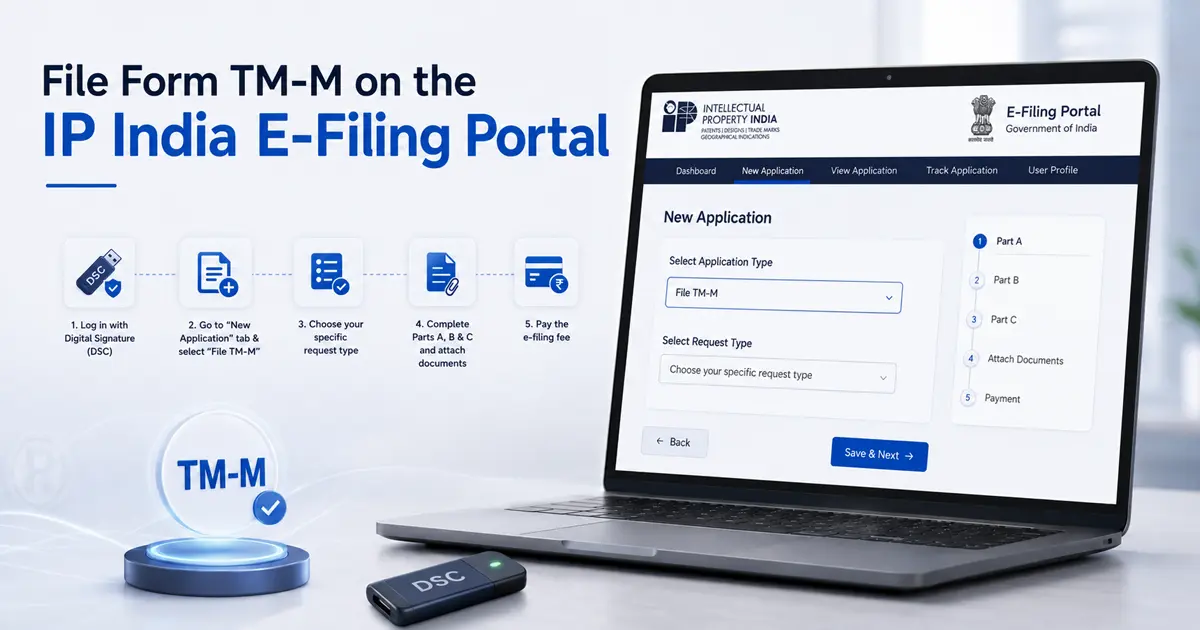
How to File Trademark Form TM-M: Purpose, Fees & Process
Duration of Design Protection in India: 10 to 15 Years
Design Registration Fees in India: 2026 Cost Breakdown

How to Object to a Trademark Application in India?

How to Withdraw a Trademark Application in India?
How to Search a Trademark by Application Number on IP India?

How to Oppose a Trademark Application in India: Full Process

Principles of Trademark Registration in India (2026 Guide)