


To register a trademark for your Meesho sellers, file an application in Form TM-48 under the Trade Marks Act, 1999. Once registered, the trademark registry gives you exclusive rights to your brand name or logo. You can then use it to register your brand on the Meesho supplier panel.
A trademark is not legally required to sell on Meesho, but it is essential if you wish to build & sell under your own brand. To start, you need a GSTIN and a bank account. Eligible small sellers can also sell without GST using an enrolment ID if they fall below the applicable turnover threshold. A registered trademark further helps you qualify for Meesho’s M-Trusted tag and defend your listings under Meesho’s brand policy.
This guide explains how to register a trademark for Meesho sellers. It is based on the Trade Marks Act, 1999, Trade Marks Rules, 2017, IP India procedures, and Meesho documentation available as of 2026.
Key Takeaways
- Trademark registration is not legally mandatory to sell on Meesho, but it is essential to sell under your own brand name and protect it from infringers.
- To sell on Meesho, you need a GSTIN or an enrolment ID and a bank account, not a trademark, and you can list products as “Unbranded.”
- A registered trademark lets you register your brand on Meesho, qualify for the M-Trusted tag and Meesho Mall, and remove counterfeit or copycat listings.
- Meesho sellers should file in the product class for their goods, such as Class 25 for apparel, plus Class 35 for online retail services.
- Brand owners register on Meesho with a trademark certificate, resellers with a brand authorization letter, and local sellers with an invoice.
- Trademark registration is filed in Form TM-48 under the Trade Marks Act, 1999, and costs ₹4,500 per class for individuals, startups, and MSMEs.
- After registration, use your certificate to register your brand on the Meesho supplier panel, where approval takes about 24 to 48 hours.
Why Should Meesho Sellers Register a Trademark?
Registering a trademark does more than allow you to sell under your own brand. It gives you legal ownership and helps you protect your brand from counterfeit sellers. Here’s why every serious Meesho seller should consider registering a trademark:
- List and grow your own brand: A trademark lets you register your brand on the Meesho supplier panel and sell under your own name, instead of listing as an unbranded seller.
- Qualify for Meesho Mall and the M-Trusted tag: Meesho Mall requires brand verification, and a trademark certificate can help support your eligibility for brand verification and the M-Trusted tag. However, Meesho’s eligibility criteria may change frequently, so check the latest Meesho guidelines before applying.
- Remove copycat and counterfeit listings: A registered trademark gives you the legal standing to file infringement complaints and have copycat listings taken down.
- Get court-backed enforcement: Courts can help trademark owners act against infringing marketplace listings. In an interim ex parte order dated 29 May 2026, the Delhi High Court directed Meesho to remove listings using look-alike marks such as JOYKE and JOYSKY and share seller details. The matter remains pending, with the next hearing scheduled for September 2026.
- Build a business asset: A registered trademark is an intangible asset that adds value to your business and can be licensed, sold, or used when expanding to other marketplaces.
- Expand across marketplaces: The same trademark protects your brand on Amazon, Flipkart, and your own website, so you can grow beyond Meesho without rebranding.
Trademark Classes for Meesho Sellers
Trademarks are registered under specific classes, and the right class depends on what you sell. A common mistake Meesho sellers make is filing only under Class 35, which covers the online retail service but not the products themselves. To fully protect your brand, register for relevant product classes based on the goods you sell.
Here are the classes most relevant to Meesho sellers:
| Product Category | Trademark Class |
| Clothing, apparel, and footwear | Class 25 |
| Kitchenware and household utensils | Class 21 |
| Cosmetics, skincare, and beauty products | Class 3 |
| Jewelry and imitation jewelry | Class 14 |
| Electronics and gadgets | Class 9 |
| Bags, luggage, and leather goods | Class 18 |
| Home furnishings and furniture | Class 20 |
| Toys and games | Class 28 |
| Food and packaged products | Class 29, 30, or 32 |
Documents Required for Trademark Registration for Meesho Sellers
To register a trademark, a Meesho seller needs a specific set of documents, which vary slightly depending on whether the application is made as an individual or a business. The documents required are:
- Applicant identity proof: PAN and Aadhaar of the individual or proprietor, or the incorporation certificate and PAN for a company, LLP, or partnership firm.
- Address proof: A recent utility bill, rent agreement, or similar document for the applicant’s address.
- Brand name or logo: A clear copy of the wordmark or the logo in JPG format if you are registering a logo mark.
- Udyam or DPIIT certificate (If Present): Required to claim the lower government fee as an MSME or startup. With this certificate, eligible applicants pay ₹4,500 per class instead of the standard ₹9,000 per class fee applicable to companies and LLPs.
- Power of Attorney (Form TM-48): An authorization allowing a trademark agent or attorney to file the application on your behalf, if you use one.
- User affidavit (if applicable): Required with proof of prior use if you claim rights under the doctrine of prior use.
Once your trademark is registered, you will also need documents to register the brand on Meesho itself:
- Trademark certificate: Proof that you own the brand, needed if you are the brand owner.
- Trademark application number: A pending trademark application may be accepted in some cases as brand proof.
- Brand authorization letter: Required instead of a Trademark Registration Certificate if you are a reseller or distributor selling another company’s brand.
- Original invoice: Accepted as brand proof for local or unbranded sellers who do not own a trademark.
Note: The name on your documents should match the applicant’s name exactly as it appears on the trademark application. Mismatched details are a common reason for objections, so check every document before filing.
How to Register a Trademark for Meesho Sellers: Part 1
To register a trademark for your Meesho business, file an application with the CGPDTM under the Trade Marks Act, 1999, in the following way:
1. Conduct a trademark search
- Search the IP India database to check whether an identical or similar mark already exists. Use the Trademark Name Search Tool to quickly check whether your brand name is available before you file.
- Confirm your brand name or logo is unique to reduce the risk of trademark objection or opposition later.
2. Choose the right class
- Identify the class for your products, such as Class 25 for apparel or Class 21 for kitchenware, and add Class 35 for your online retail brand.
- File in every class that covers what you actually sell, as one class does not protect all your products.
3. Prepare your documents
- Gather your PAN, address proof, and the brand name or logo in JPG format.
- Attach the Udyam or DPIIT certificate if you are claiming the lower fee, and prepare Form TM-48 if an agent files the application on your behalf.
4. File the application (Form TM-A)
- File the trademark application in Form TM-A online through the IP India portal.
- Enter the applicant details, the mark, and the class, then pay the government fee and receive your application number.
Note: Once filed, you can use the ™ symbol beside your brand to show the application is in process.
5. Examination by the Registry
- The Trademark Examiner reviews the application and issues an examination report.
- If an objection is raised, respond within 30 days, which is extendable by up to 30 more days on request.
6. Publication in the Trademark Journal
- Once accepted, the Trademark Registry publishes the mark in the Trademark Journal for public review.
- Any third party can oppose the mark within four months of publication.
7. Registration and certificate
- With no opposition, the Registry registers the mark and issues the registration certificate.
- You can now use the ® symbol and the certificate to register your brand on Meesho.
Trademark registration in India usually takes 6 to 18 months, though you can start using the ™ symbol and building your brand right after filing.
How to Register Your Brand on Meesho Using Your Trademark? Part 2
You can register your brand on Meesho with your trademark certificate and list products under your own brand name. Follow these steps:
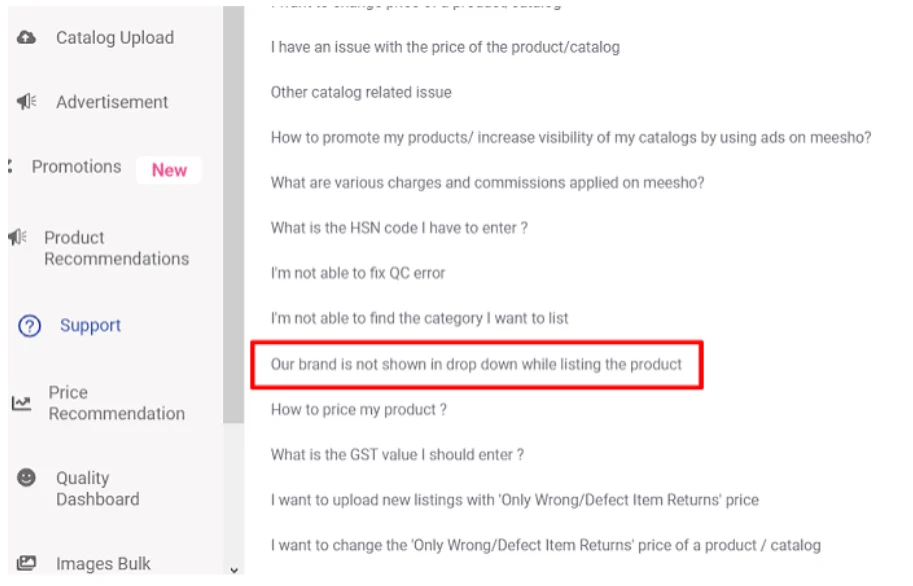
- Open the Support section: Log in to your Meesho Supplier Panel (supplier.meesho.com), click “Support,” then click “View all” under “Cataloging & Pricing.”
- Raise a brand ticket: Select “Our brand is not shown in the drop-down while listing the product” and raise a ticket.
- Add your brand details: Enter the category path for your products and add your brand name exactly as you want it to appear on your listings.
- Upload your brand documents: Upload your trademark certificate as proof of your brand. In the description, mention your brand name, registration date, and trademark class.
- Submit the ticket: Enter a callback number and submit the ticket. Meesho usually verifies and approves the brand within 24 to 48 hours, and your brand goes live within about 3 working days.
- List under your brand: Once approved, your brand name appears in the “Brand” drop-down during single or bulk catalog uploads, so you can list your products under it.
Note: If you are a reseller, upload a brand authorization letter instead of a trademark certificate, and if you are a local seller, upload an original invoice. If your approved brand does not appear in the drop-down, raise a support ticket with your brand approval reference ID.
Trademark Registration Fees for Meesho Sellers
A Meesho seller pays a government fee of ₹4,500 per class if applying as an individual, startup, or MSME, and ₹9,000 per class if applying as a company or LLP. The fee is charged per class and per mark, so filing in two classes costs twice the per-class fee.
Most Meesho sellers, being individuals or small businesses, qualify for the lower ₹4,500 fee. Here’s how the fees compare:
| Applicant Type | Government Fee (Online, per class) |
| Individual / Sole Proprietor | ₹4,500 |
| Startup (with DPIIT recognition) | ₹4,500 |
| MSME (with Udyam certificate) | ₹4,500 |
| Company / LLP | ₹9,000 |
Note: To pay the lower ₹4,500 fee, you must submit the Udyam or DPIIT certificate along with the application. The trademark registration fees are per class and non-refundable, and are prescribed under the First Schedule of the Trade Marks Rules, 2017.
Common Mistakes Meesho Sellers Make in Trademark Registration
A few avoidable mistakes can delay your trademark or leave your brand exposed on Meesho. Steering clear of these keeps your brand protected:
- Selling under a brand without a trademark: Listing under a brand name you have not registered leaves you open to counterfeit sellers and to losing the name if someone else registers it first. Register your trademark before building the brand.
- Filing only under Class 35: Class 35 covers the online retail service, not your products. Register in the product class too, such as Class 25 for apparel, so your actual goods are protected.
- Skipping the trademark search: Filing without a search risks objection or rejection if a similar mark exists. Always search the IP India database before you file.
- Assuming a trademark means instant brand approval: A trademark is proof of ownership, but you still have to complete Meesho’s brand-registration process on the supplier panel to list under your brand.
- Using the ® symbol before registration: You can use ™ once you file, but ® only after the mark is registered. Using ® early can attract a penalty.
- Mismatched details: If the name on your trademark, GST, or brand documents does not match, Meesho may reject the brand approval. Keep your business name consistent across all documents.
- Not registering as a reseller: If you resell another brand, skipping the brand authorization letter means Meesho can reject or restrict your listings. Get proper authorization before listing.
A registered trademark lets Meesho sellers list under their own brand, qualify for the M-Trusted tag, and remove unauthorized sellers for good. If you are ready to sell on Meesho under your own brand, RegisterKaro handles your entire trademark registration, from search to certificate. Contact us today to protect your Meesho brand!
