

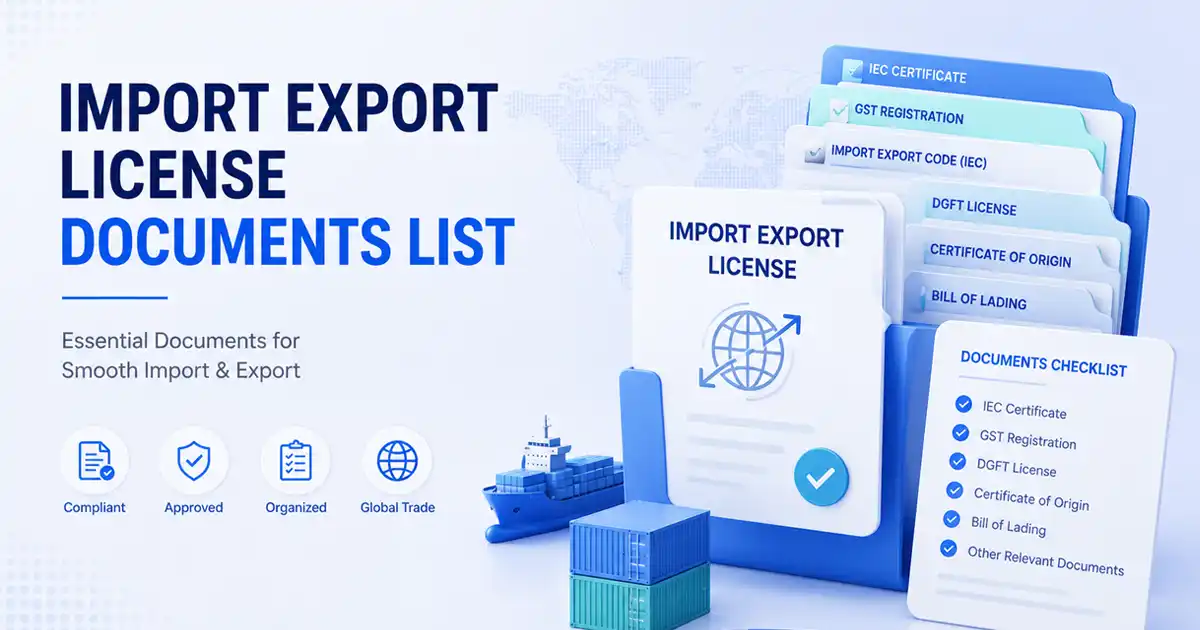
The documents required for an Import Export License (IEC) in India include personal KYC records (such as a PAN card and Aadhaar or passport), proof of business address, and bank account proof. The Directorate General of Foreign Trade (DGFT) uses these details to verify the applicant’s identity and business legitimacy before issuing the 10-digit IEC code, which is mandatory for any import or export activity in India.
The DGFT processes IEC applications online under the Foreign Trade (Development and Regulation) Act, 1992. It checks all submitted details through Form ANF-2A and verifies them against supporting documents before approving the 10-digit IEC code.
Key Takeaways
- The core documents for IEC registration are the same for every business type: PAN card, identity proof, address proof, and bank proof.
- Only the constitution document changes by entity, such as a partnership deed or certificate of incorporation.
- Under DGFT Trade Notice No. 23/2025-26, bank details are now validated in real time through NPCI. They must match your PAN and bank records.
- Companies and LLPs sign with a Class 3 DSC. Proprietors can use Aadhaar e-Sign instead.
- Name mismatches and unclear scans are the top reasons for IEC application rejection.
Complete Import Export License Documents List: Quick Checklist
The table below summarizes all the documents required for an IEC registration in India, along with the validity and format rules DGFT applies to each:
| Category | Documents Required | Validity and Format Requirements |
| PAN Card | PAN of the applicant individual or business entity | Verified in real time against the CBDT database; the name must exactly match PAN records |
| Identity Proof (Proprietorship/ Individual) | Aadhaar card, Voter ID, or Passport (any one) | Self-attested; required for the proprietor and the authorized signatory |
| Business Address Proof | Sale deed, lease deed, rent agreement, electricity bill, or telephone/mobile bill (any one) | Must be in the firm’s name; if not, attach the owner’s NOC plus their address proof as a single PDF |
| Bank Proof | Cancelled cheque bearing the pre-printed firm name, or a bank certificate in the ANF-2A(I) format | Account must be in the firm’s name; under DGFT Trade Notice No. 23/2025-26, details are validated in real time through NPCI and must match your PAN and name as per bank records |
| Passport-Size Photograph | A recent passport-size photograph of the proprietor or authorised signatory | Required where the bank certificate format is used (photo affixed and attested) |
| Entity Constitution Proof | Partnership deed, Certificate of Incorporation (CoI), or MOA and AOA | Depends on business type; not required for individuals or proprietors |
| Digital Signature / e-Sign | Class 3 DSC (Companies and LLPs) or Aadhaar e-Sign via OTP (Proprietors) | DSC must be issued in the authorized signatory’s name; Aadhaar must be linked to an active mobile number |
| Application Form | Form ANF-2A, filed online on the DGFT portal | Fully electronic and paperless; no physical or scanned ANF-2A copy is submitted |
Note: All supporting documents must be uploaded as PDFs or JPEGs, with a maximum file size of 5 MB per document.
Documents Required for Proprietorship / Individual IEC Applicants: Detailed List
IEC is issued against the applicant’s PAN, so every proprietor or individual must submit a personal KYC document set while applying for an Import Export License. The following documents are required:
1. Identity Proof
- PAN Card (Mandatory): Every applicant must provide a self-attested copy of their PAN card. The IEC is generated against this PAN, so the name must match the CBDT database exactly.
- Aadhaar Card, Voter ID, or Passport (Any One): Proprietors must submit one additional government-issued identity document.
2. Business Address Proof (Provide Any One)
Your DGFT e-IEC application requires valid business address proof to verify your principal place of business. DGFT accepts any one of the following documents:
- Sale Deed: Applicants who own the business premises can submit the sale deed as proof of ownership.
- Rent or Lease Agreement: Applicants operating from rented premises can submit a valid rent or lease agreement.
- Utility Bill: A recent electricity bill, telephone landline bill, or mobile/postpaid bill in the applicant’s name is accepted.
Note: The utility bill or address proof must be in the name of the applicant firm. If it is not, you must attach a No Objection Certificate (NOC) from the premises owner along with the owner’s address proof, combined into a single PDF file.
3. Additional Statutory and Compliance Requirements
To complete the IEC application, proprietors must satisfy a few additional compliance requirements. Ensure the preparation of these five items:
- Bank Proof: Provide a cancelled cheque bearing the pre-printed firm name, or a bank certificate in the ANF-2A(I) format. The applicant must hold the bank account in their name, and PFMS/NPCI validates it.
- Passport-Size Photograph: Provide a recent passport-size photograph, which you affix, and the bank attests when you use the bank certificate format.
- Contact Information: Provide a valid personal email address and mobile number. The DGFT portal verifies both through an OTP, which expires 15 minutes after it is sent.
- Linked Aadhaar Card: Proprietors must link their Aadhaar to an active mobile number to complete the Aadhaar e-Sign. The authentication OTP is sent to this registered mobile number.
- Digital Signature or Aadhaar e-Sign: Sign the IEC application using Aadhaar e-Sign (OTP-based), which is fully valid and does not require a Class 3 DSC. A DSC is optional, and the applicant may use one only as an alternative if they choose.
Documents Required for IEC by Business Type In Detail
The basic documents required for IEC registration are the same for all business types:
- PAN Card of the applicant or business entity.
- Identity Proof of the authorized signatory (Aadhaar Card, Passport, Voter ID, or Driving Licence).
- Business Address Proof.
- Bank Proof, either a cancelled cheque with the firm’s pre-printed name or a bank certificate in the prescribed ANF-2A(I) format.
However, each business structure requires its own constitutional document to legally establish the entity and confirm who can operate and sign on its behalf.
The constitutional documents required for IEC registration are:
- Proprietorship / Individual: You don’t need a separate constitution document. The proprietor’s own PAN and identity proof establish the firm, since DGFT issues the IEC directly against the proprietor’s PAN.
- Partnership Firm: A copy of the registered partnership deed, which names the partners and identifies the managing partner who signs the application.
- Limited Liability Partnership (LLP): The CoI issued by the Registrar of Companies (or the LLP agreement), with a designated partner acting as the authorized signatory.
- Private or Public Limited Company: The CoI issued under the Companies Act, 2013, with an authorized director signing the application using a Class 3 DSC.
- HUF: The HUF deed, with the Karta acting as the authorized signatory.
- Trust or Society: The trust deed or registration certificate (and bye-laws, in the case of a society), signed by the managing trustee or authorised signatory.
Common Reasons for IEC Document Rejection by the DGFT and How to Fix Them
The DGFT returns or holds up IEC applications for correction when documents do not meet the prescribed requirements. Here are some of the most common reasons for rejection below, alongside the solutions to ensure a successful filing:
- Name mismatch: Ensure the name matches across your PAN, bank account, and identity documents.
- Address proof mismatch: If the proof is not in the firm’s name, attach the owner’s NOC and address proof as required.
- Bank validation failure: Ensure the bank account is in the firm’s name and enter the details correctly for PFMS/NPCI validation.
- Foreign documents: NRI and foreign applicants may need notarisation or apostille for foreign documents, as applicable.
- Invalid DSC: Use a valid Class 3 DSC registered with DGFT and matching the applicant’s details. Proprietors may use Aadhaar e-Sign where permitted.
