

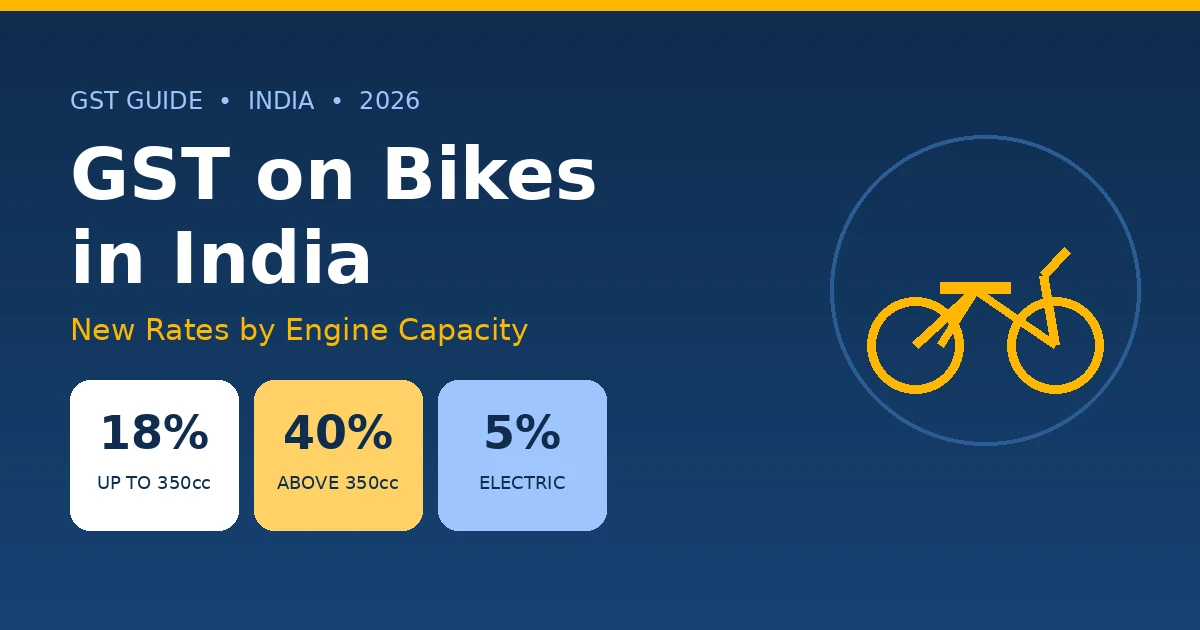
GST on bikes in India depends on engine capacity. Two-wheelers up to 350cc attract 18% GST, while those above 350cc attract 40% GST. Electric bikes continue to be taxed at 5%. These revised rates were announced in the 56th GST Council meeting and came into effect on 22 September 2025. This reduced the GST on smaller bikes from 28% to 18% and increased it on larger motorcycles above 350cc.
The change was introduced to make everyday two-wheelers more affordable. High-powered bikes above 350cc attract a higher GST rate because they are classified as premium vehicles.
Key Takeaways
- GST on bikes in India is 18% for two-wheelers up to 350cc, 40% for those above 350cc, and 5% for electric bikes.
- The rate on bikes up to 350cc was cut from 28% to 18% on 22 September 2025, making most commuter bikes cheaper.
- Bikes above 350cc had their rate raised to 40%, up from an effective 31%, and are now treated as luxury goods.
- Electric bikes continue to attract a concessional 5% GST, unchanged by the September 2025 reforms.
- Two-wheelers fall under HSN code 8711, while bike spare parts fall under HSN code 8714.
List of Bikes and GST Impact Post September 2025 Changes
The September 2025 reform affected bikes differently based on engine capacity, so popular models fall on either side of the 350cc line.
The table below shows how the GST change impacts some of India’s most popular bikes:
| Popular Bike | Engine Capacity | GST Change | Impact |
| Hero Splendor Plus | 97cc | 28% → 18% | Cheaper |
| Honda Activa | 110cc | 28% → 18% | Cheaper |
| Bajaj Pulsar 125 | 124cc | 28% → 18% | Cheaper |
| TVS Apache RTR 160 | 160cc | 28% → 18% | Cheaper |
| Yamaha R15 | 155cc | 28% → 18% | Cheaper |
| Royal Enfield Classic 350 | 349cc | 28% → 18% | Cheaper |
| Royal Enfield Hunter 350 | 349cc | 28% → 18% | Cheaper |
| Jawa 350 | 334cc | 28% → 18% | Cheaper |
| KTM 390 Duke | 399cc | 31% → 40% | Costlier |
| Royal Enfield Himalayan 450 | 452cc | 31% → 40% | Costlier |
| Triumph Speed 400 | 398cc | 31% → 40% | Costlier |
| Royal Enfield Interceptor 650 | 648cc | 31% → 40% | Costlier |
| Harley-Davidson X440 | 440cc | 31% → 40% | Costlier |
HSN Codes and GST Rates for Bikes
Every two-wheeler and its parts are classified under a specific code in the GST system, which determines the tax treatment. Bikes fall under HSN code 8711, while their spare parts fall under a separate code. Here are the relevant HSN codes for bikes:
| Item | HSN Code | GST Rate |
| Electric two-wheelers | 8711 | 5% |
| Petrol two-wheelers up to 350cc engine capacity | 8711 | 18% |
| Petrol two-wheelers with an engine capacity of above 350cc | 8711 | 40% |
| Bike spare parts and accessories | 8714 | 18% or 28% |
Note: HSN code 8711 covers motorcycles, scooters, and mopeds. Use the correct HSN code on invoices and GST filings to avoid classification issues. If you’re unsure, use an HSN code finder before billing.
Who Can Claim GST Input Tax Credit on a Bike?
GST paid on a two-wheeler can be claimed as Input Tax Credit (ITC) only for eligible business purposes, subject to GST rules and restrictions. Here is how ITC applies:
- Personal use is blocked: Under Section 17(5) of the CGST Act, ITC on a bike bought for personal use is not allowed, even if you are GST-registered.
- Resale by dealers: A dealer who buys bikes to sell them can claim ITC on that stock.
- Passenger transport: A business using bikes to provide passenger transport, such as bike taxis, can claim ITC.
- Goods and delivery transport: A business using bikes to deliver goods, such as a courier or food delivery service, can claim ITC.
- Driving schools: A driving school using bikes for training can claim ITC.
Note: GST is not charged on the principal loan amount or EMI repayment for bike purchase. However, banks may charge 18% GST on processing fees and other applicable service charges.
GST on Used and Second-Hand Bikes
GST on used and second-hand bikes depends on the seller and transaction type, with tax applying only in specific cases rather than on every resale. Here is how it works:
- Sold by a registered dealer: When a registered dealer sells a used bike, the dealer charges GST only on the margin earned from the sale. The margin is the difference between the selling price and the purchase price, not the full value.
- Sold between individuals: When one individual sells a bike to another, and neither person is a registered dealer, they do not charge GST on the sale.
