


POSH training is a legally mandated awareness program under the Sexual Harassment of Women at Workplace (Prevention, Prohibition and Redressal) Act, 2013. It educates every employee on what constitutes workplace sexual harassment, their rights and responsibilities under the law, and how to raise or respond to a complaint. Under Section 19(c) of the POSH Act and Rule 13 of the POSH Rules, 2013, every employer with 10 or more employees must organize awareness programs and workshops at regular intervals. These sessions sensitize employees to the provisions of the Act.
Despite the law being in force since 2013, many organizations still treat POSH training as a yearly formality. This leads to uninformed employees, underprepared Internal Complaints Committees, and serious legal exposure. Non-compliance attracts a fine of up to ₹50,000 under Section 26, with repeat violations leading to higher penalties and, where applicable, cancellation of the business license.
This guide covers POSH training in full: its meaning, legal requirements, who needs it, what it must include, certification options, and the latest 2026 compliance updates.
Key Takeaways
- POSH training is mandatory under Section 19(c) of the POSH Act, 2013, for every organization with 10 or more employees.
- The Act protects all women at the workplace, regardless of employment status, including contractual staff, interns, trainees, and visitors.
- POSH training must be role-specific. Employees, managers, ICC members, and senior leadership each require different training content.
- Non-compliance attracts a fine of up to ₹50,000 under Section 26. Repeat violations lead to doubled penalties and business license cancellation.
- The Companies (Accounts) Second Amendment Rules, 2025, make POSH compliance disclosures mandatory in annual Board Reports. Specifically, the amendment strengthens Rule 8(5)(vii) of the Companies (Accounts) Rules, 2014, which mandates POSH disclosure in the Directors’ Report. Required disclosures include: (a) number of complaints received, (b) number of complaints disposed of, and (c) number of cases pending for more than 90 days.
- The Supreme Court in Dr. Sohail Malik v. Union of India (2025) ruled that a woman can file her complaint with the ICC of her own workplace, even if the respondent belongs to a different organization.
- The ICC must complete its inquiry within 90 days. Annual POSH reports must be filed with the District Officer and on the SHe-Box portal.
Who Does POSH Training Apply To?
The Prevention of Sexual Harassment (POSH) Act applies to all workplaces in India, across every sector and ownership type. This includes private companies, public sector undertakings, government departments, startups, hospitals, educational institutions, factories, NGOs, and trusts. The determining factor is not the type of organization but its workforce strength. Any organization that employs 10 or more persons must comply fully with the Act.
The POSH Act specifically protects women. Under Section 2(a), it defines an “aggrieved woman” as any woman who alleges to have been subjected to sexual harassment at the workplace, irrespective of her employment status.
The following table outlines every audience that must receive POSH training and what their sessions must cover:
| Role | Who It Covers | What the Training Must Include |
|---|---|---|
| All Employees | Permanent, contractual, part-time, interns, trainees, volunteers | Definition and types of sexual harassment, complaint process, IC details, bystander responsibility, anti-retaliation protections |
| Managers and HR | Team leads, department heads, HR professionals | Responding to complaints, maintaining confidentiality, preventing retaliation, and duty of care under the Act |
| IC Members | Presiding Officer, internal members | Inquiry procedures, natural justice principles, evidence handling, report writing, 90-day inquiry timeline |
| External Member | NGO representative or person with legal expertise | Organisational policies, inquiry procedures, impartial adjudication, boundaries of the External Member role |
| Senior Leadership | C-suite, directors, board members | Accountability under the Act, Board Report disclosure obligations, and consequences of non-compliance |
| New Joiners | All new employees across designations | Foundational awareness of the Act, IC details, and complaint-filing process |
Note: Indian courts consistently apply a purposive interpretation of the Act, resolving ambiguities in favor of extending protection rather than restricting it. Employers must calculate workforce strength realistically. Short-term, project-based, and part-time arrangements all count toward the 10-employee threshold.
For a complete understanding of the law, refer to our detailed guide on the Prevention of Sexual Harassment at Workplace Act.
POSH Act 2013: The Legal Foundation of POSH Training
The Sexual Harassment of Women at Workplace (Prevention, Prohibition and Redressal) Act, 2013 traces its origin to the Supreme Court’s landmark judgment in Vishaka and Others v. State of Rajasthan (1997). In this case, the Court ruled that workplace sexual harassment violates a woman’s fundamental rights under Articles 14, 15, 19(1)(g), and 21 of the Constitution.
Since no specific legislation existed at the time, the Court issued the Vishaka Guidelines, a binding set of directives for employers to prevent and address sexual harassment at the workplace.
These guidelines remained the operative legal framework for over 16 years until Parliament replaced them with the POSH Act on December 9, 2013. The Act established three core obligations for every employer:
- Prevention of sexual harassment at the workplace.
- Prohibition of sexual harassment in all its forms.
- Redressal of complaints through a structured, time-bound inquiry process.
Key POSH Act Terms Every Employer and HR Professional Must Know
A strong understanding of POSH in HR practices helps organizations move beyond policy and into effective implementation. Before implementing POSH training, every employer and HR professional must be familiar with the following terms defined under the Act:
- The Rules: Sexual Harassment of Women at Workplace (Prevention, Prohibition and Redressal) Rules, 2013.
- Respondent: The person against whom the complaint of sexual harassment has been made.
- Presiding Officer: The senior woman employee who heads the ICC.
- External Member: A member from an NGO or association committed to the cause of women, mandatory on every ICC.
Note: The POSH Act applies to both the organized and unorganized sectors, regardless of industry type or ownership structure.
Is POSH Training Mandatory in India? Legal Requirements Explained
Yes, POSH training is a statutory requirement, not an optional HR initiative. Section 19(c) of the POSH Act, read with Rule 13 of the POSH Rules, 2013, requires every employer to organize workshops and awareness programs at regular intervals. These programs sensitize employees to the provisions of the Act. The law mandates two distinct types of training:
- Awareness programs for all employees covering their rights, responsibilities, and the complaint process under the Act.
- Orientation and capacity-building programs for ICC members to handle complaints, conduct inquiries, and fulfill their legal duties.
Under Section 26 of the Act, non-compliance attracts a fine of up to ₹50,000 for the first offense. Repeat violations result in twice the penalty and cancellation or non-renewal of the organization’s business license. Beyond financial penalties, organizations also face legal proceedings, regulatory scrutiny, and reputational damage.
Smaller establishments with fewer than 10 employees fall under the jurisdiction of the Local Complaints Committee (LC), constituted by the District Officer of the area. The LC performs the same functions as the ICC for organizations that do not meet the threshold for constituting an internal committee.
Note: The POSH Act does not prescribe a fixed frequency for awareness training. Legal experts and courts consistently recommend conducting it at least once every calendar year, with sessions for new joiners during onboarding.
Why is POSH Training Important? Benefits for Organizations and Employees
POSH training is not just a legal obligation. It is a strategic investment in workplace safety, culture, and organizational resilience.
The following table outlines the key benefits for both organizations and employees:
| Benefit | For Organisations | For Employees |
|---|---|---|
| Legal compliance | Documented training records strengthen compliance defence in audits and proceedings | Employees understand their rights and responsibilities under the Act |
| Reduced risk | Lowers the likelihood of harassment incidents and ensures a correct organisational response | Protects employees from retaliation through awareness of anti-retaliation provisions |
| Improved productivity | Reduces fear, discomfort, and distraction across teams | Enables employees to focus and perform without fear |
| Better retention | Reduces attrition driven by unsafe or toxic work environments | Confidence that the organisation values safety and dignity |
| Stronger employer brand | Attracts better talent and builds stakeholder trust | Pride in working for an ethical organisation |
| Reporting confidence | Functional and trusted complaints system | Empowers employees to come forward without fear |
| Employee well-being | Reduces stress, anxiety, and mental health challenges | Psychologically safe work environment |
| Bystander empowerment | Workplace safety becomes a shared organisational responsibility | Equips employees to recognise and report harassment they witness |
Organizations that treat POSH training as a priority, not just a compliance task, see better employee engagement and lower attrition. They also build workplaces that attract and retain the right talent.
Types of POSH Training Programs in India
POSH training is not a single program. Different organizational needs, audiences, and compliance requirements call for different types of training.
Here is a breakdown of the main types of POSH training programs available in India:
1. POSH Awareness Training for Employees
This is the most common form of POSH training. It covers the definition of sexual harassment, employee rights and responsibilities, the complaint process, and the role of the ICC. Every employee must attend this program at regular intervals.
2. POSH Training for Managers and Team Leaders
Managers carry specific responsibilities under the Act. This program focuses on how to respond to a complaint, maintain confidentiality, prevent retaliation, and create a harassment-free team environment.
3. ICC Member Training and Capacity Building
Specially designed for Internal Complaints Committee members. It covers inquiry procedures, principles of natural justice, evidence handling, report writing, and the 90-day statutory timeline. Rule 13 of the POSH Rules, 2013, specifically mandates this training.
4. Train-the-Trainer Programs
Designed for HR professionals and compliance officers who want to build internal POSH training capability. Participants learn how to design, deliver, and evaluate POSH training sessions within their organization. Several institutes offer CPD-accredited and SHRM/HRCI-recognized certifications for this program.
5. New Joiner Onboarding Training
Every new employee must receive POSH awareness training as part of their induction. This ensures that employees understand the organization’s POSH policy, the ICC, and the complaint process from their very first days.
6. POSH Refresher Training
Annual refresher sessions reinforce awareness, address gaps identified in the previous year, and incorporate any legal updates. Courts and regulators treat one-time training as insufficient. Regular refresher sessions demonstrate active compliance.
7. Industry-Specific POSH Training
Training content must reflect the realities of the work environment. A manufacturing plant, a hospital, an IT company, and a hospitality business each face different dynamics. Industry-specific POSH training addresses sector-relevant scenarios, power dynamics, and workplace settings.
Note: In 2026, courts and compliance auditors evaluate more than just whether POSH training was conducted. They also examine whether the training was relevant, role-specific, properly documented, and delivered in a language employees can understand.
Online POSH Training in India: How It Works and What to Look For
In 2026, online POSH training has become the preferred delivery format for most Indian organizations. It offers the same legal compliance value as in-person training while being significantly more scalable, cost-effective, and easier to document.
The three main delivery formats are compared below:
| Format | How It Works | Best Suited For | Key Advantage |
| Online | Self-paced modules on an LMS with assessments, certificates, and automated tracking | Large teams, multi-location organizations, remote and hybrid workforces, and new joiner onboarding | Scalable, consistent, and audit-ready |
| Classroom | In-person sessions conducted by a certified POSH trainer | ICC capacity building, leadership sensitization, and organizations with limited digital access | Interactive discussion and scenario-based learning |
| Hybrid | Online modules for foundational awareness combined with live sessions for discussion and Q&A | Mid-to-large organizations that want comprehensive coverage across all employee levels | Combines the efficiency of online with the depth of the classroom |
The right format depends on the size, structure, and needs of the organization.
What to Look for in an Online POSH Training Platform?
When selecting an online POSH training platform, organizations must evaluate the following:
- Scenario-based content relevant to the Indian workplace context.
- Multilingual support covering Hindi, English, and regional languages.
- Assessment and certification on completion.
- Automated completion tracking and tamper-proof, audit-ready reports.
- Annual reminder functionality for refresher training.
- Mobile accessibility for frontline and field employees.
- Consistent delivery of content across all locations and teams.
Note: The POSH Act does not specify a delivery format for training. Both online and offline formats are legally valid, provided the content is accurate, the training is documented, and completion records are maintained for compliance audits and Board Report disclosures.
How to Conduct POSH Training Effectively: Best Practices for Organizations
Conducting POSH training is a legal requirement. Conducting it effectively is what actually protects employees and the organization.
The following best practices help organizations build a program that works in practice, not just on paper:
- Assess organizational requirements first: Evaluate your workforce size, number of locations, languages employees speak, and sector-specific risks before selecting a format or vendor.
- Make training role-specific: Design separate content for employees, managers, ICC members, and senior leadership. Each audience carries distinct responsibilities under the Act.
- Use real-life case studies and scenarios: Abstract definitions do not help employees recognize harassment in practice. Scenario-based training improves awareness, retention, and the likelihood of correct action.
- Deliver training in the language employees understand: Organizations with factory workers, field staff, or employees in tier-2 and tier-3 cities must deliver POSH training in Hindi and relevant regional languages.
- Involve leadership actively: Leaders set the tone for workplace culture. Their visible participation in POSH training signals genuine organizational commitment, not just compliance.
- Document everything: Maintain records of attendance, training dates, content covered, trainer credentials, and completion certificates. This documentation forms your compliance defense during audits and Board Report disclosures.
- Conduct regular refresher sessions: One-time training does not constitute compliance. Conduct annual refresher sessions for all employees and update content immediately when legal changes occur.
- Gather feedback and evaluate outcomes: Collect participant feedback after every session. Track completion rates, assessment scores, and complaint trends to measure whether the training is achieving its objectives.
Organizations that follow these practices build a POSH training program that meets legal standards and creates a genuinely safer workplace.
POSH Training Certification in India: Types, Cost, and How to Get Certified
POSH training certification is not the same as organizational POSH compliance. Certification is a formal credential earned by an individual that demonstrates their depth of knowledge of the POSH Act and its implementation. While the Act does not mandate individual certification, certified ICC members, HR professionals, and POSH trainers are significantly better equipped to fulfill their responsibilities under the law.
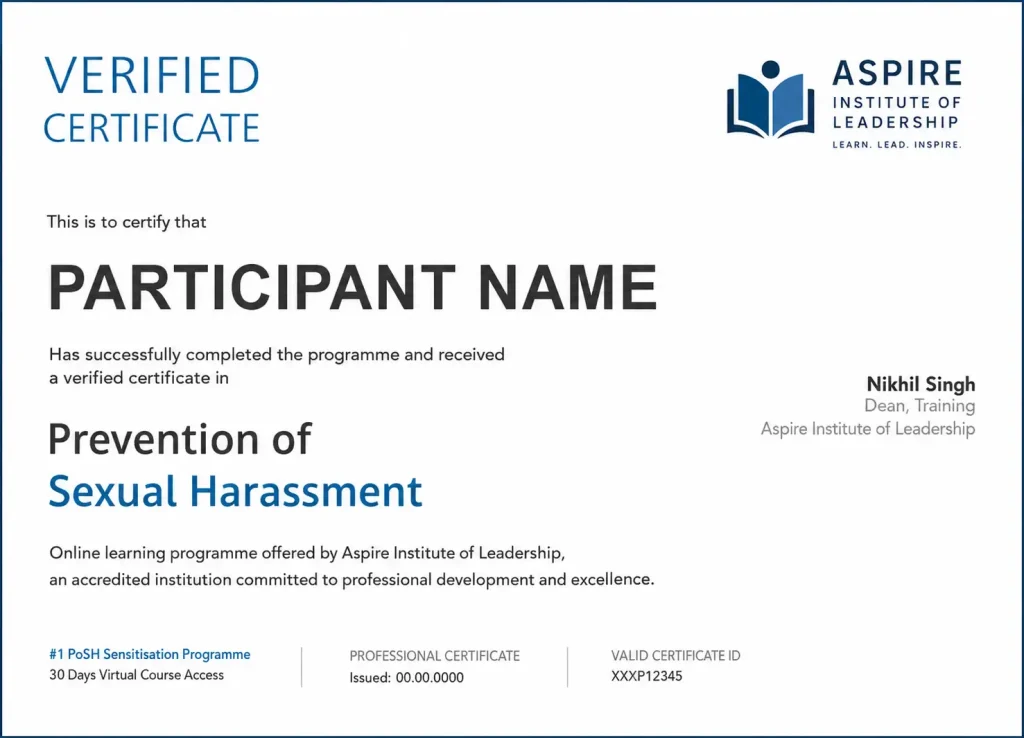
The following individuals benefit most from obtaining a formal POSH certification:
- HR professionals responsible for designing and implementing POSH programs.
- ICC members who need to demonstrate competency in inquiry procedures and the law.
- Compliance officers managing POSH documentation and annual reporting.
- Legal professionals and social workers who want to serve as External Members of the ICC.
- Individuals who want to deliver POSH training independently as certified trainers.
The table below outlines the main types of POSH certification available in India:
| Certification Type | Best For | Approximate Cost | Recognized By |
| POSH Awareness Certificate | Employees and managers are completing basic training | ₹1,000 to ₹3,000 | Issuing organization or LMS platform |
| ICC Member Certification | Internal Complaints Committee members | ₹5,000 to ₹15,000 | POSH training institutes, legal bodies |
| Train-the-Trainer Certification | HR professionals and aspiring POSH trainers | ₹8,000 to ₹25,000 | CPD, SHRM/HRCI, Ministry-empanelled institutes |
| Government-Recognized Certificate | HR professionals and compliance officers | ₹1,000 to ₹3,000 | Vskills, Ministry-empanelled providers |
Before enrolling in any POSH certification program, verify the accreditation of the institute and the trainer’s credentials. Also, confirm the assessment format and whether the certificate carries a validity period or requires renewal.
POSH Training Compliance Checklist for Organizations in India
Organizations must treat POSH compliance as an ongoing responsibility, not an annual event. Use this checklist to assess your organization’s current compliance status and identify gaps before an audit or Board Report disclosure.
1. Policy and Documentation
- POSH policy drafted, approved, and communicated to all employees.
- POSH policy is displayed prominently at the workplace, both physically and digitally.
- ICC member names and contact details are shared with all employees.
- The District Officer was informed of the ICC constitution upon formation.
2. ICC Constitution
- ICC was formally constituted by a written order with all mandatory members.
- The Presiding Officer is a senior woman employee.
- At least two internal members are committed to women’s causes or have legal knowledge.
- One External Member from an NGO or with relevant legal expertise appointed.
- Fees paid to an External Member for participation in ICC proceedings.
- At least 50% of ICC members are women.
- ICC terms are reviewed and reconstituted every three years.
- Any vacancy due to resignation or departure will be filled promptly.
3. Training and Awareness
- Annual POSH awareness training is conducted for all employees.
- POSH training is delivered during onboarding for all new joiners.
- ICC member orientation and capacity-building program conducted.
- Trainers deliver training in languages that employees understand.
- Attendance records, training content, and completion certificates are maintained.
4. Complaint Handling
- A confidential complaint filing mechanism is in place and communicated to all employees.
- ICC inquiry completed within the mandatory 90-day timeline.
- Employer action taken on ICC recommendations within 60 days.
- Disciplinary action documented and aligned with applicable service rules.
5. Reporting and Disclosure
- Annual POSH report submitted to the District Officer after the close of each calendar year; this is required even if no complaints were received during the year.
- Annual report filed on the SHe-Box portal.
- POSH compliance disclosed in the Board Report under the Companies (Accounts) Second Amendment Rules, 2025.
- Listed companies have included POSH compliance in SEBI LODR governance filings.
Note: Organizations with offices across multiple districts must submit a separate annual report in each district where an ICC is constituted.
POSH Training 2025-26: Key Legal Updates Every Employer Must Know
The regulatory and judicial environment around POSH compliance has changed significantly. Organizations that have not updated their frameworks are operating at measurably higher legal risk.
1. Mandatory POSH Disclosures in Board Reports
Effective July 14, 2025, all companies, except One Person Companies and Small Companies, must disclose POSH compliance data in their annual Board Reports. This reflects a broader shift toward corporate governance, where workplace safety is now a board-level responsibility. The disclosure is filed through the revised e-Form AOC-4 under the Companies Act, 2013.
2. Supreme Court Compliance Audit Directive: Aureliano Fernandes v. State of Goa
On August 12, 2025, the Supreme Court directed all states and union territories to conduct district-wise surveys to verify the ICC constitution, composition, and member training under Section 4 of the POSH Act. States were required to complete this within six weeks, by September 23, 2025. Organizations with non-functional or improperly constituted ICCs now face direct judicial scrutiny.
In Aureliano Fernandes v. State of Goa, (2023) SCC OnLine SC 1471 (12 May 2023), the Supreme Court observed serious implementation gaps in POSH compliance and directed all States, Union Territories, and the Central Government to verify the constitution of ICs and LCs across all eligible workplaces, conduct regular training and capacity-building for IC members, and update IC member contact details on institutional websites.
3. Expanded ICC Jurisdiction: Dr. Sohail Malik v. Union of India
On December 10, 2025, the Supreme Court ruled that a woman may file her complaint with the ICC of her own workplace, even if the respondent belongs to a different department or organization. Jurisdiction cannot be used to deny or delay a complaint.
4. SHe-Box Portal Expansion
The SHe-Box portal now functions as a centralized complaint routing and monitoring system. The Supreme Court has directed mandatory ICC registration on the portal, along with annual POSH report filing.
5. Digital Harassment Confirmed Under POSH
The Delhi High Court confirmed that WhatsApp messages, emails, and video calls fall within the scope of the POSH Act wherever a professional relationship exists. Organizations must update their policies and training programs to address digital harassment explicitly.
Note: POSH compliance is now public law compliance under active judicial supervision. Organizations must demonstrate it through documentation, not merely assume it.
Ensure your organization is fully POSH compliant in 2026. RegisterKaro helps businesses across India set up compliant ICCs, draft POSH policies, file annual reports, and conduct employee training. Get end-to-end POSH compliance support from experts who understand the law. Contact us today to build a safer, compliant, and harassment-free workplace!
