Copyright Registration Online in India
Ready to Protect Your Creative Work? Whether it's a book, software, music, artwork, or film, RegisterKaro helps you obtain Copyright Registration quickly and compliantly with expert guidance at every step.
 Form XIV Filing Across All Six Work CategoriesNOC, Power of Attorney & Statement of Particulars Handled100% Online Process — No Physical Visits or Postal SubmissionsDiscrepancy Letter & Objection Response Support IncludedTrusted by 1,000+ Creators Across India

 What Sets Us ApartWhat Sets Us Apart
What is Copyright Registration?
Copyright Registration is the legal process of securing your ownership over an original creative work under the Copyright Act, 1957, and the Copyright Rules, 2013. This registration grants you exclusive rights over how your work is used, distributed, and reproduced.
Copyright protection is automatically granted in India when a work is created. Formal registration, however, provides a real legal advantage. Under Section 48 of the Copyright Act, 1957, the Register of Copyrights serves as prima facie evidence of your ownership in a court of law. This is an important distinction, since proving ownership in a dispute is a separate matter from simply holding the right. Hence, copyright registration in India creates a public, verifiable record of your intellectual property rights.
What is the Purpose of Copyright Registration?
The main purpose of Copyright Registration includes:
- Get Official Proof: Puts your name on a public list as the owner. This serves as strong proof in court under Section 48.
- Protect Your Work: Allows you to sue people who copy your work illegally and warns others not to.
- Simplify Monetization: Makes it easier and safer to sell, rent, or license your work through a copyright license. A registered record removes ambiguity over who actually holds the rights being licensed.
- Gain Full Control: Gives you solid control over your creative vision and the money you earn from it.
- Get Official Proof: Puts your name on a public list as the owner, serving as strong proof in court under Section 48. Pairing this with the © symbol reinforces your claim publicly, though displaying © is optional and not a substitute for registration.
- Block Counterfeit Imports: Lets you record your registered copyright with Indian Customs. This helps prevent pirated or infringing copies of your work from entering the country.
Types of Copyright Licenses in India
The main types of copyright licenses are:
- Exclusive License: Grants the licensee sole rights to use the work, even if the owner cannot use it the same way or license it to anyone else during the term.
- Non-Exclusive License: Allows the licensee to use the work while the owner retains the right to grant similar licenses to others.
- Voluntary License: Granted by the owner at their own discretion, under mutually agreed terms.
- Compulsory License: Granted by the Commercial Courts (formerly the Copyright Board) when a work has been withheld from the public, under Section 31.
- Statutory License: Applies to specific uses fixed by law, such as cover versions of sound recordings under Section 31C.
Types of Creative Works Protected Under Copyright Registration
Copyright registration in India protects only specific types of works listed under Section 13 of the Copyright Act, 1957. It does not cover all kinds of creative work. Here are the categories eligible for copyright registration:
Legal Rights of a Copyright Owner: Economic and Moral Rights
Copyright registration gives the owner exclusive legal rights over their work. These rights fall into two categories:
a. Economic Rights (Section 14)
These rights allow the copyright owner to control how their work is used commercially and to earn from it. They include:
- Right to Reproduce: Make copies of the work in any format, including print, digital, or electronic storage.
- Right to Distribute: Sell, rent, license, or otherwise make copies of the work available to the public.
- Right to Public Performance: Perform, display, or communicate the work to the public, whether live or through recorded media.
- Right to Create Adaptations: Convert the work into a cinematographic film, sound recording, or other permitted adaptations, depending on the type of work.
- Right to Translate or Adapt: Translate the work into another language or adapt it into a different form, such as a dramatization, summary, or screenplay.
- Right to Communicate to the Public: Broadcast, stream, or otherwise make the work available to the public through television, radio, the internet, or other communication channels.
- Right of Commercial Rental: Authorize the commercial rental of eligible works, such as computer software, cinematographic films, and sound recordings.
b. Moral Rights (Author's Special Rights Under Section 57 of the Copyright Act, 1957)
These are personal rights that remain with the original creator, even if the economic rights have been transferred:
- Right of Attribution (Paternity Right): The author has the right to be identified and recognized as the creator of the work.
- Right to Object to Distortion (Integrity Right): The author can oppose any modification, distortion, or misuse of the work that could harm their honor or reputation. Courts have interpreted this right expansively. In Amar Nath Sehgal v. Union of India (Delhi HC, 2005), a sculptor successfully invoked Section 57 after the government destroyed a mural he'd created for a public building. This establishes that even physical destruction of a work can violate the integrity right.
Note: Moral rights are independent of the copyright owner's economic rights and cannot be waived or assigned.
Copyright Registration in India: Legal Framework & Authorities
A strong legal framework protects the rights of creators and ensures the enforcement of registration and copyright law in India.
1. Legal Framework
Copyright registration in India is governed by:
- The Copyright Act, 1957 (as amended up to 2012)
- The Copyright Rules, 2013
- The International Copyright Order, 1999
2. International Treaties
India's participation in international treaties means your copyright can be protected globally:
- Berne Convention: The cornerstone treaty ensuring that a work created in India gets the same protection in other member countries as they give to their citizens.
- Universal Copyright Convention (UCC): Another key convention providing a framework for international copyright protection.
- Trade-Related Aspects of Intellectual Property Rights (TRIPS) Agreement: A WTO agreement that sets minimum standards for IP protection, including copyright.
- WIPO Copyright Treaty (WCT): Specifically designed to protect works in the digital age (part of the Berne Convention for the Protection of Literary and Artistic Works).
3. Authorities that Govern Copyright Registration
The following authorities oversee copyright registration in India:
- The Copyright Office: The Copyright Office is a statutory body established under Section 9 of the Copyright Act. It is headed by the Registrar of Copyrights, appointed under Section 10. The office manages copyright applications and maintains the official Register of Copyrights under Section 44.
- Commercial Courts (formerly the Copyright Board, then the IPAB): Handle disputes, appeals, and licensing disagreements. The Copyright Board was abolished, and disputes are now handled by the Commercial Division of the relevant High Court.
- Department for Promotion of Industry and Internal Trade (DPIIT): The Copyright Office operates under the DPIIT. It is part of the Ministry of Commerce and Industry and oversees India's intellectual property policy.
Benefits of Copyright Registration in India
Registering your work is a powerful step to protect your creations. Here’s a summary of the key advantages:

- Legal Proof & Stronger Rights: A registration certificate is your official proof of ownership, recognized in court. It gives you stronger legal standing to stop infringement and simplifies legal disputes.
- Transferable and Inheritable Asset (Copyright Assignment): Copyright can be legally assigned, sold, licensed, or transferred through a written assignment. It can also be inherited through a will or by legal heirs, making it a valuable intellectual property asset for individuals and businesses.
- Deters Unauthorized Use: A public registration warns others against copying your work. It also strengthens your case when requesting that online platforms take down pirated content.
- Preserves Creative Control: It gives you the legal authority to decide how your work is used, adapted, or modified, protecting your artistic vision.
Disadvantages of Copyright Registration
Copyright registration in India offers real advantages, but it comes with a few genuine trade-offs worth knowing beforehand:
- Time and Cost: Registration can take 2–8 months and involves government fees, with additional costs if you use professional assistance.
- Public Record: Basic details of your work become part of the public copyright register after registration.
- Self-Enforcement: The Copyright Office does not monitor infringements; the owner must identify violations and take legal action.
- No Absolute Protection: Registration strengthens your claim but does not prevent ownership disputes or guarantee an uncontested right.
Eligibility Criteria for Copyright Registration in India
Copyright registration in India is available for eligible creators and original works. Here's who can apply and what qualifies for protection:
Who Can Apply:
- Authors and Creators: The original author of a literary, dramatic, musical, or artistic work.
- Publishers, Producers, and Composers: Depending on the type of work, such as a film producer or a music composer.
- Employers: Where work is created by an employee in the course of employment, the employer may be the rightful owner and applicant, unless a contract states otherwise.
- Legal Heirs and Assignees: Anyone who has legally inherited or acquired the rights to a work.
- Joint Authors: In the case of joint authorship, any one of the co-authors can file the application on behalf of the group.
Documents Required for Copyright Registration
The exact documents for copyright registration depend on the type of work being registered, but most applications share a common core set. Here's what you'll typically need:
Common Documents for All Applications
- Form XIV, with the Statement of Particulars (SoP) and Statement of Further Particulars (SoFP).
- Identity proof (Aadhaar, PAN, passport, or voter ID).
- Two copies of the work for unpublished works, three for published works.
- NOC from the author (on stamp paper), if the applicant isn't the author.
- NOC from the publisher, if the work is already published under a different party.
- Deed of Assignment, if ownership has been formally transferred.
- Power of Attorney, if filing through an advocate or agent.
- Form TM-60 Certificate, if the artwork is being used as a commercial logo or label.
Work-Specific Documents
- Software: Source code and object code extracts. As page count requirements may vary, it's recommended to verify the latest submission requirements with the Copyright Office before filing.
- Artistic Works Used on Goods (Logos, Labels, Packaging): A TM-60 Trademark Search Certificate from the Trade Marks Registry.
- Musical Works: Musical notations or a recording, along with composer and lyricist details.
For Joint Authorship: A written assignment or NOC from the other co-authors, if one is filing on the group's behalf.
Note: Identity verification and supporting documents are securely handled in compliance with applicable Indian data privacy standards.
How to Register Copyright in India: Step-by-Step Process
Copyright registration follows a fixed sequence set by the Copyright Act, 1957, and the Copyright Rules, 2013. Here's exactly how the process unfolds, from filing to certificate:
Step 1: Create an Account on the Copyright Office Portal
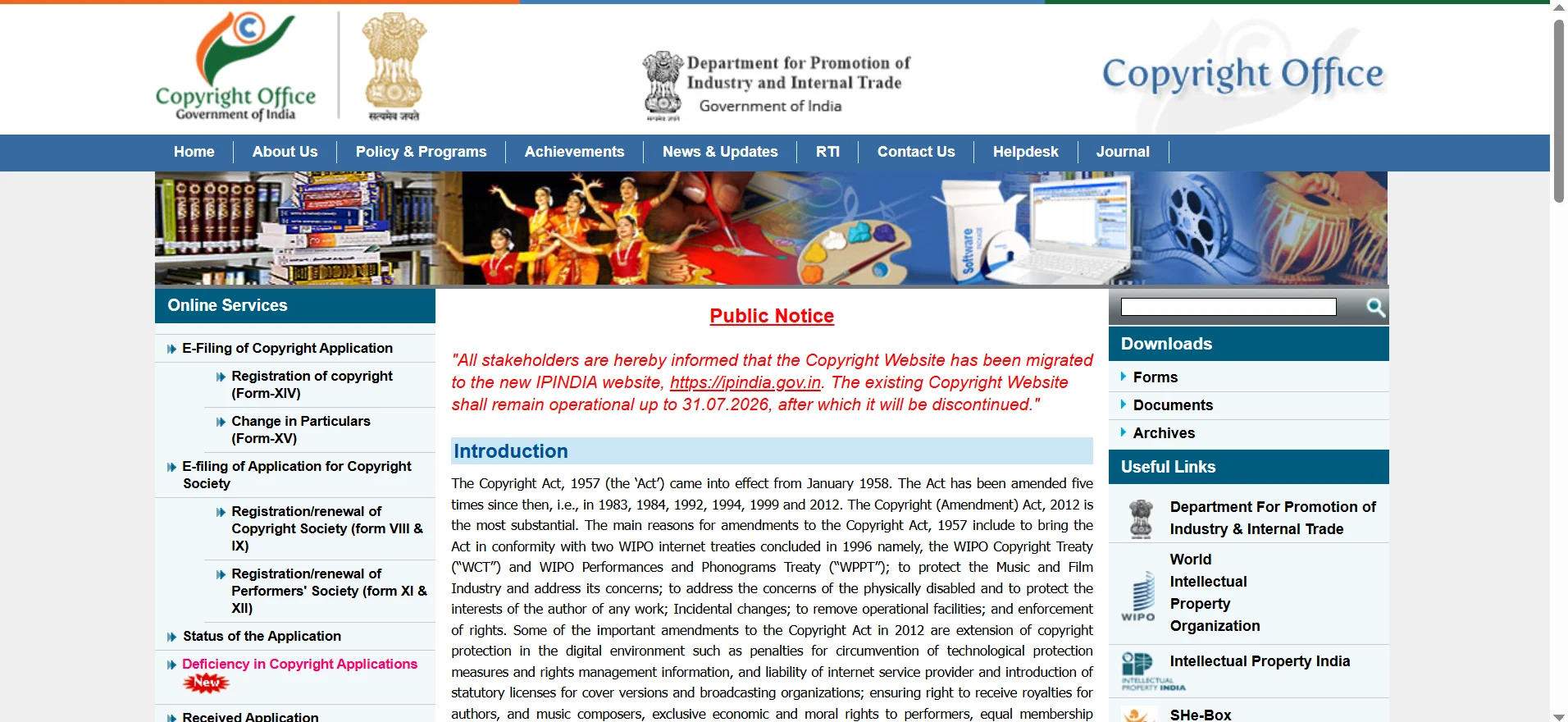
- Visit the official Copyright Office e-filing portal.
- Click "New User Registration" to create your login credentials.
- Existing applicants can simply log in with their registered ID.
Step 2: Draft Form XIV
- Select the correct category of work: literary, dramatic, musical, artistic, cinematographic film, or sound recording.
- Enter the title, language, and nature of the work.
- Provide full author details, name, address, and nationality.
- Provide applicant details, if different from the author.
- Specify the date of creation and date of publication if the work has already been published.
- Indicate ownership status: whether you're the author, an assignee, or a publisher.
Step 3: Upload the Statement of Particulars (SoP) and Statement of Further Particulars (SoFP)
- The Statement of Particulars records the core facts about the work and its ownership.
- The Statement of Further Particulars is required for literary, dramatic, musical, artistic works, and software. It explains how the applicant obtained the rights if they are not the original author.
Step 4: Upload the Work and Supporting Documents
- Upload two copies of the work for unpublished works, three for published works, in the correct format (PDF for literary works, JPG for artistic works, MP3 for sound recordings, source and object code for software).
- Attach identity proof (Aadhaar, PAN, passport, or voter ID).
- Attach an NOC from the author, on stamp paper, if the applicant isn't the author.
- An NOC from the publisher, if the work is already published under a different party.
- Attach a Power of Attorney if filing through an advocate or agent.
- Attach a TM-60 Trademark Search Certificate if the work (such as a logo) is used or capable of being used on goods.
Step 5: Pay the Prescribed Government Fee
- Pay the applicable government fee online through the BharatKosh portal, based on the category of work.
- The application remains incomplete, and no Diary Number is generated until payment is successfully processed.
Step 6: Receive a Diary Number
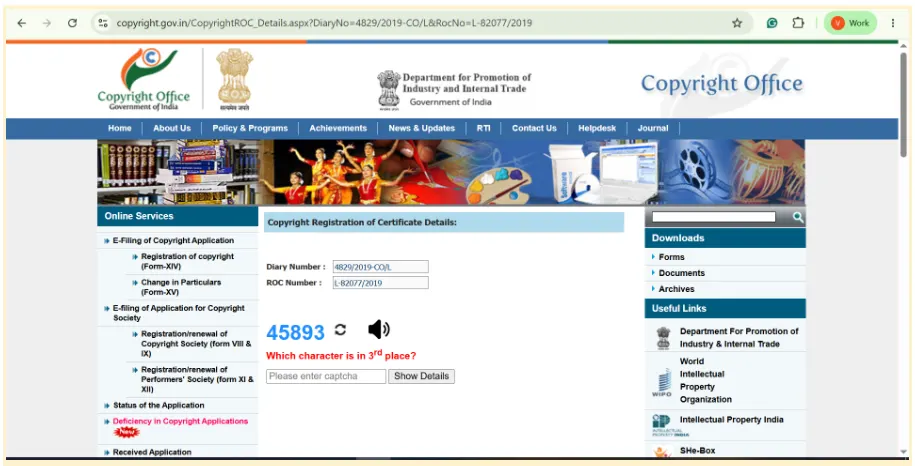
- Upon successful filing and payment, the Copyright Office issues a Diary Number instantly.
- This number is your official tracking reference for checking application status on the portal.
Step 7: Mandatory 30-Day Waiting Period
- A compulsory 30-day objection window opens immediately after the Diary Number is issued.
- Any third party can raise a formal objection during this window if they believe the work isn't original or infringes on their existing rights.
- If no objection is filed, the application automatically proceeds to examination once the window closes.
Step 8: Examination
- An examiner reviews the application for completeness, accuracy, and originality.
- If discrepancies are found, a discrepancy letter is issued to the applicant.
- You must respond within 30 days with the required clarification or documents.
Failing to respond within this window results in the application being treated as abandoned.
Step 9: Hearing (If Objected)
- If a third party files an objection, both parties receive formal notice from the examiner.
- A hearing is scheduled where both sides can present their case.
- The Registrar reviews the arguments and evidence before issuing a decision.
Step 10: Certificate Issuance
- Once the examiner is satisfied and any objections are resolved in your favor, the Registrar enters the work into the Register of Copyrights.
- The Registration Certificate (an official Extract of the Register) is generated and made available for download directly from the portal.
- Physical certificates are no longer issued, following the Copyright (Amendment) Rules, 2021.
Altogether, most uncontested applications are registered within 2 to 8 months. The process may take longer if objections or discrepancies arise.
Don't Let a Discrepancy Letter Delay Your Copyright! Over 35% of self-filed copyright applications receive a Discrepancy Letter, usually over missing Author NOCs, an incomplete Statement of Particulars, or conflicting ownership details. RegisterKaro gets your Form XIV and documents right the first time, so your application moves straight to examination.
Copyright Registration Fees in India
The Copyright Office charges fees that start from ₹500 per work, based on the category of work, not the applicant's type. Fees are payable to "Registrar of Copyrights, New Delhi" via demand draft, postal order, or online payment. Here's the complete fee breakdown:
| Category | Fee (per work) |
| Literary, Dramatic, Musical, or Artistic Work | ₹500 |
| Literary or Artistic Work Used on Goods/Services (Section 45 proviso) | ₹2,000 |
| Cinematograph Film | ₹5,000 |
| Sound Recording | ₹2,000 |
| Change of Particulars, Literary/Dramatic/Musical/Artistic Work | ₹200 |
| Change of Particulars, Literary/Artistic Work Used on Goods | ₹1,000 |
| Change of Particulars, Cinematograph Film | ₹2,000 |
| Change of Particulars, Sound Recording | ₹1,000 |
| Extract from the Indexes (Section 47) | ₹500 |
| Extract from the Register of Copyrights (Section 47) | ₹500 |
| Certified Copy of a Register Extract (Section 47) | ₹500 per copy |
| Certified Copy of Any Other Public Document | ₹500 per copy |
| Prevention of Importation of Infringing Copies (Section 53) | ₹1,200 per place of entry |
Compulsory Copyright License Fees Under Sections 31-32A
Beyond standard registration, the Copyright Act also provides for compulsory licenses in specific situations, such as when a work has been withheld from the public. These come with their own separate fee schedule:
| Type of License | Fee |
| Republish a Literary, Dramatic, Musical, or Artistic Work | ₹5,000 |
| Communicate a Work to the Public by Broadcast | ₹40,000 per applicant/station |
| Republish a Cinematograph Film | ₹15,000 |
| Republish a Sound Recording | ₹10,000 |
| Perform a Work in Public | ₹5,000 |
| Publish/Communicate a Translation | ₹5,000 |
| Publish a Work for Persons with Disabilities | ₹2,000 |
| Produce and Publish a Translation of a Literary/Dramatic Work | ₹5,000 |
Professional fees, if you hire an advocate or agent, are separate and typically range from ₹2,000 to ₹25,000, depending on complexity.
Copyright Validity and Protection Duration in India
Copyright protection begins automatically the moment an original work is created, whether or not it's ever formally registered. How long that protection lasts, however, depends entirely on the category of work. Here's the complete breakdown:
| Category of Work | Duration of Protection |
| Literary, Dramatic, Musical, and Artistic Works | Lifetime of the author, plus 60 years after their death |
| Cinematograph Films | 60 years from the year of publication |
| Sound Recordings | 60 years from the year of publication |
| Photographs | 60 years from the year of publication |
| Government Works | 60 years from the year of publication |
| Anonymous or Pseudonymous Works | 60 years from the year of publication |
Registration doesn't change the copyright term. It simply serves as proof of ownership.
Copyright Registration Renewal & Cancellation
Copyright registration in India doesn't require renewal, but it can be challenged in certain cases. Here's how each works:
1. Renewal
- Copyright registration does not require periodic renewal.
- Protection continues automatically for the full statutory term. It lasts for the author's lifetime plus 60 years for literary, dramatic, musical, and artistic works. For films, sound recordings, and certain other works, it lasts 60 years from publication.
- No filing, fee, or action is needed to keep this protection active.
2. Cancellation
- Under Section 50 of the Copyright Act, 1957, the Registrar of Copyrights can rectify or cancel a registration in certain cases. This includes entries made without sufficient cause, incorrect entries, or those containing errors or defects.
- A rectification request can be filed by the Registrar or any aggrieved person. This includes a genuine owner whose rights were overlooked.
- Once cancelled, the work loses its place on the official Register, and the prima facie evidentiary advantage under Section 48 no longer applies.
- The underlying copyright itself isn't destroyed, since it exists independently of registration, but the stronger legal footing registration provided is lost.
Civil and Criminal Penalties for Copyright Infringement in India
Copyright infringement in India carries both civil and criminal consequences under the Copyright Act, 1957.
Civil Remedies
- Injunctions: A court can order the infringer to immediately stop using, distributing, or reproducing the copyrighted work.
- Damages: The copyright owner can claim monetary compensation for the financial loss caused by the infringement.
- Account of Profits: As an alternative to damages, the owner can claim the profits the infringer earned from the unauthorized use.
- Delivery Up: The court can order the infringer to hand over or destroy all infringing copies of the work.
Criminal Penalties (Section 63)
- Imprisonment: Between 6 months and 3 years for a first-time offense.
- Fine: Between ₹50,000 and ₹2,00,000 for a first-time offense.
- Repeat Offenders (Section 63A): Face enhanced imprisonment of a minimum of 1 year, extendable up to 3 years, along with a higher fine, minimum ₹1,00,000, extendable up to ₹2,00,000.
Additional Enforcement Powers
- Search and Seizure (Section 64): Police officers, at the rank of sub-inspector or above, have the power to seize infringing copies without a warrant.
- Customs Recordal: As mentioned earlier in this guide, recording your copyright with Indian Customs helps block pirated or infringing copies from being imported into the country.
How to Check the Status of Your Copyright Application?
You can track your copyright application at any stage using the official Copyright Office portal. Here's how:
- Go to copyright.gov.in and locate the "Status of Application" section.
- Enter the Diary Number you received as an acknowledgment upon filing.
- View your application's current stage, such as under the 30-day objection window, under examination, or registered.
- Check for any discrepancy letters or objections requiring a response, and note the deadline attached.
- Continue checking periodically until the status shows the work has been entered in the Register of Copyrights.
What is a Copyright Registration Certificate?
Once your application is approved, the Registrar records it in the Register of Copyrights and issues the Registration Certificate.
- What It Is: An official Extract of the Register of Copyrights, confirming your work's entry and the details recorded against it, title, category, author, and applicant.
- How to Get It: The certificate is generated and made available for download directly from the Copyright Office portal. Physical certificates are no longer issued, following the Copyright (Amendment) Rules, 2021.
- Legal Value: Under Section 48, the Register of Copyrights serves as prima facie evidence of ownership in court. This helps prove your rights if your work is infringed.
- What It Doesn't Do: The certificate doesn't create copyright. It simply provides official proof of your ownership.
How to Download the Copyright Registration Certificate?
Once your application status shows "Registered," you can download your certificate directly from the Copyright Office portal. Here's how:
- Visit the Copyright Office Portal: Go to copyright.gov.in.
- Log in to Your Account: Use the credentials you created when filing your application.
- Locate Your Application: Navigate to "Status of Application" and enter your Diary Number.
- Confirm the Status Shows "Registered": The download option becomes available only once the Registrar has entered your work into the Register of Copyrights.
- Download the Certificate: Click the download link to save the Extract of the Register of Copyrights as a PDF.
Important: Physical certificates are no longer issued, following the Copyright (Amendment) Rules, 2021. The downloaded digital extract is your official, legally valid certificate; no separate physical copy will be sent by post.
Copyright Objection Process in India
During the mandatory 30-day waiting period following filing, any third party may raise a formal objection. This applies if they believe the work in question is not original or infringes upon their existing rights. The process unfolds as follows:
- Grounds for Objection: An objector typically asserts that the work is identical or substantially similar to an existing copyrighted work. Alternatively, they may claim the applicant is not the rightful author or owner.
- Notice and Hearing: Upon receipt of an objection, both parties are formally notified by the Copyright Office. A hearing is then scheduled before the Registrar.
- Response to the Objection: The applicant may present evidence of originality, independent creation, or a legitimate claim to authorship or ownership.
- Registrar's Determination: The Registrar reviews submissions from both parties. Based on this review, the application either proceeds to registration or is refused.
- Absence of Objection: If the 30-day window elapses without an objection being filed, the application proceeds directly to examination.
Copyright Assignment in India
A copyright owner may transfer some or all of their rights to another person or entity through a formal assignment. The following provisions apply:
- Scope of Assignment: The owner may assign the copyright in its entirety or specific rights within it. This includes reproduction rights, translation rights, or the right to adapt the work for a cinematograph film.
- Deed of Assignment Requirement: A written and signed Deed of Assignment is legally required to effect a transfer of copyright ownership. This document must specify the rights transferred, the duration, and the territory covered.
- Partial Assignment Permitted: Rights may be assigned for a limited period, a specific territory, or a defined portion of the work. This is distinct from assigning the copyright in its entirety.
- Preservation of Moral Rights: Notwithstanding the assignment of economic rights, the author retains moral rights, namely attribution and integrity, under Section 57. These rights cannot be transferred or waived.
- Recordal of Assignment: While not mandatory, recording the assignment with the Copyright Office strengthens the assignee's legal position. It also provides public notice of the transfer.
Difference Between Copyright, Trademarks, and Patents
Creators and businesses often confuse these three forms of intellectual property. Here's how they differ:
| Basis | Copyright | Trademark | Patent |
| What It Protects | Original creative expression, literary, artistic, musical, dramatic works, films, sound recordings, and software | Brand identifiers, names, logos, symbols, taglines | Inventions, new products, or processes with a technical solution |
| Governing Law | Copyright Act, 1957 | Trade Marks Act, 1999 | Patents Act, 1970 |
| Registration Requirement | Not mandatory; protection is automatic upon creation | Not mandatory, but registration strengthens enforcement | Mandatory; no protection exists without registration |
| Duration of Protection | Life of the author plus 60 years (60 years from publication for films/recordings) | 10 years, renewable indefinitely | 20 years from the filing date, non-renewable |
| Governing Authority | Copyright Office, under DPIIT | Trade Marks Registry, under CGPDTM | Indian Patent Office, under CGPDTM |
| Example | A novel, a song, a film, or software code | A brand's name and logo | A new drug formula or a mechanical device |
Many businesses need both copyright and trademark protection. For example, a logo can be protected as an artistic work under copyright and as a device mark under trademark law.
Connect with RegisterKaro and let our experts handle the legal hassle while you grow your business.
Frequently Asked Questions (FAQs)
Can AI-Generated Content Be Copyrighted in India?
Copyright law requires human authorship, so content created entirely by AI without meaningful human input may struggle to qualify. Content shaped by substantial human creativity, selection, or editing is more likely to be protected. This area of law is still evolving.
Can Two People Own Copyright?
Yes, in cases of joint authorship, two or more people can jointly own a copyright. Any one of the co-authors can file the application, though a written assignment or NOC from the other co-authors is required.
Can Copyright Be Sold?
Yes, copyright is a transferable asset. The owner can sell or assign it entirely through a Deed of Assignment, or license specific rights while retaining ownership, generating royalty income.
Can I Register Copyright Online?
Yes, the entire copyright registration process can be completed online through the Copyright Office portal at copyright.gov.in, from account creation and Form XIV filing to certificate download.
Can I sue for copyright infringement without registration?
Yes, copyright exists automatically upon creation, so you can sue for infringement without registering first. Registration, however, provides prima facie evidence of ownership under Section 48, making enforcement significantly easier.
How to file a Copyright Registration?
File Form XIV online at copyright.gov.in with the Statement of Particulars, supporting documents, and the applicable fee. You'll receive a Diary Number, followed by a 30-day objection window before examination.
How to search Copyright Registrations?
Search the Copyright Office's public Register of Copyrights on copyright.gov.in to check if a similar work is already registered before filing your own application.
Is Copyright Registration mandatory in India?
No, copyright protection is automatic upon creation of an original work. Registration is optional but recommended, since it provides prima facie evidence of ownership in court under Section 48.
Can copyright be protected without registration?
Yes, copyright protection arises automatically the moment an original work is created in a tangible form. Registration strengthens your legal position but isn't required for the underlying protection to exist.
How can a lawyer help you secure a Copyright Registration?
A lawyer helps classify your work correctly, prepares NOCs and supporting documents, responds to discrepancy letters or objections within deadlines, and represents you at hearings if a dispute arises.
How to cancel a Copyright Registration?
Under Section 50, the Registrar can rectify or cancel an entry if it was made without sufficient cause or contains an error. A person aggrieved by the entry can also apply for rectification.
What is the registration fee for copyright?
Fees range from ₹500 to ₹5,000 per work depending on category and applicant type, ₹500-2,000 for literary, artistic, or musical works, ₹2,000 for sound recordings, and ₹5,000 for films.
How long is a Copyright Registration valid in India?
Protection lasts the author's lifetime plus 60 years for literary, dramatic, musical, and artistic works, and 60 years from publication for films, sound recordings, and photographs.
What are the documents required for Copyright Registration in India?
Key documents include Form XIV, identity proof, copies of the work, an NOC from the author (if the applicant differs), and a Power of Attorney if filing through an agent.
What is the category of logo registration in copyright?
A logo's artistic elements are registered as an artistic work under copyright. If the logo is used on goods, a TM-60 Trademark Search Certificate is also required at filing.
Does copyright apply to titles and names?
No, copyright law does not protect titles, names, short phrases, or slogans on their own. These may instead qualify for protection under trademark law if used to identify a brand.
Is there a separate form for Copyright Registration of different works?
No, Form XIV is used for all categories of work, literary, artistic, musical, dramatic, sound recordings, and films, with the specific category selected within the same application.
What are the different types of Copyright Registration available?
Registration covers six categories under Section 13: literary, dramatic, musical, and artistic works, cinematograph films, and sound recordings. Software is registered as a literary work within this framework.
Can I use the copyright symbol (©) without registering my work?
Yes, the © symbol can be used the moment you create a work, since copyright exists automatically. Registration isn't required to display the symbol, though it strengthens your legal standing.
Do I need a No Objection Certificate (NOC) for Copyright Registration?
Yes, if the applicant isn't the original author, or if the work is already published under a different party, an NOC from the author or publisher is required, submitted on stamp paper.
Can I register my copyright internationally through Indian registration?
Yes, through the Berne Convention, an Indian copyright registration is automatically recognized in all 181+ member countries without needing separate registration in each jurisdiction.
Do You Need to Use the Copyright Symbol (©) in India?
No. Using the © symbol is not mandatory in India, as copyright protection begins automatically when an original work is created. However, adding the © notice is a good practice. It publicly indicates ownership and can help counter claims of innocent infringement.
How to copyright a book in India?
File Form XIV on copyright.gov.in as a literary work, upload the manuscript, and pay ₹500. After a mandatory 30-day objection window and examination, the Registrar enters the book in the Register of Copyrights and issues your certificate.

Reviewed by
Abhilash ShuklaAbhilash Shukla is an Intellectual Property Attorney and Commercial Legal Professional with over 13 years of experience advising businesses on trademark law, brand protection, intellectual property strategy, and commercial legal matters. His tenure as an Examiner of Trade Marks & Geographical Indications with the Government of India allowed him to gain first-hand expertise in trademark examination, registrability assessment, classification, and trademark registry procedures. With a deep understanding of both legal and commercial considerations, Abhilash helps businesses develop practical strategies to protect and scale the value of their brands.
Why Choose RegisterKaro for Copyright Registration Services?
Copyright registration involves correct classification, proper documentation, and timely responses. That's where RegisterKaro helps:
- Form XIV Expertise: Correctly classify your work, literary, software, artistic, musical, or cinematographic, and handle the Statement of Particulars accurately from the start.
- Complete Documentation Support: We prepare NOCs, Power of Attorney, and TM-60 certificates where required, so nothing delays your Diary Number.
- Objection and Discrepancy Handling: If an objection or discrepancy letter arises, we draft and file your response within the deadline.
- Transparent, Work-Based Pricing: Clear fees based on your work category and applicant type, no hidden charges.
- Post-Registration Support: Ongoing help with infringement monitoring and international filing guidance for work extending beyond India.

What Our Clients Say
View All
Yajan Dua
 Verified
Vishal took huge efforts to make this a success for us. There was a sense of ownership and patience that he displayed throughout the process of regist... Read more

Manoj Singh
VerifiedI had a very good experience with the firm while I have getting my company registered. Aerk Singh Suryavanshi has been great help to me, proactively r... Read more

Mohan Kumar
VerifiedRegister Karo is the best platform to take company incorporation services. Thanks to Mr. Rahul Ranjan for detailed explanation and quick response to o... Read more

Avijit Banerjee
VerifiedIncorporating my LLP felt like less of a legal hurdle and more like a victory lap! RegisterKaro streamlined the whole thing – they're like the Usain B... Read more

Ujjawal Kumar
Verified“Sweta is an extremely dedicated and reliable person. She consistently delivers high-quality work, communicates clearly, and maintains a positive atti... Read more

Karthik Seemala
VerifiedExceptional support and top-notch service! I reached out to Register Karo for company registration, and the team ensured a seamless process. They guid... Read more

Mick The Beachside
VerifiedGreat working experience with their team. They have been working on multiple projects along with me on a long term basis and so far I highly enjoy the... Read more

Sourav Sadhukhan
VerifiedVery good service and very responsible team especially Pranjal's responsibility impressed me. Sometimes I used to forget to submit any documents but P... Read more

Laxmi Transport
VerifiedExcellent service. Miss. Pari was polite and supportive. Everything was completed on time without any problems. Thanks Registerkaro for establishing m... Read more

Kashyap Vissapragada
VerifiedExcellent support by the team. They have been available throughout the process and made the company incorporation process very easy and seamless. I hi... Read more
Related Blogs
View All
What are the Differences Between Patent, Copyright & Trademark?
How to Check Copyright Status Online in India?

The Legal Boundaries of Copyright Infringement
How Copyright Law Impacts the Entertainment Industry

Procedure for Copyright Logo Design in India

Benefits of Early Copyright Registration in India

International Copyright from an Indian Perspective

Understanding Copyright Ownership and Authorship in India

The Power of Copyright Disclaimer
What is Copyright Law in India: Evolution, History & Basics