

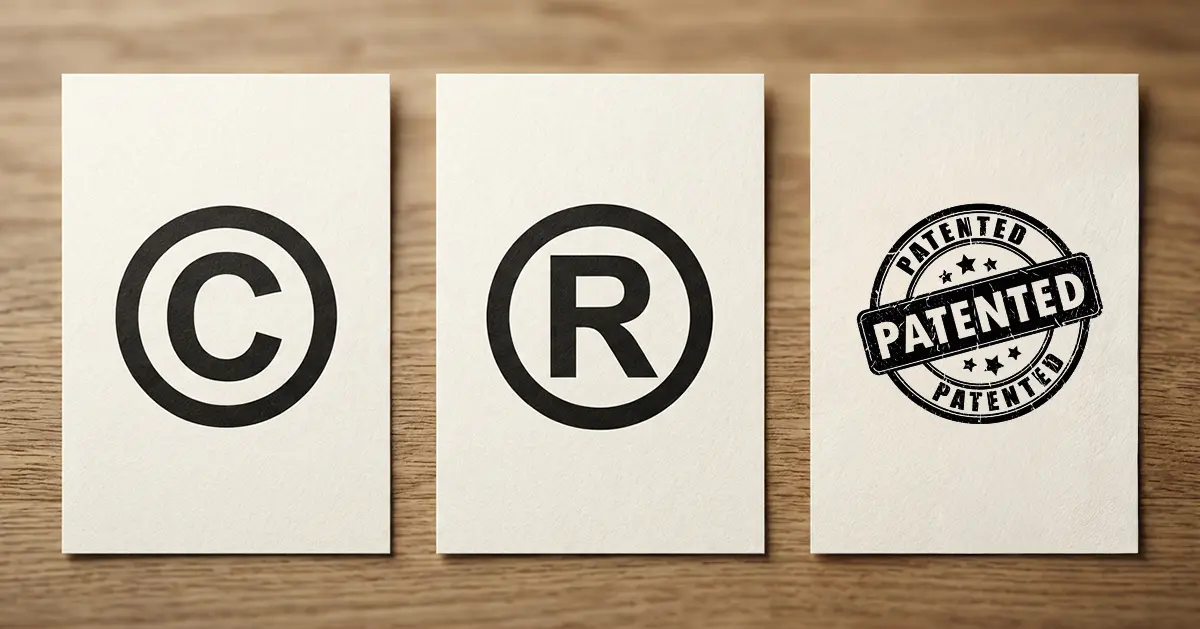
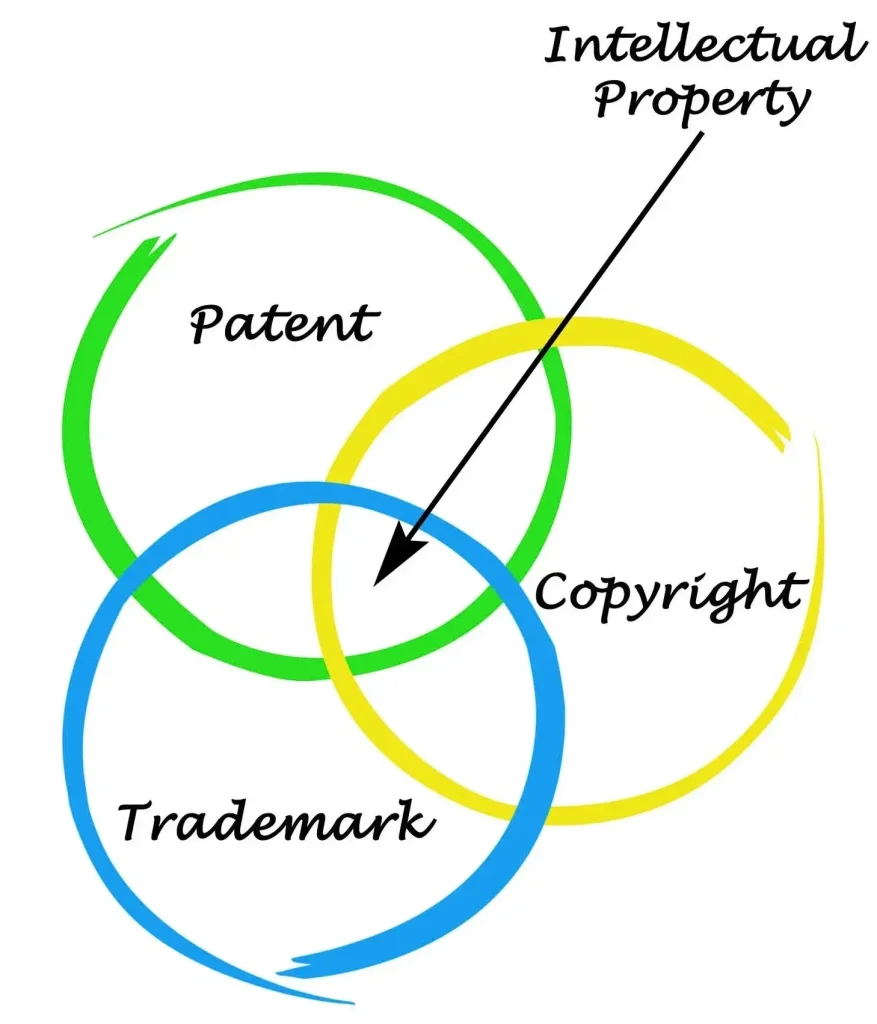
Patents, copyrights, and trademarks are all types of intangible Intellectual Property (IP) assets. They’re legally recognized, transferable, and capable of generating revenue, even without any physical form. The key difference between a patent, a copyright, and a trademark lies in what each one protects. Patents cover inventions, copyright covers creative works, and trademarks cover brand identity.
A patent stops others from making or using your invention. A copyright stops others from copying your creative work, but not the underlying idea behind it. A trademark only stops others from copying your brand name or logo, not the product’s function.
Although all three fall under the IP law, they differ significantly in what they cover, how long they last, and how you register them. A single company often builds multiple assets at once: an invention, its branding, and the creative content around it. Each one needs its own form of protection.
Key Takeaways
- Patents protect inventions for 20 years and are non-renewable. Registration is mandatory for any protection to exist.
- Copyright protects creative works automatically upon creation, lasting the author’s lifetime plus 60 years. Registration strengthens enforcement, but isn’t required.
- Trademarks protect brand identity for 10 years, renewable indefinitely. Registration isn’t mandatory, but it provides far stronger rights than passing off alone.
- Patents, copyrights, and trademarks are all intangible IP assets. They can be licensed, sold, or transferred for revenue.
- A single business asset can be protected by more than one IP right at different stages. Coca-Cola’s bottle and Amul’s branding both show this in practice.
What is Intellectual Property and its Types?
Intellectual Property (IP) covers creations of the human mind that deliver commercial value to businesses. Creators gain exclusive rights preventing unauthorized copying, commercial use, or exploitation by competitors. Indian law protects these creations through three distinct legal frameworks, each serving different purposes.
Understanding which protection type suits your creation determines whether you secure meaningful legal rights or leave valuable assets exposed.
What is a Patent?
A patent grants an inventor exclusive rights to a specific invention for a limited time. When you register a patent, you can stop others from making, using, or selling your invention without your permission.
- Subject Matter: Patents cover new and useful processes, machines, or chemical compositions.
- Legal Basis: The Patents Act, 1970, and the Patent Rules, 2003, govern these rights. Section 2(1)(j) defines an “invention” as a new product or process involving an inventive step and capable of industrial application.
- Duration: A patent lasts for 20 years from the date of filing. This depends on paying renewal fees every year. If you miss a payment, your rights can lapse before the 20 years are up.
- Requirements: Your invention must be novel, non-obvious, and useful to the industry.
- Who Can Apply: The inventor can file the application. So can an assignee, or the legal representative of a deceased inventor or assignee.
- Territorial Scope: A patent is a territorial right. An Indian patent only protects you within India. You can still stop others from importing the patented product into Indian territory. If you want protection in other countries, you must file separate applications there.
- Public Disclosure: To get a patent, you must fully disclose your invention publicly. You share the technical details with the world, in exchange for a legal monopoly of two decades.
- Nature of the Right (Section 48): A patent grants the exclusive right to use, sell, exercise, or distribute the patented invention for the patent term. It is a right to exclude others, not an unrestricted right to use the invention, as it may still infringe another valid patent.
- Provisional Applications: A provisional application secures an early priority date. It also gives you 12 months to file the complete specification with full technical details and claims. It is commonly used by startups while the invention or business is still evolving.
Can Software also Be Patented?
Copyright protects your source code as a written expression, not the underlying functionality. Many founders assume software can never be patented in India, but the CRI Guidelines, 2017, allow it if the invention shows a genuine “technical effect” beyond the code itself, not just automation or business logic. Copyright and patent protection can both apply to the same software, just to different things.
What is a Copyright?
Copyright protects original works of authorship once you fix them in a tangible medium. The moment you write a story on paper or save a song to a drive, you own the copyright.
- Subject Matter: This includes books, music, paintings, movies, and computer software code.
- Legal Basis: The Copyright Act, 1957, provides the framework. Section 13 lists the categories of work that qualify for protection.
- Duration: In most cases, copyright lasts for the lifetime of the author plus 60 years. This rule applies when there is an identifiable individual author. For works without one, such as films, sound recordings, photographs, government works, and anonymous or posthumous publications, protection instead runs for 60 years from the date of publication, or from creation if unpublished.
- Related Rights: Broadcast reproduction rights last 25 years from the year of broadcast. Performers’ rights last 50 years from the year of the performance. These are separate, narrower rights that sit alongside standard copyright.
- Rights Granted (Section 14): You gain the exclusive right to reproduce the work, issue copies, perform or communicate it to the public, make a film or sound recording of it, and adapt or translate it.
- Moral Rights (Section 57): Under Section 57, authors retain moral rights, including the right to be credited and to object to the distortion of their work, even after transferring copyright. Patents and trademarks do not provide equivalent post-transfer rights.
- © Symbol and Registration Benefits: Using the © symbol is optional, but registration strengthens your legal position in infringement cases. It also helps recover losses from unauthorized copying and creates a public record of ownership.
Many creators in India choose early copyright registration to strengthen legal enforcement and prove ownership. While you own the rights automatically, a registration certificate provides strong evidence if you need to sue someone for infringement. This protection covers the expression of your idea, not the idea itself.
What is a Trademark?
A trademark identifies the source of a product or service. It tells the customer, “the product comes from this specific company and is hence reliable and trustworthy.”
- Subject Matter: Trademark registration includes legally protecting brand names, logos, slogans, and even specific sounds or colors.
- Legal Basis: The Trade Marks Act, 1999, handles these in India. Section 2(1)(zb) defines a trademark as a mark capable of being represented graphically and distinguishing one person’s goods from others.
- Duration: Registration lasts for 10 years, but you can renew it indefinitely as long as you keep using the mark in business.
- Purpose: It prevents market confusion. Take Nike as an example. When you see a “Swoosh” on a shoe, you know Nike made it.
- Trademark Classes: India divides trademarks into 45 classes. Classes 1 to 34 cover goods, and Classes 35 to 45 cover services. You need a separate application for each class your brand operates in, so a business expanding into a new product or service line may need to file again to extend protection.
- Who Can Own a Trademark: The owner can be an individual, a business organization, or any other legal entity.
- Symbols: Once registered, you can use the ® symbol. Before registration, businesses commonly use ™ to signal a claimed but unregistered mark.
- Registration isn’t Mandatory: Unlike patents, trademarks can receive some protection without registration through the common-law remedy of passing off. However, these rights are weaker and more difficult to enforce than the statutory rights granted by registration.
The registration process includes a period where the government publishes your mark in a trademark journal. During this time, a competitor might file a trademark opposition if they believe your logo looks too similar to theirs. Once registered, you can legally act against any trademark infringement that threatens your brand identity.
Copyright vs Trademark vs Patent: Key Differences
Knowing the unique aspects of patents, copyrights, and trademarks helps protect your intellectual property. Here are the key differences:
| Feature | Patent (Patents Act, 1970) | Copyright (Copyright Act, 1957) | Trademark (Trade Marks Act, 1999) |
| What It Protects | It protects new inventions, functional processes, and technical solutions. | It protects original literary, musical, dramatic, and artistic expressions. | It protects brand names, logos, slogans, and distinctive packaging. |
| Registration Cost | Individuals/startups pay ₹1,600 to file; large companies ₹8,000 (filing fee only — examination and annual renewal fees are additional). | ₹500 per work (literary, dramatic, musical, artistic); ₹2,000 (sound recording, or a logo/label used with goods/services); ₹5,000 (cinematograph film). | Individuals and small enterprises pay ₹4,500 per mark for online filing, while all other entities pay ₹9,000 per mark online. |
| Legal Symbol | Use “Patent No.” or “Patent Pending” after you file the application. | Use the © symbol to notify the public of your ownership. | Use ™ for unregistered marks or ® once you complete registration. |
| Validity Period | The government grants protection for exactly 20 years from the filing date. | The law protects the work for the author’s life plus 60 years. | The registration lasts for 10 years, and you can renew it indefinitely. |
| Renewal | Cannot be renewed. Rights end permanently once the 20-year term expires. | Cannot be renewed once the term lapses. | Can be renewed every 10 years, indefinitely, as long as the mark stays in use. |
| Provisional Application | You can file a provisional application to lock in a priority date, then file the complete specification within 12 months. | No provisional application applies. Protection begins automatically on creation. | No provisional application applies, but a prior trademark search is strongly recommended before filing. |
| Transfer of Rights | You can sell (assign) or rent (license) your patent rights to other companies. | You can grant licenses to others to perform, copy, or adapt your work. | You can transfer the brand name or license it through a franchise model. |
| Public Information | The patent office publishes your invention details after 18 months. | The public record displays your name and the date you created the work. | The Registrar publishes the mark in a journal for trademark opposition purposes. |
How to Choose the Right IP Protection?
Deciding on the right protection for your own work requires a few simple questions:
- Does it do something? If it has a function or solves a technical problem, look at patents.
- Is it a piece of art or content? If you wrote it, filmed it, or drew it, consider copyrights.
- Does it identify who you are? If it’s your name or your face in the market, register it as a trademark.
Different professionals and businesses apply these protections based on how they operate in India:
- Startups and tech companies should register both Patents and Trademarks to protect their innovations and brand identity.
- Content creators and YouTubers should register Copyrights for their content and Trademarks for their brand.
- Manufacturers should focus on Patents for their inventions and Trademarks for their brand.
- E-commerce sellers should prioritize registration to protect their brand on platforms like Amazon and Flipkart.
- Software developers should register Copyrights for their code and Patents if their work includes technical innovations.
Small business owners often struggle with patents vs trademarks vs copyrights because registration costs money. However, the cost of losing your brand identity or your invention to a competitor is much higher.
Limitations of Patent, Copyright, and Trademark Laws
While patents, copyrights, and trademarks are powerful tools, not everything qualifies for protection under these laws. Here is a list of what you cannot protect:
- Ideas: Abstract concepts or ideas alone are not eligible for protection. You must have a tangible expression.
- Functional Objects: You can’t protect the functionality of a product under a trademark or copyright. Only design features may qualify.
- Generic Terms: Generic names or common terms cannot be trademarked, as they don’t distinguish your product from others.
- Short Phrases: Copyright doesn’t protect short phrases like taglines or slogans. These may need a trademark for protection.
- Common Knowledge: Facts, methods, or public domain information can’t be patented or copyrighted.
- Unoriginal Work: Lacks originality or creative expression, such as simple ideas or basic procedures, and cannot be copyrighted.
Real-World Scenarios: Copyright vs Trademark vs Patent Examples
Let’s look at Coca-Cola and India’s own Amul to see copyright vs trademark vs patent examples in action:
- Trademark: The “Coca-Cola” name and the contour shape of the glass bottle are registered trademarks in the form of trade dress. This prevents other companies from selling cola in a similar bottle or under a similar name. Amul’s name and its iconic girl-in-polka-dots logo work the same way, protecting the brand’s identity across India’s dairy market.
- Patent: Coca-Cola actually used a patent first. In the early 1900s, the company protected the bottle’s distinctive shape with design patents, which gave it a temporary monopoly of around 14 years. Once those patents expired, trademark and trade dress protection took over and extended that protection indefinitely, as long as the company keeps using the design. Amul, similarly, has held patents on specific dairy processing techniques over the years.
- Copyright: Coca-Cola’s commercial jingles, website content, and holiday packaging designs are all protected by copyright. Amul’s long-running topical ad cartoons, its famous “Amul Girl” illustrations, and its advertising copy are protected the same way.
This example shows how patent, trademark, and copyright rights can work together over time, for both a global brand and an Indian one. A design may first be protected by a patent and later by trademark law. Without that initial protection, competitors could copy a product before it becomes distinctive enough for trade dress protection on its own.
Common Mistakes When Choosing Between Copyright, Patent, and Trademark
Founders often pick the wrong protection simply because the three rights sound interchangeable. Here are the mistakes that come up most often:
- Trademarking a Function: A trademark protects a brand identifier, not how a product works. Use a patent for that.
- Copyrighting a Name: Names and short phrases don’t qualify for copyright. Only a trademark protects them.
- Patenting a Design Choice: If the value lies in how a product looks, use a design registration or trade dress claim, not a utility patent.
- Assuming One Right Covers Everything: A single product often needs all three. A software product may need a patent for its process, a copyright for its code, and a trademark for its brand.
- Using Copyright as a Trademark Substitute: Copyright protects your logo’s artwork, not your brand name or symbol, from competing use. Only a trademark does that.
- Delaying the Decision: Patents and trademarks run on a first-to-file basis. Hesitating lets a competitor claim the right first.
