FSSAI Central License Online in India
Apply for an FSSAI Central License online with RegisterKaro. The Central License applies to eligible food businesses based on turnover, Kind of Business, and specific activities under current FSSAI requirements.
 KOB Assessment & Central License Eligibility CheckForm B Preparation & FoSCoS FilingDocument Guidance for Manufacturers, Importers & EOUsLicense Modification & Nominee (Form IX) UpdatesCertificate Download & Ongoing Compliance Support


 What Sets Us ApartWhat Sets Us Apart
Overview of FSSAI Central License for India
An FSSAI Central License authorizes eligible Food Business Operators (FBOs) to carry out food-related activities under India's food safety regulations. FSSAI determines the applicable license category based on the business's turnover, Kind of Business (KoB), production capacity, and other prescribed criteria.
From 1 April 2026, FSSAI generally places food businesses with annual turnover above ₹50 crore under the Central License category. Certain businesses may require a Central License based on their specific KoB or activity, even when their turnover falls below this threshold.
For businesses operating food premises in multiple states, the head office requires a Central License. Each additional premise requires the applicable FSSAI license or registration based on its business activity and eligibility.
The FSSAI license carries a unique 14-digit FSSAI number. Food businesses must display or declare this number in the manner prescribed by FSSAI.
Eligibility Criteria for FSSAI Central License in India
FSSAI determines Central License eligibility through four main triggers: annual turnover, Kind of Business (KoB), production capacity, and specific food-related activities. From 1 April 2026, the general turnover threshold for Central Licensing is above ₹50 crore, while certain KoBs and activities can require a Central License under separate criteria.
Key criteria for a Central FSSAI License include:
- Annual Turnover: Businesses with annual turnover above ₹50 crore generally require a Central License, subject to the applicable KoB criteria.
- Multi-State Operations: If your food business operates premises in more than one state, you must obtain a Central License for the head office and separate licenses or registrations for other premises based on their applicable eligibility.
- Commercial Food Importers: Businesses that import food products, ingredients, or additives for commercial use require a Central License without a capacity limit.
- Large Food Manufacturing: Certain food manufacturing and processing units with production capacity above 2 metric tons per day require a Central License, subject to the applicable KoB.
- Dairy Units: Dairy units that handle or process more than 50,000 liters of liquid milk per day or 2,500 metric tons of milk solids per year require a Central License.
- Meat Processing Units: Meat processing units that handle or process more than 500 kg of meat per day or 150 metric tons per year require a Central License.
- 100% Export-Oriented Units: Manufacturers or processors operating as 100% Export-Oriented Units require a Central License without a turnover threshold.
- Specified Export Manufacturers: Certain manufacturers producing food products exclusively for export also require a Central License under the applicable export-related KoB.
- Central Government Premises: Food businesses operating under Central Government agencies or at specified Central Government premises may require a Central License based on their activity.
- Airports and Seaports: Food businesses carrying out specified activities at airports and seaports may require a Central License based on the applicable KoB.
- Specified Large Food Businesses: Wholesalers, distributors, retailers, storage operators, restaurants, caterers, and other food businesses may require a Central License when their turnover or activity meets the applicable 2026 FoSCoS criteria.
Documents Required to Secure an FSSAI Central License in India
They depend on your business type (e.g., sole proprietorship, partnership, company). Here are the details:
Identity and Business Proof Documents
To apply for an FSSAI Central License, you need to submit:
- Identity and address proof of owners or authorized persons, such as Aadhaar, PAN, or Passport.
- Recent passport-sized photos of the applicant.
- Proof of possession of premises, like a rent agreement, ownership documents, sale deed, or utility bills (no older than two months).
- A declaration form confirming that you follow FSSAI rules.
Business Registration Documents
The documents depend on your business type:
- For a sole proprietorship, a declaration on your letterhead.
- For partnership firms, a copy of the partnership deed.
- For companies, applicable constitution documents such as a Certificate of Incorporation, a Memorandum of Association (MOA), and Articles of Association (AOA).
- For co-operative societies, a resolution passed by the managing committee.
Also needed:
- Board resolution or authorization letter stating who can sign the application.
- GST registration certificate, if applicable.
- Form IX for Nomination of the Person in Charge
- Import Export Code (IEC) is required if applicable.
Other Important Documents
You may also need to provide:
- A layout plan of your manufacturing or processing unit showing rooms and equipment.
- List of machinery and raw materials used.
- Water test report from a recognized lab, if water is used in food processing.
- Details of sources for milk or meat, if applicable.
- Food-safety plans, recall plans, or other supporting records where required for the applicable business activity.
- Proof of turnover (e.g., sales records or audit reports) may be requested by the authorities.
- No Objection Certificates (NOCs) from landlords or manufacturers, if needed.
How to Get an FSSAI Central License in India: Step-by-Step Process
You can apply for an FSSAI Central License online through the FoSCoS (Food Safety Compliance System) portal. The process requires you to select the applicable Kind of Business (KoB), complete the application, upload the required documents, and pay the applicable fee.
Step 1: Visit the FoSCoS Portal
Go to the official FoSCoS portal and select the option to apply for a new License/Registration. FSSAI uses FoSCoS as its online platform for food business licensing and registration.
Step 2: Select Your State and Kind of Business
Select the state where the food business premises is located. Then select the Kind of Business (KoB) that matches your food business, such as manufacturing, importing, wholesaling, food services, storage, or another applicable category.
FoSCoS uses the selected KoB and business details to determine the applicable license category. If your business has premises in more than one state, you must declare one premise as the head office and obtain a Central License for the head office, with separate licenses or registrations for other premises based on their eligibility.
Step 3: Complete Form B
Complete the applicable fields in Form B and provide accurate information about your business. Depending on your KoB, the application may require details such as:
- Business name and premises address
- Contact details of the applicant or authorized person
- Nature and category of the food business
- Food products or food categories handled
- Production or processing capacity, where applicable
- Details of the responsible or technically qualified person, where applicable
- Water source and related details for applicable manufacturing or processing units
- Other information required for the selected KoB
The information and supporting requirements can vary according to the nature of the food business.
Step 4: Upload the Required Documents
Upload the documents applicable to your business and select KoB. Depending on the business activity, these may include:
- Form B
- Blueprint or layout plan for applicable manufacturing and processing units
- Equipment and machinery details for applicable manufacturers and processors
- List of food categories
- Proof of premises
- Constitution documents, where applicable
- Water analysis report for applicable manufacturing and processing units
- Turnover documents, where applicable
- Import Export Code (IEC) for applicable importers
- Form IX and Board Resolution for companies, where applicable
- Other documents specified by FSSAI for the selected business category
From 12 February 2025, FoSCoS auto-approves Non-Form C modifications, including Form IX nominee changes, without scrutiny or a fee. FBOs must keep nominee details updated.
Check the current FoSCoS document requirements before submitting the application, as not every document applies to every Central License applicant.
Step 5: Pay the Applicable Fee
After completing the application and uploading the required documents, pay the applicable FSSAI fee through the FoSCoS portal. The fee depends on the type of license and the applicable Kind of Business.
Step 6: Track the Application
After submission and payment, use the application reference number to track your application through FoSCoS. FSSAI may review the application and request additional information, clarification, or other action where required.
Once FSSAI approves the application, you can access the issued Central License through the FoSCoS portal.
FSSAI Central License Fees in India
The FSSAI Central License fee includes the government fee prescribed by FSSAI. You may also pay a separate professional fee if you hire a consultant or agency to assist with the application.
1. Government Fee for a New FSSAI Central License
FSSAI prescribes a ₹7,500 annual fee for a Central License under its fee schedule. The applicable fee can vary according to the type of license or service involved.
- Manufacturer/Processor: ₹7,500 per year
- Importer: ₹7,500 per year
- 100% Export-Oriented Unit: ₹7,500 per year
- Food businesses covered under the Central License fee category: ₹7,500 per year
- Other businesses requiring a Central License: ₹7,500 per year, subject to the applicable fee schedule
2. Professional Fees
Professional fees apply only if you hire a consultant or agency for assistance with the FSSAI application. FSSAI does not prescribe these charges. The amount depends on the services included, such as application preparation, document review, submission assistance, or modifications.
FSSAI Central License Certificate in India
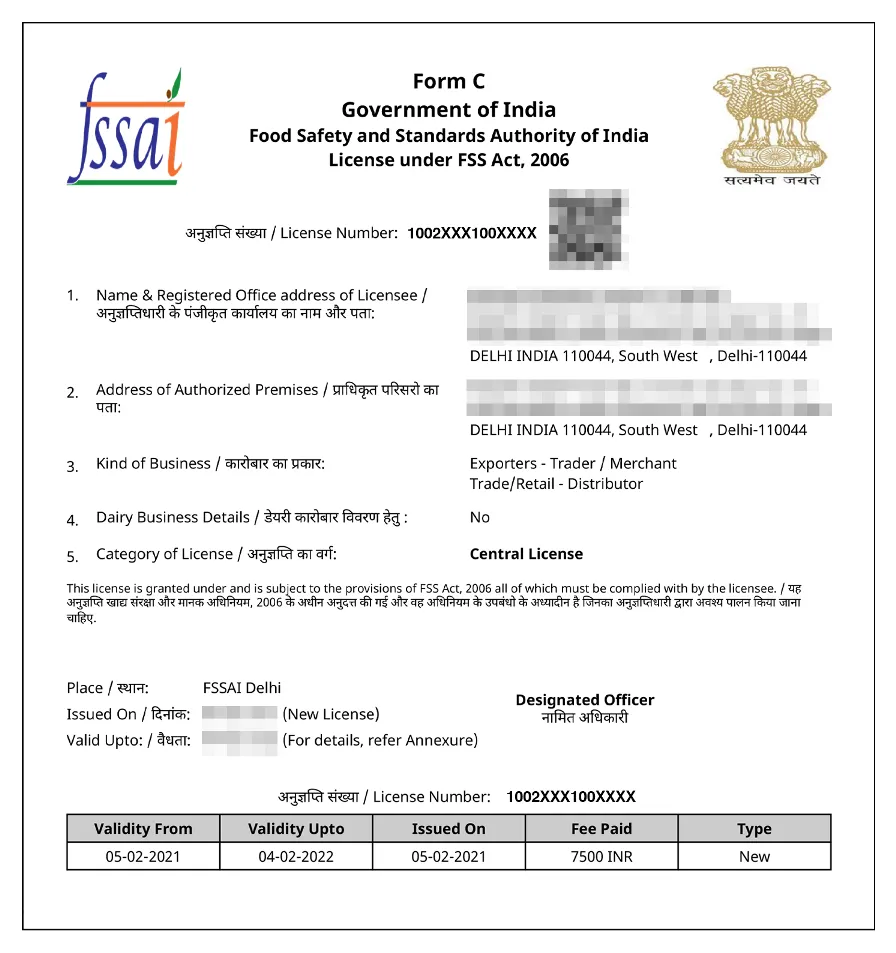
Once FSSAI approves your application, it issues the official FSSAI Central License Certificate. You must display the license details and applicable food-safety information at the food business premises as required under FSSAI rules.
The certificate includes important details such as:
- License number
- Business name and address
- Types of food you are allowed to sell
Displaying the required license details and food-safety information helps customers and authorities identify the licensed food business.
How to Track the FSSAI Central License Application
You can track your FSSAI Central License application online through the FoSCoS portal using your Application Reference Number.
- Visit the official FoSCoS portal.
- Select Track Application.
- Enter your Application Reference Number and captcha code.
- Click Submit to view the current application status.
- Check whether FSSAI has requested additional information, clarification, inspection, or other action.
How to Download the FSSAI Central License Certificate in India?
After approval, you can easily download your FSSAI Central License Certificate:
- Visit the official FoSCoS portal (foscos.fssai.gov.in).
- Log in with your username and password.
- Go to the "License/Registration" section on your dashboard.
- Choose the "Issued" option under application status.
- Click your application number to open and download the certificate in PDF.
How to Check the Status of the FSSAI Central License Certificate in India?
To stay updated on your FSSAI Central License application or certificate status:
- Open the FoSCoS portal at foscos.fssai.gov.in.
- On the homepage, select "Track Application Status."
- Enter your application reference number and state.
- Click "Submit" to see the latest status (e.g., under review, approved, or rejected).
Once the license is issued, you can also verify the 14-digit FSSAI number and license details using the FSSAI License Number Check tool. For official confirmation, verify the license details through the FoSCoS portal.
Timeline for Obtaining FSSAI Central License in India
The Licensing Authority should issue an FSSAI Central License within 60 days of receiving a completed application.
- Application Scrutiny: The Licensing Authority can review the application within 15 days and request additional information or corrections if required.
- Inspection: FSSAI may inspect the premises depending on the business activity and applicable requirements.
- License Issuance: The Licensing Authority should issue the license within 60 days after receiving the completed application, subject to the applicable requirements.
Under Regulation 2.1.6, an applicant may commence the food business if the authority does not issue the license within 60 days. This applies when the applicant has received no inadequacy notice or inspection report identifying defects.
The processing time can vary when FSSAI raises a query, requests documents, or requires an inspection. Responding promptly can help avoid additional delays.
FSSAI Central License Renewal After the 2026 Reform
FBOs do not need to follow the earlier renewal cycle for licenses issued under the perpetual-validity framework. Annual regulatory fees remain payable under the perpetual regime. Perpetual validity replaces periodic renewal, not the applicable fee.
FSSAI also allows FBOs to pay the applicable license fee for any number of years at once, for example, paying the ₹7,500 annual Central License fee for 5 years upfront (₹37,500). If your existing license or application falls under a transitional provision, check its status and applicable requirements on the FoSCoS portal before taking action.
Penalties for FSSAI Central License Non-Compliance
FSSAI Central License holders must follow the conditions of their license and applicable food safety requirements. Non-compliance can result in fines, imprisonment, suspension, cancellation, or other enforcement action.
- Operating Without the Required License: Section 63 provides imprisonment for up to 6 months and a fine of up to ₹5 lakh for carrying on a food business without the required license.
- Violating Food Safety Requirements: A Central License does not exempt an FBO from penalties for substandard, unsafe, or otherwise non-compliant food. The applicable penalty depends on the specific violation under the FSS Act.
- Unsafe Food: Section 59 prescribes imprisonment and fines based on the harm caused by unsafe food. Penalties increase when the violation causes injury, grievous injury, or death.
- Misleading Advertisements: Section 53 provides a penalty of up to ₹10 lakh for misleading advertisements relating to food.
- Failure to Follow FSO Directions: Section 55 provides a penalty of up to ₹2 lakh for failing to comply with directions issued by a Food Safety Officer without reasonable grounds.
- License Suspension or Cancellation: FSSAI can take regulatory action against a Central License, including suspension or cancellation, when the FBO fails to meet applicable licensing or food safety requirements.
Benefits of Getting an FSSAI Central License in India
An FSSAI Central License confirms that an eligible food business operates under the applicable Central Licensing framework. It also supports regulatory compliance and business operations where Central Licensing applies.
The key benefits of obtaining an FSSAI Central License include:
- Supports Regulatory Compliance: It helps eligible food businesses meet the licensing requirements under the Food Safety and Standards Act, 2006.
- Supports Wider Operations: It enables eligible food businesses to operate under the Central Licensing framework and, where applicable, undertake permitted import or export activities subject to other regulatory requirements.
- Establishes Regulatory Credibility: An active FSSAI license demonstrates that the business has obtained the food license applicable to its operations.
- Supports Business Transactions: A valid Central License can help businesses meet licensing requirements when dealing with customers, suppliers, marketplaces, institutions, and other business partners.
- Enables Specified Food Activities: A Central License allows eligible businesses to carry out the food-related activities covered by their approved Kind of Business and license conditions.
Connect with RegisterKaro and let our experts handle the legal hassle while you grow your business.
Frequently Asked Questions (FAQs)
Who needs an FSSAI Central License in India?
Businesses generally need an FSSAI Central License when their annual turnover exceeds ₹50 crore from 1 April 2026. Certain food businesses also need Central Licensing based on their Kind of Business, production capacity, importing activities, or other specified criteria.
What is the turnover limit for an FSSAI Central License?
The general turnover threshold for an FSSAI Central License is above ₹50 crore from 1 April 2026. However, FSSAI also applies separate eligibility criteria to importers, manufacturers, dairy units, meat processors, exporters, and other specified food businesses.
How can I apply for an FSSAI Central License online?
You can apply for an FSSAI Central License online through the FoSCoS portal by selecting your state and applicable Kind of Business. Complete the required application, upload supporting documents, pay the applicable government fee, and track the application using your reference number.
What documents are required for an FSSAI Central License?
The required documents depend on your food business and the selected Kind of Business. Common requirements include Form B, business constitution documents, premises proof, food category details, and authorized-person information. Manufacturers may also need layout plans, equipment details, water analysis reports, and other activity-specific documents.
How much does an FSSAI Central License cost?
The government fee for an FSSAI Central License is ₹7,500 per year under the prescribed fee schedule. FSSAI introduced perpetual validity from 1 April 2026, so the license no longer follows a periodic renewal cycle. Professional fees apply separately if you use a consultant or agency for assistance.
How long does it take to get an FSSAI Central License?
The Licensing Authority should issue an FSSAI license within 60 days of receiving the Application ID, subject to completing the required process. The authority can scrutinize the application and request additional information within the applicable period before approving or processing the license.
Do food importers need an FSSAI Central License?
Yes, commercial food importers generally require an FSSAI Central License under the applicable importing category. Importers must also meet other requirements, including obtaining an Import Export Code from the Directorate General of Foreign Trade where applicable.
Does a business operating in multiple states need an FSSAI Central License?
Yes, a food business operating across multiple states generally needs a Central License for its head office. Each additional food business premises must obtain the appropriate FSSAI license or registration based on its location, activity, turnover, and applicable eligibility criteria.
What is the difference between an FSSAI Central License and a State License?
The FSSAI Central License generally applies to larger food businesses and specified activities under Central Licensing criteria. A State License applies to eligible businesses falling within the State Licensing category. FSSAI determines the applicable category using turnover, Kind of Business, capacity, and other conditions.
How can I check my FSSAI Central License application status?
You can check your FSSAI Central License application status through the FoSCoS portal using your application reference details. The portal lets you view the current application status and identify whether FSSAI requires additional information, clarification, inspection, or other action.

Reviewed by
Joel DsouzaJoel Dsouza is a Chartered Accountant (CA) and compliance expert with over 7 years of hands-on experience in company registration, tax structuring, GST, ROC filings, and MCA compliance. As a qualified member of the Institute of Chartered Accountants of India (ICAI) and Co-Founder at RegisterKaro, he has personally advised more than 1,000 startups and SMEs across India, helping founders navigate incorporation, regulatory frameworks, and financial planning from Day 1. With deep expertise across all three levels of Finance and Portfolio Management, Joel is committed to promoting financial literacy and simplifying India's startup ecosystem through clear, actionable guidance that entrepreneurs can act on immediately.
Why Choose RegisterKaro for FSSAI Central License?
Choosing the correct FSSAI license category requires you to assess your turnover, Kind of Business, activities, and supporting documents. RegisterKaro helps you complete this process with:
- KOB Assessment: Our team assesses your business activities and identifies the applicable Kind of Business for Central Licensing.
- Document Guidance: We help identify the documents required for your specific food business and application.
- Application Support: We assist with Form B preparation, document submission, and the online application process.
- Modification Support: Our team assists with applicable changes to your FSSAI license and business details.
- Compliance Assistance: We provide ongoing support for applicable FSSAI licensing and compliance requirements.
What Our Clients Say
View All
Martand Yadav
 Verified
I had a very smooth and hassle free experience with register karo while registering my LLP. Thanks Aditya Singh for regular updates. We appreciate you... Read more

Febin Ahmed
VerifiedI recently went through the incorporation process, and Parul was exceptional in guiding me every step of the way. Her professionalism and expertise ma... Read more

Kratika Agrawal
VerifiedMy private Limited was registered by Jiya mam who handled the entire process quite professionally and efficiently. My recent experience with your team... Read more

Harsh Saini
VerifiedThe experience of working with Ms. Anchal was truly commendable. She guided us with patience and professionalism throughout the incorporation process.... Read more

Siddharth Hegde
VerifiedHad a great experience with RegisterKaro while registering my company Sthirya. Special thanks to Shruti Pandey for her excellent support, quick respon... Read more

Mohammednahiyan nahi...
VerifiedI have find very good experience with Tripti jain guidance the work was so smooth and effective and she was very quick responder and she is very good... Read more

rohit sharma
VerifiedIt was a great experience working with Anchal Gupta. She guided us through the company incorporation process very efficiently and without any delays.... Read more

Dewan Zahid Ahmed
VerifiedHad an excellent experience while incorporating our company. Aryan Singh, was our point of contact and he was very helpful and always reachable and al... Read more

Shivansh Dubey
Verifiedrecently worked with Aditya Srinet for the registration of my company, and I couldn’t be more pleased with the experience. Aditya Srinet was extremely... Read more

Saikanth Krishna
VerifiedTanvish Nagpal provided exceptional service throughout the registration process. He kept me informed about the status every step of the way. If you’re... Read more
Related Blogs
View All
How are Public and Private Temples Defined Under the Indian Trusts Act?
How to Check FSSAI Application & License Status Online

How to Start a Masala Business in India?
How to Start a Food Truck Business in India: Licenses & Cost
FSSAI License for Packaged Drinking Water: Fees & Rules

FSSAI License Fees in India: Cost, Types & How to Save

Drone Registration in India: A Step-by-Step Guide (2026)

Hospital Registration Certificate: Application, Process, Fees

Will Registration in India: Process, Benefits, and Legal Requirements
Mukhyamantri Yuva Udyami Yojana 2026: Eligibility, Benefits & Apply Online