

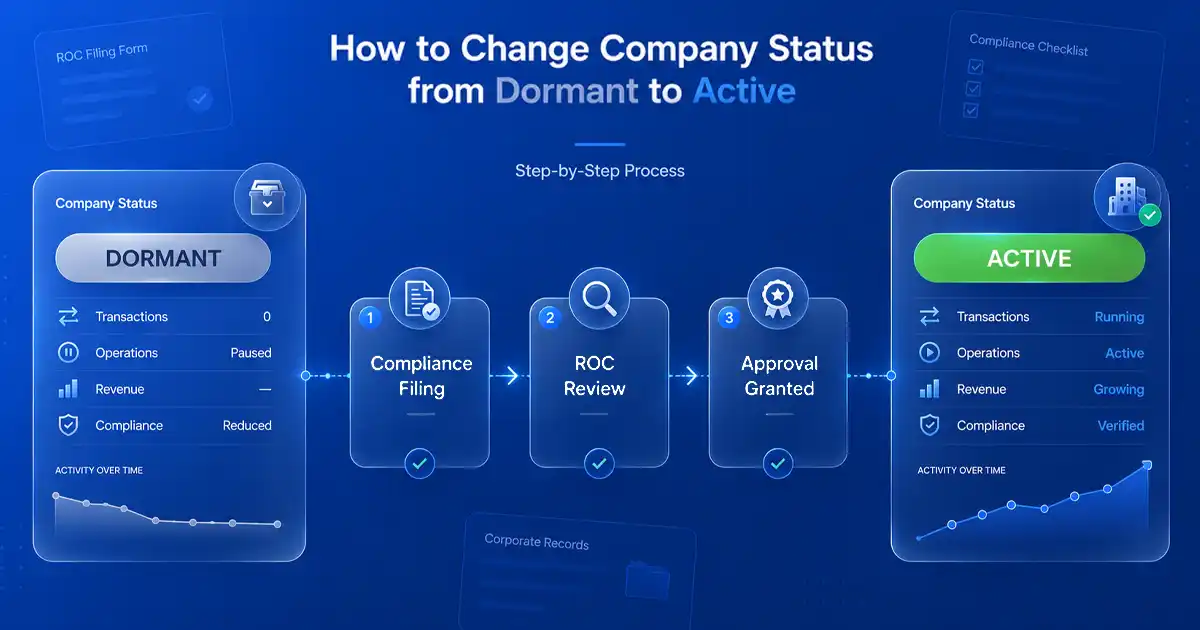
To convert a dormant company back to active status, file Form MSC-4 with the Registrar of Companies (ROC), along with the required documents and applicable fees. The ROC reviews the application and, if satisfied, issues Form MSC-5, confirming that the company has returned to active status.
Companies typically reactivate their status when they plan to resume business operations, generate revenue, hire employees, enter contracts, or undertake regular commercial transactions. Reactivation also prevents the company from remaining dormant indefinitely, as a company cannot remain dormant for more than five consecutive financial years and may be struck off by the ROC.
Key Takeaways
- ROC approves the conversion of a dormant company to active status through Form MSC-4 under Section 455 of the Companies Act, 2013.
- Companies must clear all pending compliances like AOC-4 and MGT-7 before filing MSC-4 to avoid rejection.
- You must prepare and submit key documents such as financial statements, board resolutions, and updated statutory records for reactivation.
- The ROC processes Form MSC-4 and issues Form MSC-5 as official proof of active company status.
- Companies must avoid continued inactivity or non-compliance, as it can lead to penalties or even being struck off by the ROC.
Legal Framework for Converting a Dormant Company into an Active Company
Key legal provisions guiding the conversion of a dormant company include:
- Section 455 of the Companies Act, 2013, governs dormant company status and its revival.
- Companies (Miscellaneous) Rules, 2014, prescribe the application and approval procedure.
- The Board of Directors must approve the application for activation.
- The company must file the prescribed Form MSC-4 with the ROC.
- The ROC may approve or reject the application after review.
Note: A dormant company cannot continue in dormant status indefinitely. If a company remains dormant for five consecutive financial years, the ROC may initiate action to strike off its name from the register of companies under the provisions of Rule 8 of the Companies (Miscellaneous) Rules, 2014 (read with Section 455).
Why and When Must You Convert a Dormant Company Back to Active?
A dormant company must return to active status when it resumes business or becomes ineligible for dormant status. Under Rule 8 of the Companies (Miscellaneous) Rules, 2014, it must apply for active status within seven days of becoming ineligible.
You should reactivate your company if it:
- Starts commercial activities, issues invoices, hires employees, or begins serving customers.
- Enters transactions that are not permitted under dormant status, such as earning revenue or acquiring business assets.
- No longer meets the conditions based on which the ROC granted dormant status.
Note: Before filing for reactivation, ensure all pending annual filings, compliance requirements, and statutory obligations are up to date. Any compliance gaps may delay ROC approval.
Documents Required to Convert a Dormant Company to Active
To convert a dormant company back into active status, the company must submit a set of essential documents to the ROC. These include:
- Board resolution approving conversion from dormant to active status
- Form MSC-4 (application for obtaining active status)
- Form MSC-3 (return of dormant company for the relevant financial year, filed with MSC-4)
- Updated financial statements of the company
- Pending annual returns (Form MGT-7) and financial statements (Form AOC-4), if any
- Income tax returns, if applicable
- Latest statutory registers and compliance records
- Digital Signature Certificate (DSC) of authorized directors
- Active Director Identification Number (DIN) with completed DIR-3 KYC for all directors
- Chartered Accountant certification of financial statements
- Certificate of Incorporation (COI) and the latest company master data
Note: The ROC may request additional documents such as GST details, proof of registered office, or other clarifications based on the company’s compliance history and nature of reactivation.
Forms Involved in the Conversion of a Dormant Company into an Active Company
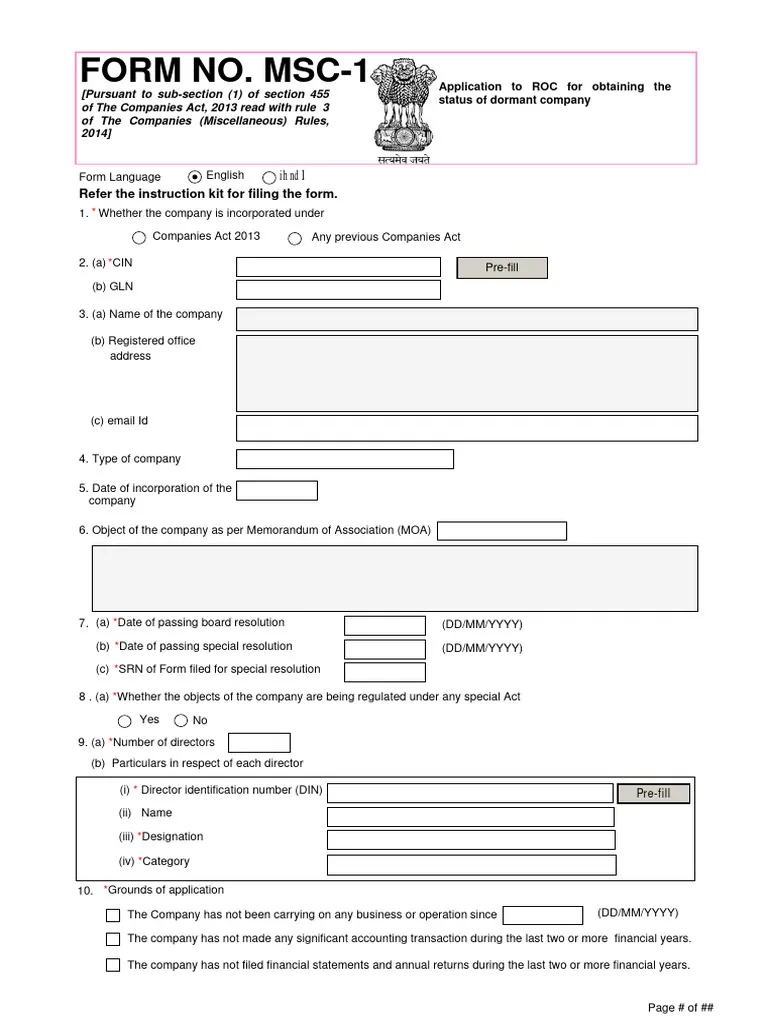
The conversion process mainly involves two filings by the company (MSC-3 and MSC-4), followed by one issuance by the ROC (MSC-5).
| Form | Purpose | Who Files It | When It Is Used |
| MSC-1 | Application for obtaining dormant status | Company | Filed when a company applies to become dormant |
| MSC-2 | Certificate of dormant status | ROC (issued, not filed) | Issued after approval of MSC-1 |
| MSC-3 | Return of Dormant Company | Company | Filed annually during dormant status to confirm compliance and financial position |
| MSC-4 | Application for obtaining Active Status | Company | Filed when the company applies to convert from dormant to active status |
| MSC-5 | Certificate of Active Status | ROC (issued, not filed) | Issued after approval of MSC-4, confirming restoration of active status |
How to Convert a Dormant Company to an Active Company? Step-by-Step Procedure
A dormant company can be converted back into an active company in 10–15 working days, depending on ROC processing and document verification. Here’s the step-by-step process:
- Hold a Board Meeting: Conduct a board meeting and pass a resolution approving the conversion of the company from dormant to active status. Authorize a director to file the application.
- Check Compliance Status: Ensure all statutory filings, returns, and fee payments are updated. Complete pending Form AOC-4 and MGT-7 filings, and ensure all directors have active DINs with DIR-3 KYC compliance.
- Prepare Required Documents: Collect financial statements, statutory registers, and declarations confirming eligibility for activation.
- File Form MSC-4: File Form MSC-4 with the ROC and attach Form MSC-3 for the relevant year, and ensure digital signing by authorized directors. Pay the normal filing fee for MSC-3 and the application fee for MSC-4, which is based on authorized share capital, plus any additional fees for pending filings.
- ROC Verification: The ROC verifies the application, checks compliance records, and may seek clarification or additional documents if required.
- Receive ROC Approval: Upon satisfaction, the ROC approves the application and issues an order restoring the company’s active status.
- Update Company Status: Once approved, the MCA updates records, marking the company as officially active.
Post-Conversion Compliance Requirements for an Active Company
Once a dormant company becomes active, it must resume full annual company compliance under the Companies Act, 2013. This includes:
- Filing of the annual return with the ROC within 60 days of the Annual General Meeting (AGM) through Form MGT-7 or MGT-7A, as applicable.
- Preparation and filing of financial statements within 30 days of the AGM through Form AOC-4.
- Conducting mandatory board meetings and general meetings as prescribed under the Companies Act, 2013. Most companies must hold at least 4 Board Meetings each year, with a maximum gap of 120 days between two meetings.
- Filing of ITR within the due dates prescribed under the Income Tax Act, generally by 31 October for companies subject to audit.
- Compliance with GST, TDS, and other applicable tax laws, including monthly, quarterly, or annual return filings, as applicable. If the GSTIN was cancelled or suspended during dormancy, check the GST active status and apply for revocation or fresh registration.
- Appointment or continuation of auditors in accordance with statutory requirements and ROC filing obligations.
Track these obligations with a statutory compliance checklist, and budget for the annual company compliance cost before resuming operations.
