

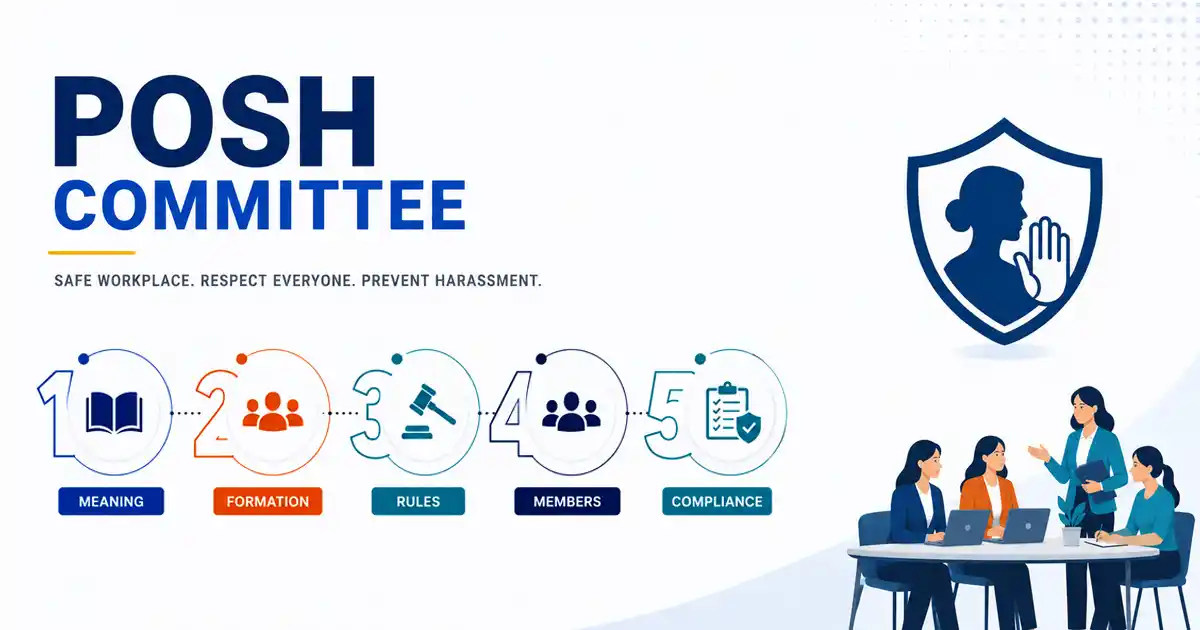
A POSH Committee, formally called the Internal Committee (IC) under Section 4 of the POSH Act, 2013, is mandatory for every Indian workplace with 10 or more employees. The IC must have at least four members:
- A senior woman as the Presiding Officer
- Two employee members
- One external member from an NGO or with relevant expertise
At least 50% of the members must be women, and their term can last up to three years.
The IC has Civil Court powers under the Code of Civil Procedure, 1908, and must complete inquiries within 90 days while following principles of natural justice. Failure to form a valid IC can attract a ₹50,000 fine, with higher penalties for repeat offenses. Companies must also disclose POSH compliance in the Directors’ Report under the Companies Act, 2013.
This guide explains the POSH Committee formation process, required composition, member eligibility, powers, registration requirements, compliance rules, and the difference between an Internal Committee and a Local Committee.
Key Takeaways
- POSH Committee formation is mandatory for every workplace in India with 10 or more employees, regardless of the sector or type of organization.
- A valid Internal Committee (IC) must have at least 4 members: a senior woman as the Presiding Officer, 2 employee members, and 1 external member with relevant expertise.
- At least 50% of the IC members must be women, and members can serve for a term of up to 3 years.
- The IC has Civil Court powers for conducting inquiries and must follow the principles of natural justice.
- A POSH complaint should generally be filed within 3 months, the IC must complete its inquiry within 90 days, and the employer must act on its recommendations within 60 days.
- Companies must disclose POSH-related compliance and complaint details in the Directors’ Report under the Companies Act, 2013.
- The POSH Act does not require central registration, but state or district authorities may impose additional registration or disclosure requirements.
- The Local Committee (LC) handles complaints where the workplace has fewer than 10 employees or where the complaint is against the employer.
What is the POSH Committee? Meaning and Legal Foundation
The POSH Committee refers to a statutory body comprising at least four members that every Indian workplace must constitute to receive, investigate, and recommend action on complaints of sexual harassment. Earlier known as the Internal Complaints Committee (ICC), it was renamed to “Internal Committee” through the 2013 Act to reflect a broader role: not just receiving complaints, but actively building a safe, respectful workplace.
The POSH committee India structure draws its authority from the Sexual Harassment of Women at Workplace (Prevention, Prohibition and Redressal) Act, 2013, commonly called the POSH Act. The Act emerged from the Supreme Court’s Vishaka Guidelines (1997) and codifies a clear legal framework for prevention, prohibition, and redressal of sexual harassment in workplaces across the country.
It is important not to confuse the POSH Act committee with a general grievance redressal committee. The IC has a very specific, statutory mandate for handling sexual harassment complaints under the POSH Act, and its composition, powers, and procedures are tightly regulated by law.
The POSH Act was not merged into the four Labour Codes that took effect on 21 November 2025, so it continues to apply as a standalone law alongside the other Labor Laws in India for a Private Company.
Why is the POSH Committee Formation Mandatory?
The POSH committee formation requirement is non-negotiable. Section 4 of the POSH Act, 2013, makes it mandatory for every employer with 10 or more employees to constitute an IC at every office or administrative unit. This applies to:
- Private companies, LLPs, partnerships, and proprietorships
- Public sector undertakings and government departments
- Hospitals, nursing homes, and clinics
- Educational institutions, namely schools, colleges, and universities
- Sports complexes and stadiums
- NGOs, trusts, and societies
- Factories, manufacturing units, and worksites
- Remote-first and hybrid organizations
The 10-employee threshold includes everyone, including permanent staff, contract workers, interns, consultants, daily-wage earners, and ad hoc employees. If you cross the threshold even briefly, the requirement for the internal committee of POSH kicks in.
Not every complaint is handled by an Internal Committee. For workplaces with fewer than 10 employees, the Local Committee (LC) takes over. The LC also has jurisdiction when the employer is the respondent in the complaint.
POSH Committee Format: Composition Under the Act
Getting the POSH committee format right is where most organizations slip up. The POSH Act lays down a precise composition that cannot be modified or relaxed.
The Four Mandatory Roles in a POSH Internal Committee
The following table presents the 4 mandatory roles crucial in building a POSH committee:
| Role | Who Can Be Appointed | Number |
|---|---|---|
| Presiding Officer | A woman employed at a senior level in the workplace. If a senior woman is not available internally, she may be nominated from another office, branch, or even another organization | 1 |
| Employee Member(s) | Employees committed to the cause of women, with experience in social work, or with legal knowledge | At least 2 |
| External Member | A person from an NGO or association committed to the cause of women, or someone familiar with issues of sexual harassment (e.g., advocates, social workers, retired judges, gender experts, empanelled POSH professionals) | 1 |
| Total Minimum | The minimum count of 4 members is mandatory for a legally valid IC | 4 members |
Critical: At least 50% of total IC members must be women; this is a statutory requirement under Section 4(2), not a recommendation. The external member is mandatory; no IC is legally valid without one. The Supreme Court has held that the external member’s role is to provide independent oversight and prevent institutional bias.
Key Composition Rules
- At least 50% of total IC members must be women. This is not a recommendation — it is a legal requirement.
- The Presiding Officer must be a woman at a senior level within the organization.
- The external member is mandatory — no IC is legally valid without one. The Supreme Court of India has held that the external member’s role is to provide independent oversight and prevent institutional bias.
- Joint or shared ICs are not permitted across group entities. The Kerala High Court in Suresh Pai S. v. State of Kerala, 2024 SCC OnLine Ker 4087 clarified that each legal entity must have its own IC, and inquiries can only be conducted by the IC of the entity where the respondent works. If your group has multiple companies or your company has multiple branches with 10+ employees, each one needs its own properly constituted IC. Subsidiary companies cannot rely on the parent company’s IC, and branch offices with separate workforces cannot share an IC with the head office.
The Format of the POSH Committee in Practice
A correctly drafted format of the POSH committee order in writing should clearly state:
- The full name and designation of the Presiding Officer.
- Names and designations of the two (or more) employee members.
- Name, qualification, and affiliation of the external member.
- The date of the constitution and the three-year term end date.
- The workplace location(s) covered.
- Contact details with email, phone, and office address for filing complaints.
- Signature of the employer or authorised representative.
Who Qualifies as Per the POSH Committee Members’ Rules
The POSH committee members’ rules are strict, and getting them wrong is one of the fastest ways to attract regulatory scrutiny.
For the Presiding Officer, the person must be a woman employee at a senior level. In some situations, she could be nominated from a sister entity if no senior woman is available internally.
For employee members, the law gives a clear preference for people committed to women’s welfare, with experience in social work, or with legal knowledge. Two members at a minimum are needed under the POSH committee.
For the external member, eligibility is restricted to:
- A person from an NGO or association committed to the cause of women
- A person familiar with issues relating to sexual harassment; typically, advocates, social workers, retired judges, gender experts, or empanelled POSH professionals.
The external member receives an allowance of ₹200 per day of proceedings (as per the original Rules) plus reimbursement of reasonable travel costs. Many organizations pay market-aligned professional fees today.
Members can be removed before completion of the three-year term in specific situations laid down in the Rules. For example, if they breach confidentiality, are convicted of an offence, or contravene Section 16 of the Act. Vacancies must be filled within a reasonable time to keep the IC operational.
POSH Committee Guidelines: How the Committee Should Function
The POSH committee guidelines govern how the IC operates. A compliant IC must follow these rules:
a. Powers of the IC
The IC holds the powers of a Civil Court under the Code of Civil Procedure, 1908. It can summon any person, enforce attendance, examine them on oath, demand documents, and call for evidence.
b. Principles of Natural Justice
The IC must inquire fairly, hear both sides, share evidence with the respondent, and avoid bias. In X v. Internal Complaints Committee, 2021 SCC OnLine Del 4906, the Delhi High Court held that ICs cannot engage in “moral policing” and must stay within the definition of sexual harassment under Section 2(n) of the POSH Act, 2013. The Punjab & Haryana and Bombay High Courts have also set aside IC findings that lacked evidence or denied the respondent a fair hearing under Article 226.
c. Confidentiality
Under Section 16, the IC must keep the identities of the complainant, respondent, and witnesses, along with the complaint, proceedings, and recommendations, fully confidential. Section 17 punishes any breach through the person’s service rules, or under Rule 12, which prescribes a ₹5,000 penalty.
d. Interim Reliefs
During the inquiry, the IC can recommend interim measures. These include transferring either party, granting the complainant up to 3 months of extra leave, issuing restraint orders, or allowing work from home.
e. Reporting and Timelines
The IC must prepare an annual report on complaints received, disposed of, pending, and acted upon, and submit it to the District Officer each year. The statutory timelines are strict:
- File the complaint within 3 months of the incident, which the IC may extend by another 3 months for valid reasons.
- Complete the inquiry within 90 days of receiving the complaint.
- Submit the written report within 10 days of finishing the inquiry.
- Act on the IC’s recommendations within 60 days of receiving the report.
POSH Committee Rules and the Companies Act 2013 Connection
The POSH committee, as per the Companies Act 2013, has its own set of disclosure requirements that overlap with and go beyond the POSH Act itself.
1. Directors’ Report Disclosure
Under Section 134(3) of the Companies Act, 2013, read with Rule 8(5)(vii) of the Companies (Accounts) Rules, 2014, every company’s Board of Directors’ Report must include a statement confirming that the company has constituted an Internal Committee under the POSH Act, 2013. The mandatory disclosures are:
- Number of complaints of sexual harassment received during the year
- Number of complaints disposed of during the year
- Number of cases pending for more than 90 days
The Companies (Accounts) Amendment Rules, 2018, made this disclosure mandatory for all companies, irrespective of size or listing status. False or misleading disclosures expose the company and its officers to liability under Section 134(8) of the Companies Act, 2013. After the Companies (Amendment) Act, 2020, this carries a penalty of ₹3 lakh on the company and ₹50,000 on every officer in default.
2. For Listed Companies
Under SEBI LODR Regulations, 2015 (as amended), the top 1,000 listed entities by market capitalization must disclose POSH-related information in their Business Responsibility and Sustainability Report (BRSR) under Principle 5 (Human Rights). Required BRSR disclosures include:
- Total POSH complaints filed during the financial year
- Complaints pending resolution at the year-end
- Number of awareness programmes or training sessions conducted during the year
- Coverage of the POSH policy across employees and contract workers
The BRSR is part of the annual report and is reviewed during ESG assessments by domestic and global investors.
3. MCA Recent Amendments
Recent MCA amendments have made POSH compliance disclosures sharper and more enforceable, with directors potentially exposed to penal consequences for false or misleading statements about the IC constitution.
In short, forming a POSH Act internal committee is no longer just a POSH Act obligation; it is a corporate governance and board-level compliance matter.
POSH Committee Registration: State-Wise Requirements
A common question is whether the IC needs to be registered with any government authority. The POSH Act itself does not require central registration. However, several state governments and district authorities have issued their own POSH committee registration circulars requiring local registration or disclosure.
States and districts that currently require IC registration or disclosure include:
- Maharashtra (especially Mumbai district): Registration with the District Officer’s office, along with compliance details
- Telangana: Registration of IC members with the relevant district authority
- Karnataka; Periodic submission of IC compliance details
- Pune: Separate government order for IC/ICC registration
- Noida and parts of UP: District-level disclosure requirements
Note: Requirements may vary by district and are subject to change. Employers should verify current obligations with the District Officer or the State Women and Child Development Department.
The SHe-Box portal (Sexual Harassment electronic-Box), maintained by the Ministry of Women and Child Development, also now allows organizations to register their IC details and receive complaints through a centralized system. Many states are increasingly making SHe-Box registration mandatory as part of compliance.
Tip: Before you finalize your IC, check with your local District Officer or labour department for any state-specific POSH committee requirements that apply to your workplace.
Why IC Formation Now Faces Stronger Scrutiny: The Aureliano Fernandes Ruling
In Aureliano Fernandes v. State of Goa, (2023) SCC OnLine SC 1471 (12 May 2023), the Supreme Court observed serious implementation gaps in POSH compliance across institutions and directed:
- All States, Union Territories, and the Central Government to take immediate steps to verify the constitution of ICs and LCs across all eligible workplaces
- District Officers to ensure Local Committees are constituted in all districts
- All institutions are to update the email addresses and contact details of IC members on their websites
- Authorities to conduct regular training and capacity-building for IC members
The Supreme Court specifically observed: “It is a sorry state of affairs that even after almost a decade of the enactment of the [POSH] Act, there are serious lapses in its enforcement.”
For employers, this ruling means: (1) ad-hoc or improperly constituted ICs are exposed to scrutiny, (2) “compliance on paper” is no longer sufficient, (3) regulators are actively checking IC effectiveness, not just existence, and (4) failure to demonstrate active IC functioning attracts enhanced penalty risk under Section 26.
Step-by-Step POSH Committee Formation Process
Here is a practical, India-ready blueprint for POSH committee formation that organizations should follow:
Step 1: Identify Your Committee Members
Review internally who fits each role. The Presiding Officer should be a respected senior woman with the authority and confidence to handle sensitive matters. Employee members should be people with genuine empathy and integrity.
Avoid appointing members purely based on seniority or department.
Step 2: Empanel an External Member
Reach out to NGOs working on women’s rights, legal professionals specializing in employment law, or empanelled POSH consultants. Verify their credentials, experience handling IC inquiries, and availability.
Sign a formal engagement letter that covers term, fees, confidentiality, and conflict-of-interest clauses.
Step 3: Issue the Order in Writing
The employer must constitute the IC by issuing a formal written order. This order must clearly name all members, define the three-year term, and be signed by the authorized signatory. Keep both physical and digital copies on record.
Step 4: Train the Committee
Section 19(c) of the POSH Act mandates that employers conduct orientation programs for IC members. The IC must undergo formal training every year covering:
- Principles of natural justice, including a fair hearing, no bias, and evidence-based findings.
- Evidence collection, including digital evidence such as emails, chat logs, and screenshots, plus witness statements.
- Victim-sensitive interviewing that uses a trauma-informed approach and avoids re-victimization.
- Report writing that records structured findings, recommendations, and any dissent.
- Confidentiality protocols under Section 16.
- Statutory timelines, namely the 90-day inquiry, the 10-day report, and the 60-day employer action.
Step 5: Publish IC Details Across the Workplace
Display the names, designations, photographs (optional), and contact details of all IC members at conspicuous places such as reception and notice boards, and add them to the employee handbook that sets out the rules and regulations for employees in a private limited company. Many employers also create dedicated POSH posters and email signatures.
Step 6: Register Where Required
Check if your state or district requires POSH committee registration with the District Officer or local labour department. Complete state-level registration and update IC details on the SHe-Box portal (Sexual Harassment electronic-Box) maintained by the Ministry of Women and Child Development. The SHe-Box portal increasingly serves as the central digital register for IC compliance and is being expanded in 2025–2026 to support direct complaint filing alongside IC inquiries.
For state-specific requirements (Maharashtra, Telangana, Karnataka, Pune, Noida), verify obligations directly with the District Officer or the State Women and Child Development Department.
Step 7: Update the Directors’ Report
Coordinate with your company secretary or compliance team to ensure POSH compliance is correctly disclosed in the Directors’ Report under Section 134(3) + Rule 8(5)(vii) of the Companies (Accounts) Rules, 2014. The disclosure must include the number of complaints received, disposed of, and pending for more than 90 days during the financial year. Listed companies must additionally include POSH data in their BRSR under Principle 5.
Step 8: Refresh Annually
Conduct an annual POSH audit. Verify the IC composition remains valid, members are still in office, training is current, and disclosures are updated. Refill any vacancies promptly.
Internal Committee vs Local Committee: Knowing the Difference
Indian law creates a parallel route through the Local Committee (LC) for two situations:
1. When a Local Committee Applies?
The LC handles complaints in two cases:
- Workplaces with fewer than 10 employees, where the law does not require an IC.
- Cases where the complaint names the employer, since the complainant cannot be expected to file with a committee the accused controls.
2. How the Local Committee is Constituted?
The District Officer constitutes the LC at the district level with these members:
- A chairperson, an eminent woman in social work, and a member from the block or taluka.
- Two members from NGOs or associations, at least one woman and one with legal knowledge.
- The concerned officer for social welfare or women and child development, as an ex officio member.
At least half the members must be women, and one must come from SC, ST, OBC, or minority communities.
Keeping Your IC Compliant
Review your IC regularly. Pull out the order in writing, check the 3-year term end date, verify the external member’s empanelment, and confirm your state’s latest POSH committee requirements. Compliance keeps shifting, and after the Aureliano Fernandes ruling and the 2024 SHe-Box expansion, regulators are watching more closely in 2026.
A valid IC is only the first step. HR leaders should align IC formation with:
- POSH Policy drafting and publication (Section 19(d))
- POSH complaint handling procedure (Sections 9–13)
- POSH training for employees and IC members (Section 19(c))
- POSH annual report and Directors’ Report disclosures (Section 21), tracked with your other due dates in a statutory compliance checklist for India
- Broader POSH implementation in HR
POSH compliance also connects with other workplace requirements, such as Shops & Establishment registration, EPF, ESIC compliance, and private limited company compliance. Build it into HR from day one, rather than adding it after you cross the 10-employee threshold.
