

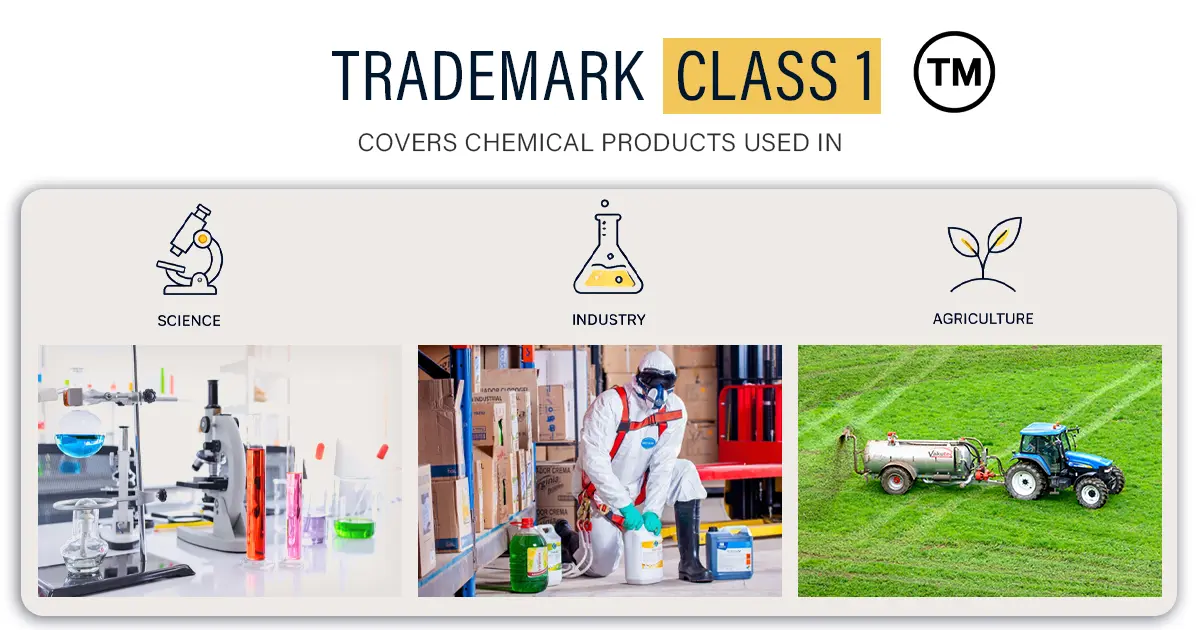
Trademark Class 1 covers industrial, scientific, and agricultural chemicals in India. It includes industrial adhesives, fertilizers, laboratory reagents, unprocessed plastics and resins, and water-treatment chemicals. These are mainly raw materials and process chemicals used by factories, laboratories, and agricultural businesses. Class 1 does not cover finished consumer products. If you manufacture or supply industrial chemicals, filing under Class 1 helps protect your brand name and logo.
Class 1 registration gives businesses exclusive rights to their brand and legal protection against counterfeits and similar labels. BASF, IFFCO, and Dow Chemicals are examples of brands with Class 1 registrations.
Key Takeaways
- Class 1 covers industrial, scientific, and agricultural chemicals, including adhesives, fertilizers, laboratory reagents, and unprocessed plastics.
- It does not cover pharmaceuticals (Class 5), household cleaning products (Class 3), paints (Class 2), fuels (Class 4), or stationery/household adhesives (Class 16).
- Since NCL 13-2026, essential oils and flavourings intended for food use fall under Class 30, not Class 1.
- Filing fees are ₹4,500 per class for individuals, DPIIT startups, and Udyam-registered MSMEs, and ₹9,000 per class for companies, LLPs, and partnership firms.
- Validity runs 10 years from the date of application, renewable indefinitely in 10-year blocks via Form TM-R, with a 6-month grace period.
- Class 1 registration does not replace approvals under the Fertilizer (Control) Order, the Insecticides Act, or BIS standards.
What is Trademark Class 1?
Trademark Class 1 covers chemicals used in industry, science, and agriculture. These include raw and industrial chemicals used for manufacturing, testing, and farming. It does not cover finished consumer goods or services.
Registering under Class 1 protects your brand at the production stage. It covers chemical products supplied to factories, laboratories, and agricultural users. It also gives you legal rights to act against trademark infringement.
Note: Trademark registration under Class 1 does not replace statutory approvals. Chemical products in India must also meet applicable safety and regulatory requirements before sale or commercial use.
Who Should Register Under Trademark Class 1?
If your brand or business falls into any of the following categories, you should register your trademark under Class 1 today:
- Industrial chemical manufacturers: Chemicals, solvents, catalysts, and compounds for industrial applications.
- Agricultural chemical and fertilizer companies: Fertilizers, soil conditioners, plant growth regulators, and other non-medicated agricultural chemicals.
- Laboratory and research chemical suppliers: Laboratory chemicals, reagents, and testing compounds used in scientific research.
- Manufacturers of adhesives and chemical additives: Industrial adhesives, bonding agents, preservatives, stabilizers, and emulsifiers.
- Plastic, resin, and polymer producers: Unprocessed plastics, synthetic resins, and polymer materials in primary form.
- Water treatment and process chemical suppliers: Chemicals for water purification, metal treatment, and textile processing.
Dow Chemicals registers its industrial solvents and adhesives under Class 1, strengthening brand recognition across sectors.
What are the Goods Covered Under Trademark Class 1?
Trademark Class 1 includes chemicals used in industry, science, and agriculture. These products usually consist of raw materials or specialized chemical formulations. They are not meant for direct consumer or medical use.
The table below highlights the main categories and examples of goods covered under Class 1:
| Category | Examples |
|---|---|
| Industrial Chemicals | Industrial chemicals, acids, alkalis, solvents, catalysts, chemical additives, petrochemical intermediates |
| Agricultural Chemicals | Agricultural chemicals, soil conditioning preparations, plant growth regulators, horticultural chemicals (excluding fungicides and herbicides) |
| Fertilizers & Manure | Fertilizers, compost, manures, superphosphates, seaweed fertilizers, nitrogenous fertilizers, organic digestate fertilizers |
| Organic & Bio Fertilizers | Bio-stimulants for plants, microbial preparations, biological preparations for industrial agriculture, soil nutrient compounds |
| Industrial Adhesives | Adhesives for industrial purposes, conductive adhesives, industrial glue compounds, bonding preparations used in manufacturing |
| Laboratory & Scientific Chemicals | Chemical reagents, laboratory analysis chemicals, scientific chemical preparations, diagnostic preparations (excluding medical use) |
| Unprocessed Plastics & Resins | Unprocessed plastics, artificial resins, polymer resins, epoxy resins, acrylic resins, thermoplastic compounds |
| Water Treatment Chemicals | Water-purifying chemicals, water-softening preparations, flocculants, purification compounds |
| Fire Prevention & Insulating Chemicals | Fire extinguishing compositions, fireproofing preparations, thermal paste, heat-resistant chemical compounds |
| Manufacturing Process Chemicals | Chemicals for textile processing, leather treatment, metal treatment, paper manufacturing, welding, soldering, industrial-use essential oils |
| Putties and Paste Fillers | Putties, gap fillers, industrial paste fillers, crack fillers, joint fillers, automotive body fillers, construction sealants for industrial use |
Which Products are Excluded from Trademark Class 1?
Trademark Class 1 covers chemicals for industrial, scientific, and agricultural purposes, but several related products belong to different trademark classes for chemicals. You must know these exclusions before filing to avoid rejection:
| Product Type | Examples | Correct Class |
|---|---|---|
| Medicinal & Pharmaceutical Chemicals | Medicines, health supplements, therapeutic chemicals | Class 5 |
| Cosmetics & Household Chemical Products | Soaps, shampoos, detergents, cleaning preparations | Class 3 |
| Essential Oils and Flavourings for Food Use | Vanilla essence, citrus oil extracts, food flavouring compounds | Class 30 |
| Paints, Varnishes & Coloring Substances | Paints, coatings, lacquers, industrial dyes | Class 2 |
| Fuels, Oils & Lubricants | Petroleum products, industrial oils, greases, fuels | Class 4 |
| Chemical Storage Items & Lab Apparatus | Containers, laboratory glassware, chemical-handling equipment | Class 21 or Class 9 |
Use RegisterKaro’s trademark Class Finder to correctly classify your chemical, adhesive, or fertilizer products before filing.
How to Register a Trademark Under Class 1?
Registering a brand under Trademark Class 1 involves a simple process. You can file as “proposed to be used” if your product is not yet launched, or “already in use” if it is available in the market.
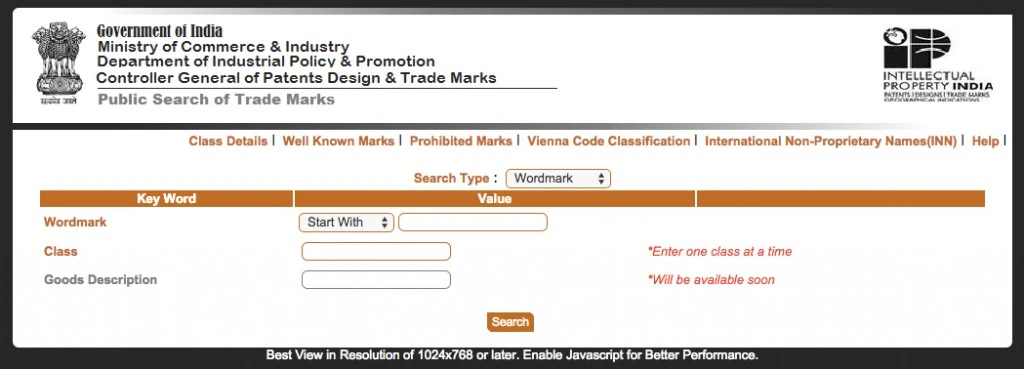
Follow these steps for successful trademark registration:
- Search first: Check the official IP India trademark database. You can also use RegisterKaro’s trademark availability check tool to check if your desired name is available.
- Select the right goods description: List all the chemical, industrial, or laboratory products you want to protect. This may include adhesives, industrial chemicals, laboratory reagents, and fertilizers. Avoid vague descriptions.
- File Form TM-A: Submit the application online through the IP India Trademark Portal. Provide your brand name, logo, product details, and applicant information. Pay the applicable fee of ₹4,500 for individuals and startups or ₹9,000 for companies.
- Examination: The Trademark Registrar reviews your application for errors, similar marks, and legal issues. If needed, the Registrar issues an Examination Report. Respond within the given timeline to avoid delays.
- Publication and opposition window: If accepted, your mark is published in the Trademark Journal. The public can file a trademark opposition within four months.
- Registration and certificate: If no one opposes the mark, or you resolve any objections, you receive the Trademark Registration Certificate. This gives you exclusive rights under Class 1.
The process generally takes 12–18 months. A trademark is valid for 10 years from the application date under Section 25 of the Trade Marks Act, 1999. You can renew it indefinitely in 10-year increments using Form TM-R. A 6-month grace period is available for late renewal, subject to a surcharge.
Trademark Classes Similar to Class 1: Multiple Class Filing
Trademark Class 1 covers chemicals used in industry, science, agriculture, and laboratories. Many chemical businesses produce products that fall under multiple trademark classes.
Below are the different trademark classes commonly related to Class 1 and how they differ:
| Class | Covers | How It Differs from Class 1 |
|---|---|---|
| Class 3 | Cosmetics, cleaning preparations, household adhesives | Consumer chemical products, not industrial or scientific chemicals |
| Class 5 | Pharmaceuticals, medical supplements, veterinary chemicals | Medicinal or therapeutic chemicals, not industrial or laboratory chemicals |
| Class 2 | Paints, varnishes, lacquers, dyes | Coatings and coloring agents, not raw chemicals and reagents |
| Class 4 | Industrial lubricants, fuels, and oils | Industrial oils and fuels, not chemical compounds or fertilizers |
| Class 21 | Laboratory glassware, containers, utensils | Equipment and containers, not the chemical products themselves |
If your brand covers multiple categories, file under all relevant classes using a Class 99 (multi-class) application. You file it using Form TM-A. The government fee applies separately to each class, with no multi-class discount.
For example, Pidilite Industries registers industrial adhesives under Class 1 and household or stationery glues under Class 16.
