Pvt Ltd Company Registration Online in India
Private limited company registration gives your business a separate legal entity under the Companies Act, 2013. RegisterKaro's CA-led team handles DSC, DIN, name approval, and SPICe+ filing from ₹1,499 + govt fees.
 Company Incorporated in 7–10 Business DaysName Approval & Filing Handled by Qualified CAs & CSPAN, TAN, DIN, DSC, MoA, AoA & Certificate of IncorporationComplete Package from ₹1,499 + Govt. Fees, No Hidden ChargesTrusted by 2 Lakh+ Startups & Entrepreneurs Across India


 What Sets Us ApartWhat Sets Us Apart
Choose the Best Pvt Ltd Company Registration Plan for Your Business
BASIC
₹1,499
+ Govt FeesWhat you'll get
- Company name help
- SPICe+ form in 2–3 working days
- Company PAN + TAN
- MOA + AOA
- PF and ESIC registration
- Incorporation certificate in 7–10 days
- DSC preparation in 3–4 days
- DIN for directors
- Expert assisted process
- INC 20A / Business commencement certificate
- Not included: MSME Registration
- Not included: Startup India Registration
- Not included: Digital signature certificate
- Not included: Company DSC
- Not included: Trademark Registration
STANDARD
₹6,499
+ Govt FeesWhat you'll get
- Company name help
- SPICe+ form in 2–3 working days
- Company PAN + TAN
- MOA + AOA
- PF and ESIC registration
- Incorporation certificate in 7–10 days
- DSC preparation in 3–4 days
- DIN for directors
- Expert assisted process
- INC 20A / Business commencement certificate
- MSME Registration
- Startup India Registration
- Not included: Digital signature certificate
- Not included: Company DSC
- Not included: Trademark Registration
PREMIUM
₹8,499
+ Govt FeesWhat you'll get
- Company name help
- SPICe+ form in 2–3 working days
- Company PAN + TAN
- MOA + AOA
- PF and ESIC registration
- Incorporation certificate in 7–10 days
- DSC preparation in 3–4 days
- DIN for directors
- Expert assisted process
- INC 20A / Business commencement certificate
- MSME Registration
- Startup India Registration
- Digital signature certificate
- Company DSC
- Trademark Registration
Overview of Private Limited Company Registration
A Private Limited Company offers a separate legal identity, limited liability, and a clear ownership structure. Under Section 9 of the Companies Act, 2013, it also enjoys perpetual succession, continuing to exist regardless of changes in its shareholders or directors.
This structure suits startups, family businesses, and growing SMEs that want to raise equity, offer ESOPs, and build credibility with banks and investors, making private limited company formation the most popular route to company registration in India.
The entire registration process runs online through the SPICe+ form on the MCA V3 portal, so no visit to a government office is needed. A single application covers name approval, DIN, MOA and AOA, PAN, and TAN, with only the DSCs obtained separately beforehand. The Central Registration Center (CRC), set up by the MCA, processes the application and issues the Certificate of Incorporation. The company’s records then move to the Registrar of Companies (ROC) for its state, which handles its annual compliance from that point.
Key Features of a Private Limited Company
Beyond the ability to trade, hire employees, and earn profits, a Private Limited Company also has these distinct features:
- Limited liability: Shareholders’ liability is limited to the unpaid amount on their shares, helping protect their personal assets from the company’s debts and liabilities
- Perpetual succession: The company continues even when shareholders or directors leave, transfer shares, or pass away.
- Ownership in its own name: The company owns property, opens bank accounts, signs contracts, and files suits in its own name.
- Minimum members: It needs at least 2 shareholders, who can be individuals or corporate bodies.
- No minimum capital: Founders can start with any amount of paid-up capital.
- Equity funding and ESOPs: The company can issue shares to angel investors and venture capital funds, and it can offer ESOPs to retain key staff.
Who Should Register a Private Limited Company? Is It Right For You?
Private Company registration suits businesses that need limited liability and room to grow. It works best for:
- Startups planning to raise funds: Angel investors and VCs invest through shares, which a Private Limited Company can issue.
- Businesses offering ESOPs: The structure allows employee stock options to attract and retain key talent.
- Family businesses: Perpetual succession keeps the company running across generations, with transfers controlled through the AOA.
- Growing SMEs: Audited accounts and a company structure improve access to bank credit, tenders, and enterprise contracts.
- NRIs and foreign investors: Most sectors allow 100% foreign ownership through an Indian Private Limited Company.
Quick Checklist to Register a Private Limited Company
Before filing SPICe+ for Pvt Ltd Company Registration, founders should use this checklist to incorporate early and avoid rejections:
- At least 2 directors, with one resident in India.
- At least 2 shareholders, with the shareholding split agreed.
- A Class 3 DSC for every director and subscriber.
- PAN, Aadhaar, and recent address proof for each director and shareholder.
- A registered office address, with a utility bill not older than 2 months and the owner’s NOC.
- Two proposed company names, checked against MCA records and the trademark registry.
- A clear description of the main business activity for the objects clause.
- Decided authorized and paid-up capital.
- An active email address and mobile number for each director.
Private Limited Company Registration Requirements in India
Before applying for incorporation of a Private Limited Company through the MCA portal, founders must finalize the company name, registered office, and people involved. The key Pvt Ltd Company requirements are:
| Requirement | What is Needed | Range or Options | Key Condition |
| Directors | At least 2 directors | Up to 15, or more through a special resolution | One director must stay in India for 182 days or more during the financial year (Section 149(3)) |
| Shareholders | At least 2 shareholders | Up to 200 | Current and former employees who became members and continue to hold shares are excluded from the 200-member limit under Section 2(68). Directors can also be shareholders. |
| Registered office | An address in India for official mail | Commercial space, residence or virtual office | A recent utility bill as address proof and a NOC from the owner |
| Company name | A unique name approved by the MCA | Must end with “Private Limited” | Must follow MCA naming rules. Check availability first with our free company name search tool |
Note: Foreign nationals, NRIs, and foreign companies can also start a Private Limited Company in India. In most sectors (such as manufacturing, IT services, and renewable energy), they can hold up to 100% of the shares under the automatic route. The company still needs one director resident in India. When an overseas parent company is the shareholder, the Indian entity is set up as a wholly owned or partly owned subsidiary. It also carries FEMA and RBI reporting, such as Form FC-GPR, after shares are allotted
Documents Required for Pvt Ltd Company Registration
For Private Limited Company registration, the MCA requires documents related to the directors and shareholders, the registered office, and the SPICe+ incorporation forms.
The Pvt Ltd Company registration documents for each category are listed below:
For Directors and Shareholders (Indian Nationals)
- PAN Card (mandatory for all directors and shareholders)
- Aadhaar card, passport, voter ID, or driving license as identity proof
- Recent passport-size photographs
- Address proof, such as a utility bill or bank statement not older than 2 months, driving license, or voter ID
- Digital Signature Certificate (DSC) for each director and subscriber
Note: Each director and shareholder also needs an active email address and mobile number. The MCA sends OTPs to both for verification during filing.
For Foreign Directors/Shareholders (Additional Documents)
- Valid passport (mandatory identity proof)
- Address proof from home country (utility bill, bank statement, or driving license)
- Recent passport-size photographs
- DSC issued in India against the passport
Note: In countries that are party to the Hague Apostille Convention, foreign documents must be notarized and then apostilled. In other countries, they must be notarized and then attested by the Indian embassy or consulate. Any document that is not in English needs a certified English translation.
For Corporate Shareholders
- Certificate of Incorporation of the shareholding company
- Board resolution approving the investment and naming an authorized representative
- Identity and address proof of the authorized representative
- For a foreign company, the same documents apostilled or consularized
For the Registered Office
- Utility bill (electricity, gas, water, or telephone) not older than 2 months, showing the office address and the owner’s name
- No Objection Certificate (NOC) from the property owner
- Notarized rent agreement and a rent receipt (if requested) for rented premises
- Proof of ownership, such as a sale deed or property tax receipt for owned premises
Incorporation Documents Filed With SPICe+
- Memorandum of Association (MOA) in e-form INC-33
- Articles of Association (AOA) in e-form INC-34
- Form INC-9 declaration by subscribers and directors, generated automatically and signed with DSC
- Form DIR-2 consent from each proposed director
Tip: The documents required for Private company registration depend on who the directors and shareholders are and how the registered office is set up. Foreign directors, corporate shareholders, and rented offices may require additional paperwork. RegisterKaro's experts review each case and confirm the exact documents before filing, so mismatched details or expired proofs don't trigger a CRC resubmission. Fill in the form to get your customized document checklist.
How to Register a Pvt Ltd Company in India: Step-by-Step Process
The procedure to incorporate a private limited company is completed online in five steps, from getting a Class 3 DSC to receiving the Certificate of Incorporation.
The step-by-step Private Limited Company registration process is:
Step 1: Get Digital Signature Certificates (DSC)
Obtain a Class 3 Digital Signature Certificate (DSC) for each proposed director and MOA subscriber to digitally sign the incorporation documents filed with the MCA.
To apply for it via a Certifying Authority such as eMudhra, licensed under the Information Technology Act, 2000, each director and subscriber generally needs:
- PAN card and Aadhaar card (passport for foreign nationals)
- Recent passport-size photograph
- Active email address and mobile number
- Online video verification
Our team arranges the DSC for each director and subscriber at just ₹2,500 per person as part of your company registration journey. We check the details against PAN and Aadhaar before issuance, helping you avoid mismatches when signing the SPICe+ incorporation forms.
Step 2: Reserve Your Unique Company Name
Complete your Pvt Ltd company name registration by reserving the name through SPICe+ Part A on the MCA V3 portal before filing the incorporation application. You can submit up to two name options in order of preference for a government fee of ₹1,000. Your company name must:
- Be unique and not identical or too similar to an existing company or LLP name
- Not infringe a registered trademark
- End with “Private Limited”
- Include a distinctive word, rather than being only generic or descriptive
- Match the business activity in the company’s objects clause
- Avoid offensive or misleading words. Words such as “Bank”, “Insurance”, “National”, “Board”, “Stock Exchange” or “Municipal” need prior approval from the relevant authority.
If the CRC rejects both names, you get one chance to resubmit without paying again. If the resubmission is also rejected, you must file a fresh SPICe+ Part A application and pay ₹1,000 again.
Once approved, the name stays reserved for 20 days, within which you must complete the incorporation filing. If you need more time, Rule 9A of the Companies (Incorporation) Rules, 2014, allows you to request an extension before the reservation expires. You can extend the reservation to 40 days from approval for ₹1,000, extend it further to 60 days for an additional ₹2,000, or extend it directly to 60 days for ₹3,000.
Tip: Most name rejections come from names that are too close to an existing company, a registered trademark, or a restricted word. Our experts check each proposed name against MCA records and the trademark registry, then shortlist options with the best chance of approval before the ₹1,000 fee is paid.
Step 3: Prepare and Draft Key Documents (MOA & AOA)
Prepare and finalize the documents filed with the incorporation application. These include:
- MOA: Defines your company’s objectives and the scope of business activities it can undertake. It is filed as e-form INC-33.
- AOA: Sets out the company’s internal management rules, including provisions for share transfers and decision-making. It is filed as e-form INC-34.
- DIR-2: Records each proposed director’s consent to act as a director.
- INC-9: Contains declarations from the subscribers and first directors. The MCA portal generally generates this form automatically.
- Registered office proof: Includes ownership proof or a rent agreement, a recent utility bill, and the property owner’s NOC, as applicable.
Check that all documents contain accurate, consistent details and have the required digital signatures before filing. Errors or mismatched information can lead to resubmission requests and delays.
Tip: A vague object clause in the MOA is a common reason the CRC sends a filing back. Our experts draft the MOA and AOA around your business activity and funding plans, with appropriate provisions for share transfers and future investors.
Step 4: File the SPICe+ Incorporation Form
File the SPICe+ form online through the MCA V3 portal to complete Private Limited Company registration online. Together with its linked AGILE-PRO-S form, this single application covers:
- Company incorporation and CIN allotment
- PAN and TAN allotment
- DIN for up to 3 directors (If more than 3 proposed directors lack a DIN, the others can be appointed after incorporation, applying for a DIN through Form DIR-3 at that stage)
- EPFO and ESIC registration
- GST registration, if needed
- Professional tax registration in Maharashtra, Karnataka, and West Bengal, where it is integrated with AGILE-PRO-S
- Shops and Establishment registration for companies incorporated in Delhi
- A company bank account
Before submission, a practicing Chartered Accountant, Company Secretary, or Cost Accountant must certify the SPICe+ form. This confirms that the information provided and attached documents are accurate and comply with the Companies Act, 2013.
Tip: Small errors in SPICe+, such as a mismatched name, a wrong NIC code, or a missing attachment, can lead to a resubmission request. Our team prepares and files SPICe+ and AGILE-PRO-S together, and sets the authorized capital to keep government fees as low as possible.
Step 5: Receive Your Certificate of Incorporation (COI)
After the CRC verifies and approves the application, it issues the Certificate of Incorporation (COI), also called the Company Registration Certificate. This document confirms your company’s legal existence and records its name, Corporate Identification Number (CIN), date of incorporation, PAN, and TAN.
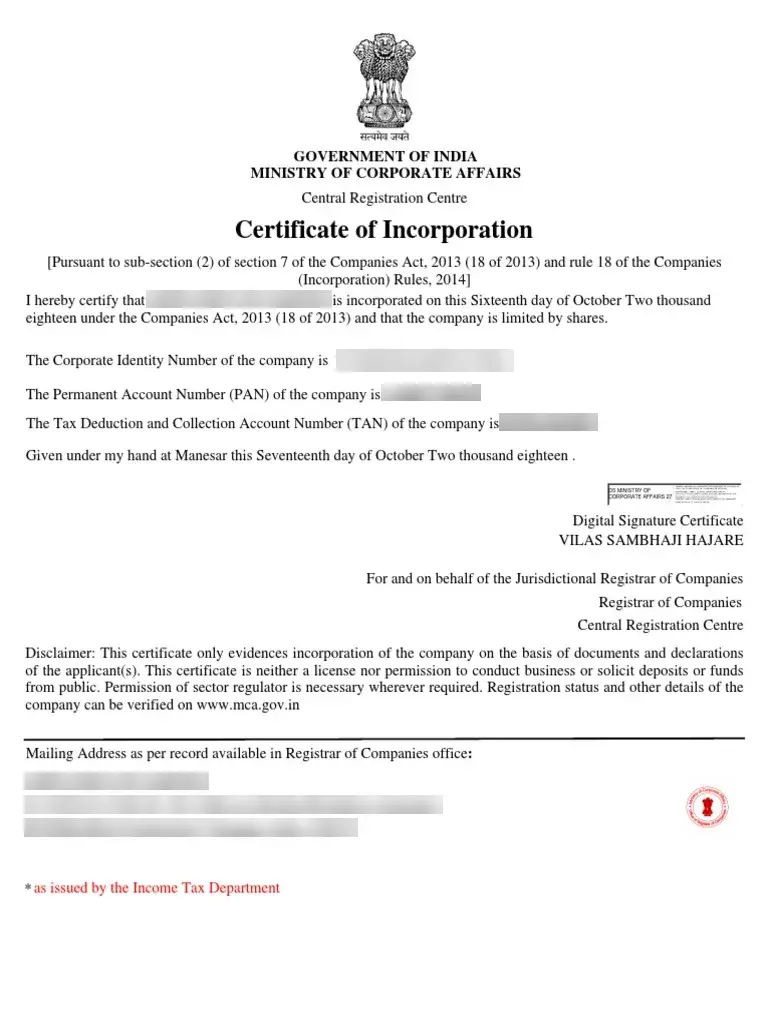
From the date on the COI, your company is a legal entity. You will need the COI for:
- Opening and operating your company’s bank account
- Obtaining GST and other tax registrations not covered by SPICe+
- Signing contracts in the company’s name
- Applying for required licenses and business permits
- Raising funds and bringing investors on board
Tip: Receiving your COI is an important milestone, but your compliance obligations continue after incorporation. You must file Form INC-20A within 180 days of incorporation to declare that the subscribers have paid for their shares. The company cannot commence business or exercise borrowing powers until it files this declaration. We track INC-20A and other post-incorporation deadlines to help you meet your compliance requirements on time.
Private Limited Company Registration Timeline
If all the documents are in order, new Private Limited Company registration usually takes 7 to 10 working days from the DSC application to the Certificate of Incorporation. Here’s how long each stage takes:
| Step | Typical Time | What Affects It |
| DSC | 1 to 2 days | How quickly each director and subscriber completes video verification |
| Name reservation (SPICe+ Part A) | 2 to 3 working days | Whether the name is unique and free of restricted words |
| Drafting MOA, AOA and other documents | 1 to 2 days | Finalizing the objects clause, supporting documents, and signatures |
| SPICe+ filing and CRC approval | 3 to 5 working days | Application accuracy and whether the CRC requests resubmission |
| Total | 7 to 10 working days | Assuming there are no major delays or resubmission requests |
A rejected company name, apostille requirements for foreign directors’ documents, or a CRC resubmission request due to mismatched details can extend the timeline. Our team reviews proposed names and incorporation documents before filing to help avoid preventable delays and keep your registration on schedule.
Fees for Registration of Private Limited Company in India
The Pvt Ltd Company registration cost in India starts at a professional fee of ₹1,499. The MCA charges no incorporation filing fee for companies with authorized capital of up to ₹15 lakh, although name reservation and state-specific stamp duty involve separate costs.
The table below breaks down the main expenses for registration of a Private Limited Company:
| Fee Category | Item | Cost |
| Government fees | Name reservation (SPICe+ Part A) | ₹1,000 |
| SPICe+ incorporation fee | Nil for authorized capital up to ₹15 lakh. Above ₹15 lakh, slab-based fees apply under the Companies (Registration Offices and Fees) Rules, 2014. | |
| Stamp duty on MOA and AOA | Varies by state and authorized capital | |
| PAN and TAN | ₹143 (issued through SPICe+) | |
| Professional fees | DSC | ₹2,500 per DSC |
| Service charges (MOA, AOA drafting and filing) | ₹1,499 for Indian clients; varies for foreign and NRI clients | |
| Post-registration costs | Company seal and stationery (optional) | ₹500 to ₹1,500 |
| Bank account opening | Varies by bank | |
| GST registration | Nil government fee |
For a full breakdown, read our comprehensive guide on company registration fees in India.
Note: Stamp duty and government fees differ by state and rise with authorized capital, so no two companies pay the same amount. Our company incorporation fees calculator estimates the exact cost for your state and capital in seconds.
Is There a Minimum Capital Requirement for a Pvt Ltd Company?
A Private Limited Company in India has no minimum paid-up capital requirement. The Companies (Amendment) Act, 2015 removed the earlier ₹1 lakh minimum, so you can start with any amount, provided each subscriber takes at least one share.
You must still declare an authorized capital, which sets the maximum value of shares your company can issue. The MCA charges no incorporation fee for authorized capital up to ₹15 lakh, although state stamp duty applies. Many founders start with ₹1 lakh in authorized capital and increase it as the business grows.
To raise this limit, the company must pass an ordinary resolution and file Form SH-7 with the MCA within 30 days, as required under Section 64 of the Companies Act, 2013.
What is a Private Limited Company Registration Number?
A Private Limited Company Registration Number, also known as a Corporate Identity Number (CIN), is a unique 21-character code that the CRC assigns during incorporation. It appears on the COI and identifies the company in its filings. Anyone can also use it to check the company’s details on the MCA register.
The CIN contains specific information about the company:
| Part | What It Indicates |
| Listing status (1 letter) | Whether the company is listed (L) or unlisted (U) |
| Industry code (5 digits) | The company's primary business activity |
| State code (2 letters) | The state of the registered office |
| Year of incorporation (4 digits) | The year the company was incorporated |
| Company type (3 letters) | The company type, such as PTC for Private Limited Company |
| Registration number (6 digits) | The unique number assigned by the ROC |
The CIN is required for MCA filings, annual returns, and financial statements. Section 12(3)(c) of the Companies Act, 2013, also requires companies to display it on their letterheads, invoices, notices, and official publications. For details on how to find a company’s CIN and where to use it, read our guide to the CIN number.
Benefits of Registering a Pvt Ltd Company in 2026
A Pvt Ltd Company combines legal protection, tax efficiency, and access to funding in one structure. Registering one also gives a business these benefits:
- Limited liability: Your personal assets stay protected, as all risk falls only on the capital you have invested in the company. This protection applies because a Private Limited Company is “limited by shares” under Section 2(22) of the Companies Act, 2013.
- Separate legal entity: The company is legally separate from its owners. It can own property, enter contracts, and sue or be sued in its own name, independently of its shareholders.
- Lower corporate tax: Companies whose turnover did not exceed ₹400 crore in FY 2024-25, the look-back year for Tax Year 2026-27, are taxed at 25%. Eligible companies can instead opt for the 22% rate under Section 200 of the Income Tax Act, 2025 (Section 115BAA of the 1961 Act). Both rates are below the 30% top individual slab, and eligible business expenses such as salaries, rent, and depreciation can also be claimed as deductions.
- Investor-ready structure: VCs and angel investors prefer Pvt Ltd Companies because the share-based structure provides clear ownership, investment, dilution, and exit mechanisms.
- Easier access to loans: Proper financial records and audited accounts can improve access to bank and NBFC financing compared with many unincorporated businesses.
- 100% FDI allowed: Most sectors permit 100% FDI under the automatic route, making the structure suitable for businesses seeking overseas capital.
- ESOPs to attract talent: A Pvt Ltd Company can offer ESOPs to eligible employees to attract and retain talent while aligning them with long-term growth.
- Higher credibility: A registered company can build greater trust with clients, banks, vendors, and investors. It can also participate in tenders and enterprise contracts that may not be accessible to informal businesses.
- Smooth ownership changes: Ownership is represented through shares, which can be transferred subject to the Companies Act and the Articles of Association. This allows new investors or shareholders to enter without disrupting the company's operations.
- Perpetual succession: The company continues to exist independently of changes in ownership. It can keep operating even if a shareholder leaves, retires, or passes away, providing long-term business continuity and stability.
- Startup benefits: An eligible company can get free DPIIT Startup India recognition. Since February 2026, recognition covers companies up to 10 years old with turnover up to ₹200 crore, up from ₹100 crore. Deep Tech startups qualify for up to 20 years, with turnover up to ₹300 crore. Recognized startups with an IMB certificate can also claim a 3-year tax holiday under Section 140 of the Income Tax Act, 2025.
Limitations of a Private Limited Company
Despite its benefits, a Private Limited Company involves stricter compliance, recurring costs, and restrictions on ownership and fundraising. Its main drawbacks include:
- Filing financial statements (AOC-4) and annual returns (MGT-7 or MGT-7A), completing applicable director KYC, and holding at least four board meetings a year, or two for a small company.
- Mandatory annual audits under Section 139 of the Companies Act, 2013, regardless of turnover.
- Restrictions on share transfers under Section 2(68), which limit shareholders’ ability to freely transfer shares to outsiders.
- Inability to invite the public to subscribe to shares or debentures or list securities on a stock exchange.
- Public access to financial statements, annual returns, and director details filed with the MCA.
- Corporate tax on company profits, followed by personal tax on dividends received by shareholders.
- Additional fees and statutory penalties for missed filings and other compliance defaults.
Post-Incorporation Compliance for a Private Limited Company
After incorporation, a Private Limited Company has a few one-time filings to complete, followed by yearly ROC and tax filings. Missed deadlines bring penalties on both the company and its directors:
| Compliance | Form | Deadline | Penalty for Default |
| Registered office verification | Form INC-22 | Within 30 days of incorporation, if the address was not verified in SPICe+ | ₹1,000 per day, up to ₹1 lakh on the company and each officer in default (Section 12(8)) |
| First board meeting | N/A | Within 30 days of incorporation | ₹10,000 plus ₹1,000 per day, up to ₹2 lakh on the company (Section 450) |
| First auditor appointment | ADT-1 | Within 30 days of incorporation (Section 139(6)) | ₹25,000 to ₹5 lakh on the company (Section 147 (1)) |
| Share certificates | SH-1 | Within 2 months of incorporation | ₹50,000 on the company and every officer in default (Section 56(6)) |
| Commencement of business | INC-20A | Within 180 days of incorporation | ₹50,000 on the company, plus ₹1,000 per day on officers, up to ₹1 lakh (Section 10A) |
| Board meetings | N/A | 4 a year (2 for a small company) | ₹10,000 plus ₹1,000 per day, up to ₹2 lakh on the company (Section 450) |
| Annual general meeting | N/A | First AGM within 9 months of the first financial year end | Fine up to ₹1 lakh, plus up to ₹5,000 per day of continuing default (Section 99) |
| Financial statements | AOC-4 | Within 30 days of the AGM | ₹10,000 plus ₹100 per day, up to ₹2 lakh on the company (Section 137) |
| Annual return | MGT-7 / MGT-7A | Within 60 days of the AGM | ₹10,000 plus ₹100 per day, up to ₹2 lakh on the company (Section 92) |
| Return of deposits | DPT-3 | June 30 each year, for amounts outstanding as of March 31 | ₹5,000, plus ₹500 per day of continuing default (Rule 21, Companies (Acceptance of Deposits) Rules, 2014) |
| MSME dues return | MSME-1 | October 31 and April 30 for each half-year, if dues to micro or small suppliers exceed 45 days | ₹20,000 on the company, and ₹20,000 plus ₹1,000 per day, up to ₹3 lakh, on each officer (Section 405(4)) |
| Director KYC | DIR-3 KYC | Once every 3 years by June 30; within 30 days of any change in details | DIN deactivated until filed, with a late fee |
| Income tax return | ITR-6 | October 31 each year | Late fee up to ₹5,000, plus interest on unpaid tax (Section 428, Income Tax Act, 2025) |
Our Private Limited Company compliance page covers each filing in detail, and the first year’s compliance can be bundled with incorporation. To track deadlines for your company now, use our Compliance Calendar.
Note: Most newly incorporated Private Limited Companies qualify as small companies if their paid-up capital does not exceed ₹10 crore and turnover does not exceed ₹100 crore. These revised limits took effect on December 1, 2025, under G.S.R. 880(E). However, the definition excludes holding and subsidiary companies, Section 8 companies, and companies governed by a special Act. If a company later loses its small-company status, Rule 9B of the Companies (Prospectus and Allotment of Securities) Rules, 2014, requires it to dematerialize all its securities within 18 months from the end of the financial year in which it ceased to qualify. After that, it can issue or transfer securities only in demat form.
Small companies benefit from simpler compliance requirements, including:
- Fewer board meetings: Only two board meetings a year are required.
- Simplified annual filing: They can file the shorter Form MGT-7A.
- No cash flow statement: They are exempt from preparing one.
- Reduced penalties: Under Section 446B, they pay half of most penalties, subject to the applicable statutory caps of ₹2 lakh for the company and ₹1 lakh for each officer in default.
Common Mistakes That Delay Your Pvt Ltd Company Application
Most SPICe+ resubmissions happen due to a few common errors. Avoid these mistakes to prevent delays and rejection:
- Choosing a similar company name: A name that conflicts with an existing company, LLP, or trademark may get rejected. Search the MCA database and trademark registry before submitting your proposed name.
- Drafting an incorrect objects clause: If the objects clause doesn’t match the proposed name or the actual business, the CRC raises an objection. Draft it to clearly cover the intended business activities.
- Submitting incorrect address proof: Old utility bills, address mismatches, or missing NOC from the property owner can delay approval. Submit a recent utility bill, valid ownership/rental documents, and owner consent wherever required.
- Providing inconsistent details: Mismatches in director names, DIN, PAN, Aadhaar, DSC, or application details can result in resubmission. Verify all personal and company details across documents before filing.
- Using an invalid DSC: An inactive or incorrect Digital Signature Certificate can prevent successful form submission. Ensure every proposed director and subscriber has an active Class 3 DSC before filing SPICe+ forms.
- Making capital structure errors: Incorrect authorized capital, paid-up capital, or subscriber shareholding details can lead to corrections. Confirm capital details and share allocation with all subscribers before submission.
Comparison Between Different Types of Company Registration in India
The right business structure depends on the liability protection, tax rate, compliance load, and funding a business needs. Here's how Private Company Registration compares with other structures:
| Feature | Private Limited Company | One Person Company (OPC) | Limited Liability Partnership (LLP) | Partnership Firm | Sole Proprietorship |
| Legal status | Separate legal entity | Separate legal entity | Separate legal entity | No separate legal entity | No separate legal entity |
| Liability | Limited to the shares held | Limited to the shares held | Limited to the agreed contribution | Unlimited | Unlimited |
| Minimum members | 2 directors and 2 shareholders | 1 member and 1 director | 2 designated partners | 2 partners | 1 proprietor |
| Maximum members | 200 shareholders | 1 member | No limit | 50 partners | 1 proprietor |
| Income tax rate | 25% (22% optional under Section 200) | 25% (22% optional under Section 200) | 30% | 30% | Individual slab rates |
| Compliance | High: annual MCA filings and mandatory audit | Moderate: annual MCA filings, mandatory audit, no AGM | Moderate: annual MCA filings, audit only above set limits | Low: income tax filings | Low: income tax filings |
| Equity funding | Best suited for angel and VC investment | Limited; must convert to raise equity | Limited; cannot issue shares | Not suitable | Not suitable |
| Governing law and authority | Companies Act, 2013 (MCA) | Companies Act, 2013 (MCA) | LLP Act, 2008 (MCA) | Indian Partnership Act, 1932 (State Registrar of Firms) | No specific law or registrar |
| Ideal for | Startups and businesses planning to raise funds | Solo founders who want limited liability | Professional and service firms | Small businesses with shared ownership | Small traders and local businesses |
Register a Private Limited Company in Your City
Connect with RegisterKaro and let our experts handle the legal hassle while you grow your business.
Frequently Asked Questions (FAQs)
Can a salaried person become a director of a Private Limited Company?
Yes, the Companies Act, 2013, does not prohibit salaried employees from becoming directors or shareholders. However, their employment contracts may restrict outside business activities, so they should check the terms and obtain their employer’s NOC if required.
Can a government or PSU employee register or hold shares in a company?
Government employees can hold shares as private investments, subject to applicable conduct rules. Under Rule 15 of the Central Civil Services (Conduct) Rules, 1964, they generally need prior government sanction to promote, register, or manage a company. PSU employees must follow their respective service rules.
Can I register a Pvt Ltd company with my family members, such as my spouse?
Yes, your spouse, parents, siblings, or other eligible relatives can become directors and shareholders. Two family members can meet the minimum requirement of two directors and two shareholders, provided both satisfy the applicable eligibility conditions.
Can I use a virtual office or co-working space as my registered office for Private company incorporation?
Yes, a virtual office or co-working space can serve as your registered office if it meets the legal requirements and supports official correspondence. You may need a recent utility bill, the property owner's NOC, and a rent or service agreement. The ROC may also verify the address.
Can another company or LLP hold shares in my Private Limited Company?
Yes, a company or LLP can hold shares in a Private Limited Company, subject to the applicable authorization and documentation requirements. However, only an individual can be appointed as a director, not another company or LLP.
Do I need to deposit the full capital before Private company incorporation?
No, subscribers generally pay for their shares after incorporation by depositing the amount into the company's bank account. The company must then file Form INC-20A within 180 days of incorporation, confirming receipt of the subscription money, before commencing business or exercising borrowing powers.
Does a Private Limited Company need a company secretary?
A Private Company with paid-up share capital of ₹10 crore or more must appoint a whole-time company secretary under Rule 8A of the Companies (Appointment and Remuneration of Managerial Personnel) Rules, 2014. Smaller companies may engage a practicing company secretary for professional support.
How long is the approved company name valid?
A name approved through SPICe+ Part A remains reserved for 20 days from the approval date. You must complete the incorporation filing within this period. If the reservation expires, you must apply again and pay the applicable name reservation fee.
Can NRIs or foreign nationals hold 100% of an Indian company?
Yes, NRIs and foreign nationals can hold 100% of an Indian company's shares in many sectors under the automatic route, subject to applicable FDI rules. Some sectors have investment caps or require government approval. Investments from countries sharing a land border with India are also subject to additional approval requirements. The company must have at least one resident director.
How much does Private Limited Company registration cost?
The cost of Private Limited Company registration starts at a professional fee of ₹1,499. Additional expenses include the ₹1,000 name reservation fee, ₹2,500 per Digital Signature Certificate (DSC), and applicable state stamp duty. The MCA charges no incorporation filing fee for authorized capital up to ₹15 lakh.
How to start a Private Limited Company in India?
Obtain DSCs for the proposed directors and subscribers, reserve your company name through SPICe+ Part A, and prepare the MOA and AOA. Then file SPICe+ with AGILE-PRO-S through the MCA V3 portal. Once the CRC approves the application, it issues the Certificate of Incorporation with the company's PAN and TAN.
How long does Private Limited Company registration take?
Private Limited Company registration usually takes 7 to 10 working days if all documents are complete and accurate. Name rejections, apostille requirements for foreign directors' documents, or CRC resubmission requests can extend the timeline.
Can I register a Private Limited Company online without visiting an office?
Yes, you can complete the incorporation process online through the SPICe+ form on the MCA V3 portal. Applicants submit documents digitally and complete DSC verification as required. Once approved, the Certificate of Incorporation is issued electronically, so an in-person visit to the ROC is generally unnecessary.
Can a single person open a Private Limited Company?
No, a Private Limited Company requires at least two directors and two shareholders. A sole founder can instead register a One Person Company (OPC), which provides a separate legal identity and limited liability with a single member.

Reviewed by
Joel DsouzaJoel Dsouza is a Chartered Accountant (CA) and compliance expert with over 7 years of hands-on experience in company registration, tax structuring, GST, ROC filings, and MCA compliance. As a qualified member of the Institute of Chartered Accountants of India (ICAI) and Co-Founder at RegisterKaro, he has personally advised more than 1,000 startups and SMEs across India, helping founders navigate incorporation, regulatory frameworks, and financial planning from Day 1. With deep expertise across all three levels of Finance and Portfolio Management, Joel is committed to promoting financial literacy and simplifying India's startup ecosystem through clear, actionable guidance that entrepreneurs can act on immediately.
Why Choose RegisterKaro for Private Limited Company Registration?
RegisterKaro’s Private Limited Company registration services cover everything from the first name check to the compliance that follows incorporation. Here's what that includes:
- End-to-end incorporation: Our Chartered Accountants and Company Secretaries handle your DSC, name reservation, MOA and AOA drafting, and SPICe+ filing, along with DIN, PAN, and TAN allotment.
- 7 to 10-day turnaround: We check every document before filing and respond to any CRC resubmission remarks within 24 hours.
- Name screening before you pay: We check every proposed name against MCA records and the trademark registry before you pay the ₹1,000 reservation fee. That cuts the risk of rejection and refiling.
- A dedicated CA or CS: We assign one professional to your application from name approval to the Certificate of Incorporation, reachable by call, WhatsApp, and email.
- First-year compliance bundle: We can bundle INC-20A, ADT-1, AOC-4, MGT-7 or MGT-7A, and ITR-6 into one plan instead of billing each filing separately.
- Deadline reminders: We send reminders for MCA, tax, and annual compliance dates, so your company never misses a filing.

What Our Clients Say
View All
Abhilasha Acharekar
 Verified
I had a great experience with RegisterKaro for my Private Limited Company registration. The entire process was smooth and well-managed. A special than... Read more

Ravi sen Gupta
VerifiedThanks a lot Shagun singhal , for her contribution in making our pvt ltd.. we had to suffer a lot but she did tried and closed all the formalities and... Read more

Padmapriya Parthasar...
VerifiedThe best service by Aman Saxena. She completely guided me with 100% patience in my busy schedule. She helped me understanding that I have troubles in... Read more

Raj Badgujar
VerifiedI recently registered my company RGB Build Con Pvt Ltd through Register Karo, and I am extremely satisfied with their service. The entire process was... Read more

Rahul Malik
VerifiedI got my Pvt ltd Company incorporated through register karo and Vishal helped me a lot in the process answering all my queries and did a great job Vis... Read more

Shivam Singh
VerifiedI had a great experience with RegisterKaro for incorporating my Private Limited Company. The entire process was smooth and well-managed. Sumit, in par... Read more

Anish Nain
VerifiedMs. Anchal Gupta played a vital role in successfully incorporating our company. Her thoughtful approach, attention to detail, and clear communication... Read more

SUMIT YADAV
VerifiedI had an excellent experience with the ICEGATE registration process. Rahul handled the entire process professionally, completed it on time, and ensure... Read more

Shoyab Ahmad
VerifiedOne of the best registration service providers. The team is experienced, friendly, and delivers exactly what they promise. I would definitely recommen... Read more

PrimePinnacle Techso...
VerifiedIt was smooth experience from the document collection till registration. I would strongly recommend registerkaro for any help or assistance for your n... Read more
Private Limited Company Registration Across India
Related Blogs
View All
How to Convert a Private Limited Company into an LLP (2026)

Can a Private Limited Company Invest in Mutual Funds?

Conversion of Section 8 Company to Private Limited Company: Process, Forms, and Fees

CEO Appointment in Private Limited Company: Procedure Guide

What is the Difference Between an OPC and a Private Limited Company?
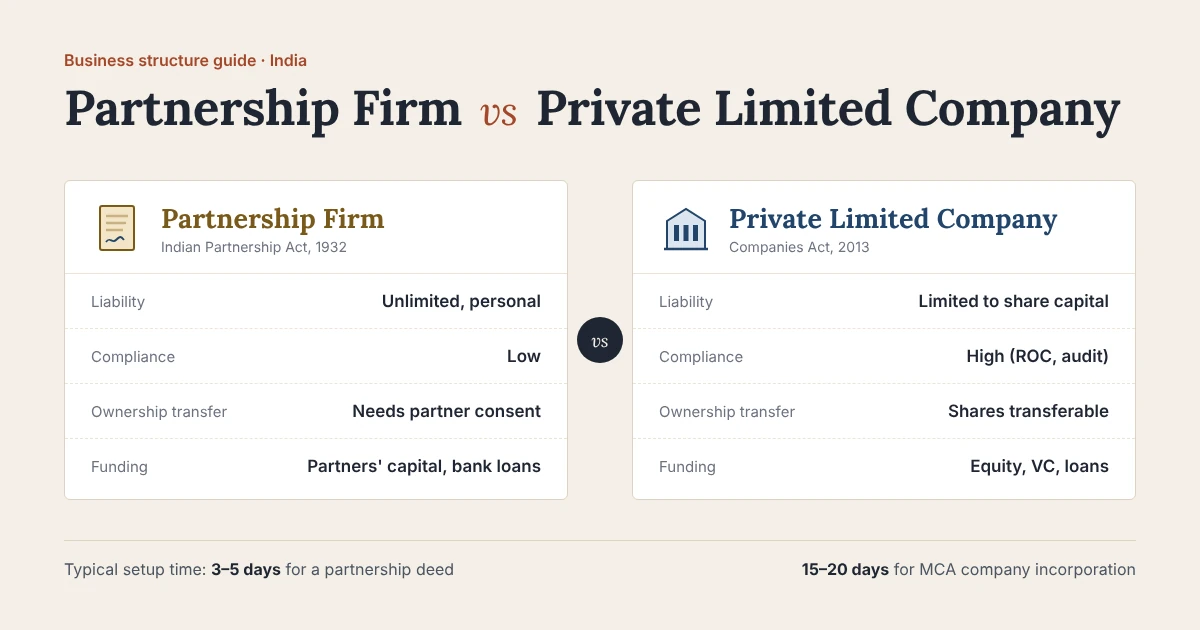
Difference Between Partnership and Company (Firm vs Pvt Ltd)

Private Limited Company Corporate Tax Rate in 2026: Key Insights and Updates
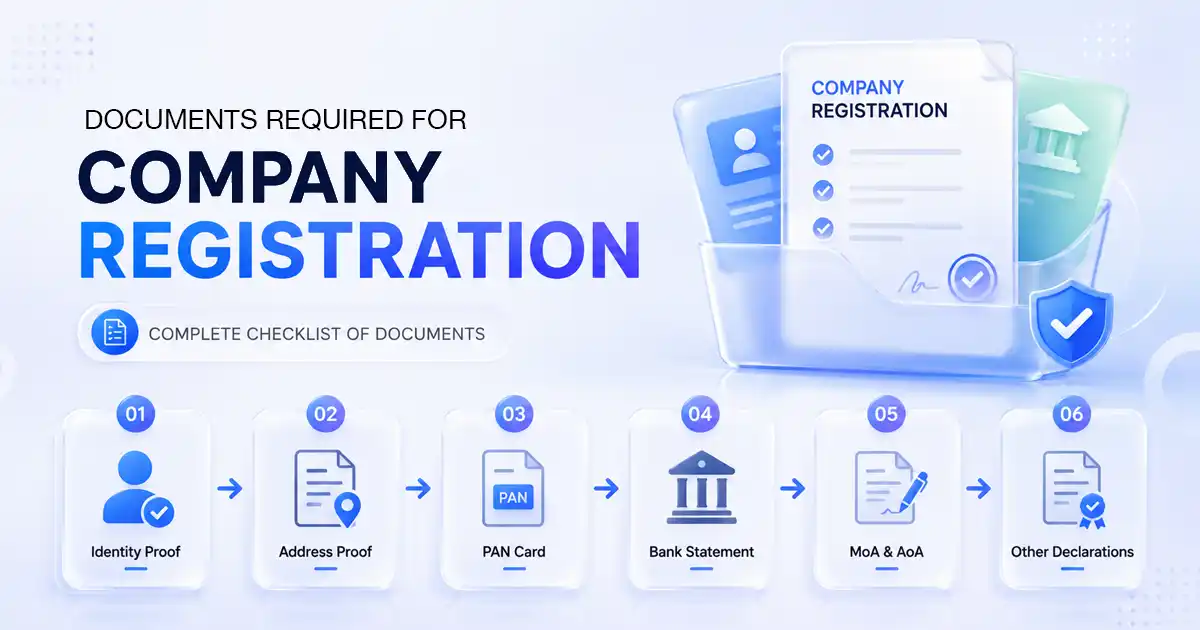
Documents Required for Company Registration in India – A Checklist

How to Convert an LLP to a Private Limited Company in India
Difference Between Private and Public Company in India