


Registering a company in India legally involves several charges, government fees, form filing costs, stamp duty, and professional fees if you take help. For most businesses, the total works out to roughly ₹8,000 to ₹20,000, though there is no single fixed price. What you actually pay depends on the company type, authorized capital, registered office state, and the number of directors or partners who need a digital signature.
Government fees are mandatory charges paid to the MCA and state authorities, while professional fees cover assistance you hire for the registration process, which vary by provider. For most small companies, the government cost remains relatively low because the MCA charges no filing fee for authorized capital up to ₹15 lakh. However, applicable state stamp duty still applies.
Calculate Your Exact Company Registration Cost in 30 Seconds
Skip the guesswork. Enter your entity type (Private Limited, LLP, or OPC), state, and capital to instantly see your government fees, stamp duty, DSC, and professional charges — plus your total incorporation cost.
Stamp duty at published MOA and AOA rates for Maharashtra.
Total incorporation cost
₹ —
Private CompanyMaharashtra
Press Calculate My Cost to see your breakdown.
Key Takeaways
- There is no single fixed fee to register a company in India. Instead, the total depends on the company type, authorized capital, registered office state, and number of directors or partners requiring a DSC.
- Starting a Public Limited Company costs considerably more than a private company because it requires at least 3 directors and 7 subscribers, increasing DSC, documentation, stamp duty, and professional costs.
- The MCA filing fee is nil for authorized capital up to ₹15 lakh, which keeps the central government filing cost low for many new companies.
- Stamp duty is usually the biggest variable in the government cost, as it differs by state.
- Each state sets its own stamp duty, so the same company can have a significantly different registration cost depending on its registered office.
- Each DSC costs around ₹2,500, so adding more directors or partners increases the total.
- Registration is a one-time cost, but a registered company also spends roughly ₹25,000–₹75,000 a year on accounting and compliance.
How Much Does Company Registration Cost in India in 2026?
For most small businesses, company registration in India costs around ₹8,000 to ₹20,000. Public Limited Company registration costs are higher due to its additional incorporation and compliance requirements, while OPC registration fees are generally lower because of its simpler structure.
The table below provides indicative registration costs for different business structures, including government fees, DSC, stamp duty, and basic professional fees:
| Business Structure | Cost | Main Cost Drivers |
| Private Limited Company | ₹8,000–₹15,000 | Capital, DSC, stamp duty |
| One Person Company (OPC) | ₹6,500–₹15,000 | Capital, DSC |
| LLP | ₹6,000–₹35,000 | Contribution, DSC, agreement stamp duty |
| Public Limited Company | ₹50,000–₹1,00,000+ | Higher number of directors and shareholders, capital, stamp duty |
| Section 8 Company | ₹6,000–₹15,000 | DSC, professional fees, licensing process |
Disclaimer: These figures are indicative, as MCA charges, stamp duty, and professional fees vary by company and service provider.
Real-World Example: Cost by Business Structure
Two friends plan to start a business in Delhi with ₹15 lakh in capital. Their registration costs can vary significantly depending on the structure they choose:
| Cost Component | Private Limited | LLP | Public Limited |
| MCA/incorporation filing | Nil, up to ₹15 lakh authorized capital | Contribution-based | Capital-based |
| Stamp duty | ₹2,460 | LLP Agreement, based on applicable state duty | Higher, depending on capital and state |
| DSC | ~₹5,000 for 2 directors | ~₹5,000 for 2 designated partners | ~₹17,500+ for at least 7 subscribers/directors (each signatory needs a Class 3 DSC) |
| Name reservation | ₹1,000 | ₹200 | ₹1,000 |
| Professional / drafting fees | ~₹5,000 | ~₹5,000 | Usually higher |
| Indicative cost | ~₹13,500 | Depends on contribution and agreement stamp duty | Generally higher than a private company |
This does not mean that LLP registration fees are higher. Its MCA fee is contribution-based, so it only edges above a company’s nil fee at this high ₹15 lakh level. In most cases, LLPs cost less due to lower stamp duty, fewer DSCs, and simpler documentation.
If one wishes to later convert an LLP to a Public Limited Company, the cost can rise to ₹50,000 or more. A public company requires at least 7 shareholders and 3 directors, increasing DSC, incorporation, stamp duty, and compliance costs.
This shows that your business structure can significantly affect registration costs. Even with the same founders, capital, and location, the total can vary depending on whether you choose a Private Limited Company, LLP, or Public Limited Company.
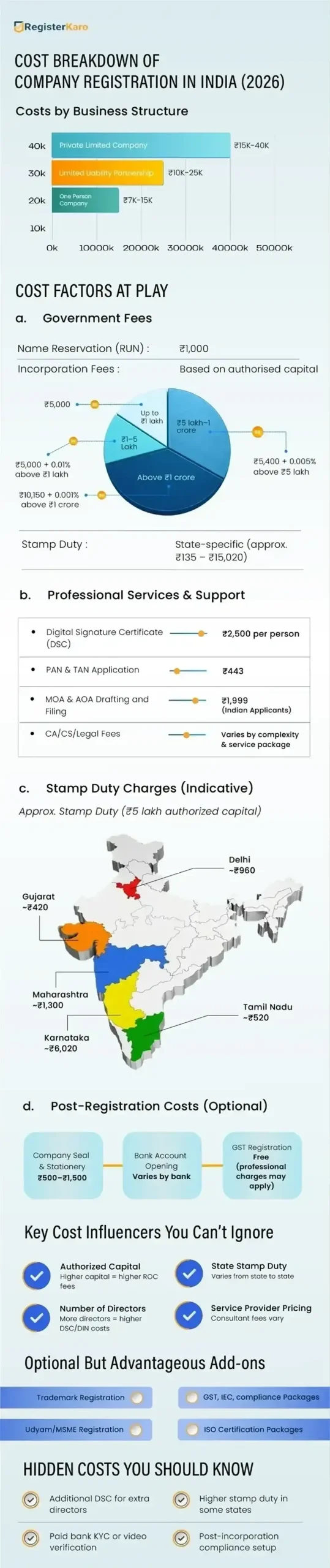
Key Components of Company Incorporation Cost
Your total business registration cost includes different factors. These include:
1. MCA / ROC Filing Fees
The MCA charges a fee for processing incorporation through SPICe+, based on authorized capital. It is:
- Up to ₹15 lakh: Nil (zero-fee incorporation scheme).
- Above ₹15 lakh: The fee is calculated on a slab basis under Rule 12 of the Companies (Registration Offices and Fees) Rules, 2014, a base amount plus an add-on for every ₹10,000 of capital:
- More than ₹15 lakh up to ₹50 lakh: ₹36,000 + ₹300 for every ₹10,000 (or part thereof) above ₹10 lakh.
- More than ₹50 lakh up to ₹1 crore: ₹1,56,000 + ₹100 for every ₹10,000 (or part thereof) above ₹50 lakh.
- More than ₹1 crore: ₹2,06,000 + ₹75 for every ₹10,000 or part thereof above ₹1 crore, subject to the prescribed maximum fee of ₹2.5 crore.
You can check the exact MCA fee for your authorized capital with our MCA Fees Calculator. For companies within the ₹15 lakh threshold, state stamp duty is usually the largest variable in the government-side cost.
2. Company Name Reservation
Reserving a company name separately through SPICe+ Part A costs ₹1,000 per application. You can propose up to two names in one application. If both are rejected and you submit a fresh application, the ₹1,000 fee applies again.
Checking company name availability using the MCA’s official company site or a free company name check tool can help avoid this extra cost.
Note: The ₹1,000 fee applies when you file Part A separately for name reservation. If Part A is filed together with Part B as part of the incorporation application, there is generally no separate name-reservation fee.
3. Digital Signature Certificate (DSC)
Each person required to digitally sign the incorporation documents needs a valid Digital Signature Certificate (DSC). For a typical two-director company, this often means two DSCs.
- A company with 2 directors pays around ₹5,000 in total DSC charges
- A company with 4 directors pays around ₹10,000
4. Stamp Duty on MOA and AOA
Stamp duty applies to your incorporation documents, including the MOA, AOA, and SPICe+ forms. The amount depends on your registered office state and authorized capital, making it a major factor in the overall Private Limited Company registration cost.
- States with the lowest stamp duty: ₹0 in Sikkim and around ₹135–₹195 in Haryana.
- States with the highest stamp duty: Around ₹10,020 in Karnataka and ₹10,025 in Punjab.
- States with mid-range stamp duty:
- Tamil Nadu: around ₹720 for authorized capital up to ₹10 lakh (the AOA slab of ₹500 applies per ₹10 lakh, plus fixed MOA and form charges).
- Maharashtra: around ₹1,300 for authorized capital up to ₹5 lakh, rising in ₹1,000 steps for every additional ₹5 lakh of capital.
- Delhi:₹360 to ₹2,460 (roughly ₹360 at ₹1 lakh of authorized capital and ₹2,460 at ₹15 lakh). Delhi charges about 0.15% of authorized capital plus a small fixed component, so the amount rises steadily with capital (for example, about ₹1,710 at ₹10 lakh).
The MCA portal calculates the applicable stamp duty based on your state and authorized capital during SPICe+ filing.
Note: Stamp duty rates and slabs vary by state and authorized capital, so the exact amount depends on your company’s details. You can calculate the applicable amount using the stamp duty calculator.
5. PAN, TAN, and DIN
DIN, PAN, and TAN are all obtained through the incorporation form itself, so they don’t require separate applications. There are, however, small statutory PAN and TAN charges built into SPICe+ (or FiLLiP for an LLP):
- PAN: ₹66
- TAN: ₹65
- DIN: Allotted through SPICe+ for up to three directors at no separate charge.
6. Professional or Service Fees
Professional fees cover the cost of getting a professional or platform to handle your incorporation. For example, our fees start around ₹1,499 and vary based on the provider and services included. They may cover:
- Document preparation and drafting
- SPICe+ form preparation and filing
- MCA filing and follow-up
- Post-incorporation support
When comparing quotes, check whether the starting price covers only professional fees or also includes government charges and stamp duty. This helps you compare packages accurately and avoid unexpected costs later.
Government Fees vs Professional Fees for Company Registration: What’s the Difference?
Government charges are mandatory, while professional fees cover optional assistance with the registration process.
The table below explains each charge, who you pay it to, and what determines its amount:
| Cost | Paid To | Is it Mandatory? | Depends On |
| MCA filing fee | Central government (MCA) | Yes | Authorized capital |
| Stamp duty | State government | Yes | State + authorized capital |
| DSC | Certifying authority | Yes | Number of people requiring DSC |
| Name reservation | Central government (MCA) | No, if Part A is filed together with Part B | Number of applications filed |
| Professional fee | Service provider | Optional | Scope of services |
Note: You can complete the process yourself and avoid professional fees, but you still need to pay the applicable government charges and other statutory costs. Professional support, however, can help you choose a compliant name, prepare the MOA and AOA correctly, file SPICe+ without errors, and choose suitable authorized capital to manage stamp duty and fees. Experts can also guide you through requirements such as INC-20A and GST registration, helping you avoid delays and costly mistakes.

How to Estimate Your Exact Company Registration Cost?
Use this formula to estimate your registration cost:
Total Cost = MCA Filing Fee + Stamp Duty + DSC + Name Reservation + Professional Fees
Consider a Private Limited Company with 2 directors and ₹10 lakh authorized capital, registered in Delhi.
- MCA filing fee (capital under ₹15 lakh): ₹0
- Stamp duty (Delhi): ₹1,710
- DSC (2 × ₹2,500): ₹5,000
- Name reservation: ₹1,000
- Professional fees: ~₹5,000
- Total: ₹12,700
If the same company were registered in Karnataka, the total would be around ₹21,000. The main difference is stamp duty, which is approximately ₹10,020 in Karnataka compared with ₹1,710 in Delhi for authorized capital of up to ₹10 lakh.
For a quicker estimate, use the Company Incorporation Fees Calculator, which factors in your entity type, state, capital, and number of directors or partners.
Recurring Costs After Successful Registration of Company
Company registration is a one-time expense, but maintaining a company involves ongoing compliance, accounting, and statutory costs. The exact expenses depend on the company’s transactions, GST status, turnover, and whether professional services are outsourced.
| Cost | Typical cost | When it applies |
| Accounting and bookkeeping | ₹1,000–₹10,000/month | Depends on transaction volume and whether accounting is outsourced |
| Annual ROC filings (AOC-4 and MGT-7) | ₹5,000–₹15,000/year | Every financial year, including applicable professional fees |
| Statutory audit | ₹10,000–₹50,000/year | Generally applicable to companies, subject to statutory requirements |
| Income-tax return and tax audit | ₹5,000–₹25,000/year | ITR filing is annual; tax audit applies where the company meets the applicable conditions |
| GST compliance | ₹500–₹2,000/month | If the company is registered or required to register under GST |
| DSC renewal | ~₹2,500/certificate | When a director’s or authorized signatory’s DSC expires, typically every 1–3 years |
| Director KYC (DIR-3 KYC) | ₹500–₹1,000/director | When professional assistance is used, and the filing is applicable |
A small company may spend around ₹25,000–₹75,000 per year on accounting and compliance, excluding business expenses such as rent, salaries, licenses, and banking charges. The actual amount can be higher or lower depending on the company’s activities and compliance requirements.
Immediate Post-Registration Costs
Some expenses arise soon after incorporation. While they are not part of the registration fee, you may need to pay them within the first few weeks or months of starting operations:
- INC-20A (Commencement of Business): A government filing fee applies based on the company’s nominal share capital, ranging from ₹200 to ₹600. Companies without share capital pay ₹200. The form must generally be filed within 180 days of incorporation, before the company commences business or exercises borrowing powers.
- GST registration: The government does not charge a fee for GST registration. Professional assistance typically costs ₹1,000–₹2,000. Registration becomes mandatory when you meet the applicable threshold or fall under compulsory registration rules.
- Current bank account: Banks may require a minimum balance, often ₹5,000–₹25,000, which can tie up part of your working capital.
- Professional tax registration: States that levy professional tax, such as Maharashtra and Karnataka, may require registration or enrollment. Applicable fees vary by state.
- Other licenses: You may need a Shop and Establishment registration or a sector-specific license based on your business activity and location.
Tips to Avoid Unnecessary Registration Costs
Follow these tips to avoid additional costs during incorporation:
- Set authorized capital carefully: MCA filing fees remain nil up to ₹15 lakh of authorized capital.
- Check name availability first: A rejected name may require another ₹1,000 name reservation application.
- Submit accurate documents: Errors or mismatches can lead to queries, corrections, or re-filing.
- Check what your quote includes: Confirm whether the advertised price covers government fees and stamp duty or only professional fees.
- Compare service packages: Check what each provider includes before choosing the lowest-priced option.
- Get DSCs only when needed: The number of directors and subscribers requiring DSCs affects the total cost.
- Check state stamp duty: Stamp duty varies by state, so consider this cost when planning your registered office.
- Avoid unnecessary capital: Set authorized capital based on your business needs rather than choosing a higher amount without a reason.
- Plan post-incorporation costs: Budget separately for INC-20A, GST, accounting, audit, and annual compliance.
