


A board resolution for a trademark application is a formal decision by a company’s board of directors authorizing a specific person to complete trademark name registration on the company’s behalf. The board passes this under Section 179 of the Companies Act, 2013, and appoints the authorized signatory, usually a director. The Trade Marks Registry requires this resolution as proof that the person filing the application has the board’s approval.
A company must pass this resolution before filing its trademark application, and an LLP passes a Partners’ / Designated Partners’ Resolution of its designated partners. Individuals, proprietors, and partnership firms do not need one, as they have no board. Without a valid resolution, or with a wrongly worded one, a company’s trademark application can receive a deficiency notice from the Registry.
This guide explains the board resolution for a trademark application, covering its format, a ready-to-use sample, the assignment variant, and how to pass it correctly.
Key Takeaways
- A board resolution for a trademark application is a company’s formal authorization, passed under Section 179 of the Companies Act, 2013.
- The Trade Marks Registry requires it as proof of authorization, and a missing or wrongly worded resolution is a common cause of deficiency notices.
- The resolution must be on company letterhead, written in the present tense (“RESOLVED THAT”), name the authorized signatory with their DIN, state the scope, and be certified as a true copy.
- The board can pass it at a board meeting or by circulation under Section 175, as Section 179(3) does not restrict authorizing a signatory to board meetings.
- A board resolution for the assignment of a trademark authorizes the transfer and empowers a director to execute the assignment deed and file Form TM-P.
What is a Board Resolution for a Trademark Application?
The board of directors records a board resolution as a formal decision taken at a meeting or through circulation. For a trademark, it captures two decisions in one document: the board’s approval to apply for the mark and the appointment of the person who will handle the filing.
A board resolution for a trademark application typically includes:
- Approval to apply: The board’s decision to register the trademark in the company’s name.
- Authorized signatory: The name and designation of the director or officer authorized to sign and file the application.
- Scope of authority: Permission to appoint a trademark attorney, file the application, respond to objections, and represent the company in related proceedings.
- Certification: The board confirms that the document is a true copy of the resolution it has passed.
Why does the Board require a Resolution for Trademark Registration?
A board resolution serves as proof that the person filing the trademark application has the company’s authorization. It confirms that the application has the board’s approval, allowing the Trade Marks Registry to verify that the signatory is acting on the company’s behalf.
Here’s why the resolution matters:
- Proves authorization: The board authorizes the person signing the application or the appointed attorney to act for the company through the resolution.
- Establishes accountability: The document puts on record which director or officer is responsible for the filing and related proceedings.
- Supports the Power of Attorney (POA): When a trademark agent files using Form TM-M, the board resolution backs the authority granted to that agent.
- Creates a clean legal record: The company records the resolution in its minutes and uses it as proof of proper corporate approval if anyone questions or disputes the trademark.
Who Needs a Board Resolution for a Trademark Application?
The requirement depends on the type of business entity. The table below shows who needs a board resolution and how each type of business authorizes a trademark application:
| Business Entity | Board Resolution Required? | Authorization Method |
| Private and public limited companies | Yes | The board passes a resolution authorizing a director or officer to file the trademark application and appoint a trademark attorney. |
| One Person Company (OPC) | Yes | If the OPC has only one director, no board meeting is required. The sole director records, signs, and dates the decision in the minutes book under Section 122(4) of the Companies Act, 2013. |
| Section 8 (non-profit) companies | Yes | They authorize the trademark application through a board resolution. |
| Limited Liability Partnerships (LLPs) | No | Designated partners pass a Partners’ Resolution (or Consent Letter) to authorize the trademark application. |
| Partnership firms | No | The partnership deed authorizes a partner to file the application. |
| Sole proprietors and individuals | No | The proprietor or individual files and signs the application directly. |
Note: If an agent or attorney files on behalf of an applicant, the applicant also submits a POA in Form TM-M to authorize the agent to act. For a company, the board resolution supports this POA.
How to Pass a Board Resolution for a Trademark Application?
Companies record decisions through several types of resolutions, and the one authorizing a trademark filing can be passed either at a board meeting or by circulation. Section 179(3) of the Companies (Meetings of Board and its Powers) Rules, 2014, does not restrict authorizing a signatory for trademark filing to board meetings, so the board can use either route. Here’s how each is done:
1. Passing the Resolution at a Board Meeting
- Issue a notice of the board meeting to all directors at least 7 days in advance, along with the agenda for the trademark filing.
- Hold the meeting with the required quorum, which is one-third of the total directors or two directors, whichever is higher.
- Pass the board resolution by a majority of directors present and voting, authorizing the trademark application and the signatory.
- Record the resolution in the minutes book and prepare a certified true copy for the Registry.
2. Passing the Resolution by Circulation
- Verify that your company’s Articles of Association (AOA) allow resolutions to be passed by circulation.
- Circulate the draft resolution and supporting documents to all directors under Section 175 of the Companies Act, 2013.
- Give directors up to 7 days to respond. Allow additional time if you send the documents by physical post.
- Obtain approval from a majority of the directors entitled to vote.
- If at least one-third of the directors request a board meeting, the company must decide the matter at the meeting instead.
- After approval, place the resolution before the next board meeting and record it in the minutes book.
After approval, a director or the company secretary signs the certified true copy and submits it with the trademark application.
Note: A single-director OPC does not hold a meeting. Under Section 122(4) of the Companies Act, 2013, the director records the resolution in the minutes book, signs and dates it, and the law treats that date as the meeting date.
Sample & Format Board Resolution for Trademark Application
A board resolution for trademark registration follows a standard format prescribed by good corporate practice and Secretarial Standard 1 (SS-1). Getting the format right ensures the Trade Marks Registry accepts it without a query. A properly drafted resolution should include the following elements:
- The company prints the resolution on its official letterhead and displays its name, Company Identification Number (CIN), and registered office address.
- The document states at the beginning that it is a “Certified True Copy of the Resolution passed at the meeting of the Board of Directors.”
- The resolution mentions the date, time, and place of the board meeting at which the board passed it.
- The operative part begins in the present tense with “RESOLVED THAT,” as required under SS-1.
- State the full name, designation, and Director Identification Number (DIN) of the person authorized to file the trademark.
- Clearly list the powers granted, such as signing the application, appointing a trademark attorney, and responding to objections or opposition.
- End with a certification signed by a director or the company secretary, with their name, designation, and date.
- Affix the common seal only if the company has one, as it is not mandatory under the Companies Act, 2013.
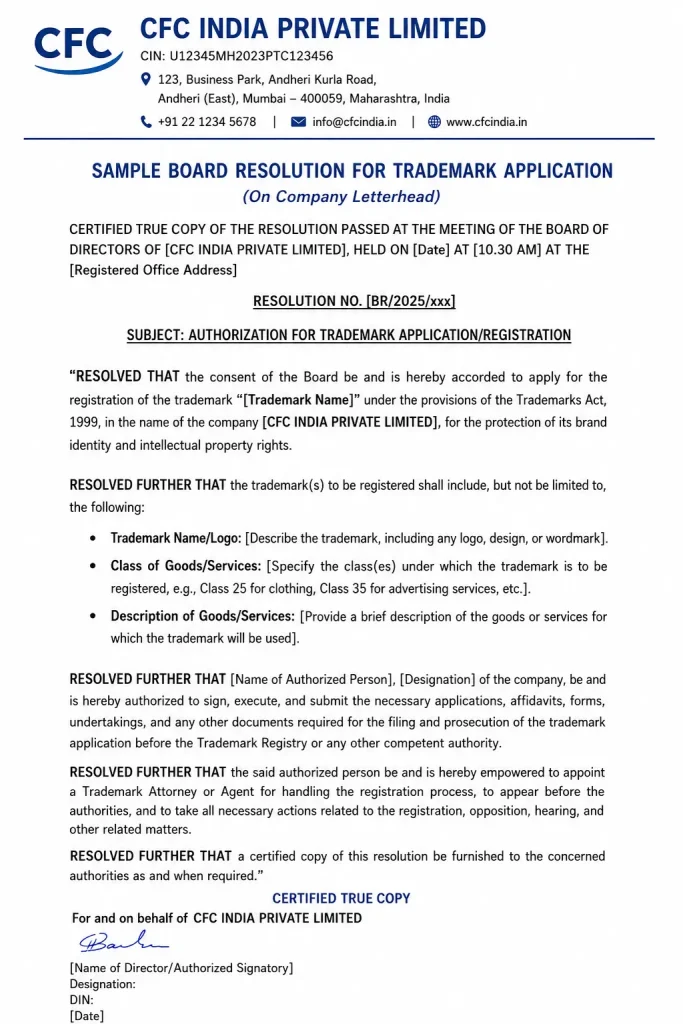
Use the sample below as a reference while drafting your board resolution:
(On Company Letterhead)
CERTIFIED TRUE COPY OF THE RESOLUTION PASSED AT THE MEETING OF THE BOARD OF DIRECTORS OF [CFC INDIA PRIVATE LIMITED], HELD ON [Date] AT [10.30 AM] AT THE [Registered Office Address]
RESOLUTION NO. [BR/2025/xxx]
SUBJECT: AUTHORIZATION FOR TRADEMARK APPLICATION/REGISTRATION
“RESOLVED THAT the consent of the Board be and is hereby accorded to apply for the registration of the trademark “[Trademark Name]” under the provisions of the Trademarks Act, 1999, in the name of the company [CFC INDIA PRIVATE LIMITED], for the protection of its brand identity and intellectual property rights.
FURTHER RESOLVED THAT the trademark(s) to be registered shall include, but not be limited to, the following:
- Trademark Name/Logo: [Describe the trademark, including any logo, design, or wordmark].
- Class of Goods/Services: [Specify the class(es) under which the trademark is to be registered, e.g., Class 25 for clothing, Class 35 for advertising services, etc.].
- Description of Goods/Services: [Provide a brief description of the goods or services for which the trademark will be used].
RESOLVED FURTHER THAT [Name of Authorized Person], [Designation] of the company, be and is hereby authorized to sign, execute, and submit the necessary applications, affidavits, forms, undertakings, and any other documents required for the filing and prosecution of the trademark application before the Trademark Registry or any other competent authority.
FURTHER RESOLVED THAT the said authorized person be and is hereby empowered to appoint a Trademark Attorney or Agent for handling the registration process, to appear before the authorities, and to take all necessary actions related to the registration, opposition, hearing, and other related matters.
RESOLVED FURTHER THAT a certified copy of this resolution be furnished to the concerned authorities as and when required.”
CERTIFIED TRUE COPY
For and on behalf of CFC INDIA PRIVATE LIMITED
[Signature]
[Name of Director/Authorized Signatory]
Designation:
DIN:
[Date]
Note: The resolution must be written in the present tense (“RESOLVED THAT the Board hereby approves…”), not the past tense. Using the past tense is a common drafting error flagged during secretarial audits.
Board Resolution for Assignment of Trademark
When a company transfers ownership of its trademark, follow these steps:
- Pass a board resolution approving the trademark assignment.
- Authorize a director to execute the assignment deed and complete the required formalities.
- File Form TM-P with the Trade Marks Registry under Rule 75 of the Trade Marks Rules, 2017.
- Submit the stamped assignment deed within six months of its execution.
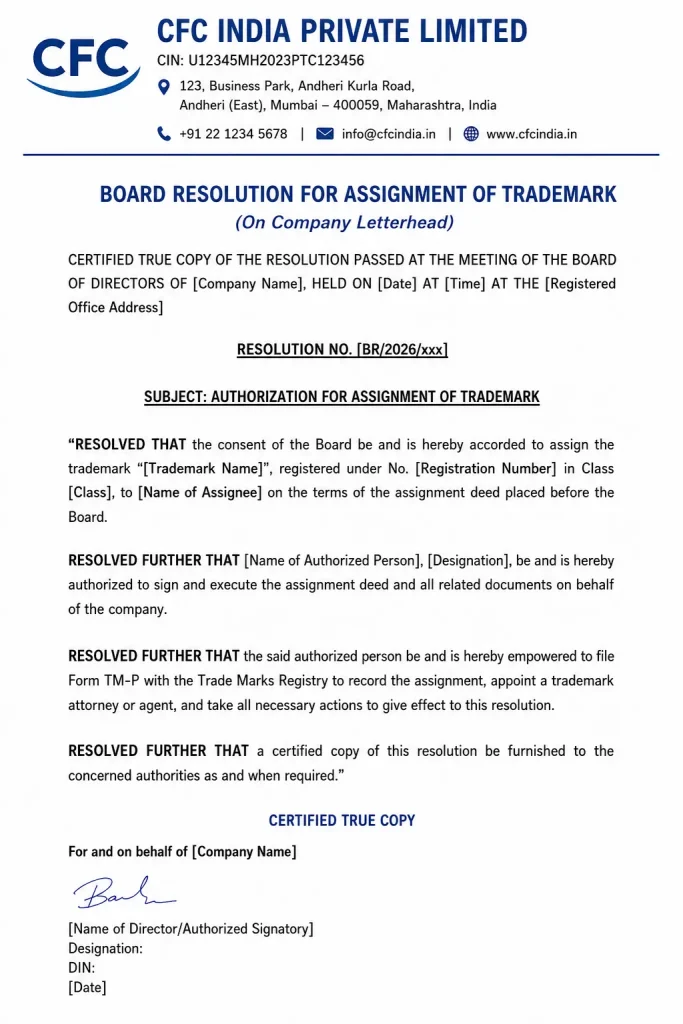
The sample below shows how to incorporate the above requirements into a properly drafted board resolution for trademark assignment.
(On Company Letterhead)
CERTIFIED TRUE COPY OF THE RESOLUTION PASSED AT THE MEETING OF THE BOARD OF DIRECTORS OF [CFC INDIA PRIVATE LIMITED], HELD ON [Date] AT [Time] AT THE [Registered Office Address]
RESOLUTION NO. [BR/2026/xxx]
SUBJECT: AUTHORIZATION FOR ASSIGNMENT OF TRADEMARK
“RESOLVED THAT the consent of the Board be and is hereby accorded to assign the trademark “[Trademark Name]”, registered under No. [Registration Number] in Class [Class], to [Name of Assignee], on the terms set out in the assignment deed placed before the Board.
RESOLVED FURTHER THAT [Name of Authorized Person], [Designation] of the company, be and is hereby authorized to negotiate, finalize, sign, and execute the assignment deed and all related documents on behalf of the company.
FURTHER RESOLVED THAT the said authorized person be and is hereby empowered to file Form TM-P with the Trade Marks Registry to record the assignment, to appoint a trademark attorney or agent, and to do all acts necessary to give effect to this resolution.
RESOLVED FURTHER THAT a certified copy of this resolution be furnished to the concerned authorities as and when required.”
CERTIFIED TRUE COPY
For and on behalf of CFC INDIA PRIVATE LIMITED
[Signature]
[Name of Director/Authorized Signatory]
Designation:
DIN:
[Date]
Note: Execute the assignment deed on stamp paper as per the applicable state stamp duty. File Form TM-P within six months of executing the deed to keep the transfer enforceable.
Common Mistakes to Avoid in a Trademark Board Resolution
An incorrectly drafted board resolution can lead to a deficiency notice and delay your trademark application. Avoid these common mistakes to ensure your application gets accepted the first time:
- Using the past tense: Under Secretarial Standard-1, the operative part must be in the present tense (for example, “RESOLVED THAT the Board hereby approves…”). Past-tense wording is a common audit error.
- Missing the authorized signatory’s DIN: Always mention the authorized director’s name, designation, and DIN. If you miss any of these, it creates confusion about who the authorized person is.
- Keeping the authority vague: Clearly state the powers granted, such as signing documents, appointing an attorney, and responding to objections. Avoid general wording.
- Leaving out the certification: Include the “Certified True Copy” statement and the certifying signature. Without them, the document is not valid for submission.
- Name mismatch with official records: Ensure the company name, signatory name, and designation exactly match the MCA and PAN records. Any mismatch can result in a deficiency notice.
- Not using the company letterhead: Print the resolution on the company’s official letterhead showing the company name and CIN. The authorities may reject a plain document.
- Signed by an unauthorized person: A director or officer authorized under the Articles of Association must sign the resolution and trademark application, and an unauthorized employee must not sign them.
A board resolution is a small but critical step in a company’s trademark filing, and errors in it are a leading cause of delays. RegisterKaro drafts your board resolution and handles the entire trademark registration, from filing to objection replies. Contact us today to register your company’s trademark without the stress!
