

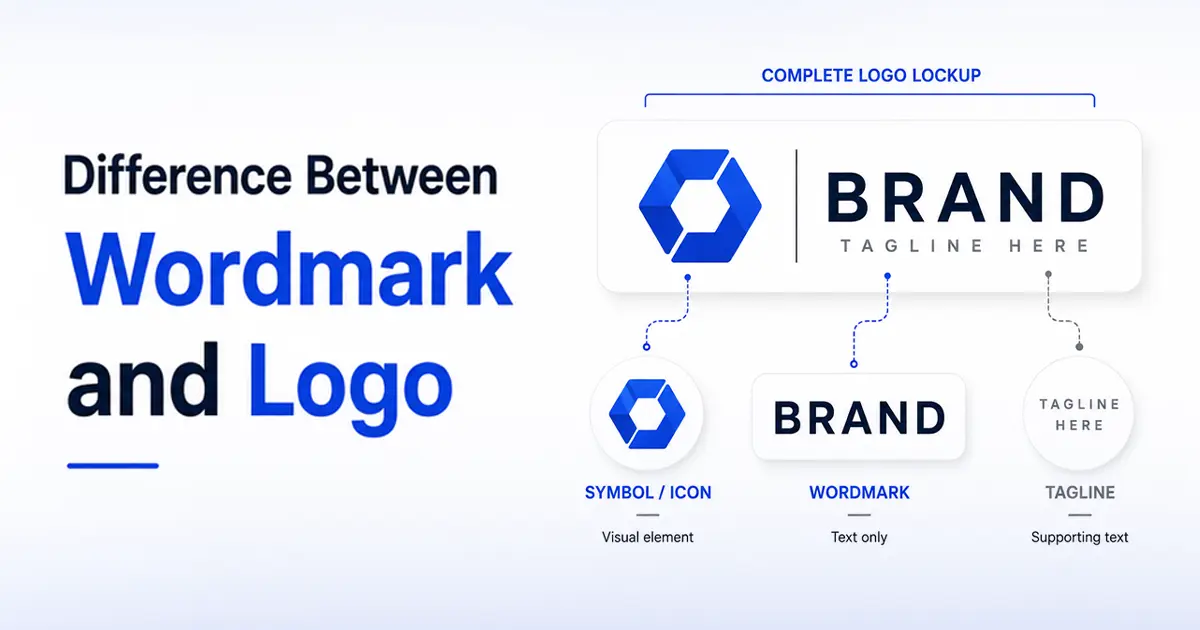
The main difference between a wordmark and a logo is scope: a wordmark is a text-only logo that uses the brand name in a distinctive typeface (no symbol, no icon), while “logo” is a broader umbrella term that includes wordmarks, logomarks (symbol-only), lettermarks (initials), and combination marks (symbol + text). Every wordmark is a logo, but not every logo is a wordmark.
The distinction matters most when registering a trademark in India. Under Section 17 of the Trade Marks Act, 1999, a composite trademark (wordmark + logo together) protects only the combination as a whole, meaning if you later use just the wordmark or just the logo independently, your enforcement rights weaken. Registering the wordmark and logo as two separate trademarks is the safer strategy for most growing brands.
Trademark filings in India are processed through the IP India e-filing portal managed by the Controller General of Patents, Designs and Trade Marks (CGPDTM), with separate per-class fees for each application. This guide covers the design distinction, the strategic trademark choice, real Indian brand examples, industry-fit guidance, and the common filing mistakes that leave brands partially unprotected.
Key Takeaways
- A wordmark is a specific type of logo. It is text-only, using the brand name in a distinctive typeface with no symbol or icon.
- Logos cover four primary types: logomark (symbol only), wordmark (text only), lettermark (initials), and combination mark (symbol + text).
- Section 17 of the Trade Marks Act, 1999 is the critical statutory anchor — a composite trademark protects only the combination as a whole. Register the wordmark and logo as separate trademarks to ensure independent protection for each element.
- Wordmark registration protects the brand name in any font, colour, or style. Logo registration protects only the specific visual design filed.
What is a Logo?
A logo is a visual mark a brand uses to represent itself. It is not limited to a single design format. A logo can take the form of a symbol, an icon, an emblem, stylized text, or a combination of these elements.
Designers and brand strategists classify logos into four primary types:
- Logomark: A symbol or icon that represents the brand without any text. The Tata ‘T’ symbol is a widely recognized Indian example. The Apple symbol and the Nike swoosh are established global examples.
- Wordmark: A text-only logo that uses the full brand name, styled in a distinctive typeface, with no accompanying symbol.
- Lettermark: A text-based logo that uses only the brand’s initials or first letter, rather than the full name. LIC and Tata Consultancy Services (TCS) are Indian examples. IBM and ESPN are global ones.
- Combination mark: A logo that pairs a symbol with the brand name in text form. HDFC Bank, Swiggy, and Amul use combination marks as their primary brand identity. Over 60% of Fortune 500 companies use a combination mark, making it the most widely adopted logo type globally.
People frequently use the term “logo” to refer only to a symbol or icon, which creates confusion with wordmarks. In precise branding terminology, a wordmark is not the opposite of a logo. It is, in fact, a specific type of logo.
What is a Wordmark?
A wordmark, also known as a logotype, is a text-only logo that uses the full brand name styled in a distinctive typeface, with no accompanying symbol, icon, or graphic element. In a wordmark, typography becomes the primary visual identifier; the choice of font, letter spacing, color, and weight collectively communicates the brand’s personality, values, and positioning.
The choice of font, letter spacing, color, and weight collectively communicates the brand’s personality, values, and positioning. 31% of companies use wordmark logos, making them one of the leading choices for brand visibility. Beyond design, wordmark registration under the Trade Marks Act, 1999, gives a brand exclusive rights over its name across all fonts, colors, and styles.
A wordmark is not a separate category from a logo. It is a specific type of logo in which the brand name itself serves as the complete visual identity.
What Makes a Wordmark Effective?
- The brand name is short, distinct, and easy to recall.
- The typeface reflects the brand’s personality. A serif font signals tradition and authority; a sans-serif font signals modernity and clarity.
- The mark remains legible and recognizable at all sizes, from a mobile screen to a billboard.
- The design works in both color and single-color formats.
Indian examples: Infosys, Wipro, Myntra
Global examples: Google, Coca-Cola, Visa, eBay, and FedEx are well-known examples of wordmarks. FedEx is especially famous for the hidden arrow between the “E” and “x,” which symbolizes speed and precision.
A well-designed wordmark turns the brand name into a strong, self-sufficient visual identity that eliminates the need for any accompanying symbol or icon.
Key Difference Between Wordmark and Logo
When businesses compare a wordmark and a logo, they are typically comparing a text-only identity against a symbol-based or combination identity.
The table below sets out the key distinctions for startups, small businesses, and established brands side by side:
| Parameter | Wordmark | Logo (Symbol or Combination Mark) |
| Composition | Brand name only, styled in a distinctive typeface | Symbol or icon, either standalone or paired with text |
| Brand recall method | Builds recognition through the brand name | Builds recognition through a visual symbol or icon |
| Design complexity | Lower. Typography drives the entire design | Higher. Requires concept development for the symbol |
| Scalability | Scales well across all formats and sizes | Symbols scale well. Combination marks need careful adaptation |
| Versatility | Requires full brand name. May not suit small spaces like app icons or favicons | A symbol can be used independently in constrained spaces |
| Cost | Generally, lower design and production costs | Generally higher due to symbol conceptualization and execution |
| Legibility | Always legible. It is the brand name in text form | A symbol may not communicate clearly without prior brand context |
| Best suited for | New brands, service businesses, tech companies, and startups | Established brands, consumer goods, FMCG, retail |
| Trademark protection | Broader. Protects the name in any font, color, or style | Narrower. Protects only the specific visual design registered |
The key difference lies in emphasis and memory. A wordmark builds recognition through the brand name, while a symbol-based logo does so through an image. A combination mark aims to achieve both and is the most widely used format globally.
Wordmark vs Logo: Which is Better for Indian Startups?
For most Indian startups, the choice between a wordmark and a logo is not purely a design decision. It carries practical implications for brand building, budget, and legal protection.
The table below compares how each option performs across the factors that matter most to early-stage businesses:
| Factor | Wordmark | Logo (Symbol or Combination Mark) |
| Name recognition | Builds name recall with every impression, critical for new brands with no existing audience | Builds visual recall. Name recognition develops separately and takes longer |
| Design cost | Lower, typography-driven design requires less conceptualization and iteration | Higher symbol development involves concept creation, illustration, and multiple revisions |
| Indicative design cost (India) | ₹5,000 to ₹30,000 for a professional wordmark | ₹25,000 to ₹1,00,000 or more for a full combination mark |
| Platform scalability | Works consistently across digital and print without modification | Combination marks often require a separate icon version for app icons, favicons, and social media |
| Trademark protection | Broader, protects the brand name in any font, color, or style under the Trade Marks Act, 1999 | Narrower, it protects only the specific registered visual design. Design changes may require fresh registration |
| Rebranding flexibility | High, the wordmark registration protects the name through visual identity changes | Low, significant design changes may require a new trademark application |
| Best for | Service businesses, tech startups, D2C brands, bootstrapped founders | Consumer goods, food and beverage, fashion, product-first brands with visual categories |
The recommended approach for startups is to begin with a wordmark and register it as a trademark immediately. A logomark or combination mark can be developed later, once the brand name has established recall in the market.
How to Choose Between a Wordmark and a Logo?
Choosing between a wordmark and a logo is a strategic decision, not a creative one. The following factors help businesses arrive at the right choice while registering a trademark:
1. Name Length and Distinctiveness
A short, distinctive, and easy-to-pronounce brand name is well-suited to a wordmark. The name carries enough linguistic weight to serve as the complete visual identity. A long or complex name benefits from a symbol or combination mark, which provides a simpler visual anchor.
Example: Zerodha and Myntra built their entire visual identity around the brand name alone. Tata Motors, by contrast, uses a combination mark because the symbol carries recognition across product lines where the full name may not always appear.
2. Industry and Audience
Tech, legal, financial, and service–based brands generally perform well with wordmarks. Consumer goods, food and beverage, retail, and fashion brands benefit from symbol-based or combination marks where visual recall at the point of sale matters more.
Example: Infosys and Wipro have built decades of brand equity through typography alone. Amul and Haldiram’s use distinctive symbols and colors to stand out on crowded retail shelves within seconds.
3. Platform and Format Requirements
A wordmark works consistently across websites, business cards, packaging, and print. If the brand requires a strong app icon or favicon presence, a standalone symbol becomes necessary, which points toward a combination mark.
Example: Swiggy deploys its orange flame icon independently in app and notification contexts while using the full combination mark across marketing and packaging.
The right choice ultimately depends on the specific combination of these three factors.
Which to Register Between Wordmark vs Logo?
Under the Trade Marks Act, 1999, a wordmark and a logo register as distinct trademarks in India, each offering a different scope of legal protection.
1. Wordmark Trademark
A wordmark trademark protects the brand name in text form, regardless of font, color, size, or style. Registering “ZERODHA” as a wordmark gives the brand exclusive rights to that name across all visual presentations. Competitors cannot use the same or a deceptively similar name even if their logo looks entirely different. This makes wordmark registration the broader and more durable form of protection, particularly valuable as brands evolve their visual identity over time.
2. Logo Trademark (Device Mark)
A logo trademark protects the specific visual design of a brand, including its shape, font treatment, color combination, and icon. If the brand subsequently changes its logo significantly, the existing registration may not cover the new design, requiring a fresh application.
3. Composite Trademark (Merging Wordmark and Logo)
A business can register both the wordmark and logo together as a composite trademark. However, under Section 17 of the Trade Marks Act, 1999, this protects only the combination as a whole. If the brand uses only the wordmark or only the logo separately, it may not qualify as proper use of the registered composite mark. This can weaken trademark protection and enforcement rights.
Recommendation: Register the wordmark and logo as separate trademarks to ensure independent protection for each element.
Trademark Filing fees: ₹4,500 per class for startups and individuals; ₹9,000 per class for all other applicants (online filing). Registration typically takes 12 to 18 months. The brand can use the ™ symbol immediately upon filing and the ® symbol only after official registration.
All registered marks must be renewed every 10 years under Section 25 of the Trade Marks Act, 1999.
Section 17 of the Trade Marks Act, 1999: Why Separate Registration Matters
Section 17 governs composite trademarks, marks that combine multiple elements (typically a wordmark + logo + tagline). The provision has two sub-sections that directly affect every Indian brand’s filing strategy:
- Section 17(1): Grants the trademark owner exclusive rights over the registered trademark as a whole.
- Section 17(2): Clarifies that exclusive rights do not automatically extend to descriptive, generic, or non-distinctive parts of the trademark; the Registry may require disclaimers over individual elements.
Worked Example
Suppose a startup called “FinNova” registers a composite trademark featuring
(1) the wordmark “FinNova” in a custom serif typeface,
(2) a circular logomark, and
(3) the tagline “Smart Money for Smart People”; all together as one trademark.
What this composite registration protects:
- The combination of all three elements used together
What this composite registration may NOT protect:
- The wordmark “FinNova” is used alone on a billboard
- The circular logomark is used alone as a social media avatar
- The tagline used alone on the packaging
If a competitor uses just the name “FinNova” with a different logo and tagline, the composite registration may not be sufficient to enforce against that infringement. Separate registrations for each element (one for the wordmark “FinNova,” one for the standalone logo, and optionally one for the tagline) provide independent enforcement rights for each element.
The Indian Practitioner Recommendation:
Most experienced trademark agents recommend a three-mark filing strategy for serious brands:
- Wordmark: The brand name in plain or stylised text
- Logo (Device Mark): The standalone symbol or logomark
- Composite Mark: The full brand lockup as it appears in actual commercial use
Filing all three (with separate per-class fees for each) costs more upfront but gives the brand the maximum enforcement flexibility as it grows.
How Many Trademark Applications Do You Actually Need to File?
The number of applications depends on your filing strategy and how many trademark classes you operate in.
Scenario 1: Single-Element Filing (Minimum Protection)
File one trademark application, typically the wordmark, in your primary trademark class.
- Per class: ₹4,500 (individual/startup/MSME) or ₹9,000 (company/LLP/partnership)
- Pros: Lowest cost, fastest filing
- Cons: Logo and tagline remain unprotected
Scenario 2: Two-Element Filing (Standard Recommended)
File two separate applications: wordmark + standalone logo (device mark) — each in your primary trademark class.
- Per class total: ₹9,000 (individual/startup/MSME) or ₹18,000 (company/LLP/partnership)
- Pros: Independent protection for both name and visual identity
- Cons: Higher cost upfront; tagline still unprotected
Scenario 3: Three-Element Filing (Maximum Protection)
File three separate applications: wordmark + standalone logo + composite mark (the full brand lockup as used commercially).
- Per class total: ₹13,500 (individual/startup/MSME) or ₹27,000 (company/LLP/ partnership)
- Pros: Maximum enforcement flexibility; covers every common usage scenario
- Cons: Highest upfront cost
If You Operate in Multiple Classes
Each class requires a separate per-class fee. For example, an edtech startup that needs Class 41 (education services) and Class 42 (software/tech platform) protection would multiply the above costs by 2.
Best Industries for Wordmarks and Logos in India
Different industries follow established visual conventions that shape how audiences perceive and recall a brand.
The table below sets out which mark type performs best by industry, with Indian examples:
| Industry | Recommended Mark Type | Indian Example |
| Technology and SaaS | Wordmark | Infosys, Wipro, HCL |
| Legal and consulting | Wordmark | Cyril Amarchand Mangaldas, Deloitte India |
| Financial services | Wordmark | Zerodha, Angel One |
| D2C and e-commerce | Wordmark | Myntra, Meesho |
| Fast-moving consumer goods | Logo | Amul, Dabur, Marico |
| Food and beverage | Logo | Haldiram’s, Paper Boat |
| Retail and fashion | Wordmark or Logo | Fabindia (wordmark), Manyavar (logo) |
| Healthcare and pharmaceuticals | Logo | Apollo Hospitals, Sun Pharma |
| Education | Wordmark or Logo | Vedantu (wordmark), BYJU’S (logo) |
| Automotive | Logo | Tata Motors, Mahindra |
| Banking | Logo | HDFC Bank, SBI, ICICI Bank |
| Media and entertainment | Wordmark or Logo | Zee Entertainment, Sony LIV |
Common Mistakes Businesses Make While Designing a Logo or Wordmark
Businesses frequently invest in logo or wordmark design only to discover the mark does not serve the brand effectively in practice. The following are the most common mistakes to avoid:
- Choosing a complex logo before establishing brand recall: A new brand that leads with a symbol asks its audience to learn the name and the symbol simultaneously. A wordmark eliminates this friction. Complexity earns its place only after the name is known.
- Selecting a typeface that does not reflect brand personality: Typography carries meaning for both logos and wordmarks. A playful, rounded font on a legal services firm sends the wrong signal. The typeface must align with the industry, audience, and brand tone.
- Ignoring scalability: A logo or wordmark that looks sharp on a website header may become illegible on a business card or favicon. Test every mark at multiple sizes before finalization.
- Not designing in vector format: A logo or wordmark delivered only as a raster file cannot scale without losing quality. Always obtain the final mark in vector format (AI, EPS, or SVG).
- Copying competitor logo or wordmark styles too closely: A mark that is identical or deceptively similar to an existing registered trademark exposes the business to infringement claims under Section 29 of the Trade Marks Act, 1999, and passing-off action under common law. The Registry may also refuse registration under Section 11(1)(b) if there’s a likelihood of confusion with a prior-filed mark. Always run a comprehensive trademark clearance search (word search + phonetic search + Vienna classification image search) on the IP India portal and the WIPO Global Brand Database before finalising any design.
- Following design trends over timeless principles: Trend-driven logos and wordmarks risk looking outdated within two to three years. Simplicity, scalability, and clarity outlast every design trend.
- Redesigning too frequently: Frequent redesigns reset brand recall for both logos and wordmarks. Visual consistency over time builds stronger recognition than chasing trends.
