

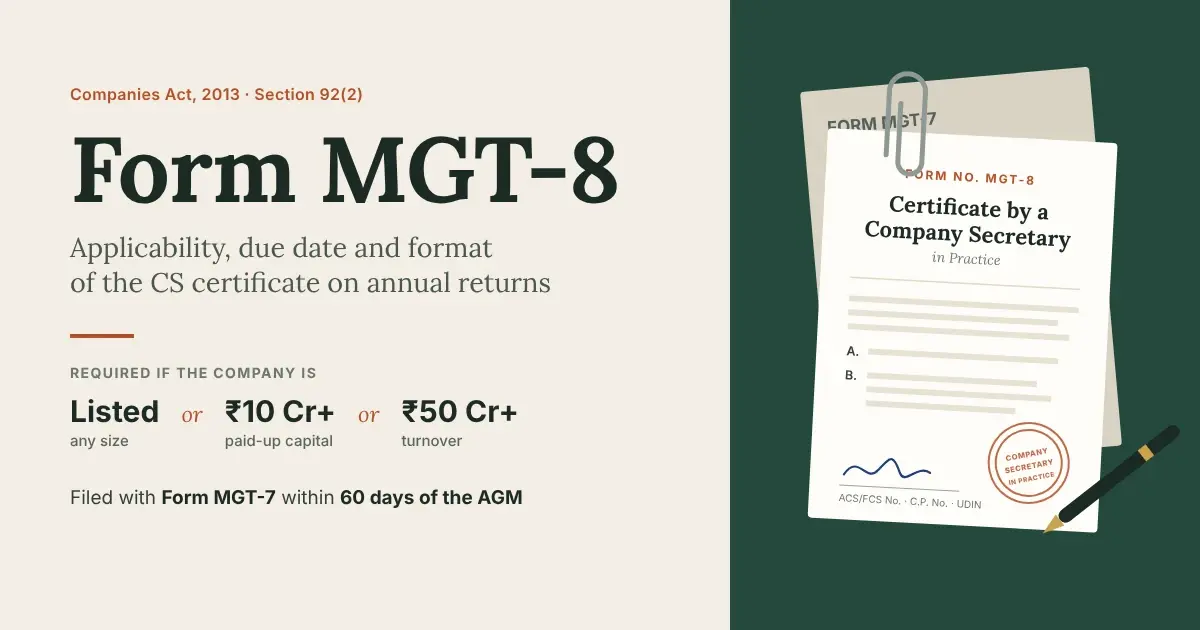
Form MGT-8 is a certificate issued by a Company Secretary (CS) in practice confirming the accuracy of a company’s annual return and its compliance with the Companies Act, 2013. Under Section 92(2), read with Rule 11(2) of the Companies (Management and Administration) Rules, 2014, every listed company must obtain this certificate. The requirement also applies to companies with paid-up share capital of ₹10 crore or more, or annual turnover of ₹50 crore or more.
Eligible companies must attach MGT-8 to Form MGT-7 and file both with the Registrar of Companies (ROC) within 60 days of the Annual General Meeting (AGM). The Company Secretary reviews the company’s records and compliance filings before issuing the certificate. Under Section 92(6), a practicing Company Secretary who certifies a non-compliant annual return is liable to a penalty of ₹2 lakh.
Key Takeaways
- Form MGT-8 is a certificate issued by a Company Secretary in practice to verify a company’s annual return and compliance with the Companies Act, 2013.
- It is mandatory for listed companies and companies with paid-up share capital of ₹10 crore or more, or turnover of ₹50 crore or more, including private companies.
- The requirement applies separately to each financial year, so a company must obtain MGT-8 for any year in which it meets either threshold.
- Only a Company Secretary in practice holding a valid ICSI Certificate of Practice can certify MGT-8. The company’s in-house Company Secretary cannot issue it.
- The company must attach MGT-8 to Form MGT-7 and file both within 60 days of the AGM. No separate filing fee applies to MGT-8.
What is Form MGT-8?
Form MGT-8 is a certificate issued by a Company Secretary in practice confirming the accuracy of a company’s annual return. The annual return, filed in Form MGT-7, reports the company’s shareholding, directors, meetings, share transfers, and other key details for the financial year.
To certify the return, the Company Secretary reviews the company’s statutory registers, meeting minutes, filings, and other records to verify the reported details and assess compliance with the applicable provisions of the Companies Act, 2013. The company then attaches the certificate to its annual return filing on the MCA portal.
Purpose of Form MGT-8
Form MGT-8 helps the Registrar, shareholders, and investors verify a company’s annual return and assess its compliance with legal requirements. The certifying Company Secretary checks the company’s records and filings to:
- Verify that the company maintains its statutory registers and records correctly.
- Check that the company holds and records board and general meetings as required by law.
- Review whether the company handles share transfers, allotments, loans, charges, and related-party transactions in compliance with applicable requirements.
- Confirm that the company files the required forms and returns with the Registrar within the prescribed deadlines.
MGT-8 Applicability: Which Companies Need It?
Under Section 92(2) of the Companies Act, 2013, read with Rule 11(2) of the Companies (Management and Administration) Rules, 2014, a company must obtain an MGT-8 certificate if it meets any one of these criteria:
| MGT-8 Criteria | Limit | MGT-8 Required? |
| Listed company | Any size | Yes |
| Paid-up share capital | ₹10 crore or more | Yes |
| Turnover | ₹50 crore or more | Yes |
| Unlisted company below both limits | Paid-up capital under ₹10 crore and turnover under ₹50 crore | No |
The two thresholds apply independently, so your company must obtain MGT-8 if it meets either one. For instance, even if your unlisted company has paid-up capital of just ₹2 crore, turnover of ₹60 crore triggers the requirement. You must assess these thresholds each financial year, so if your company’s turnover first exceeds ₹50 crore in FY 2026-27, MGT-8 will be required for that year’s annual return.
Note: MGT-8 applicability for Private Limited Companies is the same as for public companies, because Rule 11(2) does not distinguish between them. A private company with paid-up capital of ₹10 crore or more, or turnover of ₹50 crore or more, must attach an MGT-8 certificate to its annual return as part of its yearly private limited company compliance.
Companies Exempt from MGT-8
Unlisted companies that remain below both MGT-8 thresholds do not need certification from a practicing Company Secretary. These include:
- One Person Companies (OPCs), which file their annual return in Form MGT-7A.
- Small companies that stay below both thresholds.
- Private and unlisted public companies with paid-up capital below ₹10 crore and turnover below ₹50 crore.
These companies must still file their annual returns, as the exemption applies only to the separate MGT-8 certificate. However, an OPC or small company that files Form MGT-7A still needs MGT-8 if it crosses either limit.
Who Can Certify Form MGT-8?
Only a Company Secretary (CS) who is a member of the Institute of Company Secretaries of India (ICSI) and holds a valid Certificate of Practice can certify Form MGT-8. The company’s in-house CS cannot issue the certificate because the role requires an independent professional. Before signing, the practicing CS must verify the company’s statutory registers, meeting minutes, and filings rather than rely solely on management’s explanations.
When certifying Form MGT-8, the practicing Company Secretary must:
- Sign the certificate with their Digital Signature Certificate (DSC).
- State their ICSI membership number and certificate of practice number.
- Generate a Unique Document Identification Number (UDIN), which ICSI requires for every certificate its practicing members issue.
What Does Form MGT-8 Include?
Form MGT-8 covers two areas: the accuracy of the company’s annual return as of the financial year-end and its compliance with the Companies Act, 2013 during the year. A practicing Company Secretary certifies both.
The table below lists the compliance areas the Company Secretary reviews before signing the certificate:
| Area | What the CS Verifies |
| Registers and records | Statutory registers were maintained, and entries were made on time. |
| Closure of register of members | The register of members or security holders was closed, where needed, in line with Section 91. |
| Filings | Forms and returns were filed on time. |
| Statutory approvals | Approvals needed from the Central Government, Tribunal, Regional Director, Court or other authorities were obtained. |
| Meetings | Board, committee and general meetings were properly called, held and minuted. |
| Securities | Shares were issued, allotted, transferred, transmitted, or bought back according to the law. |
| Rights kept in abeyance | Rights to dividend, rights shares, and bonus shares were kept in abeyance where a share transfer was pending registration, as Section 126 requires. |
| Dividends | Dividends were declared and paid correctly, and unpaid amounts were transferred to the Investor Education and Protection Fund (IEPF). |
| Financial statement and Board’s report | The audited financial statement was signed as Section 134 requires, and the Board’s report was prepared under Sections 134(3), (4) and (5). |
| Directors and KMP | Directors and Key Managerial Personnel were appointed, reappointed, or retired correctly. |
| Auditors | Auditors were appointed under Section 139. |
| Loans and transactions | Loans to directors (Section 185), related party contracts (Section 188), and loans and investments (Section 186) complied with the Act. |
| Company Status | The company’s status under the Act, such as private, public or listed, is correctly stated. |
| Deposits and borrowings | Deposits were accepted or repaid correctly, and charges were created, modified, or satisfied as required. |
| Constitution | Changes to the Memorandum of Association (MOA) or Articles of Association (AOA) followed the prescribed procedure. |
MGT-8 Draft Format: Key Sections Explained
Practicing Company Secretaries use the exact wording of the MGT-8 format prescribed by the MCA under Rule 11(2). An MGT-8 draft reads as follows:
Form No. MGT-8[Pursuant to Section 92(2) of the Act and Rule 11(2) of the Companies (Management and Administration) Rules, 2014]
Certificate by a Company Secretary in Practice
I/We have examined the registers, records, books and papers of [Company Name] (CIN: [CIN]), as required to be maintained under the Companies Act, 2013 and the rules made thereunder, for the financial year ended 31st March 2027. In my/our opinion and to the best of my/our information and according to the examinations carried out by me/us and explanations furnished to me/us by the company, its officers and agents, I/we certify that:
- The annual return states the facts as at the close of the aforesaid financial year correctly and adequately.
- During the aforesaid financial year, the company has complied with the provisions of the Act and Rules made thereunder in respect of:
- its status under the Act;
- maintenance of registers, records and making entries therein within the time prescribed;
- filing of forms and returns with the Registrar, Regional Director, Central Government, the Tribunal, Court or other authorities within the prescribed time;
- … (continues through the remaining compliance areas listed in the table above)
Place: ____ Date: ____
Signature: ____
Name of Company Secretary in Practice: ____
ACS/FCS No.: ____ C.P. No.: ____ UDIN: ____
Where the company has not complied with a point, the Company Secretary adds a remark under it instead of deleting it. That way, every exception is disclosed in the certificate. To prepare the certificate for your company, download the complete Form MGT-8 format (PDF).
MGT-8 Due Date
The MGT-8 due date follows the Form MGT-7 filing deadline, because the certificate accompanies the annual return. Under Section 92(4) of the Companies Act, 2013, a company must file its annual return within 60 days of its Annual General Meeting (AGM). If the company does not hold an AGM, it must file the return within 60 days of the date on which the AGM should have been held, along with a statement explaining why the AGM was not held.
The practicing CS must issue the certificate before the company files its annual return. For FY 2026-27, the key deadlines are:
| Event | Deadline for FY 2026-27 |
| Last date for the AGM (6 months from the end of the financial year) | September 30, 2027 |
| Last date for MGT-7 with MGT-8, if the AGM is held on September 30, 2027 | November 29, 2027 |
| Last date for MGT-7 with MGT-8, if the AGM is held earlier | 60 days from the actual AGM date |
| First AGM of a company whose first financial year ends on March 31, 2027 | December 31, 2027 (9 months from year-end) |
| Last date for MGT-7 with MGT-8 after that first AGM | February 29, 2028 |
Late filing attracts an additional fee of ₹100 per day. Section 92(5) also imposes a penalty of ₹10,000 plus ₹100 per day of continuing default, up to ₹2 lakh on the company and ₹50,000 on each officer in default.
MGT-8 Checklist: Documents Reviewed Before Certification
Before certifying Form MGT-8, the practicing Company Secretary reviews the company’s records and filings for the full financial year.
- Statutory registers: Register of members, register of directors and KMP, register of charges, register of loans and investments under Section 186, and register of contracts with related parties (MBP-4).
- Meeting records: Notices, agendas, attendance records and minutes of board, committee and general meetings.
- Director records: Disclosures of interest (MBP-1), declarations of non-disqualification (DIR-8), consents to act as director (DIR-2) and DIN details.
- Share capital records: Allotment filings (PAS-3), share transfer deeds (SH-4), share certificates, and any buyback records.
- Financial records: Audited financial statements, the auditor’s report, the Board’s report, and auditor appointment records (Form ADT-1).
- ROC filings: SRNs and challans for forms filed during the year, such as Form MGT-14, AOC-4, DPT-3, and CHG-1.
- Dividend records: Board and shareholder approvals, payment records, and transfers to the Investor Education and Protection Fund (IEPF).
- Constitutional documents: The current MOA and AOA, and records of any changes made during the year.
Tip: If the review reveals gaps, such as missing register entries or delayed filings, address them before certification wherever possible. Any unresolved non-compliance or exception must be disclosed in the certificate.
How to File Form MGT-8 with MGT-7?
Form MGT-8 has no separate filing on the MCA portal. The company attaches it to Form MGT-7 and files both together on the MCA V3 portal:
- Prepare the annual return: After the AGM, compile the details for Form MGT-7 and file it within 60 days.
- Engage a practicing Company Secretary: Share the statutory registers, meeting minutes, and filing records for review. After that, resolve any gaps found during the compliance check.
- Obtain the MGT-8 certificate: The practicing CS prepares the certificate in the prescribed format, signs it with a DSC, and generates its Unique Document Identification Number (UDIN).
- Attach the certificate to MGT-7: Upload the signed MGT-8 certificate as a PDF attachment to Form MGT-7 before the form is submitted.
Notes:
- MGT-8 has no separate government fee. The company pays only the MGT-7 filing fee, which ranges between ₹200 and ₹600, depending on its nominal share capital.
- ICSI limits the number of annual returns a Company Secretary in practice can sign. From FY 2025, the limit is 75 companies a year, or 125 for a peer-reviewed Company Secretary. This cap applies to signing e-Form MGT-7, not to certifying MGT-8.
If the company files MGT-7 late, the MCA charges an additional fee of ₹100 per day of delay, with no upper limit, on top of the regular filing fee. The practicing Company Secretary charges a separate fee for reviewing records and issuing MGT-8, based on the company’s size and compliance complexity.
Penalty for Non-Compliance with MGT-8
A default involving MGT-8 can lead to separate penalties for the certifying Company Secretary, the company and its officers. The table below sets out who is liable for each type of default and the penalty that applies:
| Who | Default | Penalty | Section or Rule |
| Company Secretary in practice | Certifies an annual return that does not comply with the Act or its rules | ₹2 lakh | Section 92(6) |
| Company and its officers | Fail to file MGT-7, with the MGT-8 certificate where required, within 60 days of the AGM | ₹10,000 plus ₹100 per day of continuing default, up to ₹2 lakh for the company and ₹50,000 for each officer in default | Section 92(5) |
| Company | Files the annual return late | Additional fee of ₹100 per day of delay | Companies (Registration Offices and Fees) Rules, 2014 |
A Company Secretary who knowingly certifies false information may also face action under Section 448 for making a false statement and disciplinary proceedings by ICSI. Section 446B reduces certain penalties for eligible One Person Companies, small companies, start-ups, Producer Companies, and their officers in default.
G.S.R. 880(E), effective December 1, 2025, raised the small company turnover limit from ₹40 crore to ₹100 crore and paid-up capital from ₹4 crore to ₹10 crore. Now a small company can trigger MGT-8 in two ways: turnover between ₹50 crore and ₹100 crore, or paid-up capital of exactly ₹10 crore. A company with turnover between ₹50 crore and ₹100 crore files Form MGT-7A with an MGT-8 certificate and can claim reduced penalties for a default. However, this relief does not apply to a practicing Company Secretary, who remains liable for the full ₹2 lakh penalty.
MGT-8 vs Secretarial Audit
A practicing Company Secretary prepares both MGT-8 and the secretarial audit report, but they cover different ground. MGT-8 certifies the annual return, while a secretarial audit reviews compliance with a much wider set of laws. Here’s how they compare:
| Basis | Form MGT-8 | Secretarial Audit (Form MR-3) |
| Governing provisions | Section 92(2) and Rule 11(2) of the Companies (Management and Administration) Rules, 2014 | Section 204 and Rule 9 of the Companies (Appointment and Remuneration of Managerial Personnel) Rules, 2014 |
| Scope | The annual return and compliance with the Companies Act, 2013 | Compliance with the Companies Act and other laws, such as SEBI regulations, FEMA, and industry-specific laws |
| Applies to | Listed companies, and companies with paid-up capital of ₹10 crore or more or turnover of ₹50 crore or more | Listed companies; public companies with paid-up capital of ₹50 crore or more, or turnover of ₹250 crore or more; and companies with bank or financial institution borrowings of ₹100 crore or more |
| Output | A certificate attached to Form MGT-7 | An audit report annexed to the Board’s report |
| Filed with the Registrar | As part of the annual return (MGT-7) | As part of the financial statements (AOC-4) |
A company may need both an MGT-8 certificate and a secretarial audit. For example, a listed company needs MGT-8 for its annual return and a secretarial audit report for its Board’s report, alongside its other annual compliance for public limited companies.
Conclusion
For larger companies, Form MGT-8 turns the annual return from a self-declaration into an independently verified document. Once a company crosses ₹10 crore in paid-up capital or ₹50 crore in turnover, its records come under closer scrutiny every year.
The certification goes faster when registers, minutes, and ROC filings are kept current throughout the year, rather than gathered just before the deadline. RegisterKaro’s Company Secretaries can review a company’s records, issue the MGT-8 certificate, and file it with MGT-7 well before the due date.
