
Blog Banner SVG

Don't Let Paperwork Slow You Down

Register Your Business Online in Just 7 days

Blog Banner
HomeBlogAnnual Compliances for Public Limited Company in India: 2026-27 Guide
CompliancePublic Limited Company

Annual Compliances for Public Limited Company in India: 2026-27 Guide
Srihari Dhondalay
Updated:
19 min read
annual compliances for public limited company in india

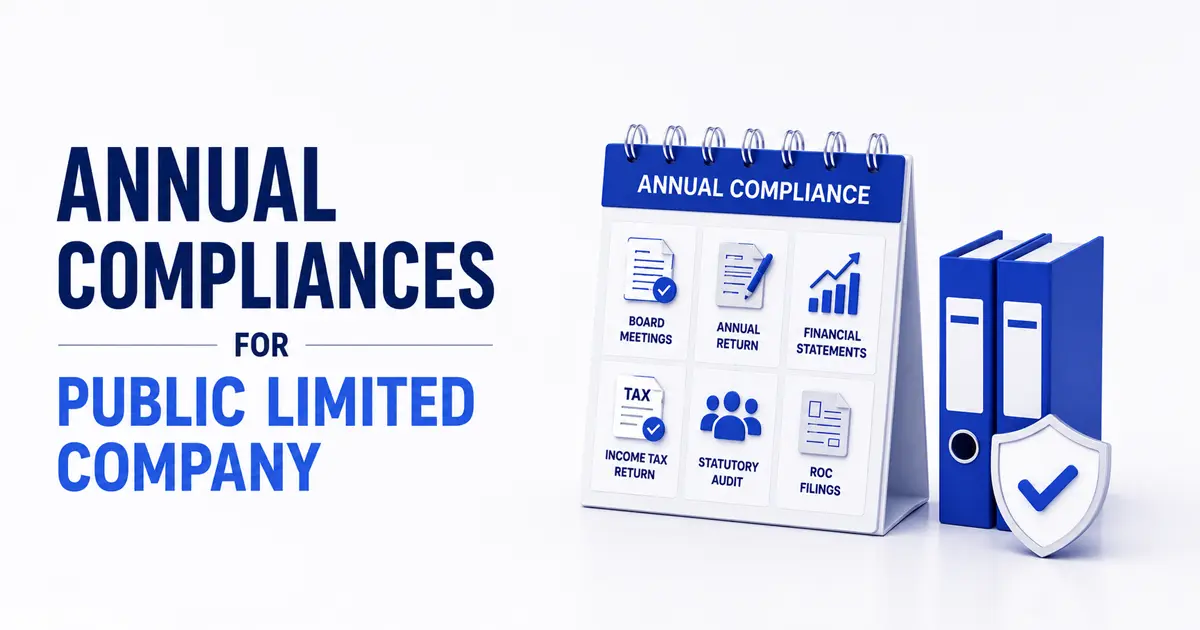
Annual compliances for a public limited company in India include ROC filings (AOC-4, MGT-7, DPT-3, MSME-1, PAS-6, BEN-2, CSR-2), event-based filings (ADT-1, DIR-3 KYC, MBP-1, DIR-8), a mandatory Annual General Meeting within 6 months of FY-end, statutory and secretarial audits, board meetings, income tax return filing, and, for listed companies, SEBI (LODR) Regulations, 2015 disclosures. All filings are governed by the Companies Act, 2013, Companies Rules (various), and SEBI LODR for listed entities.

The compliance framework differs sharply between listed and unlisted public companies. Listed public companies must comply with SEBI LODR (quarterly financials, BRSR, corporate governance reports) in addition to ROC and income tax requirements. Unlisted public companies follow ROC, audit, and tax-related compliance under the Companies Act, 2013, but face the same per-day late fees and director disqualification risk as listed entities.

Missing even a single annual filing can trigger heavy late fees (₹100 per day per form with no cap), director disqualification under Section 164(2), and ultimately strike-off under Section 248. This guide breaks down every compliance for FY 2026-27, with form names, statutory citations, due dates, and the practical sequencing your Company Secretary needs to action.

Key Takeaways

  • Public limited company compliance includes annual ROC filings (AOC-4 within 30 days of AGM, MGT-7 within 60 days), half-yearly filings (PAS-6, MSME-1), event-based filings (ADT-1, DIR-3 KYC, BEN-2, CSR-2), and listed-entity disclosures under SEBI LODR.
  • AGM deadline: Within 6 months of FY-end (30 September for April–March companies); first AGM within 9 months of incorporation.
  • Board meetings: Minimum 4 per year with no gap exceeding 120 days under Section 173(1).
  • Director disqualification under Section 164(2) triggers after 3 consecutive years of AOC-4 / MGT-7 default, barring directorship in any company for 5 years.
  • Late filing fee: ₹100 per day per form with no cap; a missed AOC-4 + MGT-7 can compound to several lakhs in a single year.
  • Secretarial audit (Form MR-3): Mandatory for every listed company and unlisted public companies with ≥₹50 crore paid-up capital, ≥₹250 crore turnover, or ≥₹100 crore loans/borrowings.

What is a Public Limited Company?

A public limited company is a business entity defined under Section 2(71) of the Companies Act, 2013. It can offer shares to the general public and raise capital from a large number of investors through stock exchanges or public offerings. This helps businesses expand operations, increase market presence, and access broader investment opportunities. 

Unlike private companies, public limited companies face stricter legal and disclosure requirements under Indian corporate law. These businesses must follow detailed ROC filings, audit requirements, and governance standards throughout the financial year.

Minimum Requirements to Incorporate a Public Limited Company

Public limited company registration requires the following minimum requirements:

  • At least 7 shareholders
  • At least 3 directors
  • A mandatory statutory audit by a qualified Chartered Accountant
  • No restriction on the transfer of shares

Public companies raise funds directly from investors, which places higher legal duties on them under the Companies Act, 2013. As a result, the annual compliance for a public limited company is more detailed and time-bound than for a private one. Promoters must follow every ROC filing, audit rule, and disclosure norm to keep the business legally active.

Why is Annual Compliance Important for Public Limited Companies?

Annual compliance for a public limited company keeps the business legally active and in good standing with the Registrar of Companies (ROC). It also protects directors from disqualification and saves the entity from being struck off the official register.

Some of the other key reasons behind the mandatory compliance for a public limited company include the following: 

a. Legal Validity and Good Standing: A company that files every return on time maintains its active status on the MCA portal without interruption. This active status is essential for signing contracts, securing bank loans, and continuing daily business operations without legal hurdles.

b. Avoiding Penalties and Director Disqualification: Late filing of annual returns and financial statements attracts additional fees that grow with each day of delay. Continued default may also lead to director disqualification under Section 164 of the Companies Act, 2013. 

c. Improving Investor Confidence: Investors and lenders review the compliance history of a public company before they commit any funds to the business. A clean filing record reflects strong corporate governance and builds long-term trust with shareholders and stakeholders alike. 

d. Essential for Fundraising and Due Diligence: Pending ROC filings or gaps in the compliance checklist for a public limited company often delay fundraising, mergers, and due diligence approvals.  

Types of Compliance Requirements Applicable to Public Limited Companies

The compliance for a public limited company falls into several distinct categories under Indian corporate law:

a. ROC Compliances

ROC compliances include annual filings under the Companies Act, 2013, submitted through the MCA portal. These filings include financial statements in AOC-4, annual returns in MGT-7, and director disclosures through MBP-1 and DIR-8. Other periodic forms, such as DPT-3, MSME-1, and PAS-6, also form part of the standard compliance checklist for public companies.  

b. Income Tax Compliances

Every public limited company whose total turnover or gross receipts exceed ₹1 crore in a financial year must undergo a tax audit under Section 44AB of the Income-tax Act, 1961. The threshold rises to ₹10 crore if at least 95% of all receipts and payments are made through non-cash modes (digital, banking channels), a substantial benefit for digitally-operated public companies. The tax audit report must be filed in Form 3CA-3CD by 30 September of the assessment year, and the income tax return in ITR-6 by 31 October of the assessment year.

c. Secretarial Compliances

Every listed public company must obtain a secretarial audit report in Form MR-3 each financial year. The same applies to unlisted public companies that meet any of the following thresholds:

  • Paid-up share capital of ₹50 crore or more
  • Turnover of ₹250 crore or more
  • Outstanding loans or borrowings of ₹100 crore or more from banks and public financial institutions at any point during the financial year

A practicing Company Secretary issues this report, which forms part of the board’s report.

d. SEBI Compliances for Listed Companies

In addition to all Companies Act, 2013 requirements, every listed public company must comply with the SEBI (Listing Obligations and Disclosure Requirements) Regulations, 2015 (LODR), the SEBI (Prohibition of Insider Trading) Regulations, 2015 (PIT), and the SEBI (Substantial Acquisition of Shares and Takeovers) Regulations, 2011 (SAST), among others.

RegulationFiling / ComplianceFrequency / Trigger
LODR Regulation 33Quarterly financial resultsWithin 45 days of quarter-end, 60 days for annual results
LODR Regulation 31Shareholding pattern disclosureWithin 21 days of quarter-end
LODR Regulation 27Corporate governance reportWithin 21 days of quarter-end
LODR Regulation 24AAnnual Secretarial Compliance ReportWithin 60 days from the FY-end
LODR Regulation 34Annual Report and BRSRSent to shareholders before AGM; BRSR mandatory for top 1,000 listed entities by market cap
LODR Regulation 30Material event disclosureWithin 24 hours (most cases)
PIT Regulation 7Trading plan and insider disclosuresOn occurrence + annual
SAST Regulation 30Annual disclosure of shareholdingWithin 7 working days of FY-end

Listed companies must also comply with the SEBI SCORES complaint redressal mechanism, file periodic returns to NSE/BSE, and disclose related party transactions under LODR Regulation 23.

e. Labor Law and GST Compliances

Public companies must also comply with the Provident Fund Act, ESIC rules, and the Goods and Services Tax (GST) framework. The exact scope depends on the nature, size, and workforce strength of the business operations.

Compliance for Unlisted Public Companies: How It Differs From Listed Companies

An unlisted public limited company is a public company whose shares are not listed on any recognised stock exchange. It still has the legal characteristics of a public company (minimum 7 shareholders, 3 directors, freely transferable shares) but does not face SEBI’s continuous disclosure regime.

The compliance framework for unlisted public companies is substantially lighter than that of listed companies but heavier than that of private companies. Here’s how it breaks down:

Compliance AreaListed Public CompanyUnlisted Public Company
Companies Act ROC filings (AOC-4, MGT-7, DPT-3, MSME-1, PAS-6, BEN-2, CSR-2)RequiredRequired
Statutory audit (Chartered Accountant)RequiredRequired
Secretarial audit (Form MR-3)Required for every listed companyRequired only if paid-up capital ≥₹50 cr OR turnover ≥₹250 cr OR loans/borrowings ≥₹100 cr
SEBI LODR quarterly financial resultsRequiredNot applicable
Corporate governance report (Regulation 27)RequiredNot applicable
Business Responsibility & Sustainability Report (BRSR)Required for the top 1,000 listed entities by market capNot applicable
Insider trading compliance (SEBI PIT 2015)RequiredNot applicable
Audit Committee (Section 177)Required for every listedRequired if paid-up ≥₹10 cr / turnover ≥₹100 cr / borrowings ≥₹50 cr
Annual board meetingsMinimum 4Minimum 4
AGMRequired within 6 months of FY-endRequired within 6 months of FY-end

Unlisted public companies still must file every ROC return, hold the same board meeting frequency, and conduct the same statutory audit as listed entities, but escape the heavy SEBI continuous-disclosure layer.

Complete Annual Compliance Checklist for Public Limited Company

The compliance checklist for a public limited company below includes major ROC filings, audit requirements, and statutory compliances applicable during the financial year. Each item carries its own due date, prescribed form, and section reference under Indian corporate law.  

1. Disclosure of Interest by Directors (MBP-1)

Every director must disclose their interest in other companies, firms, or bodies corporate during the first board meeting of each financial year. The company records this disclosure in Form MBP-1 under Section 184 of the Companies Act, 2013.

2. Intimation of Non-Disqualification (DIR-8)

Every director must submit a written declaration confirming that they are not disqualified from holding the position of director. The company collects this declaration in Form DIR-8 at the start of every financial year or before reappointment.

3. Return of Deposits (DPT-3)

Every public company that has accepted deposits or carries outstanding loans must file Form DPT-3 with the ROC by 30 June. This filing may still apply even when the entity accepts no fresh deposits.

4. MSME-1 Return

Public companies must file Form MSME-1 when they fail to clear payments to Micro, Small, and Medium Enterprises within 45 days. This half-yearly return falls due on 31 October for the April-September period and 30 April for the October-March period.

5. Reconciliation of Share Capital Audit (PAS-6)

Every unlisted public company must reconcile its share capital with NSDL and CDSL records on a half-yearly basis. The entity must then file Form PAS-6 to confirm that shares held in demat form match the depository records.

5A. Reporting on CSR (Form CSR-2)

Every company covered under Section 135 of the Companies Act, 2013, with a net worth of ≥₹500 crore, a turnover of ≥ ₹1,000 crore, or a net profit of ≥ ₹5 crore in the preceding FY, must file Form CSR-2 with the ROC reporting on CSR activities undertaken during the financial year. CSR-2 is filed as an addendum to AOC-4, with the same due date (within 30 days of the AGM).

5B. Significant Beneficial Ownership Disclosure (Form BEN-2)

Every public limited company must file Form BEN-2 with the ROC under Section 90 of the Companies Act, 2013, read with Rule 4 of the Companies (Significant Beneficial Owners) Rules, 2018, whenever:

  • It receives a declaration in Form BEN-1 from a Significant Beneficial Owner (SBO), or
  • Any change occurs in the SBO’s particulars.

BEN-2 must be filed within 30 days of receipt of the declaration. Non-filing attracts a penalty under Section 90(11) and Section 90(10).

6. DIR-3 KYC for Directors

All directors holding a Director Identification Number must complete their annual KYC by 30 September each year. Form DIR-3 KYC requires the director to verify personal details and contact information on the MCA portal.

7. Board’s Report Preparation (Section 134(3))

The Board of Directors must prepare an annual Board Report under Section 134(3) of the Companies Act, 2013, which must include, at a minimum:

  • Extract of the annual return (referenced from MGT-7)
  • Number of board meetings held during the year
  • Directors’ Responsibility Statement under Section 134(3)(c) and 134(5)
  • Declaration on Independence by Independent Directors (for listed and applicable unlisted companies)
  • Company’s policy on directors’ appointment and remuneration (Section 178)
  • Explanation of every reservation, qualification, or adverse remark made by the auditor or company secretary in their respective reports
  • Particulars of loans, guarantees, and investments under Section 186
  • Particulars of contracts with related parties under Section 188 (Form AOC-2)
  • CSR policy and CSR activities (for Section 135 companies; cross-referenced with CSR-2)
  • Conservation of energy, technology absorption, foreign exchange earnings & outgo
  • Risk management policy
  • Adequacy of internal financial controls

The Board’s Report accompanies the financial statements filed with AOC-4 and is presented to shareholders at the AGM.

8. Statutory Audit and Auditor’s Report

Every public limited company must get its financial statements audited by a qualified Chartered Accountant during the year. The auditor must then issue a formal Auditor’s Report, which forms part of the documents filed with the ROC.

9. Secretarial Audit Report (MR-3)

The following public companies must obtain a secretarial audit report in Form MR-3:

  • Paid-up share capital of ₹50 crore or more
  • Annual turnover of ₹250 crore or more
  • Outstanding loans or borrowings of ₹100 crore or more from banks or public financial institutions

A Practicing Company Secretary issues this report, and the requirement also applies to every listed public company. The MR-3 report must form part of the Board’s Report.  

10. Annual General Meeting (AGM)

Every public limited company must hold its AGM within 6 months of the close of the financial year. Companies following the April-March financial year must conclude the AGM by 30 September each year. The AGM agenda generally covers financial statement adoption, dividend declaration, and the appointment of directors and auditors. Companies may also conduct AGMs through video conferencing when the MCA permits such meetings through official notifications.

11. Filing Financial Statements (AOC-4)

The company must file Form AOC-4 with the ROC within 30 days from the date of the AGM. This form carries the balance sheet, profit and loss account, cash flow statement, auditor’s report, and Board’s Report.

12. Filing Annual Return (MGT-7)

The company must file its annual return in Form MGT-7 within 60 days from the date of the AGM. This return shares full details about shareholders, directors, charges, and key managerial personnel. 

13. Appointment of Auditor (ADT-1)

Every public limited company must file Form ADT-1 with the ROC after appointing a statutory auditor at the AGM. The company must submit this form within 15 days of the auditor’s appointment under Section 139 of the Companies Act, 2013. 

14. Income Tax Return Filing

Public companies must file their income tax return by 31 October of the relevant assessment year when their accounts fall under mandatory tax audit provisions. Due dates may also change through CBDT notifications issued during the financial year.

The current tax audit requirement arises under Section 44AB of the Income-tax Act, 1961, while the proposed new Income Tax Bill retains similar provisions under Section 63.   

Compliance Calendar for Public Limited Company (FY 2026-27)

The compliance calendar for a public limited company below highlights the major annual filing deadlines and statutory requirements applicable during FY 2026-27:

MonthCompliance ActivityForm / ActionDue Date
AprilDisclosure of interest by directorsMBP-1First Board Meeting of FY
AprilDirector non-disqualification declarationDIR-8First Board Meeting of FY
AprilOutstanding MSME dues (Oct 2025 – Mar 2026)MSME-130 April 2026
MayShare capital reconciliation (Oct 2025 – Mar 2026)PAS-630 May 2026
JuneReturn of deposits and outstanding loansDPT-330 June 2026
June – AugustSecretarial audit and Board’s Report preparationMR-3 / Board ReportBefore AGM
SeptemberAnnual General MeetingAGM30 September 2026
SeptemberDirector KYC verificationDIR-3 KYC30 September 2026
OctoberFiling of financial statementsAOC-4Within 30 days of AGM
OctoberOutstanding MSME dues (Apr 2026 – Sep 2026)MSME-131 October 2026
OctoberIncome tax return filing for audited companiesITR-631 October 2026*
NovemberFiling of annual returnMGT-7Within 60 days of AGM
NovemberShare capital reconciliation (Apr 2026 – Sep 2026)PAS-629 November 2026

Note: CBDT may revise income tax return due dates through official notifications during the financial year.

Board Meeting Requirements for Public Limited Companies

The Companies Act, 2013, sets clear rules for board meetings of public limited companies. Key requirements include the following:  

Minimum Four Board Meetings Per Year

Every public limited company must hold at least four board meetings in a calendar year. The gap between two consecutive meetings must not exceed 120 days. The company must send proper notice and maintain minutes for every board meeting.

Mandatory Committees

The Companies Act, 2013, requires certain public companies to constitute specific board committees based on their financial position and shareholder base:

  • Audit Committee: Section 177 makes this committee mandatory for listed public companies and certain eligible unlisted public companies. This requirement applies to companies with ₹10 crore paid-up capital, ₹100 crore turnover, or ₹50 crore outstanding borrowings, deposits, or debentures.
  • Nomination and Remuneration Committee: Section 178 applies the same threshold limits prescribed for the Audit Committee under the Companies Act, 2013.
  • Stakeholder Relationship Committee: Every public company with more than 1,000 shareholders, debenture holders, deposit holders, or other security holders must constitute this committee.

Listed companies must also form additional committees under the SEBI (LODR) Regulations, 2015, including the Risk Management Committee. Public companies covered under Section 135 must also constitute a CSR Committee when they meet any of the following limits:

  • Net worth ≥ ₹500 crore, OR
  • Turnover ≥ ₹1,000 crore, OR
  • Net profit ≥ ₹5 crore

Exemption: Under Section 135(9) (inserted by the Companies (Amendment) Act, 2020), companies whose CSR obligation does not exceed ₹50 lakh in a financial year are not required to constitute a CSR Committee — the functions of the Committee can be discharged directly by the Board. However, the company must still spend the CSR amount and file Form CSR-2.

Corporate Laws (Amendment) Bill, 2026: Upcoming Changes

The Corporate Laws (Amendment) Bill, 2026, proposes several important changes to the Companies Act, 2013, and LLP Act, 2008. The Government introduced this Bill in the Lok Sabha on 23 March 2026 and referred it to a Joint Parliamentary Committee for further review.

The proposed amendments mainly focus on reducing procedural burdens while strengthening corporate governance and regulatory oversight. Key proposed changes include the following:

  • Permission for certain companies to conduct more flexible buyback transactions during the financial year.
  • Expansion of the small company threshold under the Companies Act, 2013.
  • Recognition of virtual and hybrid AGMs under prescribed conditions.
  • Stronger regulatory powers for the National Financial Reporting Authority (NFRA).
  • Faster merger approvals for eligible companies through simplified procedures.

These amendments have not yet become law and may change after parliamentary review and final approval. Public companies should therefore monitor official MCA notifications before implementing any compliance-related changes.

Penalties for Non-Compliance and How to Avoid Them

Non-compliance with the mandatory compliance for a public limited company attracts heavy financial and legal consequences under the Companies Act, 2013. The table below explains each major penalty along with the practical steps to avoid it:

Type of PenaltyWhat It MeansSolution
Late Filing PenaltiesThe ROC charges additional filing fees for delayed submissions, and the penalty amount increases with each day of default.Maintain a clear compliance calendar and assign responsible personnel to monitor every statutory filing deadline.
Director Disqualification (Section 164)The Registrar disqualifies directors for non-filing of annual returns or financial statements for three consecutive years. A disqualified director cannot hold office in any company for five years.File AOC-4 and MGT-7 on time and complete DIR-3 KYC by 30 September each year.
Company Strike-Off (Section 248)The ROC may strike off a company that has not been carrying on any business or operation for two immediately preceding financial years and has not applied for dormant company status under Section 455. ROC issues notice in Form STK-1 before strike-off. Struck-off entity loses legal existence and its bank accounts/PAN become unusable. | File AOC-4, MGT-7, ITR, and reply to STK-1 notice within the prescribed time. If struck off, the company can be restored via an NCLT application under Section 252 within 3 years.Submit every ROC filing on time and reply to ROC notices without delay.
Prosecution and Monetary PenaltiesSections 92 and 137 prescribe fixed penalties for non-filing of annual returns and financial statements.Engage qualified company secretaries and auditors to review every filing before the due date.

If you want to manage annual compliances for your public limited company without missing critical filing deadlines, RegisterKaro can help. Our experts handle ROC filings, board compliances, audit coordination, and annual return filings with complete professional support.

Contact us today for end-to-end compliance assistance tailored to your business requirements!