A change of director in an OPC takes place due to resignation, death, disqualification, incapacity, or the appointment of a new director to manage the company. In such cases, the OPC must pass the required resolution and obtain the new director’s consent. Thereafter, Form DIR-12 must be filed with the ROC within 30 days of the appointment or cessation.
The MCA now cross-checks director details and filing records instantly. Even small errors can result in filing rejections and additional fees of up to 12 times the normal amount.
This guide covers the complete process of changing an OPC’s director, including eligibility requirements, documentation, resolutions, and MCA filings. It also explains the post-change compliance obligations to help ensure the transition is completed accurately and within the prescribed timelines.
Key Takeaways
- An OPC must have a director at all times. Therefore, the incoming director should be appointed before the outgoing director’s resignation takes effect.
- Form DIR-12 must be filed within 30 days. Delays beyond 90 days attract up to 12 times the standard government fees.
- The incoming director must hold a valid DSC (Class 3) and DIN and must submit Form DIR-2 and Form DIR-8 before the resolution is passed.
- A director change and a nominee change are two separate legal processes filed through different MCA forms.
- When the sole member-director dies, the nominee assumes membership first and must separately complete the director appointment procedure.
When and Why a Director Change Happens in an OPC?
A change in the director of an OPC does not occur arbitrarily. It is typically triggered by a specific legal or operational event, each of which requires compliance with prescribed procedures. The most common reasons include:
- Resignation: The existing director voluntarily steps down by submitting a written notice to the company. The company must then file Form DIR-12 with the ROC within 30 days of receiving the resignation.
- Removal: The sole member removes a director before the expiry of their term under Section 169 of the Companies Act, 2013. This requires a special notice and an ordinary resolution passed by the sole member.
- Death or Incapacity: The death or incapacity of the sole member-director results in the nominee stepping into the position of member as per the OPC’s nomination arrangement. The nominee must then complete the necessary legal formalities to assume control of the company.
- Disqualification: If a director becomes disqualified under Section 164 of the Companies Act, 2013, they vacate office immediately. The company must appoint a replacement and file Form DIR-12 without delay.
The reason for the director change determines the applicable procedure, supporting documents, and MCA forms that the company must file. It is also important to note that a director change and a nominee change are two entirely separate processes. A nominee change is filed through Form INC-4, while a director change is always filed through Form DIR-12.
Eligibility Criteria for Appointment of Director in OPC
The Companies Act, 2013, prescribes eligibility conditions for appointing directors in an OPC, including age, DIN, and compliance requirements.
The following table outlines who qualifies and who is disqualified from holding the position:
| Who Can Be Appointed | Who Cannot Be Appointed |
| A natural person (individual only), an Indian citizen, an NRI, and a foreign national are all eligible | A company, LLP, or any other legal entity |
| A person who is at least 18 years of age | A person declared of unsound mind by a competent court |
| A person holding a valid Director Identification Number (DIN) issued by the MCA | An undischarged insolvent or a person with a pending insolvency application |
| A person possessing a valid Class 3 Digital Signature Certificate (DSC) | A person convicted and sentenced to imprisonment of six months or more |
| A person who is not disqualified under Section 164 of the Companies Act, 2013 | A person who is or has been a director of a company that has not filed financial statements or annual returns for three consecutive financial years |
Note: The Companies Act, 2013, does not prescribe any citizenship requirement, so an OPC can appoint NRIs and foreign nationals as directors. The 182-day residency requirement under Section 149(3) applies at the company level, meaning at least one director must satisfy this condition. However, the Indian citizenship and 120-day residency requirements apply only to the OPC’s members and nominees, not to its directors.
Documents Required for Change of Director in OPC
The company divides the required documents into three categories based on the party responsible for submitting them:
1. From the Incoming Director
The incoming director must submit the following documents before the appointment resolution is passed:
- A PAN Card & Aadhaar Card
- Address Proof, a utility bill, or a bank statement not older than two months.
- Passport-size photograph
- A Class 3 Digital Signature Certificate (DSC) is required to sign and submit all electronic forms on the MCA portal.
- Form DIR-2, the written consent of the individual to act as director of the specific company.
- Form DIR-8, a declaration confirming that the individual is not disqualified under Section 164 of the Companies Act, 2013.
Note: If the incoming director is a foreign national, the director submits a passport as identity proof and ensures that all documents comply with MCA requirements through apostille or notarization.
2. From the Outgoing Director
The outgoing director must submit the following documents upon resignation or removal:
- Written Resignation Letter, a formal intimation addressed to the company stating the effective date of resignation.
- Form DIR-11 is an optional filing by the outgoing director to independently notify the MCA of their resignation and limit future liability.
3. Company-Level Records
In addition to individual documents, the company must maintain the following records before filing with the ROC:
- Board Resolution or Circular Resolution, approving the appointment of the incoming director and formally noting the resignation or removal of the outgoing director.
- Certificate of Incorporation, confirming the legal existence of the OPC.
- PAN Card of the Company is required for MCA portal verification.
- Memorandum of Association (MOA) and Articles of Association (AOA).
It is always a good practice to keep copies of all submitted documents safely with you, as the ROC may ask for supporting records during future compliance checks or audits.
How to Change a Director in OPC: Step-by-Step Process
The company must appoint the new director before the outgoing director resigns; an OPC must not remain without a director for any point in time under the Companies Act, 2013.
The complete process is as follows:
Step 1: Obtain a DSC for the Incoming Director
The incoming director must obtain a valid Class 3 Digital Signature Certificate before any MCA filing can proceed. This typically takes 1 to 2 working days.
Step 2: Apply for a Director Identification Number
If the incoming director does not already hold a DIN, the director applies for it through Form DIR-3 on the MCA portal. If the director already holds a DIN but has not completed DIR-3 KYC, the MCA marks the DIN as inactive. The director then reactivates the DIN by filing DIR-3 KYC and paying the applicable late fee before any appointment or filing proceeds.
The application must be supported with a PAN card, address proof, and a photograph.
Step 3: Collect Form DIR-2 and Form DIR-8
The incoming director must sign Form DIR-2 (consent to act as director) and Form DIR-8 (declaration of non-disqualification under Section 164). Both forms are to be signed before the resolution is passed.
Step 4: Pass a Resolution
In a single-director OPC, a formal board meeting is not required. Instead, under Section 122(4), the sole director passes a written circular resolution, enters it in the minute book, signs and dates it. Where an OPC has more than one director, the company approves the resolution in a properly convened board meeting after giving at least seven days’ notice to all directors.
Step 5: File Form DIR-12 with the ROC
The company files Form DIR-12 within 30 days of a director’s appointment or resignation, along with DIR-2, DIR-8, a certified copy of the resolution, and the resignation letter, where applicable. Unlike private limited companies, OPC filings do not require certification from a Company Secretary or Chartered Accountant.
Delays beyond the 30-day deadline attract additional fees:
| Delay Period | Applicable Fee Multiplier |
| Up to 30 days | 2× normal fees |
| 31 to 60 days | 4× normal fees |
| 61 to 90 days | 6× normal fees |
| 91 to 180 days | 10× normal fees |
| Beyond 180 days | 12× normal fees |
Step 6: Outgoing Director Files Form DIR-11 (Optional)
The outgoing director may independently file Form DIR-11 to notify the MCA of their resignation. Although an optional step, still recommended as it limits personal liability for company defaults arising after the resignation date.
Step 7: Update Statutory Registers
The company must update the Register of Directors under Section 170 and the Minutes Book to reflect the change. If the outgoing director is also the sole member, the company records the change in membership through the required filings.
The company usually completes this through Form MGT-7A (Annual Return, where applicable) and by updating the register of members under Section 88 of the Companies Act, 2013. This keeps both director and ownership records aligned with MCA filings.
The entire process typically takes between 5 and 15 working days, provided all documents are in order at the time of filing.
Cost of Changing Director in OPC: Government Fees, DSC, DIN & Professional Charges
The total cost of changing a director in an OPC ranges from ₹3,000 to ₹10,000+, depending on share capital and professional assistance.
The breakdown of costs is as follows:
| Component | Cost | Details |
| Government filing fees (DIR-12 & DIR-11) | ₹200–₹400 | MCA fee based on authorised share capital (₹200 up to ₹1 lakh, ₹300 for ₹1–₹4.99 lakh, ₹400 for ₹5–₹24.99 lakh) |
| Digital Signature Certificate (DSC) | ₹1,000–₹2,000 | Required for the incoming director to file forms on the MCA portal |
| Director Identification Number (DIN) | ₹0–₹500 | Free if already allotted; ₹500 if a new DIN is applied |
| Professional fees (optional) | ₹2,000–₹5,000 | Charges for CA/CS or consultant handling drafting and filing |
Overall, the final cost varies based on company structure, filing method, and professional support used.
Board Resolution Format for Appointment of Director in OPC
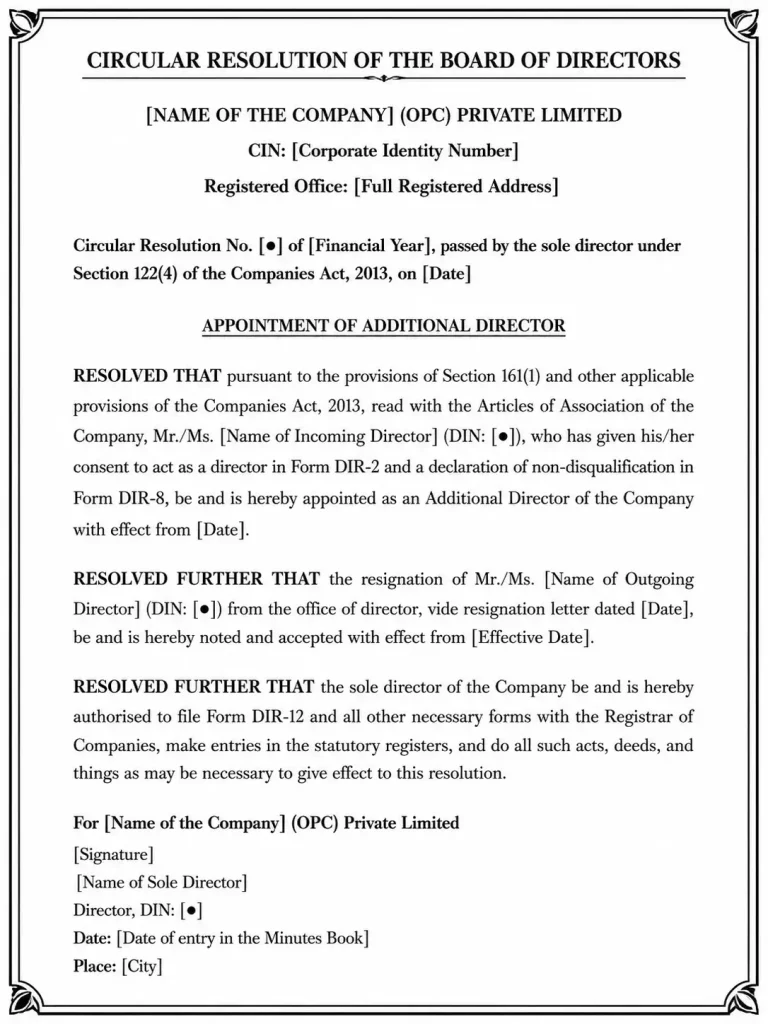
A board resolution is a mandatory internal document that must be prepared before filing Form DIR-12 with the ROC. In a single-director OPC, this takes the form of a written circular resolution under Section 122(4) of the Companies Act, 2013.
The following image is a standard format that OPCs can use:

If the change involves only an appointment with no resignation, the company deletes the second “RESOLVED FURTHER THAT” paragraph.
Note: Since OPCs are exempt from holding AGMs, the company regularizes the Additional Director’s appointment through a members’ resolution to confirm the appointment permanently. The company enters the resolution in the Minutes Book on the date of signing, and the MCA treats this date as the date of the board meeting for all filing purposes.
How to Remove a Director in an OPC (Section 169)?
Section 169 of the Companies Act, 2013, governs the removal of a director before the expiry of their term. In an OPC, the process is simpler than in other companies. This is because Section 122 exempts OPCs from formal general meeting requirements. However, the company complies with the special notice requirement and ensures that the director has the right to be heard.
The procedure is as follows:
- The sole member issues a special notice under Section 115 proposing the removal of the director.
- The company sends the notice to the concerned director, who may submit a written representation. The sole member must review it before proceeding.
- The sole member passes an ordinary resolution by recording it in the minutes book, which serves as the effective approval date.
- The company appoints a replacement director if required to ensure continuous compliance.
- The company files Form DIR-12 within 30 days along with the notice, resolution, and any representation received.
The company fills the vacancy at the time of removal or later as a casual vacancy, but the company does not reappoint the removed director to fill it.
Director Change in OPC Due to Death or Incapacity of Sole Member
The death or incapacity of the sole member-director activates the nominee appointed at incorporation and requires immediate legal action to ensure business continuity.
The complete procedure is as follows:
- The nominee appointed through Form INC-3 automatically becomes a member of the OPC upon the death or incapacity of the sole member. The company files Form INC-4 within 30 days along with death or incapacity proof, nominee consent, and identity and address documents.
- The new member must appoint another nominee within 15 days as per Rule 4(6). The company submits the new nominee’s consent in Form INC-3 through Form INC-4.
- After becoming a member, the nominee appoints a director by obtaining a DSC and DIN and submitting Form DIR-2 and DIR-8. The company passes a resolution and files Form DIR-12 within 30 days.
- The company updates the Register of Members and Register of Directors after completing INC-4 and DIR-12 filings.
The company pays an additional fee of ₹100 per day for the delayed filing of Form INC-4 until it completes compliance, subject to MCA limits.
Key Compliance Steps After a Change of Directors in OPC
Filing Form DIR-12 does not conclude the director change process. The company fulfils several post-change obligations to ensure all regulatory records accurately reflect the new directorship. The key updates required are as follows:
1. GST Registration: The new director submits their PAN, Aadhaar, and photograph through an amendment application on the GST portal.
2. Bank Account Signatories: The company’s bank must be formally notified of the change. The new director submits their signature, identity proof, and a certified copy of the board resolution to revise the authorized signatory records.
3. Income Tax Records: The company links the new director’s PAN with the company’s PAN on the Income Tax portal to ensure proper compliance.
4. Business Licences and Registrations: Any trade licences, Udyam registration, or Import Export Code carrying the outgoing director’s details must be revised with the relevant authorities.
5. DIR-3 KYC: The new director must complete DIR-3 KYC on the MCA portal by 30th September of the relevant financial year. Non-filing results in DIN deactivation, which blocks all future MCA filings for the company.
Planning a director change after your OPC registration? RegisterKaro’s compliance experts handle director change filings, board resolutions, and DIR-12 submissions accurately and on time. Contact us today to ensure your OPC director change is completed correctly and within the prescribed timelines!