


A Power of Attorney for trademark registration authorizes an agent or attorney to act before the Trademark Registry for you. The Registry records this authorization through Form TM-M, which supports your trademark application and related proceedings.
You need this authorization whenever another person files, manages, or defends your trademark application. It helps the Registry verify your representative’s authority and process communications through the appointed agent.
This guide explains the POA for trademark registration, its legal basis, format, stamp rules, and online filing process in 2026.
Key Takeaways
- A Power of Attorney (POA) authorizes a trademark agent or attorney to act on your behalf before the Trademark Registry.
- Form TM-M is the prescribed document used to record this authorization for trademark matters in India.
- A valid POA is required whenever an agent files, manages, or defends your trademark application before the Registry.
- The legal framework for appointing trademark representatives includes Section 145 of the Trade Marks Act, 1999, read with Rules 19 and 21 of the Trade Marks Rules, 2017.
- Only registered trademark agents, legal practitioners, or other authorized representatives can be appointed to act before the Trademark Registry.
- The POA must include the applicant’s details, agent’s details, trademark information, scope of authority, and the applicant’s signature.
- The signed Form TM-M can be uploaded through the IP India e-filing portal along with the trademark application.
- Applicants can revoke an existing POA and appoint a new agent at any time by submitting a fresh Form TM-M.
What is a Power of Attorney for Trademark Registration?
A Power of Attorney for trademark registration is a legal document that authorizes an agent to act on your behalf. It lets a trademark agent or attorney file, manage, and defend your application before the Registry. The Registry uses the prescribed Form TM-M to record this authorization in official records.
Without a valid POA for trademark registration, the Registry cannot accept actions taken by your representative. The examiner may also raise an objection and pause your application until you submit proper authorization.
Note: Form TM-48 has been integrated into Form TM-M under the Trade Marks Rules, 2017.
Legal Basis: Power of Attorney for Trademark Registration Under New Rule
The Power of Attorney for trademark registration follows the Trade Marks Rules, 2017, which is the current legal framework in India. These rules set the procedure for authorizing an agent to act before the Trademark Registry.
Section 145 of the Trade Marks Act, 1999, read with Rules 19 and 21 of the Trade Marks Rules, 2017, creates the legal foundation for appointing an authorized representative. The following provisions explain the appointment process and the authority available to the representative:
- Rule 19 of the Trade Marks Rules, 2017 specifically explains that an applicant must execute an authorization in the prescribed form (Form TM-M) to appoint an agent. This rule ensures that the Trademark Registry accepts only properly authorized representatives.
- Section 145 of the Trade Marks Act, 1999, recognizes trademark agents and defines their authority to act on behalf of applicants.
When Do You Need a POA for Trademark Registration?
The requirement of POA for trademark registration applies across several stages of the trademark lifecycle, including the following situations:
- Filing the application: You must submit Form TM-M when a trademark agent or attorney files the application for you.
- Responding to objections: Your agent needs authorization to answer examination reports and objection notices on your behalf.
- Opposition and rectification: A valid POA lets your representative handle opposition, counter-statements, and rectification proceedings.
- Renewal and assignment: Your agent needs valid authorization to file renewal applications, record assignments, and manage transfer proceedings.
- Foreign applicants: Applicants outside India appoint an Indian trademark agent through a POA to manage their trademark matters before the Registry.
Who Can Execute and Who Can Be Appointed for a Trademark POA?
A POA for trademark registration involves two parties: the applicant who grants authority and the agent who receives it. The rules define who may act in each role.
Who Can Execute the Power of Attorney for Trademark Registration?
Any eligible applicant can sign a Power of Attorney for trademark registration in India. This includes:
- Individual or sole proprietor: The person who owns the mark signs the document directly.
- Partnership firm: An authorized managing partner signs the document, or all partners sign it jointly.
- LLP or company: An authorized representative signs it, such as a Director, Partner, or Company Secretary (CS).
A company, LLP, or partnership firm must authorize its signatory through a proper internal document. This authorization usually takes the form of a Board Resolution or an LLP Resolution.
Who Can Be Appointed as an Agent for Trademark Registration?
You may appoint only a person whom the rules permit to act before the Trademark Registry as your representative. The following persons qualify for appointment:
- A legal practitioner: An advocate enrolled under the Advocates Act can represent you in trademark matters.
- A registered trademark agent: A person registered with the Registry as a trademark agent qualifies to act for you.
- A constituted attorney: An employee under the sole and regular employment of the applicant may also act as an agent.
Note: You must name a specific individual as your agent, not only a law firm or agency. The Registry rejects a POA that names a firm alone without identifying a named person.
Format of Power of Attorney for Trademark Registration in India
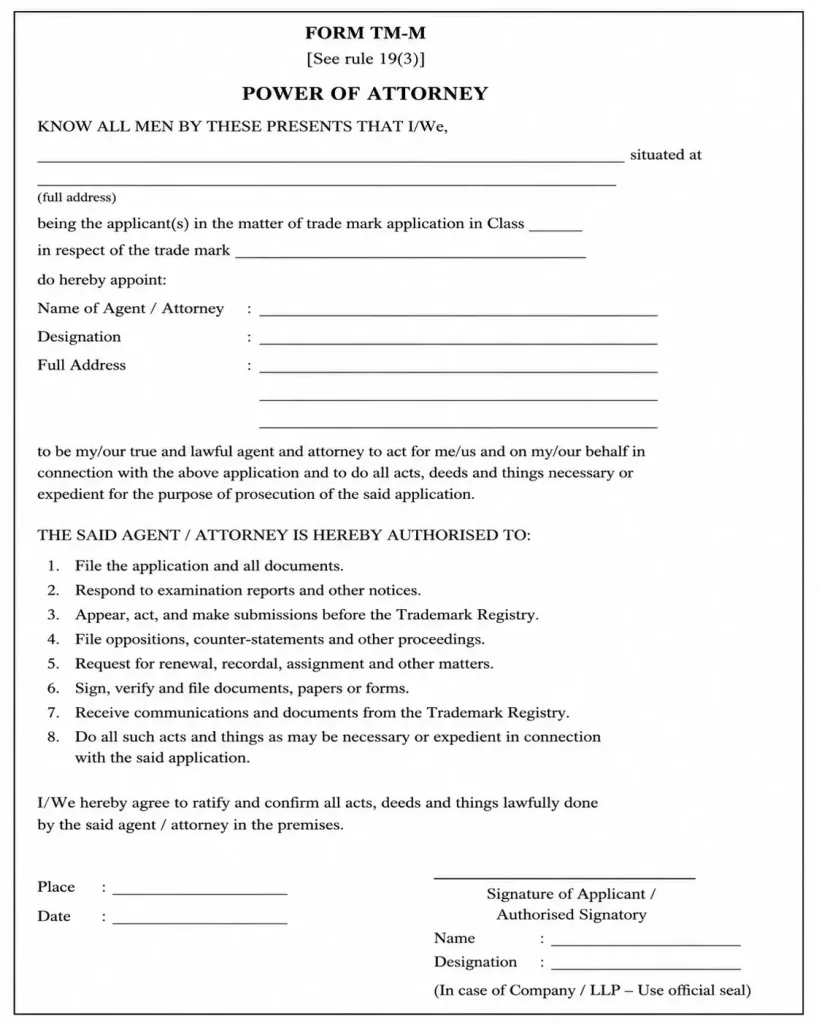
Form TM-M provides the prescribed format of a Power of Attorney for trademark registration in India. The form remains concise, but applicants must provide accurate and complete information.
A valid POA for trademark registration format should include the following elements:
- Applicant details: State the full name, address, and legal status of the trademark owner.
- Agent details: Name the authorized agent or attorney, with the designation and full address.
- Trademark details: Add the application number, class, and mark description to link to the correct application.
- Scope of authority: Describe the powers granted, such as filing, responding, appearing, and renewing.
- Signature, date, and place: The applicant or authorized signatory signs and dates the document.
Tip: Clearly state the scope of authority in the POA. Clear wording helps your agent act correctly and reduces avoidable Registry queries.
Stamp Paper and Notarization Requirements for a Trademark POA
Stamp duty rules for a POA for trademark registration vary from one state to another. Most applicants execute the document on a non-judicial stamp paper, since a trademark POA constitutes a special (non-property) authorization.
In practice, you should execute the Power of Attorney (Form TM-M) on a ₹100 non-judicial stamp paper or e-stamp paper, though a few states apply slightly different rates. You should confirm the applicable stamp value with your state authority before you sign the form.
Note: Notarization of Form TM-M is generally not mandatory for a standard trademark filing. However, some applicants notarize the document to add an extra layer of authenticity. Foreign applicants often notarize the POA to support verification of their signatures.
How to Submit the POA Online for Trademark Registration?
Submit the POA for trademark registration online through the IP India e-filing portal. Follow these steps to attach and authenticate the document correctly:
- Log in to the portal: Access your account on the IP India e-filing portal.
- File Form TM-A: Open the trademark application and enter your applicant, agent, and mark details.
- Upload the signed Form TM-M: Attach the signed POA as a supporting document linked to your application.
- Select the correct category: Attach the POA under the authorization or supporting-document category tied to Form TM-A.
- Authenticate the filing: Sign the submission using a Class 3 Digital Signature Certificate (DSC) or eSign.
- Save the acknowledgment: The Registry issues an acknowledgment that confirms your authorization on record.
Note for existing or pending applications: You can appoint or change an agent even after you file the application. In that case, file a standalone Form TM-M against the existing application number, rather than attaching it to a fresh Form TM-A. Upload the signed POA, quote the application number, and authenticate the request with a Class 3 DSC or eSign.
Validity, Revocation, and Changing Your Agent for a Trademark POA
A Power of Attorney for trademark registration works on a few simple rules that every applicant should understand:
- Validity: The POA usually remains valid until you revoke it in writing, since the current rules set no fixed expiry date.
- Continued authority: Your agent can keep acting across the application and all related proceedings until you withdraw the authorization.
- Revocation: You may revoke the POA at any time by informing both the Registry and your agent in writing.
- Changing your agent: To appoint a new representative, you sign a fresh Form TM-M in favor of the new agent.
- Effect of the new POA: The fresh authorization replaces the earlier one for all future actions on your application.
Conclusion
A Power of Attorney for trademark registration protects your rights when an agent acts on your behalf. It gives your representative clear legal authority under Section 145 and Rule 19 of the current rules. A correct POA for trademark registration format prevents delays and keeps your application compliant. Prepare the document carefully, sign it properly, and submit it with your trademark application.
RegisterKaro helps you prepare, verify, and file your POA for trademark registration without confusion or delays. Contact us today to complete your trademark filing with expert support across India!
