


Form TM-A is the official application form for registering a brand name, logo, or trademark in India under the Trade Marks Rules, 2017. Applicants must file it online through the IP India e-filing portal.
Every applicant, whether an individual, startup, or company, must use this form. Entering the correct applicant details, trademark class, and mark representation the first time helps avoid delays and objections.
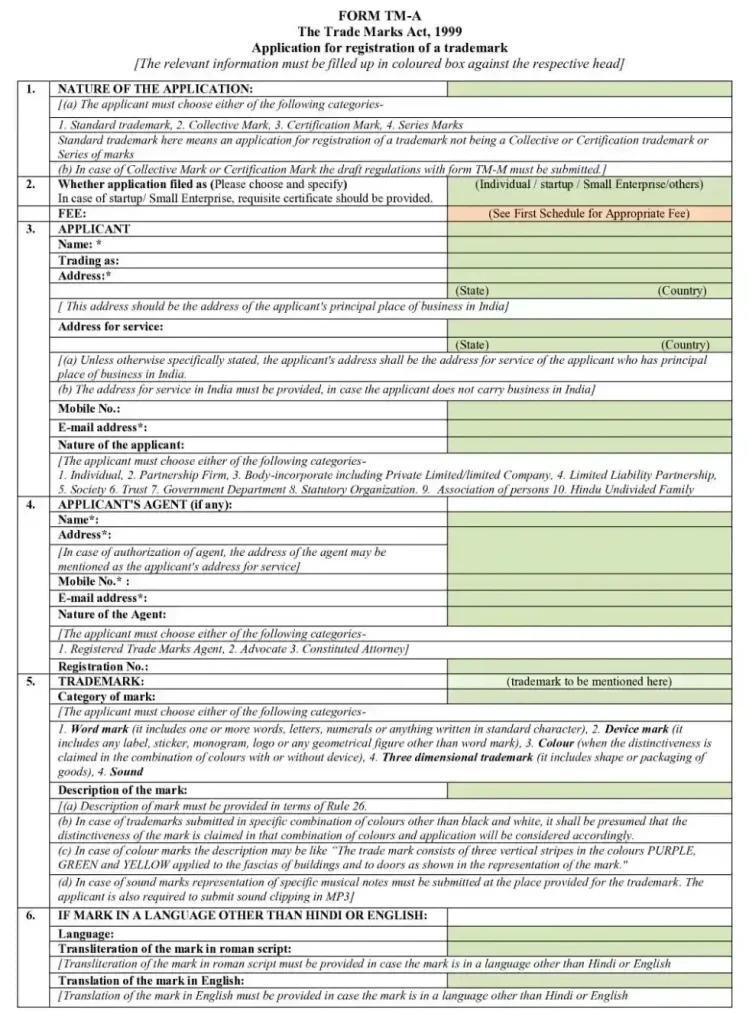
What does the TM-A Form Contain?
The TM-A form includes several sections that require specific details:
- Applicant’s Details: This section includes the name, address, and contact details of the applicant.
- Trademark Details: It contains the details for the trademark you want to register.
- Class of Goods or Services: The Nice Classification class under which your mark falls, based on its field of use.
- Trademark Representation: A clear representation of the mark, a logo, a wordmark, or both.
- Signatory Details: The authorized representative signs the application.
Filling in all these details accurately is essential, as mistakes can delay or reject your application.
Why is Form TM-A Important?
Trademark registration offers numerous benefits, such as:
- Legal protection for your brand.
- Prevention of infringement.
- Exclusive rights to use your mark in your business domain.
Without filing the form TM-A, you cannot obtain protection. It is the first official step to safeguarding your intellectual property.
Essential Information You Need Before Filing the Form TM-A
Ensure you gather all necessary information before starting Form TM-A to avoid interruptions and ensure accurate submission. They are:
- Applicant Details: Use complete legal names exactly as they appear on your ID or incorporation certificates. Companies need their registered office address. Individuals require their current residential address with proof.
- Mark Representation: Upload a clear, high-quality logo image (commonly in JPEG format). Ensure word marks use the correct spelling and capitalization. For combined marks, include both the text and design elements. The mark must be clear, legible, and generally not exceed 8 cm × 8 cm.
- Priority and Use Claims: Indicate if you claim prior use in India with supporting evidence. Foreign applicants must provide their home country application number and date. For first use, provide proof like invoices or ads.
- Representative Authorization: If using an agent, submit Power of Attorney documents. Specify the agent type:
- Registered Agent: A qualified person who clears the Mark exam.
- Advocate: A legal professional representing clients in court.
- Constituted Attorney: A power of attorney holder acting on behalf of the applicant.
Gathering all required details ensures a smooth process and helps avoid delays in filing Form TM-A.
Documents Required for Filing Form TM-A
To file your application, the following TM-A documents are required:
- Identity proof of applicant: This could be your Aadhaar card, passport, or any government-issued ID.
- Address proof: Submit documents like a utility bill or bank statement confirming your address.
- Logo (if applicable): If your mark includes a logo, submit a clear representation of it.
- MSME / Startup certificate: If you are a Micro, Small, or Medium Enterprise (MSME) or a Startup, include the relevant certificate.
- Power of Attorney (if agent involved): If you’re using an agent, submit a signed Power of Attorney to authorize them.
- Proof of use (if claiming use): Provide documents like invoices, advertisements, or packaging if you are claiming prior use of the mark in India.
These documents are essential to complete the TM-A form online filing and initiate the registration procedure in India. Ensure all documents are accurate and up to date to avoid delays in the registration process.
How to Fill Out Form TM-A?
Filling out the form TM-A correctly will help you avoid delays in the registration process. Follow these steps to ensure your TM-A form is legally protected under the law.
Step 1: Applicant’s Information
The first section of the TM-A form requires the applicant’s personal or business information. This includes:
- Full name
- Address (residential or business)
- Nationality
- Email address and phone number
Step 2: Type of Applicant
Choose Individual, Proprietor, Partnership, LLP, Company, Trust, Society, or Government Body matching your legal status.
Enter your complete legal name exactly as it appears on official documents without abbreviations.
Remember:
- Companies input their registered company name from the Certificate of Incorporation verbatim.
- Partnerships use the firm name registered in their partnership deed.
- Individual applicants provide their full name, matching passport or Aadhaar card details.
Step 3: Mark Details and Representation
Choose the type of trademark you are applying for. There are several types, including word marks, device marks, and combined marks, among others.
- Word marks contain only text without design elements or special fonts.
- Device marks consist purely of logos, symbols, or graphical designs.
- Combined marks integrate both text and design elements.
Upload your representation meeting the specified technical requirements in the TM-A form. JPEG files should not exceed 8 cm × 8 cm in dimension.
Tip: If your mark contains non-English words, provide accurate English translations or transliterations in the translation field.
Step 4: Goods and Services Classification
In form TM-A, you need to specify the class of goods or services under which your mark falls. The trademark class system includes 45 classes, ranging from Class 1 (chemicals) to Class 45 (legal services). It is crucial to choose the right class, as it defines the area in which your mark will be protected.
Enter detailed descriptions of your specific goods or services within the chosen class precisely. Vague descriptions such as “trading in goods” trigger examination objections that require clarification. Instead, specify “retail store services featuring electronic gadgets” or “manufacturing and selling cotton fabrics” clearly.
Avoid overly broad descriptions attempting to cover unrelated items within one class. List only goods or services you genuinely intend to use your mark with commercially. Remember, unused registrations are subject to cancellation through non-use rectification proceedings after registration.
Tip: Use RegisterKaro’s free trademark class finder to identify the right class for your products.
Note: NCL 13-2026, effective from 1 January 2026, updated several class headings. Check that your goods or services still fall under the correct class before filing.
Step 5: Priority and Use Claims
Indicate if you are claiming priority for your mark based on earlier applications. For convention priority claims, file within six months of the original application. Provide the application number, filing date, and country, along with certified copies as supporting evidence.
Declare whether your mark is “Proposed to be Used” or “Already in Use” in India. Proposed use applications don’t require evidence but create potential vulnerabilities against prior user challenges.
For use claims, specify the exact date when you first used the mark commercially in India. Provide supporting evidence like invoices, advertisements, product packaging, or business documents showing the mark’s use.
Step 6: Power of Attorney (If Applicable)
If filing through an agent, provide their complete registration details, including agent number and firm name. Upload the signed Power of Attorney authorizing the agent to represent you before the Registry.
Company applications require board resolutions designating individuals authorized to sign documents and make representations. These resolutions prove corporate authorization for the filing decision.
Step 7: Payment Details
The last step of the form TM-A requires you to pay the prescribed fee for registration. TM-A filing fees vary depending on whether the applicant is an individual or a company.
Individuals, MSMEs, and Startups pay ₹4,500 per class, while Companies and Partnership Firms pay ₹9,000 per class. Fees apply separately for each class selected.
The total timeline for the trademark registration process varies, but it typically takes 12 to 18 months.
Common Mistakes in Filing Form TM-A in India
Many applicants make common errors when filling out the form TM-A. Some of these include:
- Incorrect details in the applicant’s information.
- Failing to select the right class of goods or services.
- Providing a blurry or incorrect representation.
- Missing signatures or Power of Attorney documents.
- Incorrect payment details.
To avoid these issues, double-check the TM-A form before submitting it. It’s also advisable to seek legal help if you’re unsure about any step in the process.
TM-A vs Other Forms
The TM-A form is specifically used to apply for mark registration in India. It is the primary application form for registering your mark with the Registry.
Other forms serve distinct purposes:
- TM-A: Used for registration applications.
- TM-R: Used for renewals.
- TM-O: Used for opposition, objection responses, and counter-statements.
Each form is designed for a specific stage or action within the registration process.
