GST Return Filing Online in India
File your GST returns online in India with RegisterKaro. Get expert assistance with GSTR-1, GSTR-3B, GSTR-9, & ITC claims, ensuring timely, accurate, and compliant submissions every filing period.
 Monthly & Quarterly Filing SupportError-Free Submission & ReconciliationMaximize ITC with Expert ReviewDedicated GST ProfessionalsGSTR-2B ITC Reconciliation & Due-Date Tracking

 What Sets Us ApartWhat Sets Us Apart
Complete Your GST Return Filing in No Time
Curious about how GST return filing works with RegisterKaro? This short video walks you through the real process—how businesses just like yours get their returns filed smoothly without delays or confusion.
See what happens behind the scenes and why businesses trust us for timely, accurate GST return filing.
Got questions?

What is a GST Return?
A Goods and Services Tax (GST) return is an official document providing a comprehensive record of a business's financial activities. It provides a summary of sales and purchases, including the tax collected on sales (output tax) and the tax paid on purchases (input tax). Businesses must submit these returns electronically through the Government of India's official GST portal.
Regular businesses under GST must file GSTR-1 and GSTR-3B as applicable. GSTR-1 reports outward supplies, while GSTR-3B summarizes tax liability and ITC. In addition to these, most regular taxpayers must also file an annual return, bringing the total to as many as 25 returns per year for a monthly filer.
This process ensures compliance with tax regulations and forms the backbone of the Goods and Services Tax Network (GSTN). Even if a business has no activity during a tax period, filing a 'nil' return is mandatory to maintain compliance.
What Information is Included in a GST Return?
GST returns require businesses to report their taxable sales and eligible purchases. They must report the GST collected on sales as output tax and the GST paid on eligible purchases as Input Tax Credit (ITC). Key details required include:
| Category | Details to Report |
| Basic Information | Business name, GSTIN, and return period |
| Outward Supplies | Sales invoices, exports, applicable inter-state supplies, and HSN/SAC summary |
| Inward Supplies | Purchase invoices, imports of goods and services, and applicable supplies from unregistered persons |
| Tax and ITC | Output GST, ITC claimed or reversed, tax payable, and tax paid |
| Adjustments | Debit notes, credit notes, advances, and amendments to previously reported details |
Who Should File GST Return?
Requirements for filing GST returns vary based on business turnover and type.
1. Registered Dealers and Businesses
Every business registered under GST must file its returns regularly. The general thresholds for GST registration, which then mandate filing, are:
- Businesses supplying only goods: ₹40 lakh annual aggregate turnover in most states, and it doesn't cover certain notified goods such as ice cream, pan masala, and tobacco products. The threshold is ₹20 lakh in Arunachal Pradesh, Manipur, Meghalaya, Mizoram, Nagaland, Puducherry, Sikkim, Telangana, Tripura and Uttarakhand.
- Businesses supplying only services or both goods and services: ₹20 lakh annual aggregate turnover in most states.
- Manipur, Mizoram, Nagaland, and Tripura: The threshold is generally ₹20 lakh for goods and ₹10 lakh for services or mixed supplies.
All normal taxpayers and casual taxpayers are required to file Form GSTR-3B.
2. Taxpayers Under the Composition Scheme
Small taxpayers can opt for the Composition Scheme if their aggregate turnover meets the applicable limits. For goods, the general turnover limit is ₹1.5 crore, while certain specified states have a ₹75 lakh limit. A separate scheme allows eligible suppliers of services or mixed supplies with turnover up to ₹50 lakh to opt in.
The scheme simplifies compliance through quarterly tax payments using Form CMP-08 and an annual return in Form GSTR-4. The earlier annual return in Form GSTR-9A was discontinued from FY 2019-20 onward. The quarterly Form GSTR-4 was also discontinued from April 1, 2019.
It provides a simplified compliance framework for eligible small businesses instead of applying the same filing requirements as regular taxpayers.
3. Specific Cases of GST Return Filing
Beyond general businesses, specific entities have distinct GST filing obligations:
- E-commerce Operators: E-commerce operators required to collect TCS under GST must obtain GST registration irrespective of their value of supply. They must file GSTR-8 monthly, detailing supplies affected through their platform and Tax Collected at Source (TCS). For marketplace sellers (Amazon, Flipkart, Meesho), see our GST return filing for e-commerce sellers page.
- Input Service Distributors (ISD): An Input Service Distributor receives invoices for input services and distributes the eligible input tax credit to its distinct registered units. ISD registration is mandatory for persons required to operate as an ISD. They must file GSTR-6 monthly, generally by the 13th of the succeeding month.
- Non-Resident Taxable Persons: Individuals or entities conducting taxable transactions in India without a fixed business location must file GSTR-5 monthly.
- TDS Deductors: Registered persons required to deduct tax at source under GST rules must file GSTR-7 monthly.
- Persons with Unique Identification Number (UIN): Entities like UN bodies or embassies, granted a UIN, must file GSTR-11 monthly, detailing inward supplies for refund claims.
4. Exemptions from GST Return Filing
While most registered businesses must file GST returns, certain situations or entities may have specific exemptions or simplified requirements.
- Agriculturalists (Farmers): Generally exempt from GST.
- Small Businesses: Businesses below the applicable GST registration thresholds may not need registration, subject to exceptions. The general threshold is ₹40 lakh for businesses supplying goods and ₹20 lakh for services or mixed supplies. Certain states have lower thresholds, including ₹20 lakh for goods and ₹10 lakh for services.
- Suppliers of Exempt/Nil-Rated Goods & Services: Those dealing exclusively in supplies such as certain food products, healthcare, and education services.
- Non-GST Supplies: Entities dealing with goods or services that fall outside the purview of GST law (e.g., alcohol for human consumption, petrol).
- Government Entities and PSUs: Entities dealing with non-GST supplies or exempted/nil-rated goods/services.
- UN Bodies and Foreign Consulates: UN bodies, embassies and other eligible entities holding a UIN can claim refunds through GSTR-11 for eligible inward supplies, subject to the applicable conditions. While they must register for a unique GST ID, they are only required to file returns for months during which they make purchases.
How Many Returns Are There Under GST? Types of Returns
GST has several return and statement forms for different types of taxpayers and compliance requirements. A taxpayer may need to file one or more of these forms depending on their registration type, business activities, filing scheme, and turnover.
GST filings generally include monthly, quarterly, and annual returns or statements, with the applicable frequency and forms varying by taxpayer category.
-
Monthly GST Returns
Businesses with an annual turnover exceeding ₹5 crore are generally required to file GSTR-1 for outward supplies and GSTR-3B for summary reporting and tax payment. Eligible taxpayers with turnover up to ₹5 crore may opt for the QRMP scheme and file GSTR-1 and GSTR-3B quarterly, subject to the applicable conditions.
Monthly filing allows businesses to report transactions and tax liabilities more frequently and supports timely GST compliance.
-
Quarterly GST Returns (QRMP Scheme)
Businesses with an annual turnover of up to ₹5 crore can choose to file GST returns quarterly under the Quarterly Return Monthly Payment (QRMP) scheme. Under this scheme, taxpayers file GSTR-3B quarterly but pay tax monthly.
They also have the option to file GSTR-1 monthly or quarterly. This reduces the compliance burden for Micro, Small, and Medium Enterprises (MSMEs).
-
Annual Filings
Applicable regular taxpayers must file GSTR-9 by December 31 of the following financial year, subject to applicable exemptions. Composition taxpayers must file GSTR-4 by June 30 of the following financial year.
GSTR-9C Self-Certification Requirement
GSTR-9C is a self-certified reconciliation statement that reconciles the figures reported in GSTR-9 with the corresponding figures in the taxpayer's annual financial statements. It generally applies to regular taxpayers whose aggregate turnover exceeds ₹5 crore, subject to applicable rules and exemptions.
Earlier, taxpayers were required to get GSTR-9C certified by a Chartered Accountant (CA) or Cost Accountant (CMA). However, this requirement was removed through the Finance Act, 2021, with the change taking effect from August 1, 2021, through Notification No. 29/2021-Central Tax.
GSTR-9C is now self-certified by the taxpayer. The taxpayer is responsible for reconciling the relevant figures, reporting the required differences and reasons for reconciliation, and ensuring that the information submitted is accurate.
The removal of CA/CMA certification does not eliminate the need for reconciliation. Taxpayers required to furnish GSTR-9C must still prepare and submit the statement along with GSTR-9 within the applicable timeline.
For the complete annual return and reconciliation guide (GSTR-9 and GSTR-9C), see our GSTR-9 Filing page.
GST Return Filing Categorization: Based on Taxpayer Type
The variety of GST returns caters to different taxpayer categories, ensuring tailored compliance requirements:
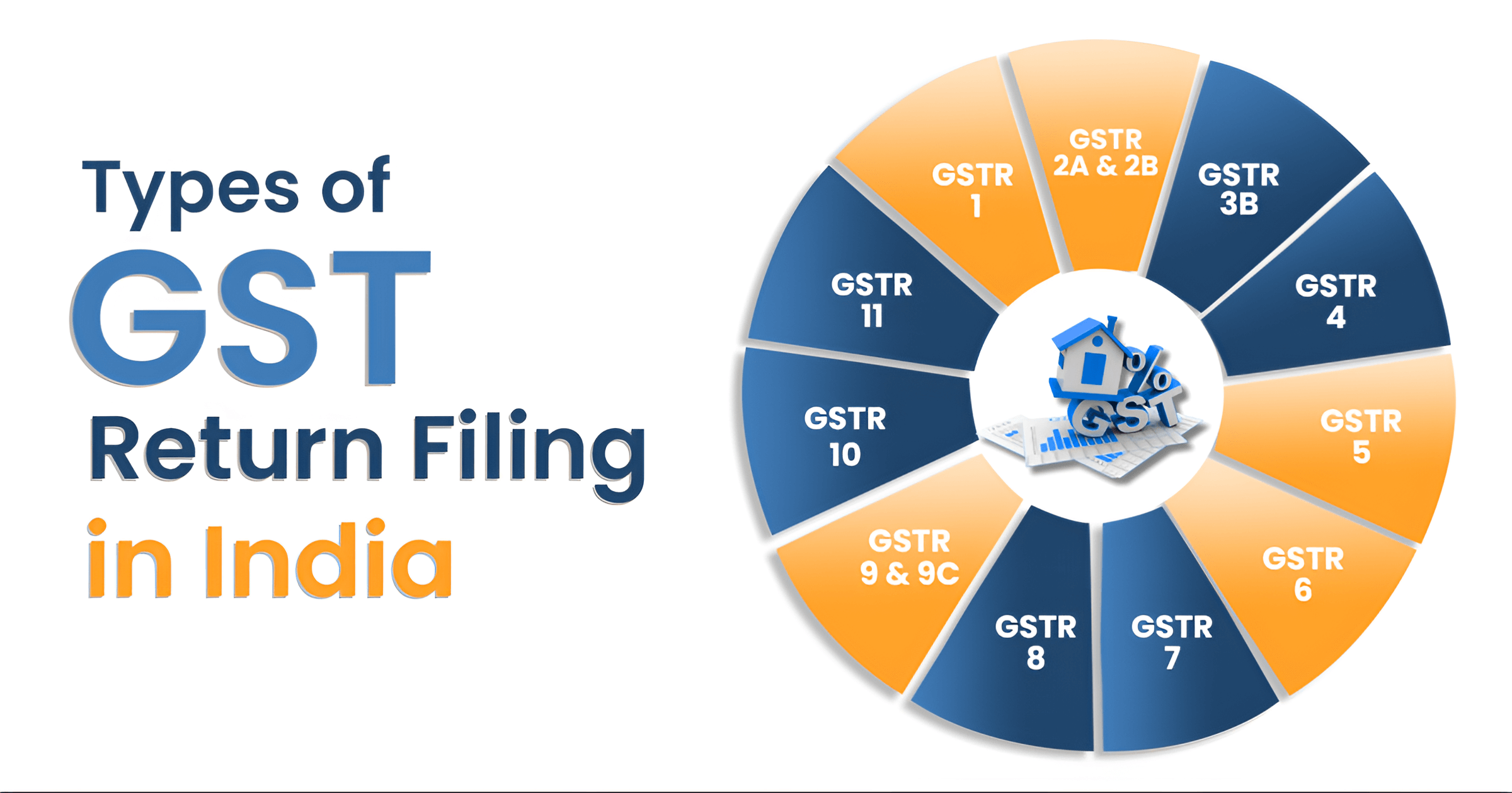
| Return Type | Applicable To | Purpose | Frequency | Due Date |
| GSTR-1 | Regular Taxpayers | Report outward supplies and tax liability | Monthly/Quarterly | 11th (monthly) / 13th (quarterly) of next month |
| GSTR-2A | Regular Taxpayers | Auto-drafted purchase return (dynamic) | Auto-generated | Ongoing (view-only) |
| GSTR-2B | Eligible registered taxpayers | Static, auto-drafted ITC statement based on supplier filings and other eligible data | Auto-generated Monthly | Generated on the 14th of the following month |
| GSTR-3B | Regular Taxpayers | Summary of sales, ITC, and tax payable | Monthly/Quarterly | 20th / 22nd / 24th of next month (based on state) |
| GSTR-4 | Composition Scheme Taxpayers | Annual return declaring turnover and tax paid | Annually | 30th June of the following FY |
| CMP-08 | Composition Scheme Taxpayers | Statement for self-assessed tax payment | Quarterly | 18th of the month following the quarter |
| GSTR-5 | Non-Resident Taxable Persons | Report taxable supplies and tax payable | Monthly | 13th of the following month or within 7 days after the end of the registration period, whichever is earlier |
| GSTR-6 | Input Service Distributors (ISD) | Distribute ITC to branches | Monthly | 13th of the following month |
| GSTR-7 | TDS Deductors | Report tax deducted and credits to deductees | Monthly | 10th of the following month |
| GSTR-8 | E-commerce Operators | Report supplies made and TCS collected | Monthly | 10th of the following month |
| GSTR-9 | Eligible regular taxpayers with aggregate turnover exceeding ₹2 crore | Annual return summarizing GST transactions and tax reported during the year | Annually | 31st December of the following FY |
| GSTR-9C | Businesses with turnover > ₹5 crore | Audit & reconciliation statement | Annually | 31st December of the following FY |
| GSTR-10 | Taxpayers with Cancelled GSTIN | Final return post cancellation | One-time | Within 3 months of cancellation |
| GSTR-11 | UIN Holders (e.g., Embassies) | Claim GST refund on inward supplies | Monthly | 28th of each month |
Simplification of the Return Filing Process Over Time
The GST Council has consistently introduced measures to simplify the GST return filing process, aiming to ease compliance, especially for small businesses. Key initiatives include:
- QRMP Scheme: Eligible taxpayers with aggregate turnover up to ₹5 crore can opt to file GSTR-1 and GSTR-3B quarterly, while paying tax through monthly challans.
- Auto-Drafted GSTR-2B: GSTR-2B provides an auto-drafted, static statement of eligible input tax credit information and helps businesses reconcile ITC before filing returns.
- Online and Auto-Populated Data: GST return forms use data from invoices and other filings to reduce manual data entry and support more accurate reporting.
These steps reduce filing frequency and minimize errors in reporting. Additional simplifications include:
- Offline tools and APIs for return preparation
- Digital authentication via DSC or EVC
- Facility to file NIL returns via SMS.
Taxpayers can also amend returns to correct errors, helping avoid penalties.
How to File GST Returns Online for Your Business?
To file GST returns online, taxpayers need an active GST registration and access to their account on the official GST portal. Before filing, verify your GSTIN and check its registration details to save time and avoid penalties later.
Here is a step-by-step process for filing GST returns online:
Step 1: Log in to the GST Portal
Visit the official GST website (gst.gov.in). Enter your GSTIN, username, and password. Complete the CAPTCHA verification and click "Login".
Step 2: Select the GST Return Form
Navigate to the 'Services' tab, then click on 'Returns' and select 'ReturnsDashboard'. Choose the financial year and the relevant return filing period (month/quarter). Select the appropriate GST return form (e.g., GSTR-1, GSTR-3B).
Step 3: Enter Business Details
Fill in details of your sales (outward supplies), purchases (inward supplies), ITC, and tax liabilities. Make sure all details are accurate before uploading, as any errors can result in penalties.
Step 4: Upload Invoices and Sales Data
Upload invoices for outward supplies in the prescribed format. If applicable, add invoices for purchases to claim ITC.
Step 5: Review and Validate Data
Cross-check all entered details before submission. The system may auto-calculate the tax payable after ITC adjustment.
Step 6: Make GST Payment (If Required)
If there is any net tax liability, proceed with the payment. You can pay using multiple options like net banking, debit/credit card, NEFT/RTGS, or UPI.
Step 7: Submit the GST Return
Review the return carefully and click 'Submit' to proceed with filing. For GSTR-3B, certain auto-populated outward tax liability fields are non-editable from the July 2025 tax period. If corrections are required, eligible amendments can be made through GSTR-1A before filing GSTR-3B.
Complete verification using a Digital Signature Certificate (DSC), which is mandatory for companies and LLPs, or an Electronic Verification Code (EVC), where permitted. After successful filing, an Application Reference Number (ARN) is generated, and the acknowledgment can be downloaded for your records.
Documents Required to File a GST Return
Essential documents required for GST return filing include:
- Invoices for Outward Supplies (Sales): These are sales invoices issued to customers. They must include details like GSTIN, name, address, invoice number, date, description of goods/services, value, tax charged, and the supplier's signature.
- Invoices for Inward Supplies (Purchases): These are purchase invoices received from suppliers and contain similar details to sales invoices, including GSTIN, name, address, invoice number, etc. These are vital for claiming the ITC.
- Bank Statements for Reconciliation: Monthly bank statements provide a record of transactions and are essential for reconciling financial records with GST filings.
- Details of Debit and Credit Notes Issued: These notes are issued for returns of goods or changes in value. They must include the original invoice number, revised amount, and differential tax.
- Summary of Inter-state and Intra-state Sales: A consolidated summary of sales categorized by GST rates, distinguishing between sales within the state and to other states.
- Bills of Supply: Issued when selling exempted goods/services or if the business opted for the composition levy. They include basic business details, description, and value of supplies.
- Advance Receipt Vouchers: Required if advance payments are received for future supplies. These vouchers detail the supplier, recipient, description, value, and tax payable on the advance.
- Delivery Challans: Necessary when goods are transported for reasons other than supply (e.g., for job work). They contain details like name, address, GSTIN, goods description, and purpose of transportation.
- Account Ledgers: Comprehensive records of all financial transactions are essential for accurate reporting and audits.
GST Return Filing Due Dates
Meeting GST return filing deadlines is important to avoid late fees and maintain GST compliance. The due date varies based on the return type, filing frequency, and taxpayer category. This table outlines common GST return filing due dates:
| GST Return Name | Filing Frequency | Due Date |
| GSTR-1 | Monthly | 11th of the next month |
| GSTR-1 | Quarterly (QRMP Scheme) | 13th of the month succeeding the quarter |
| GSTR-3B | Monthly | 20th of the next month |
| GSTR-3B | Quarterly (QRMP Scheme) | 22nd or 24th of the month succeeding the quarter (depending on state) |
| GSTR-4 | Annually | 30th June of the following financial year |
| GSTR-5 | Monthly (Non-resident taxpayers) | 13th of the next month |
| GSTR-6 | Monthly (ISD) | 13th of the next month |
| GSTR-7 | Monthly (TDS Deductors) | 10th of the next month |
| GSTR-8 | Monthly (E-commerce Operators) | 10th of the next month |
| GSTR-9 / GSTR-9C | Annually | 31st December of the next financial year |
| GSTR-10 | Once (Final Return) | Within 3 months of the cancellation date or order |
| CMP-08 | Quarterly (Composition Levy) | 18th of the month succeeding the quarter |
| ITC-04 | Annually/Half-yearly | 25th April / 25th October |
Note: Due dates are subject to change by CBIC notifications or orders.
Penalty for Delayed GST Return Filing: Interest and Late Fees
Failing to submit GST returns on time incurs financial penalties, including late fees and interest.
- Interest Charges: Interest is applicable at 18% per annum on the outstanding tax amount. Use our GST interest calculator to estimate the exact interest and late fee. Interest starts accumulating from the day after the filing due date and continues until the payment is made.
- Late Fees Structure:
- GSTR-1: ₹50 per day for regular returns and ₹20 per day for nil returns. The maximum late fee is ₹500 for nil returns and ₹2,000, ₹5,000, or ₹10,000 for other returns based on the applicable turnover slab.
- GSTR-3B: ₹20 per day for nil returns and ₹50 per day for other returns. The maximum late fee is ₹500 for nil returns and ₹2,000, ₹5,000, or ₹10,000 for other returns based on the applicable turnover slab.
- GSTR-9: From FY 2022-23 onward, the late fee is rationalized based on aggregate turnover:
- Up to ₹5 crore: ₹50 per day, subject to a maximum of 0.04% of turnover in the State or Union territory.
- More than ₹5 crore and up to ₹20 crore: ₹100 per day, subject to a maximum of 0.04% of turnover in the State or Union territory.
- More than ₹20 crore: ₹200 per day, subject to a maximum of 0.50% of turnover in the State or Union territory.
- GSTR-10 (Final Return): A late fee of ₹200 per day applies, subject to the applicable statutory provisions.
- GSTR-9A: This form is no longer applicable for current GST filings and should not be included as a current return.
- General Penalty: Where the GST Act or Rules do not prescribe a separate penalty for a contravention, Section 125 allows a general penalty of up to ₹25,000.
- Late Fee Payment Rule: Late fees, interest, penalties, and other amounts payable under GST are discharged through the electronic cash ledger. ITC in the electronic credit ledger cannot be used to pay late fees or interest.
Failure to file applicable GST returns for six continuous months can lead to suspension and potential cancellation of GST registration. For taxpayers under the QRMP Scheme, non-filing for two continuous tax periods, meaning two quarters, can lead to such action.
For professional GST filing charges and package details, see our GST filing fees guide.
Importance of Accurate and Timely GST Return Filing
Filing GST returns within the specified deadlines is crucial to avoid financial penalties. Late filing incurs interest charges at 18% per annum, plus late fees of ₹50 per day (₹20 per day for NIL returns) for routine returns like GSTR-1 and GSTR-3B.
- Avoiding Penalties and Late Fees: Timely submission prevents financial burdens from penalties and late fees. These charges can significantly impact a business's profitability.
- Claiming ITC: ITC allows businesses to claim credit for the GST paid on purchases used for business purposes. This valuable credit can only be claimed if GST returns are filed on time.
- Maintaining Compliance and Credibility: Regular and accurate filing demonstrates a business's commitment to tax compliance. A good compliance rating enhances a business's reputation, which can be beneficial when applying for loans, tenders, or attracting investors.
- Tracking Business Performance: The data derived from regular checks offers a clear snapshot of sales, purchases, and tax flows, aiding strategic planning. Businesses can use this data to track their performance, spot areas that need improvement, and make smarter financial decisions.
- Reduced Risk of Audits: Timely and accurate filing significantly decreases the likelihood of a business being selected for an audit by tax authorities. This saves considerable time, resources, and potential stress associated with tax audits, allowing businesses to focus on core operations.
- Streamlined Business Operations: Consistent GST return filing helps maintain organized financial records. This simplifies overall tax compliance for a business, making operations smoother and more efficient.
The Role of GST Return Filing in India's Tax System
The GST system transformed India's indirect tax landscape in 2017 by replacing multiple central and state levies with a unified structure. This change required businesses to file regular GST returns to comply with tax regulations.
How GST return filing supports the GST system:
- Enable accurate calculation of a business’s net tax liability
- Ensure compliance with Indian tax laws and regulations
- Maintain transparent, auditable records of business transactions
- Help the government monitor tax collection and track supply chains
- Aid in detecting and preventing tax evasion
- Allow businesses to claim ITC
- Prevent the cascading effect of taxes (tax on tax)
How to Check GST Return Status?
Taxpayers can track their GST return filing status online through the official GST portal using various options.
-
Tracking Through ARN
The Application Reference Number (ARN) is a unique 15-character alphanumeric number generated after submitting certain GST applications or forms. You can use it to track the status of the submitted application or request. To track using ARN:
-
- Visit the GST Portal: Go to the official GST website (www.gst.gov.in).
- Log in to Your Account: Click the 'Login' button and enter your username and password.
- Navigate to Track Return Status: On the dashboard, click 'Services' > 'Returns' > 'Track Return Status'.
- Choose ARN Option: Select 'ARN' from the tracking methods.
- Enter ARN: Input the ARN received via email or SMS.
- Click Search: Click the 'Search' button to view the return status.
-
Tracking through GST Returns Filing Period
This method allows checking the status of all returns filed within a specific timeframe. To track using the filing period:
-
- Visit the GST Portal and log in: Similar to the ARN method, you need to log in through the GST portal with your username & password.
- Navigate to Track Return Status: Click “Returns” on the “Services” option from the navigation menu. Then select “Track Return Status”.
- Choose Return Filing Period Option: Select 'Return Filing Period'.
- Select Dates: Use the calendar to select the start and end dates for the period (DD/MM/YYYY).
- Click Search: Click the 'Search' button. The portal will display the status of all returns filed during that period.
-
Tracking by Filing Status
This method allows filtering returns by their current processing status. To track using status:
-
- Visit the GST Portal and log in: Log in through your GST account and select Track Return Status.
- Choose Status Option: Select 'Status' from the tracking methods.
- Select Specific Status: Choose the desired status (e.g., Filed-Valid, Filed-Invalid, Validated but not filed) from the dropdown menu.
- Click Search: Click the 'Search' button. A list of all returns matching the selected status will be shown.
How to Download GST Returns Online?
Taxpayers can easily download their filed GST return forms from the official GST portal for record-keeping and verification purposes. Here are the steps to download GST return forms:
- Visit the GST Portal: Go to the official GST website.
- Log in to your GST Account: Click the “Login” button, enter your Username and Password, and input the Captcha code. Click “LOGIN”.
- Navigate to the ‘Returns Dashboard’: Once logged in, click on the “Services” tab, then “Returns,” and select “Returns Dashboard”.
- Select the Financial Year and Period: Choose the specific financial year and the appropriate return period (monthly, quarterly, or annually) for which you want to download the return form.
- Download the GST Return Form: Click on the specific form type (e.g., GSTR-1, GSTR-3B) to open it. Look for the “Download” option and click on it. The form will be downloaded to your device, typically in PDF or Excel format.
Past GST return forms can be accessed by selecting the relevant financial year and return period on the "Returns Dashboard".
Connect with RegisterKaro and let our experts handle the legal hassle while you grow your business.
Frequently Asked Questions (FAQs)
Is filing a nil GST return necessary?
Yes, filing a nil return is mandatory even if a business has no transactions during a tax period. This maintains compliance and avoids penalties.
What are the consequences of late GST return filing?
Late filing attracts penalties and interest. Late fees run at ₹50 per day (₹20 per day for NIL returns) for GSTR-1 and GSTR-3B, capped based on your turnover slab, and interest on outstanding tax accrues at 18% per annum. Non-filing for six continuous months can also lead to GSTIN suspension or cancellation.
Can a GST return be filed offline?
No, GST return filing must be done online through the official GST portal. However, offline tools are available to prepare JSON files for upload.
What documents are needed for GST return filing?
Key documents include invoices for sales and purchases, debit and credit notes, bank statements for reconciliation, and summaries of inter-state and intra-state sales.
How often should GST returns be filed?
The frequency depends on the taxpayer's registration type and turnover. It can be monthly, quarterly, or annually. Businesses with over ₹5 crore turnover file monthly; those up to ₹5 crore can opt for quarterly filing under QRMP.
What is the turnover limit for GST return filing?
The turnover limit for mandatory GST registration is generally ₹40 lakh for businesses supplying only goods and ₹20 lakh for businesses supplying services or both goods and services. In Manipur, Mizoram, Nagaland, and Tripura, the limits are generally ₹20 lakh for goods and ₹10 lakh for services or mixed supplies. Certain exceptions and compulsory registration provisions may apply.
How can one check if a vendor has filed their GST return?
You can verify a vendor's GST registration and related details using their GSTIN on the official GST portal. For return filing information, check the available filing status or return details for the relevant tax period, where accessible.
What is the difference between GSTR-2A and GSTR-2B? Which one should I rely on for ITC?
GSTR-2A is a dynamic statement that auto-populates details of inward supplies (purchases) from the GSTR-1 filed by your suppliers, updating continuously as suppliers file, including late filings. GSTR-2B is a static statement generated monthly (on the 14th of the following month), providing a fixed, consolidated summary of eligible and ineligible ITC for a specific tax period. GSTR-2B is generally the more reliable reference for claiming ITC, since it's stable and doesn't shift after generation.
What is GSTR-9C, and its importance?
GSTR-9C is a self-certified reconciliation statement that reconciles the figures reported in GSTR-9 with the taxpayer's audited annual financial statements. It generally applies to regular taxpayers whose aggregate turnover exceeds ₹5 crore, subject to applicable rules and exemptions. A Chartered Accountant or Cost Accountant certification is no longer required.
What is GSTR-10 (Final Return), and when should it be filed?
GSTR-10, also known as the Final Return, is a one-time return filed by taxpayers whose GST registration has been cancelled or surrendered. It ensures all liabilities are settled, and ITC reversals are accounted for before the registration is fully cancelled. You must file GSTR-10 within three months from the date of cancellation or the date of the cancellation order, whichever is later.
How can I check my GST return filing status online?
You can check your GST return filing status on the official GST portal by navigating to 'Services' > 'Returns' > 'Track Return Status'. You can track by Application Reference Number (ARN), by return filing period, or by status (e.g., 'Filed', 'Submitted', 'Pending for Filing', 'Error').
What happens if I stop my business but don't cancel my GST registration?
If you stop your business but fail to cancel your GST registration and continue not to file returns, you'll face continuous late fees and interest on deemed tax liabilities. This can lead to significant penalties, and the GST department may initiate suo motu cancellation of your registration, which could impact your ability to register again in the future. Always file a GSTR-10 (Final Return) after cancelling your registration.
What is GSTR-9 (Annual Return), and who needs to file it?
GSTR-9 is the annual GST return that summarizes all the monthly or quarterly returns (GSTR-1 and GSTR-3B) filed during a financial year. It provides a comprehensive overview of outward supplies, inward supplies, ITC availed, and tax paid for the entire year. All registered regular taxpayers with turnover exceeding ₹2 crore must file GSTR-9; filing is optional below that threshold. Exceptions also apply to composition dealers, non-resident taxable persons, Input Service Distributors, and casual taxable persons.
Is there a time limit for filing old, overdue GST returns?
Yes, GST returns cannot be filed if more than 3 years have passed from their original due date. This restriction applies across most return types, including GSTR-1, GSTR-3B, GSTR-4, and GSTR-9. If you have long-pending returns, file them as soon as possible rather than assuming you can catch up later.

Reviewed by
Joel DsouzaJoel Dsouza is a Chartered Accountant (CA) and compliance expert with over 7 years of hands-on experience in company registration, tax structuring, GST, ROC filings, and MCA compliance. As a qualified member of the Institute of Chartered Accountants of India (ICAI) and Co-Founder at RegisterKaro, he has personally advised more than 1,000 startups and SMEs across India, helping founders navigate incorporation, regulatory frameworks, and financial planning from Day 1. With deep expertise across all three levels of Finance and Portfolio Management, Joel is committed to promoting financial literacy and simplifying India's startup ecosystem through clear, actionable guidance that entrepreneurs can act on immediately.
Why Choose RegisterKaro for GST Return Filing?
Here's why RegisterKaro is a trusted choice for GST return filing services in India:
- Expert GST filing assistance: Our GST experts help you prepare your returns based on your outward supplies, purchases, ITC, and applicable filing requirements.
- Correct return and scheme selection: We help identify the applicable return forms and filing frequency based on your turnover, taxpayer category, and eligibility for schemes like QRMP or Composition.
- Accurate ITC reconciliation: We review your purchase records against GSTR-2B to help you claim eligible input tax credit and flag mismatches with suppliers.
- Complete filing support: We help prepare the required details, file your GSTR-1, GSTR-3B, and annual returns, and complete the applicable payment and verification process.
- Support for GST notices: Our team can assist with responding to applicable GST notices, late-fee issues, and filing-related queries.

What Our Clients Say
View All
Shivani Nagwanshi
 Verified
I really appreciate register karo because I am new in company incorporation process I don't know the procedure but register karo help me a lot and mak... Read more

MD ISTEKHAR ALI
VerifiedI had a good experience with the RegisterKaro team. They were professional, responsive, and guided me throughout the registration process. They explai... Read more

Srinivas Teja
VerifiedI recently registered my LLP company through RegisterKaro, and I’m really happy with their service. The entire process was smooth, fast, and very prof... Read more

Rahul Basu
VerifiedVery prompt, efficient and highly responsive. A big help to any startup in initial stages for incorporation, registration and navigating the multiple... Read more

WINS MARINE
VerifiedI had a great experience getting my Section 8 company registered with the help of Shruti Pandey. She was very professional, knowledgeable, and guided... Read more

Neha Lakra
VerifiedI just completed the registration process by the help of RegisterKaro, who helps me shamelessly and guided me throughout the process. The company is h... Read more

Aum Taylor
VerifiedIt was good but not smooth as Aspected and for gst i have to do everything by my own so human response is good but not clarity so just improve that it... Read more

Pritpal Singh Mathar...
VerifiedI had a really good experience with RegisterKaro for my company incorporation. The process felt easy and stress-free. Khushi Chandra was very kind, pa... Read more

ravindra kusampudi
VerifiedProfessional approach and timely response, nice experience working with registerkaro team..this is my second company I got registered through this com... Read more

United Roy
VerifiedI am happy to say that registerkaro team did great job from pitching call to final COI, my experience was so smooth without any lag and thanks to My b... Read more
Related Blogs
View All
Documents Required for GST Registration in India (Checklist)

How to Change Email ID on GST Portal? 2026 Guide

Can You Run Multiple Businesses Under One GST Number?

GST Registration Fees & Charges in India: Filing Cost Breakdown

How to Check GST Active Status Online: A Guide for Businesses
SAC vs HSN Code Under GST: Key Differences Explained
GST Refund Process 2026: Section 54 Rules, Form RFD-01 & Time Limit

GST Composition Scheme: Features, Benefits & Tax Rates 2026

GST on Catering Services: Tax Rates and Compliance
GST ARN Number: What It Is, Format & How to Track It