


A POSH policy is a mandatory written framework that Indian employers must implement under the Sexual Harassment of Women at Workplace Act, 2013. A POSH policy establishes the process for reporting workplace sexual harassment complaints, conducting fair investigations, and taking disciplinary action when violations are proven. Any policy that fails to address these core areas remains incomplete under the law.
From July 14, 2025, detailed POSH disclosures become mandatory in the Board’s Report under the Companies (Accounts) Second Amendment Rules, 2025.
This guide covers the POSH policy meaning, key provisions, applicability, a sample POSH policy format, and all updates up to May 2026.
Key Takeaways
- POSH policy’s full form is Prevention of Sexual Harassment Policy, mandated under the POSH Act, 2013.
- Every organization with 10 or more employees must implement a POSH policy and constitute an Internal Complaints Committee (ICC).
- The policy applies to all women employees, including permanent, temporary, contractual, and domestic workers.
- The ICC must include a senior woman employee as Presiding Officer, at least two internal members, and one external member from an NGO or with legal expertise.
- Complaints must be filed within three months of the incident; inquiries must be completed within 90 days.
- Non-compliance attracts a fine of up to ₹50,000 for the first offense under Section 26 of the POSH Act. Repeat violations can result in double fines and business license cancellation.
- Effective July 14, 2025, companies must disclose POSH complaint statistics and workforce gender data in their annual Board’s Report under the Companies (Accounts) Second Amendment Rules, 2025.
- The SHe-Box portal, managed by the Ministry of Women and Child Development, enables any woman to file a workplace harassment complaint online.
What is POSH Policy and Who Does it Apply To?
A POSH policy establishes a safe mechanism through which employees can report workplace harassment concerns. Organizations implement this policy under the Sexual Harassment of Women at Workplace (Prevention, Prohibition and Redressal) Act, 2013, commonly known as the POSH Act.
Before the POSH Act came into effect on December 9, 2013, workplaces in India followed the Vishakha Guidelines issued by the Supreme Court in 1997. Those guidelines provided direction but lacked a formal enforcement mechanism. The 2013 Act replaced them with binding legal obligations, a structured complaint mechanism, defined timelines, and real penalties for non-compliance.
The POSH HR policy is the document through which an organization translates these legal obligations into its day-to-day workplace practices.
POSH Policy Applicability: Who Does it Apply To?
The POSH Act applies to every workplace in India where 10 or more employees work. The following types of organizations must implement a POSH policy and constitute an Internal Complaints Committee:
- Private companies, public sector enterprises, and government departments with 10 or more employees.
- Non-Governmental Organizations (NGOs), charitable trusts, and Section 8 companies that employ 10 or more people.
- Educational institutions, hospitals, hotels, restaurants, and other service sector establishments above the threshold.
- Organizations with multiple offices or branches must constitute a separate ICC for each office or location where employees work.
Organizations with fewer than 10 employees are not required to form an ICC. However, women employees in such workplaces can approach the Local Complaints Committee (LCC) in each district.
Employees Protected Under the POSH Policy
The POSH Act protects all women who work or visit a workplace in any capacity, including:
- Permanent, temporary, part-time, and contractual women employees on the organization’s payroll.
- Women employed through third-party contractors, staffing agencies, or outsourcing arrangements.
- Interns, trainees, apprentices, and volunteers working at the organization’s premises.
- Domestic workers employed at a private household also qualify as a workplace under the Act.
- Women visiting the workplace as clients, customers, or vendors may experience harassment during their visit.
Key Provisions of a POSH Policy in a Company: Format
The sample POSH policy format below highlights the key provisions that every POSH policy and procedures document must contain:
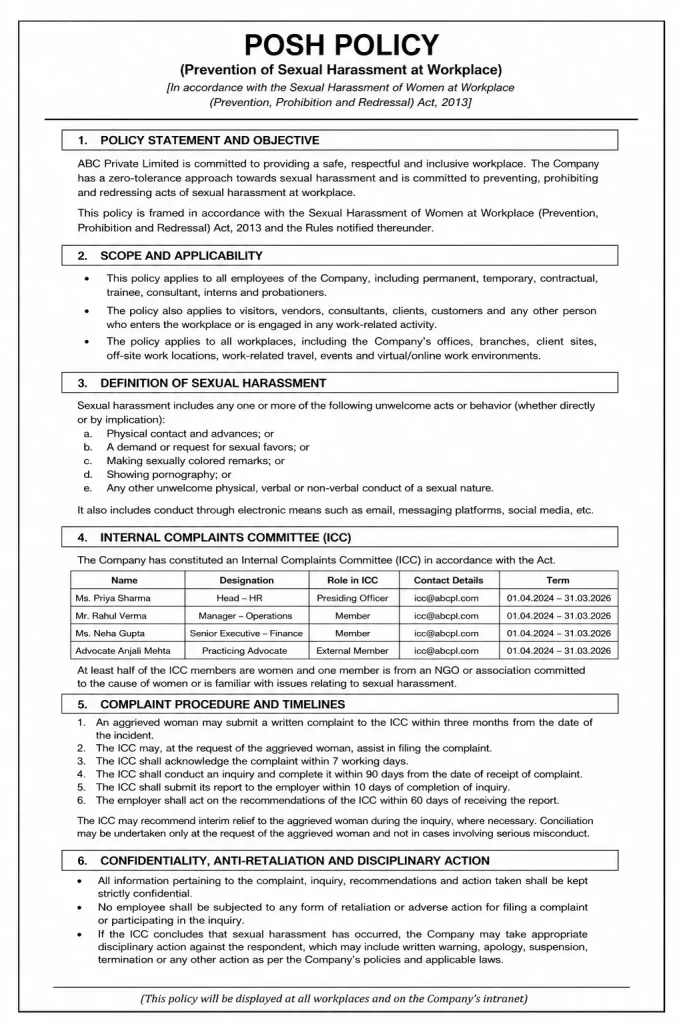
1. Definition of Sexual Harassment
The policy must define sexual harassment clearly in alignment with Section 2(n) of the POSH Act. Sexual harassment includes any unwelcome physical, verbal, or non-verbal conduct of a sexual nature. The policy must specify that the following circumstances, when linked to sexual behavior, also constitute sexual harassment:
- An implied or explicit promise of preferential treatment in employment in exchange for sexual favors.
- An implied or explicit threat of detrimental treatment if sexual demands are refused.
- Interference with work performance or creation of an intimidating, offensive, or hostile work environment.
- Humiliating treatment that affects health or safety, including through digital or online means.
2. Constitution and Composition of the Internal Complaints Committee (ICC)
Every organization with 10 or more employees must constitute an ICC or POSH Committee as the central body for receiving and investigating complaints. The ICC must meet the following mandatory composition requirements prescribed under Section 4 of the POSH Act:
- A senior woman employee of the organization must serve as the Presiding Officer of the ICC.
- At least two members from among employees who are committed to the cause of women’s rights or have experience in social work or legal knowledge.
- One external member from an NGO or association working in the field of women’s rights, or a person familiar with issues relating to sexual harassment. The external member is mandatory; without this member, the ICC is legally invalid.
- At least half of the total ICC members must be women.
- Each ICC member serves a term of no more than three years. When any member vacates the position, the employer must reconstitute the ICC immediately.
3. Complaint Filing Mechanism and Timelines
The complaint filing mechanism must include the following elements:
- A written complaint must be submitted to the ICC within 3 months of the date of the incident or the last incident in a series of incidents.
- If the complainant is unable to write the complaint, the ICC must assist with the same.
- The ICC may extend the three-month filing window when circumstances prevent timely filing. The ICC must record the reasons for such an extension in writing.
- As per Rule 6 of the POSH Rules, the complainant must submit six copies of the written complaint.
- The ICC must send one copy to the respondent within 7 days of receiving the complaint.
4. Inquiry Process and Timelines
The policy must describe the complete inquiry process so that both the complainant and the respondent understand their rights and obligations. The inquiry under the POSH Act follows these steps and timelines:
- Conciliation may be attempted only at the request of the complainant before a formal inquiry begins. It should not involve monetary settlement.
- If conciliation is not requested or fails, the ICC initiates a formal inquiry, which should be concluded within 90 days of receiving the complaint.
- Both the complainant and the respondent must receive equal opportunity to present their case, submit evidence, and examine witnesses.
- The ICC must submit its inquiry report to the employer within 10 days of completing the inquiry.
- The employer must implement the ICC’s recommendations (corrective actions) within 60 days of receiving the inquiry report.
- Either party may appeal to the relevant Labor Court or tribunal within 90 days of receiving the ICC’s recommendations under Section 18 of the POSH Act.
5. Confidentiality Requirements
The POSH policy must state that the following information must not be disclosed to any person not involved in the inquiry:
- The identity of the complainant, the respondent, and any witnesses.
- The contents of the complaint, statements recorded, evidence submitted, and recommendations of the ICC.
- Any information that would enable the identification of the parties involved.
Breach of confidentiality violates Section 16 of the POSH Act and may result in disciplinary action and legal liability.
6. Employer Obligations Under the POSH Policy
The POSH policy must define the employer’s specific legal obligations under Section 19 of the POSH Act. Every employer must fulfill the following duties:
- Display information about the POSH policy and the names & contact details of ICC members at conspicuous locations within the workplace.
- Conduct regular awareness and sensitization programs for all employees, including ICC members.
- Provide a safe working environment and ensure that the complainant is not subject to any retaliation, victimization, or hostile treatment during or after the inquiry.
- Submit an annual report to the District Officer (where required) disclosing the number of complaints received and resolved during the year.
Penalties for Non-Compliance With the POSH Policy
The POSH Act prescribes specific financial and operational penalties under Section 26 for employers who fail to meet their statutory duties. The table below summarizes the penalties applicable to organizations that do not comply with POSH requirements:
| Violation | Penalty |
| Failure to constitute an ICC | Fine of up to ₹50,000 for the first offense under Section 26 of the POSH Act |
| Failure to act on ICC recommendations | Fine of up to ₹50,000 for the employer |
| Failure to file an annual report with the District Officer | Fine of up to ₹50,000 |
| Repeat violation of any POSH provision | Fine doubled to ₹1,00,000 and possible cancellation or non-renewal of the business license |
| Breach of confidentiality under Section 16 | Disciplinary action under service rules and potential legal liability |
| Non-disclosure in Board’s Report (post July 2025) | Penalties under Section 134(8) of the Companies Act, 2013, on the company and directors |
Some state governments have introduced additional penalties. For instance, Tamil Nadu has issued regulatory directives providing for fines of up to ₹1 lakh for failure to constitute an ICC, along with potential license cancellation.
Common POSH Policy Implementation Mistakes and How to Fix Them
Organizations often make the following POSH policy implementation mistakes, but timely corrective actions can help maintain compliance:
- Missing External ICC Member: An ICC becomes legally invalid when the organization does not appoint the mandatory external member. Appoint a qualified external member and document the appointment properly.
- Delayed ICC Reconstitution: ICC vacancies often remain unfilled after members leave or complete their term. Review committee membership regularly and appoint replacements without delay.
- Poor Policy Visibility: Employees may not know how to report concerns when the POSH policy remains inaccessible. Display the policy and ICC details on notice boards and employee portals.
- Lack of Employee Training: Workplace awareness declines when organizations skip POSH training and sensitization programs. Conduct regular training sessions for employees and ICC members.
- Non-Compliance with SHe-Box Requirements: Failure to update ICC information can lead to compliance gaps. Maintain updated records and complete all required registrations and reporting obligations.
- Missing Board’s Report Disclosures: Some companies overlook mandatory POSH disclosures during annual reporting. Verify all disclosure requirements before finalizing the Board’s Report.
- Inadequate Record Keeping: Poor documentation can create difficulties during audits, inquiries, or legal proceedings. Maintain secure and confidential records of all complaints and related actions.
- Failure to Review the Policy: Many employers treat the POSH policy as a one-time compliance document. Always review and update the policy periodically to reflect legal and workplace changes.
Need help implementing a compliant POSH policy for your organization? RegisterKaro can assist with POSH policy drafting, ICC constitution guidance, compliance reviews, and documentation support to help your business meet statutory requirements. Contact us today for expert POSH compliance consultation and end-to-end compliance assistance!
