Public Limited Company Registration in India
Register your public limited company in a smooth and compliant manner with RegisterKaro. Our team helps you meet all MCA and legal requirements, ensuring everything is in place from the start.
 Assistance with Name Approval & DINSupport for DSC & Drafting of MOA & AOADirect Coordination with ROC & MCA OfficialsComplete Help with Documentation & FilingGuidance on Capital Requirements & Legal Compliance

 What Sets Us ApartWhat Sets Us Apart
What is a Public Limited Company?
A Public Limited Company (PLC) is a business structure that allows a company to raise capital from investors by issuing securities to the public, subject to the requirements of applicable laws and regulations. Under Section 2(71) of the Companies Act, 2013, a public company is defined simply as a company that is not a private company.
A PLC has a separate legal identity from its shareholders and can own assets, enter into contracts, incur liabilities, and conduct business in its own name. The Board of Directors manages the company's affairs and oversees its governance, while the managing director or other appointed officers may handle its day-to-day operations. Shareholders receive limited liability protection, which generally limits their financial liability to the amount unpaid on the shares they hold.
A public company can raise capital through permitted methods, including public issues, rights issues, and private placements, subject to the applicable provisions of the Companies Act, 2013, and, where applicable, SEBI regulations. A public company can also list its securities on a recognized stock exchange after meeting the prescribed requirements. This structure can therefore support businesses that require broader access to capital and intend to operate and expand on a larger scale.
Key Features of a Public Limited Company
A Public Limited Company has the following features:
- Limited Liability: Shareholders' liability is generally limited to the amount unpaid on their shares.
- Access to Capital: A public company can obtain funds through avenues such as public offerings, rights issues, or private placements, subject to applicable laws and regulations.
- Separate Legal Entity: The company has a legal identity separate from its members and can own property, enter into contracts, and sue or be sued in its own name.
- Transferability of Shares: Shares of a public company are generally freely transferable, subject to applicable laws and the company's Articles of Association (AoA).
- Perpetual Succession: The company continues to exist independently of changes in its membership or ownership.
- Minimum Membership: A public company must have at least 7 members, with no statutory maximum.
- Name Requirement: The name of a public company must end with the word "Limited."
- Higher Compliance Requirements: Public companies are subject to extensive corporate, financial reporting, disclosure, and governance requirements.
Types of Public Limited Companies
Public Limited Companies generally fall into two categories based on whether their securities are listed on a recognized stock exchange:
- Listed Public Company: A listed public company lists its securities on a recognized stock exchange, such as the BSE or NSE, subject to applicable listing requirements and regulations. Investors can trade its listed securities through the stock exchange.
- Unlisted Public Company: An unlisted public company does not list its securities on a recognized stock exchange. It can raise capital through permitted methods, including private placement and other applicable routes, subject to legal and regulatory requirements.
Benefits of Registering a Public Limited Company in India
A Public Limited Company offers several advantages to businesses seeking capital, credibility, and long-term growth:
- Potential Access to Capital: A PLC may have more opportunities to raise funds through public issues, rights issues, and other permitted securities.
- Limited Liability: Shareholders' liability remains limited to the amount unpaid on their shares.
- Enhanced Credibility: A public company can strengthen its credibility with investors, lenders, business partners, and customers through greater transparency and regulatory oversight.
- Transferability of Shares: Shareholders can generally transfer shares more easily, subject to applicable laws and the company's status.
- Employee Incentives: Eligible public companies can use employee stock options and other share-based incentives to attract and retain skilled employees.
- Access to Finance: A public company may have greater access to institutional finance and other funding options, subject to its financial position and eligibility.
- Growth Opportunities: Access to broader sources of capital can support business expansion, acquisitions, infrastructure development, and other long-term growth initiatives.
Who Should Register a Public Limited Company and What You Need?
Before initiating the incorporation of a Public Limited Company, the proposed company must satisfy the requirements prescribed under the Companies Act, 2013. The key eligibility criteria and minimum requirements are as follows:
- A minimum of 7 shareholders, with no upper limit on the number of members.
- A minimum of 3 directors, with no statutory maximum.
- At least one resident director, meaning a director who has stayed in India for at least 182 days during the previous calendar year.
- A Director Identification Number (DIN) for every proposed director.
- A Digital Signature Certificate (DSC) for each proposed director to sign electronic filings.
- No minimum paid-up capital, as per the Companies (Amendment) Act, 2015, so you may start with any amount.
- A registered office in India for official communication.
- A unique company name ending in "Limited" that follows the MCA naming rules.
Documents Required for Public Limited Company Registration
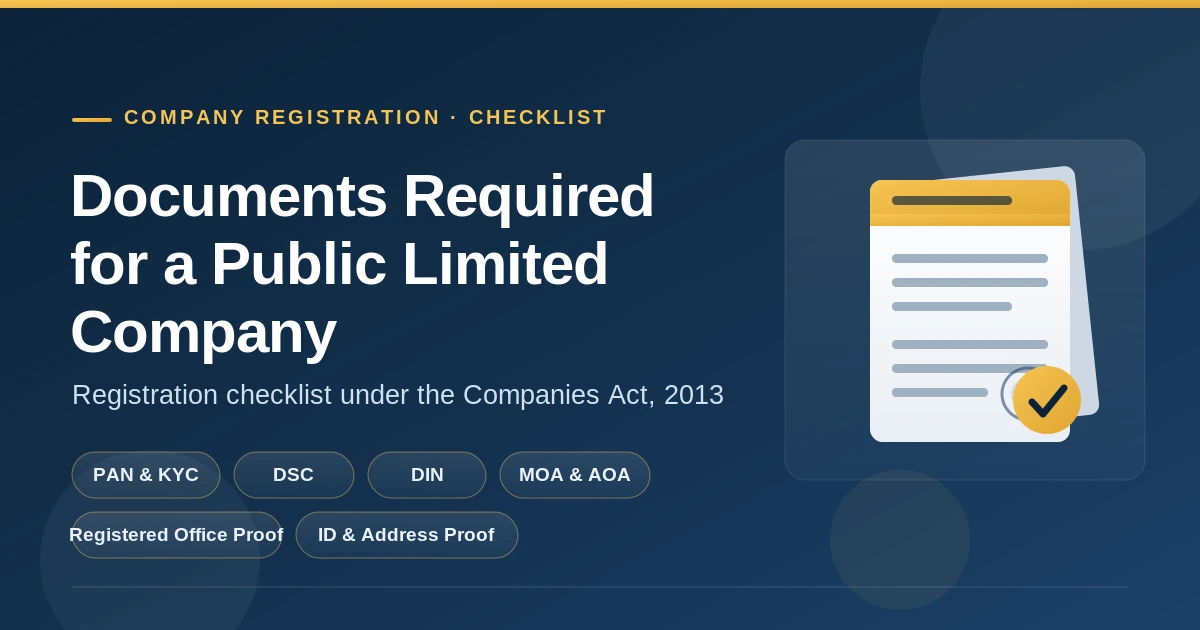
To successfully register a Public Limited Company in India, you will need to gather and submit the following documents:
- Identity Proof for Shareholders and Directors: Acceptable forms of identification for all shareholders and directors include Aadhaar cards, PAN cards, or voter IDs.
- Address Proof for Shareholders and Directors: Documents proving the residential address are required for all involved members and directors.
- PAN Card Details: Permanent Account Number (PAN) details are necessary for all directors, shareholders, and members of the company.
- Company Office Address Proof: This can be a recent utility bill (not older than two months), such as an electricity bill, telephone bill, or gas bill, confirming the location of your company's registered office or business premises.
- Landlord's Consent Letter: A No-Objection Certificate (NOC) or consent letter from the landlord of your business premises is required, granting permission for your company to operate from that specific location.
- Digital Signature Certificates (DSC): Digital Signature Certificates (DSCs) are mandatory for all designated directors to digitally authenticate documents submitted during the registration process.
- MoA & AoA: Copies of the company's Articles of Association (AoA) and Memorandum of Association (MoA) are essential foundational documents.
Step-by-Step Public Limited Company Registration Process
Public limited company registration involves setting up the required shareholders, directors, company name, and registered office before filing incorporation documents with the MCA.
Step 1: Obtain Digital Signature Certificates (DSC)
Before initiating the registration, it is mandatory to obtain Digital Signature Certificates (DSC) for all proposed directors and subscribers. The DSC is crucial for electronically filing various forms on the Ministry of Corporate Affairs (MCA) portal.
Step 2: Apply for Director Identification Number (DIN)
Each individual slated to be a director must possess a Director Identification Number (DIN). This can be conveniently applied for using the integrated SPICe+ form, requiring submission of identity and address proofs.
Step 3: Check Company Name Availability
Utilize the MCA online portal to ascertain the availability of your desired company name. This critical step ensures the proposed name is unique and does not infringe upon existing trademarks or company names.
Step 4: File SPICe+ Form
Upon successful name approval, proceed to file the comprehensive SPICe+ form, which consolidates various legalities for company incorporation. Alongside this form, the Memorandum of Association (MoA) and Articles of Association (AoA), outlining the company's constitution and internal rules, must be submitted.
Step 5: Certificate of Incorporation
Following the submission and review of the SPICe+ form and supporting documents, the Registrar of Companies (ROC) will issue the Certificate of Incorporation. This legally validates the company's existence, complete with its Corporate Identification Number (CIN) and incorporation date.
Step 6: Apply for PAN and TAN
With the Certificate of Incorporation in hand, the subsequent step is to apply for the company's Permanent Account Number (PAN) and Tax Deduction and Collection Account Number (TAN). Both are indispensable for all tax-related transactions and compliance.
Step 7: Open a Company Bank Account
Finally, establish a bank account in the name of the company. This requires presenting the Certificate of Incorporation, MoA, AoA, PAN, and other relevant documents to the chosen bank, enabling the company to conduct its financial transactions.
In most instances, the entire process is completed within 10 to 15 working days, subject to MCA and ROC approvals and the submission of complete documentation.
Public Limited Company Registration Cost
For a standard Public Limited Company, the approximate incorporation cost may range from ₹15,000 to ₹45,000 or more, depending on the company's specific requirements and the state in which it is incorporated. Approximate Cost Breakdown:
| Cost Component | Approximate Cost | Remarks |
| DSC for Directors | ₹1,500 – ₹2,500 per director | Required for digital signing of MCA forms |
| Name Reservation | ₹0 – ₹1,000 | Depends on the method used for name reservation |
| MCA/ROC Government Fees | ₹5,000 – ₹15,000+ | Generally depends on authorized share capital and applicable filings |
| Stamp Duty on MoA & AoA | ₹200 – ₹5,000+ | Varies according to the state of incorporation |
| Professional Fees | ₹10,000 – ₹30,000 | Depends on the consultant and scope of services |
| Total Approximate Cost | ₹15,000 – ₹45,000+ | Indicative cost; may vary based on specific requirements |
The above figures are indicative and should be used for budgeting purposes. Government fees and stamp duty may increase with higher authorized share capital, while professional charges depend on the services included in the incorporation package.
Factors Affecting Public Limited Company Registration Cost
The final incorporation cost can vary based on:
- Authorized Share Capital: Higher authorized capital can result in higher applicable government fees and stamp duty.
- Number of Directors: Additional directors may increase DSC and professional service costs.
- State of Incorporation: Stamp duty on incorporation documents varies from state to state.
- Professional Assistance: CA, CS, legal, or company registration service fees vary depending on the complexity and scope of assistance.
- Additional Registrations: GST, MSME, IEC, or other registrations, where applicable, may involve additional charges.
Note: The registration cost does not include the company's share capital or future expenses such as annual ROC compliance, audit fees, taxation, accounting, or other ongoing regulatory costs.
Your First Steps After Incorporation: A Compliance Checklist
Company incorporation is simpler now, but post-incorporation compliance remains important for every company. Annual compliances for Public Limited Company also require timely filings, records, and disclosures under applicable provisions of the Companies Act, 2013.
1. Hold the First Board Meeting
As per Section 173(1) of the Companies Act 2013, the company must hold its first Board of Directors meeting within 30 days of its incorporation date. Directors are permitted to attend either in person or via video conferencing.
2. Appoint the First Auditor
Under Section 139(6) of the Companies Act, 2013, the Board must appoint the first auditor within 30 days of registration. If the Board fails, members must appoint the auditor within 90 days at an extraordinary general meeting. The first auditor holds office until the conclusion of the first annual general meeting.
3. Open a Company Bank Account
Companies are required to open a bank account. This is essential as the company, being an artificial entity, cannot conduct financial transactions in the name of any natural person.
4. Disclose Director's Interest
At the first Board meeting, every director must disclose their interests in other companies, firms, bodies corporate, or associations under Section 184(1). Directors must also disclose any changes in these interests at the first Board meeting held during each financial year. Independent directors must additionally submit their declaration confirming that they meet the prescribed independence requirements.
5. Establish a Registered Office
Under Section 12(1), a company must establish a registered office within 30 days of its incorporation date. This address will serve as the official point for all communications from various authorities, and the company must inform the Registrar of Companies (ROC) about it within the same 30-day period.
6. Issue Share Certificates
Share certificates must be issued to all subscribers (the initial shareholders) within 60 days of the date of incorporation. For additional share allotments, the 60-day period begins from the date of allotment.
7. Obtain Certificate of Commencement of Business
The company must obtain a certificate of commencement of business within 180 days. This requires filing a disclosure from the directors confirming that every subscriber has paid the amount due on their shares.
8. Maintain Statutory Registers
The company is required to maintain statutory registers at its registered office in the prescribed format. Failure to do so will subject the company to penalties.
9. Display Company Name and Details
Every company must display its name and registered office details at its registered office and other required business locations. The company must also print its name, registered office address, and other prescribed details on its business letters, invoices, and official documents. A common seal is optional and does not need to be maintained by every company.
10. Set Up Books of Accounts
As per Section 128, every company must maintain proper books of accounts that accurately and fairly represent its financial state. The double-entry system must be followed, and accounting should be done on an accrual basis.
Connect with RegisterKaro and let our experts handle the legal hassle while you grow your business.
MCA Registered Public Limited Companies in India
The MCA register holds 61,268 public limited companies in India, of which 54,306 are currently active. Here is what the register looks like before you add yours to it.
Latest Public Limited Companies Incorporated in India
| Company | CIN | Incorporated | Type |
|---|---|---|---|
| SUNRAYS STEP III LIMITEDElectricity, Gas and Water companies | U35100GJ2026PLC178709 | 1 Jun 2026 | Public Limited |
| SUNRAYS STEP II LIMITEDElectricity, Gas and Water companies | U35100GJ2026PLC178695 | 1 Jun 2026 | Public Limited |
| ARASAN STEP I LIMITEDElectricity, Gas and Water companies | U35100GJ2026PLC178715 | 1 Jun 2026 | Public Limited |
| GLOBAL MINIMETALS LIMITEDManufacturing (Metals and Chemicals, and products thereof) | U24310MH2026PLC472095 | 1 Jun 2026 | Public Limited |
| ARASAN STEP III LIMITEDElectricity, Gas and Water companies | U35100GJ2026PLC178728 | 1 Jun 2026 | Public Limited |
| ARASAN STEP IV LIMITEDElectricity, Gas and Water companies | U35100GJ2026PLC178736 | 1 Jun 2026 | Public Limited |
| GRD EV LIMITEDTrading | U45100DC2026PLC471918 | 1 Jun 2026 | Public Limited |
| ARASAN STEP II LIMITEDElectricity, Gas and Water companies | U35100GJ2026PLC178716 | 1 Jun 2026 | Public Limited |
| SUNRAYS STEP I LIMITEDElectricity, Gas and Water companies | U35100GJ2026PLC178685 | 1 Jun 2026 | Public Limited |
| INDIAN COAL EXCHANGE LIMITEDFinance | U66190DL2026PLC467125 | 1 Jun 2026 | Public Limited |
Frequently Asked Questions (FAQs)
What are the minimum requirements to register a Public Limited Company in India?
To register a Public Limited Company, you need at least 7 shareholders and 3 directors. At least one director must satisfy the resident director requirement under Indian law. The company also needs a registered office in India, valid director identification, digital signatures, and a unique name ending with “Limited.”
How much does it cost to register a Public Limited Company in India?
The cost of registering a Public Limited Company generally ranges from ₹15,000 to ₹45,000 or more. The final amount depends on authorized capital, state-wise stamp duty, government filing fees, professional charges, and additional services. Higher authorized capital or specific registration requirements may increase the overall incorporation cost.
How long does it take to register a Public Limited Company?
Public Limited Company registration generally takes around 10 to 15 working days after submitting complete and accurate documents. The timeline depends on name approval, document verification, and processing by the Ministry of Corporate Affairs. Any errors, resubmissions, or additional requirements can increase the registration time.
What documents are required for Public Limited Company registration?
Public Limited Company registration requires identity and address proof for the proposed directors and shareholders. You also need PAN details, Digital Signature Certificates, registered office proof, and a No-Objection Certificate from the property owner. The incorporation application also includes the company's Memorandum and Articles of Association.
What is the difference between a Public Limited Company and a Private Limited Company?
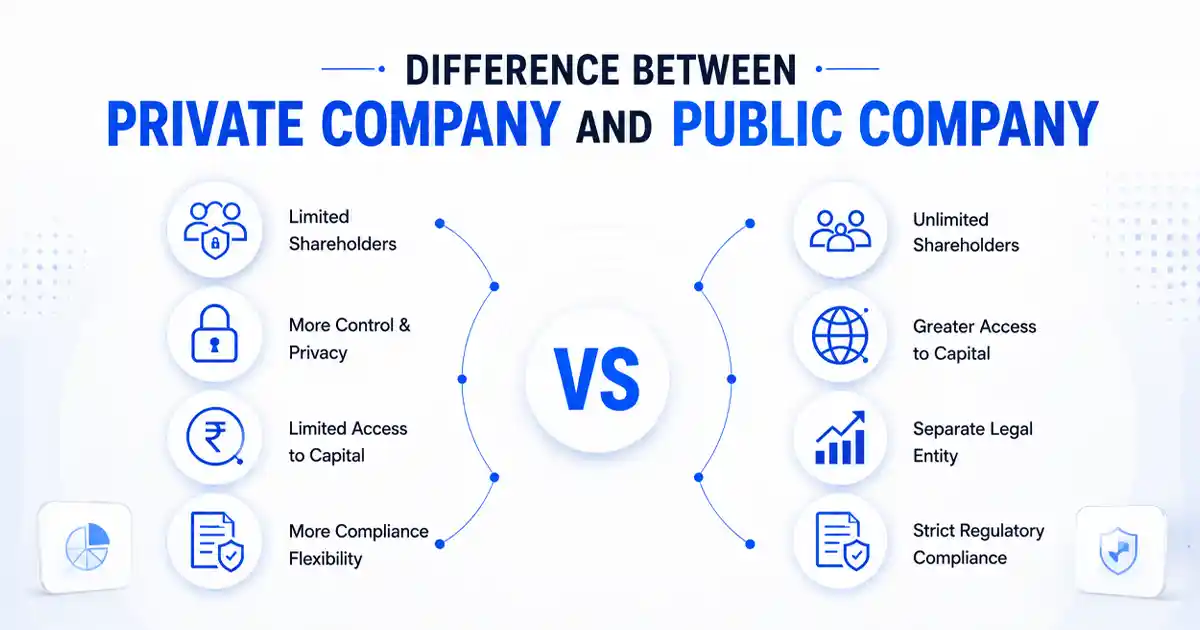
A Public Limited Company requires at least seven members and three directors, while a Private Limited Company requires two members and two directors. A public company can offer securities to the public subject to applicable laws, whereas a private company cannot invite public subscription and generally restricts share transfers.
Is there a minimum capital requirement for a Public Limited Company?
No, Indian law does not prescribe a minimum paid-up capital for incorporating a Public Limited Company. The Companies (Amendment) Act, 2015 removed the earlier minimum capital requirement. However, promoters should determine suitable capital based on the company's business activities, funding requirements, and expected operational expenses.
How many directors and shareholders are required for a Public Limited Company?
A Public Limited Company must have at least seven shareholders and three directors at the time of incorporation. The Companies Act, 2013, does not prescribe a maximum number of shareholders for a public company. A company can appoint additional directors, subject to the applicable provisions and prescribed limits.
Can a foreign national or NRI be a director in a Public Limited Company?
Yes, a foreign national or NRI can become a director of an Indian Public Limited Company. The proposed director must meet the applicable legal requirements and submit the required identity and address documents. The company must also have at least one director who satisfies the resident director requirement under Indian law.
What are the annual compliance requirements for a Public Limited Company?
A Public Limited Company must complete several annual compliance requirements under the Companies Act, 2013. These include holding the Annual General Meeting, maintaining proper books and statutory registers, conducting a statutory audit, filing financial statements and annual returns, and completing applicable director KYC and other regulatory filings.

Reviewed by
Joel DsouzaJoel Dsouza is a Chartered Accountant (CA) and compliance expert with over 7 years of hands-on experience in company registration, tax structuring, GST, ROC filings, and MCA compliance. As a qualified member of the Institute of Chartered Accountants of India (ICAI) and Co-Founder at RegisterKaro, he has personally advised more than 1,000 startups and SMEs across India, helping founders navigate incorporation, regulatory frameworks, and financial planning from Day 1. With deep expertise across all three levels of Finance and Portfolio Management, Joel is committed to promoting financial literacy and simplifying India's startup ecosystem through clear, actionable guidance that entrepreneurs can act on immediately.
Why Choose Registerkaro for Public Limited Company Registration?
Registerkaro stands out in the market by offering the following key benefits that support your business’s growth and compliance needs:
- Expert Guidance: Registerkaro’s experienced professionals guide you throughout the entire registration process, ensuring accuracy and compliance with all legal requirements.
- Streamlined Process: Clients benefit from a highly organized and efficient registration process, minimizing delays and reducing the administrative burden.
- Documentation Support: Complete assistance is offered with preparing and filing all necessary legal documents, including the Memorandum of Association (MoA), Articles of Association (AoA), and various e-forms.
- Compliance Assurance: Registerkaro assures full compliance with the Companies Act, 2013, and other relevant regulations, minimizing the risk of penalties and legal issues.
- PAN/TAN Application: Integrated support is provided for applying for the company's Permanent Account Number (PAN) and Tax Deduction and Collection Account Number (TAN), essential for all tax-related transactions.
- Digital Convenience: Experience a largely digital process for document submission and communication, making the registration more accessible and time-efficient.
- Post-Incorporation Advice: Registerkaro offers valuable advice and support on crucial post-incorporation compliances, helping newly registered PLCs operate smoothly from the outset.

What Our Clients Say
View All
Sudip
 Verified
I recently used Registerkaro for my Private limited company incorporation and had a fantastic experience. Tanvish Nagpal was incredibly helpful throug... Read more

gopi krishna
VerifiedIt's a very good experience with RegisterKaro during the process of incorporation especially @Himanshu shukla,he is very responsive throughout the pro... Read more

Mihir Barnwal
VerifiedWe had a great experience with Register Karo! Samriddhi, in particular, provided excellent service and was incredibly helpful and professional through... Read more

vinod bhaskaran
VerifiedThe service is really good and comfortable as we can get things done from home without fuss. 5 star rating not given as seemed a bit slow, but may be... Read more

raushan kumar
VerifiedI had a great experience working with Deepshikha Jaiswal on Director Addition and Removal process . She handled my concerns with great patience and hu... Read more

Sanjit das
VerifiedGood and on-time service thank you Anukul and Ayushi. Also thanks to GST team for great job and specially Mr. Ammar Hussain for his support. Thank you... Read more

Shivani Nagwanshi
VerifiedI really appreciate register karo because I am new in company incorporation process I don't know the procedure but register karo help me a lot and mak... Read more

Rahul Waghmare
Verifiedit was very nice experience to get my company registration on Register Karo, staff is very nice, punctual about their duties, thanks to Team register... Read more

Ronit Dhansoia
VerifiedProfessional, knowledgeable, and easy to work with. If you’re starting a company and want someone who genuinely cares about getting it right, Prayansh... Read more

Jatin Mural
VerifiedSuper smooth experience getting our business registered through RegisterKaro! Anchal Gupta and the support team were super helpful and kept us in the... Read more
Public Limited Company Registration Across India
Related Blogs
View All
Minimum and Maximum Number of Directors in a Public Company
Documents Required for Public Limited Company Registration in India

Public Limited Company Registration Fees: Stamp Duty, Govt Costs & Charges

Annual Compliances for Public Limited Company in India: 2026-27 Guide

Conversion of a Public Company into a Private Company: Legal Requirements
Difference Between Private Company and Public Company in India