Public Limited Company Registration in Delhi
Register your Public Limited Company in Delhi online with RegisterKaro starting at ₹1,999. Get end-to-end expert assistance for MCA incorporation, ROC Delhi approval, and complete compliance setup for smooth business operations.
 Quick Online Registration via MCA SPICe+ Portal in Delhi JurisdictionExpert Guidance for MOA, AOA & Company StructuringAccurate Documentation, DSC Setup & Name Approval AssistanceEnd-to-End Filing Support with ROC NCT of Delhi CompliancePost-Incorporation Compliance Support, including INC-20A, AGM & ROC Filings

 What Sets Us ApartWhat Sets Us Apart
What is a Public Limited Company in Delhi?
A Public Limited Company in Delhi is a formal business structure registered under Section 2(71) of the Companies Act, 2013. It is governed by the Registrar of Companies (ROC), NCT of Delhi, under the Ministry of Corporate Affairs (MCA). It is a separate legal entity that allows businesses to raise capital from the public and operate at scale.
Delhi has a thriving and policy-driven corporate ecosystem where Public Limited Companies play a central role in services, trade, and manufacturing. From the financial corridors of Connaught Place to the industrial zones of Okhla, this structure is widely used by companies planning significant expansion. It is also preferred by businesses operating from modern office campuses in Aerocity and preparing for a future stock exchange listing.
Public Limited Company Registration offers various advantages for Delhi businesses:
- Policy and regulatory proximity: Being India’s national capital, Delhi gives public companies direct access to the MCA, DPIIT, SEBI’s Northern Regional Office, and central government ministries. This makes regulatory approvals and compliance management significantly more accessible.
- Strong industrial base: Delhi's manufacturing sector grew 9% in 2024–25, nearly three times the national average of 4.1%, providing a solid foundation for industrial and export-oriented public companies.
- Growing startup-to-scale pipeline: Delhi-NCR is India's second-largest startup hub, with many high-growth businesses transitioning into Public Limited Companies to unlock institutional funding and broader investor access.
- Deep PSU and B2B market: Major central public sector enterprises, including NTPC, ONGC, Indian Oil, Power Grid Corporation, and NHPC, operate out of Delhi. This creates an established procurement and contracting ecosystem that actively prefers public limited entities as business partners.
Many Public Limited Companies in Delhi operate as unlisted public companies. They follow public company compliance requirements under the Companies Act, 2013, but do not trade their shares on the NSE or BSE.
Why Choose a Public Limited Company (PLC) in Delhi?
Delhi offers a unique mix of policy access, infrastructure, and economic scale that makes it a strong base for a public limited company:
- Strong fundraising potential: A PLC in Delhi can raise funds from the public through IPOs, FPOs, rights issues, and debentures. Delhi registered 12,759 new companies from April 2024 to January 2025, maintaining its position among India's top 3 states for company incorporations. This reflects a steadily expanding corporate ecosystem where investor activity and institutional capital continue to grow year-on-year.
- Access to stock markets: Companies registered under the ROC NCT Delhi can list on the NSE or BSE after meeting SEBI norms. Delhi's proximity to SEBI's Northern Regional Office gives businesses direct access to listing guidance and regulatory support, connecting them to national and global investors.
- Better credibility in Northern India markets: In Delhi and across Northern India, a Public Limited Company signals stronger governance and transparency. Banks in key financial zones like Connaught Place and Barakhamba Road often prefer Public Limited Companies for large credit facilities. This is due to stricter compliance and disclosure requirements under ROC NCT Delhi and MCA regulations.
- Scalability for large businesses: Unlike private companies, a PLC has no limit on shareholders. This makes it suitable for infrastructure, fintech, logistics, healthcare, and large services companies, all sectors driving Delhi's growth, with the tertiary sector contributing approximately 85.40% of Delhi's GSDP.
- Highest per capita income among Indian states: Delhi records a GSDP per capita of ₹5,52,727 for FY 2024–25, the highest among all states and union territories with updated data. This means strong domestic purchasing power, a deep pool of high-net-worth investors, and sophisticated capital partners for public companies.
- Significant FDI destination: Delhi attracted ₹58,074 crore in FDI equity inflows in FY 2024–25, accounting for 12% of India's total FDI, ranking third among all Indian states. This sustained foreign investor interest gives public companies stronger access to cross-border capital and global institutional funding.
- Easy transition for growing private businesses: Many startups and closely held businesses in Delhi eventually choose to convert a Private Company into a Public Company to raise larger capital or prepare for IPO eligibility. For companies in fast-growing sectors like fintech, ed-tech, and logistics, converting into a Public Limited Company creates better fundraising and expansion opportunities.
- DPIIT Startup India benefits for scaling businesses: Delhi-based businesses with DPIIT Startup Recognition can access tax exemptions, startup funding support, faster IP processing, and easier compliance. Delhi-NCR’s startup ecosystem helps companies scale before moving to Public Limited Company structures and institutional fundraising.
Eligibility for Public Limited Company Registration in Delhi
To register a public limited company in Delhi, you should meet these conditions under the Companies Act, 2013:
- A Public Limited Company must have at least 7 shareholders, and there is no upper limit on the number of shareholders.
- It must have a minimum of 3 directors, and it can have a maximum of 15 directors under standard provisions.
- At least one director must be a resident of India, meaning the person must have stayed in India for 182 days or more in the financial year.
- Every director must hold a Director Identification Number (DIN). The SPICe+ form can allot DIN to up to three first-time directors during incorporation.
- All directors and shareholders (subscribers) must obtain a Digital Signature Certificate (DSC) to sign MCA incorporation forms electronically.
- A Public Limited Company has no minimum paid-up capital requirement. The earlier ₹5 lakh condition was removed under the Companies (Amendment) Act, 2015.
- The company must declare its authorized share capital in the Memorandum of Association (MOA). In Delhi, promoters commonly start with ₹1 lakh or ₹5 lakh for practical setup planning.
- Companies falling within the prescribed thresholds under Section 177 of the Companies Act, 2013 must constitute an Audit Committee to oversee financial reporting, internal controls, auditor independence, and compliance processes.
- Under Section 178 of the Companies Act, 2013, eligible public companies must also form a Nomination and Remuneration Committee to manage director appointments, senior management evaluation, and remuneration policies.
- A Public Limited Company must appoint a Woman Director if it meets the criteria prescribed under Section 149(1) of the Companies Act, 2013.
- The company must have a registered office address in Delhi or anywhere under the ROC NCT Delhi jurisdiction. This address can be residential or commercial.
- The company name must end with the word "Limited" and must not use "Private Limited" in any form.
- No director should be disqualified under Section 164 of the Companies Act, 2013, which includes cases like insolvency, criminal conviction, or removal from previous directorship roles.
- Every director must be at least 18 years of age and of sound mind to be legally eligible. Moreover, an individual cannot hold office as a director in more than 20 companies at the same time under Section 165(1).
- A Public Limited Company must appoint at least one-third of the board as Independent Directors if it falls under the thresholds specified under Section 149(4) of the Companies Act, 2013.
Note: NRIs and foreign nationals can become directors or shareholders in a public company, but they must comply with FEMA regulations and applicable FDI guidelines.
Authorities Regulating Public Limited Company Registration in Delhi
Several authorities oversee the registration and post-incorporation compliance of public limited companies in Delhi:
| Authority | Role | When It Applies |
| Ministry of Corporate Affairs (MCA) | Governs incorporation under the Companies Act, 2013, and handles all online filings via mca.gov.in. | During incorporation + ongoing compliance |
| Registrar of Companies (ROC), NCT of Delhi | Approves incorporation, issues a Certificate of Incorporation (CIN), and maintains company records. Following the MCA notification dated 23rd October 2025, Delhi is split into ROC NCT Delhi-I (South, Southwest, New Delhi, Southeast, East Delhi) and ROC NCT Delhi-II (Central, West, North, Northwest, Northeast Delhi and Shahdara), effective 16th February 2026. | At registration + record maintenance |
| Regional Director (Northern Region-I), New Delhi | Handles approvals for special cases like shifting the registered office from one state to another or inter-ROC transfers within Delhi. | Only for exceptional approvals |
| Income Tax Department (CBDT) | Issues PAN and TAN through SPICe+ and manages tax compliance after incorporation. | During and after incorporation |
| SEBI (Securities and Exchange Board of India) | Regulates public companies that raise funds from the public or get listed on the NSE/BSE. SEBI's Northern Regional Office is located at 5th Floor, Bank of Baroda Building, 16, Sansad Marg, New Delhi – 110001. | If an IPO or listing is planned |
| Reserve Bank of India (RBI) | Regulates foreign investment under FEMA rules for NRIs and foreign shareholders. RBI's New Delhi Regional Office is located at 6, Sansad Marg, New Delhi – 110001. | If foreign investment is involved |
| Government of NCT of Delhi | Collects stamp duty on MOA and AOA as per the Delhi state stamp laws. | At incorporation |
| Stock Exchanges (NSE/BSE) | Regulate listing, trading, and compliance for listed public companies. | After listing only |
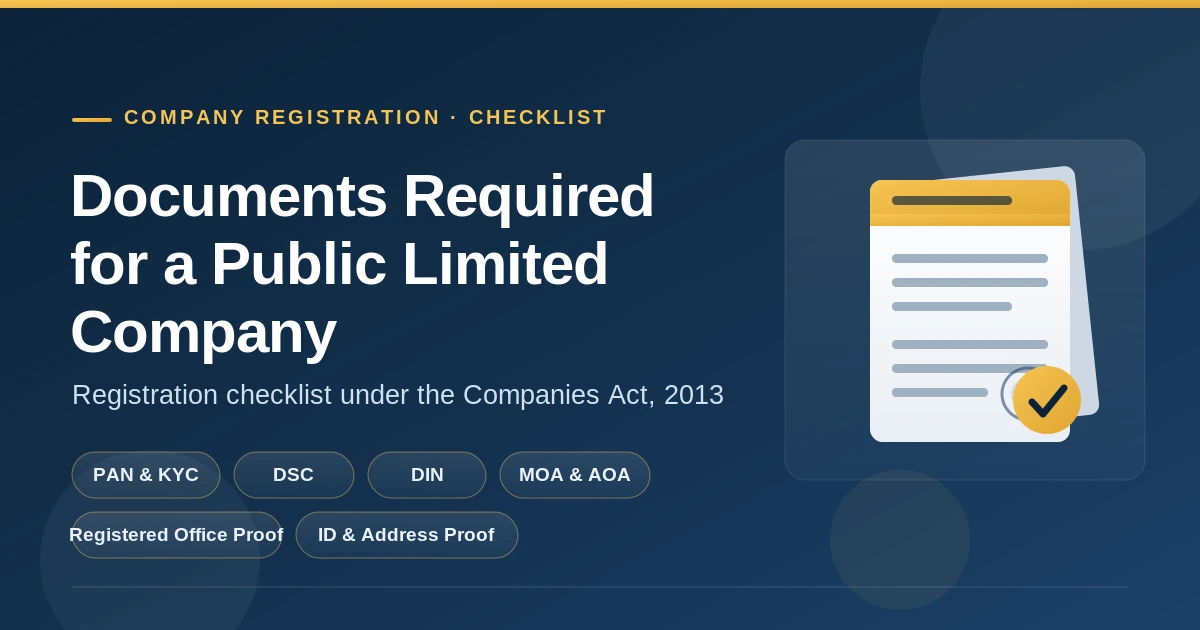
Documents Required to Register a Public Limited Company in Delhi
Keep the following documents ready in a recent and clearly scanned format for SPICe+ filing:
1. For Each Director and Shareholder (Indian Nationals)
Each Indian director and shareholder must provide:
- PAN card (mandatory)
- Aadhaar card / Voter ID / Passport (identity proof)
- Address proof (bank statement or utility bill not older than 2–3 months)
- Passport-size photograph
- DSC
- Valid email ID and mobile number (linked for OTP verification)
For Each Director and Shareholder (Foreign Nationals)
Each foreign participant must submit:
- Valid passport (notarized and apostilled)
- Address proof, such as a bank statement or utility bill (not older than 2 months, notarized and apostilled)
- Business visa (if staying in India at the time of incorporation)
For the Registered Office in Delhi
Proof of the company's Delhi address must include:
- Latest electricity bill/telephone bill/property tax receipt (not older than 2–3 months)
- Rent agreement (if rented property)
- No Objection Certificate (NOC) from the owner (if rented)
- Sale deed or ownership proof (if self-owned property)
Company-Level Documents
These documents define and legally form the company:
- Memorandum of Association (MOA)
- Articles of Association (AOA)
- Name approval confirmation (RUN or SPICe+ Part A)
- Form INC-9 (declaration by subscribers and directors)
- Form DIR-2 (consent to act as director)
- Declaration of non-disqualification under Section 164
- Identity and address proofs of all seven subscribers to the MOA
How to Register a Public Limited Company in Delhi?
The entire process to register a public limited company is completed online through the MCA portal.
Step 1: Obtain DSC: Secure DSC for every director and the seven MOA subscribers via licensed certifying authorities like eMudhra, Sify, or Capricorn.
Step 2: Reserve the company name through SPICe+ Part A: Choose a unique name ending with "Limited" for your company using RegisterKaro's free company name search tool. Log in to the MCA portal and file SPICe+ Part A to submit two proposed names in order of preference. The government fee is ₹1,000, and once approved, the name remains reserved for 20 days.
Step 3: File SPICe+ Part B: Submit the integrated SPICe+ Form, which handles incorporation, DIN allotment (for up to three directors), PAN, and TAN. Fill in the details of the company, registered office in Delhi, directors, and authorized capital structure.
Step 4: Attach MOA, AOA, and linked forms: Upload e-MOA (INC-33), e-AOA (INC-34), and AGILE-PRO-S, which also enables GSTIN, EPFO, ESIC, and bank account setup. All documents must be digitally signed by a CA, CS, or CMA.
Step 5: Pay government fees and stamp duty: Pay applicable MCA incorporation fees and Delhi stamp duty, which the SPICe+ system auto-calculates based on authorized capital. Pay online through net banking or UPI.
Step 6: ROC NCT Delhi verification: The ROC NCT Delhi reviews the application. If the officer raises objections, respond and resubmit corrections within the given time window.
Step 7: Receive the Certificate of Incorporation: Once approved, ROC NCT Delhi issues the Certificate of Incorporation, along with CIN, PAN, and TAN. At this stage, the company becomes a legally registered entity.
The entire process of registering a Public Company in Delhi takes around 15 to 21 working days.
Public Limited Company Registration Fees in Delhi
The cost of registering a Public Limited Company in Delhi depends on authorized capital, government charges, professional fees, and Delhi stamp duty. All filings are completed online through the MCA portal under the SPICe+ system.
1. Government Fees (MCA + ROC NCT Delhi)
Government charges include name reservation, incorporation, and certification. These are calculated based on authorized share capital (nil for authorized capital of up to ₹15 lakh). Higher capital leads to higher fees.
Key components include:
- SPICe+ incorporation filing fees (MCA portal)
- Name reservation fee (₹1,000 for SPICe+ Part A)
- ROC NCT Delhi processing charges
- Certificate issuance and filing-related fees
Note: The MCA's standalone RUN (Reserve Unique Name) service is generally used for existing companies changing their names. New Public Limited Company incorporations are typically processed through the integrated SPICe+ Part A system.
2. Delhi Stamp Duty
Stamp duty is levied by the Government of NCT of Delhi on:
- MOA
- AOA
The amount depends on the authorized capital slab and is auto-calculated during SPICe+ filing.
3. Professional Fees
Professional charges vary based on the service provider and the complexity of incorporation. These usually include:
- Drafting of MOA and AOA
- Filing of SPICe+ forms and linked applications
- DSC support and compliance assistance
- CA/CS certification of incorporation documents
4. Additional Compliance Costs (Post-Incorporation)
After registration, companies may also incur:
- GST registration (if applicable)
- Accounting and audit setup
- Annual compliance filing costs with MCA
Post-Incorporation Compliance for Public Limited Companies in Delhi
Once ROC NCT Delhi issues the Certificate of Incorporation, a public limited company must meet various compliance requirements to stay legally active:
- Hold the first Board Meeting within 30 days to appoint the first auditor, note share subscriptions, and authorize the opening of a bank account. All directors must attend in person or via video conferencing.
- Appoint the first statutory auditor under Section 139(6) within 30 days. The auditor must be a practicing Chartered Accountant and hold office until the first AGM.
- File Form MBP-1 under Section 184(1) to disclose director interests at the first Board Meeting.
- File Form DIR-8 (Section 164) confirming that directors are not disqualified.
- Issue share certificates to subscribers within 60 days of incorporation and pay applicable Delhi stamp duty within 30 days of issuance.
- File Form INC-20A to commence business under Section 10A within 180 days of incorporation. Attach a bank statement showing receipt of subscription money.
Ongoing and Annual Compliances for Public Ltd Companies in Delhi
The Public Limited Company in Delhi must follow regular, ongoing, and annual compliance requirements to stay legally active. It must:
- Hold the first AGM within 9 months from the end of the first financial year, and thereafter every year within 6 months of the financial year-end. The gap between two AGMs shall not exceed 15 months.
- Conduct at least 4 Board Meetings every year, ensuring no gap exceeds 120 days.
- File Form AOC-4 (financial statements) and Form MGT-7 (annual return) within 30 and 60 days of the AGM, respectively.
- File Income Tax Return (ITR-6) by October 31 of the assessment year.
- Complete DIR-3 KYC for all directors by September 30 each year.
- Maintain statutory registers at the Delhi registered office, including members, directors, charges, and contracts registers.
- Display company details (name, CIN, address, contact) on signage, letterheads, invoices, and the website.
Delhi-based companies must also obtain Professional Tax registration with the applicable Delhi authority within 30 days of hiring employees.
Public vs Private Limited Company in Delhi
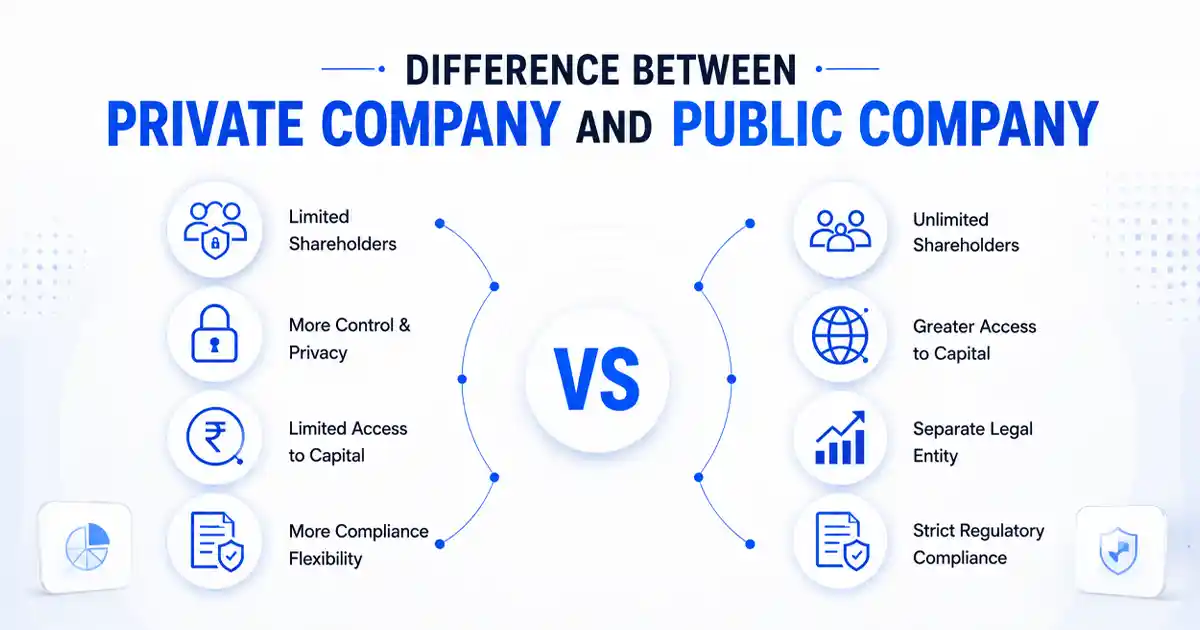
Both Public and Private Limited Companies offer limited liability and separate legal identity, and are registered under the MCA (ROC NCT Delhi for Delhi jurisdiction). However, they differ significantly in structure, compliance, and fundraising ability.
| Feature | Public Limited Company in Delhi | Private Limited Company in Delhi |
| Best For | Large Delhi businesses planning expansion, public funding, or IPOs | Startups, consultants, agencies, and growing businesses in Delhi |
| Minimum members | Requires at least 7 shareholders to incorporate. | Requires at least 2 shareholders. |
| Maximum members | No upper limit on shareholders. | Capped at 200 members (excluding employee shareholders). |
| Minimum directors | Requires at least 3 directors. | Requires at least 2 directors. |
| Maximum directors | Up to 15 directors (can be increased via special resolution). | Up to 15 directors. |
| Independent directors | Mandatory for listed companies under Section 149(4) (at least one-third of the board). | Not required. |
| Name suffix | Must end with "Limited". | Must end with "Private Limited". |
| Share transferability | Shares are freely transferable under the law. | Share transfer is restricted by the Articles of Association. |
| Public fundraising | Can raise funds from the public through prospectuses and share offers. | Cannot invite the public to subscribe to shares. |
| Stock exchange listing | Can list on NSE or BSE after SEBI compliance. | Cannot list shares on stock exchanges. |
| Capital raising options | Can raise capital via IPO, FPO, rights issue, and public debentures. | Limited to private placements, rights issues, and ESOPs. |
| Quorum in general meetings | Requires at least 5 members personally present (Section 103). | Requires at least 2 members personally present. |
| Annual return filing | Must file Form MGT-7. | Can file simplified MGT-7A (if eligible). |
| Managerial remuneration | Subject to limits under Section 197 of the Companies Act. | Fewer restrictions on managerial pay. |
| Compliance level | High compliance burden (committees, disclosures, audits). | Lower compliance requirements. |
| Disclosure requirements | High transparency; additional SEBI/stock exchange disclosures if listed. | Limited disclosure obligations. |
| Use case | Best for IPOs, large fundraising, and regulated industries. | Best for startups, SMEs, and family-run businesses. |
| Delhi regulatory context | ROC NCT Delhi handles incorporation, but compliance involves higher professional support (CA/CS) due to stricter filings and the new dual-ROC jurisdiction effective February 2026. | Easier compliance is managed mainly through ROC NCT Delhi filings with fewer statutory requirements. |
Connect with RegisterKaro and let our experts handle the legal hassle while you grow your business.
Frequently Asked Questions (FAQs)
How many people do I need to register a public limited company in Delhi?
You need a minimum of seven shareholders and three directors to register a public limited company in Delhi. At least one must be a resident director, meaning they must have stayed in India for 182 days or more in the preceding financial year. The maximum limit is 15 directors, which can be increased beyond 15 by passing a special resolution.
What is the minimum capital required for public limited company registration in Delhi?
There is no minimum paid-up capital required for public limited company registration in Delhi. The earlier ₹5 lakh requirement has been removed. You only need to declare authorized capital in the MOA, commonly set at ₹1 lakh or higher.
How long does it take to register a public limited company in Delhi?
Public limited company registration in Delhi usually takes 15 to 21 working days. The timeline depends on DSC issuance, name approval through SPICe+ Part A, documentation, and ROC Delhi verification.
Where is the ROC office for company registration in Delhi located?
The ROC office for company registration in Delhi is located at IFCI Tower, 61, Nehru Place, New Delhi – 110019. Following the MCA notification dated 23rd October 2025, Delhi is now divided into two jurisdictions, effective 16th February 2026:
- ROC NCT Delhi-I: South Delhi, Southwest Delhi, New Delhi, Southeast Delhi, and East Delhi.
- ROC NCT Delhi-II: Central Delhi, West Delhi, North Delhi, Northwest Delhi, Northeast Delhi, and Shahdara.
Can a foreign national be a director in a Delhi-based public limited company?
Yes, a foreign national can be a director in a Delhi-based public limited company. However, at least one director must be a resident Indian. Foreign directors must submit notarized and apostilled identity and address proofs.
What is the difference between authorized capital and paid-up capital for a PLC in Delhi?
Authorized capital is the maximum share capital a company can issue, as stated in the MOA. Paid-up capital is the actual amount contributed by shareholders. Delhi PLCs must declare authorized capital, while paid-up capital can vary.
Can a public limited company in Delhi list on the stock exchange?
Yes, a public limited company in Delhi can list on stock exchanges like BSE or NSE after meeting SEBI requirements. Listing is not automatic and requires compliance with eligibility norms and disclosures.
What is Form INC-20A, and when must a Delhi PLC file it?
Form INC-20A is the declaration of commencement of business under the Companies Act, 2013. A Delhi public limited company must file it within 180 days of incorporation. Missing the deadline leads to penalties for the company and officers.
How much stamp duty applies to MOA and AOA in Delhi for a public limited company?
Stamp duty on MOA and AOA in Delhi depends on the authorized share capital. The SPICe+ system calculates the exact amount automatically based on the declared capital at the time of incorporation.
Can I convert my private limited company in Delhi into a public limited company later?
Yes, a private limited company in Delhi can be converted into a public limited company later. It requires a special resolution, MOA and AOA amendments, and ROC Delhi filings. The company must also meet minimum shareholder and director requirements after conversion.
How does the new dual-ROC structure (Delhi-I and Delhi-II) affect my public company registration?
The new dual-ROC structure divides Delhi into ROC NCT Delhi-I and ROC NCT Delhi-II based on district jurisdiction. Your company registration, filings, and compliance will now be handled by the assigned ROC office for your registered office location, helping streamline processing and reduce administrative workload.

Reviewed by
Joel DsouzaJoel Dsouza is a Chartered Accountant (CA) and compliance expert with over 7 years of hands-on experience in company registration, tax structuring, GST, ROC filings, and MCA compliance. As a qualified member of the Institute of Chartered Accountants of India (ICAI) and Co-Founder at RegisterKaro, he has personally advised more than 1,000 startups and SMEs across India, helping founders navigate incorporation, regulatory frameworks, and financial planning from Day 1. With deep expertise across all three levels of Finance and Portfolio Management, Joel is committed to promoting financial literacy and simplifying India's startup ecosystem through clear, actionable guidance that entrepreneurs can act on immediately.
Why Choose RegisterKaro for Public Limited Company Registration in Delhi?
Public Limited Company registration in Delhi involves multiple ROC and MCA compliance. RegisterKaro ensures a smooth and stress-free incorporation process. Here's how we support you:
- End-to-End Incorporation Support with ROC NCT Delhi Filing: We manage the complete incorporation process, including DSC setup, name approval, MOA/AOA drafting, SPICe+ filing, and ROC NCT Delhi coordination. Our team ensures your application aligns with MCA requirements to avoid delays or rejections.
- Fast, Fully Online Process via MCA SPICe+ System: No physical visits to ROC NCT Delhi or government offices. From Connaught Place to anywhere across the NCR, everything is handled online, including DIN allotment, PAN, TAN, and incorporation certificate issuance through SPICe+ integration.
- Local Expertise with ROC NCT Delhi Compliance Practices: Our team understands the filing patterns, documentation standards, and compliance expectations followed under the ROC NCT Delhi jurisdiction, including the dual-ROC structure effective February 2026.
- Transparent Pricing with Complete Compliance Guidance: We offer clear, upfront pricing with no hidden charges. You also get guided support for post-incorporation compliance like INC-20A, board meetings, statutory audit setup, and annual ROC filings, which are critical for Public Limited Companies.
- Post-Incorporation & Growth Support for Delhi Businesses: Beyond registration, we support companies in bank account opening, statutory auditor appointment, ROC compliance tracking, and IPO-readiness support, helping Delhi-based Public Limited Companies scale confidently in capital markets.

What Our Clients Say
View All
Kr Vignesh
 Verified
Chavvi did a good job of helping me choose from a wide variety of schemes and apply for them as well. She also followed up on the application process!... Read more

Aisha Singh
VerifiedRegisterKaro made my company registration process stress-free. Their experts handled the paperwork professionally, and I received regular updates unti... Read more

Chandrashekar Reddy...
VerifiedFast and hassle free to register your company. I personally suggest that miss vandant ravant well coordinated with me for smooth processing the whole... Read more

Ayush vaidya
VerifiedWorking with you guys were great and smooth and specially talking about Mitushi she did a great job and made sure the process grabs speed ! Last but n... Read more

AROGYYA AMARKANTAK P...
VerifiedEverything was fine, they took time and got everything done, the work is also continuing with the complaint, it was a very good experience to be assoc... Read more

HOYOH
VerifiedAman Ji did a great job and did it at the right time as told. By the way, the rest of the people in the company, Ansuman ji, are also good advisors. A... Read more

Taranjeet Singh
VerifiedI had a great experience with RegisterKaro. Their team provided excellent support throughout the process and made everything very smooth and hassle-fr... Read more

Uttara Rani Ghoshal
VerifiedI had a smooth and efficient experience incorporating my company.The entire process, from documentation to final registration, was handled professiona... Read more

Aryan Agarwal
VerifiedThank you for successfully completing my ISO work. I am very satisfied with your service and would be happy to recommend RegisterKaro to others for IS... Read more

Amal Ajith
VerifiedPricing and service are good. But I hope they improve their communication. Sometimes the response is slow, which creates confusion. Also, after the in... Read more
Other Business Services in Delhi
Related Blogs
View All
Minimum and Maximum Number of Directors in a Public Company
Documents Required for Public Limited Company Registration in India

Public Limited Company Registration Fees: Stamp Duty, Govt Costs & Charges

Annual Compliances for Public Limited Company in India: 2026-27 Guide

Conversion of a Public Company into a Private Company: Legal Requirements
Difference Between Private Company and Public Company in India